Thoughts on schooling and parenting

I recently saw this video and was wondering what your guys thoughts on it were:
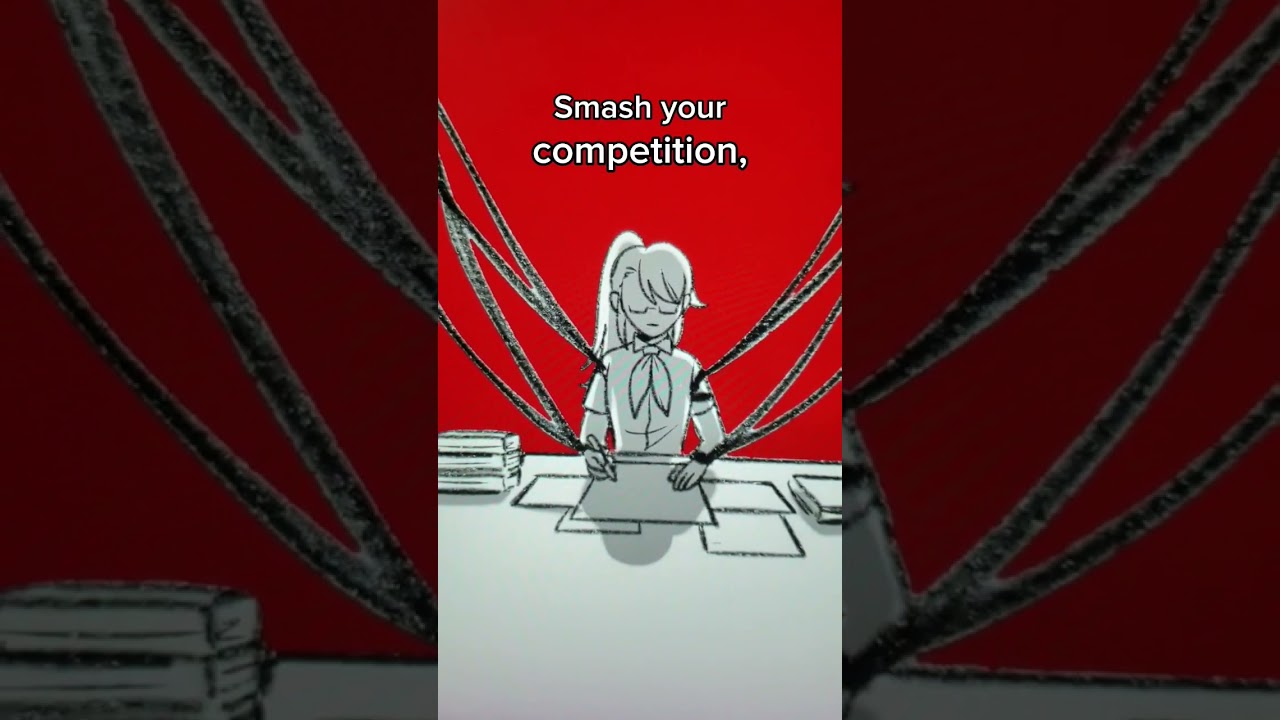
I hypothesize that the video’s context is a student who was into art but pressured into getting good grades, or at least the author has heard stories of it. Reading a few of the top comments, it appears that most other viewers have jumped onto the band wagon of “anti pressurized grades.”

I have no problem with this. If a student is only capable of Cs or Bs, then they shouldn’t be pushed to exhaustion chasing grades they cannot obtain. A few people were trying to make humor to make light of the sad situation posed, joking that when the video says “Show us something we ain’t seen before,” they would simply get zeros. However, I noticed people saying a lot of things about parents.
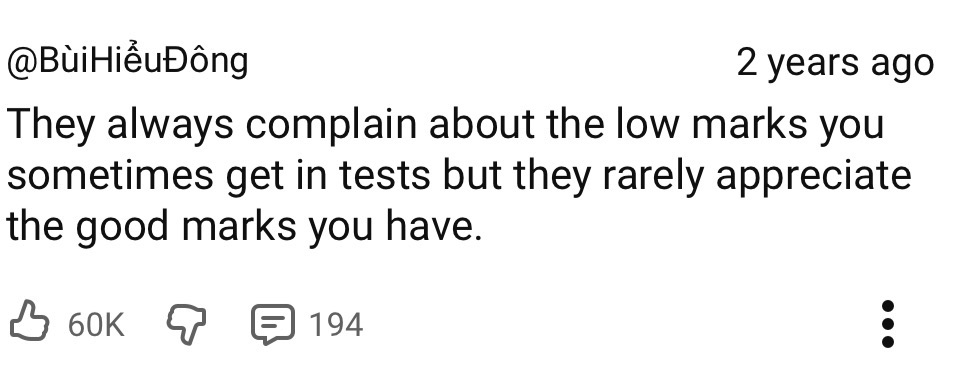

I think the reason I’m so confused is that this situation reflects mine so much. However, I must confess a few things. First of all, getting A’s isn’t too difficult for someone like me. If I’m getting B’s, I’m not trying but getting A’s is like working 9 to 5 for me (and last time I checked i haven’t congratulated my parents on their jobs lately, but probably should). Also, except in some unfortunate circumstances, parents make it their sole purpose to make sure you are doing the best you can, because life is harder for those who didn’t do good in school. Most of these comments (I don’t look at others opinions often, but in this circumstance I wanted to see what the consensus was) seem to look at their own school experiences but seemingly ignore the perspective of the parents, or even assume some sort of semi-malicious behavior. Don’t get me wrong. As the eldest I’m sure I’ve set some unfortunate precedents myself, especially for my classmates. However, I feel like this isn’t the parents’ fault. What say you guys?


1 Like
  • What I see in that animation isn’t just pressure to perform, but pressure to fight. It starts with familiar expectations (grades, comparison), but then escalates into something harsher—“smash your competition,” “entertain us,” “victory’s your only payment.” By the end, she’s not just trying to succeed; she’s been turned into a kind of reluctant gladiator.

  • That matters, because a stage implies you can step off. A gladiator doesn’t have that option. The system isn’t asking for excellence so much as it’s demanding survival through competition.

  • And the key detail is that she doesn’t look triumphant—she looks tired, conflicted. So the critique isn’t just about pressure; it’s about what kind of person that pressure is trying to produce.

  • BTW, check out the song that she uses just a small clip from: Jann - Gladiator (lyrics)

"Welcome to the party, say hi to everybody
Paid for by Martini but they’re sippin’ on Bacardi
Body’s more than just a flesh, you can sell it for success
What’s your price, what’s your address?
We can finish at my place
Ever been to Bali? I really need some sun
Such a shame 'bout that tsunami, I’ll have to go to Cali
I can get you dressed, wrap your body in excess
Give them something to obsess over

You’ll love it when I
Give it to you, leave you wanting more
I know your addiction’s attention
Let’s start a show
Is it everything and more than you were hoping for?
Show us something we ain’t never seen before

Smash your competition, baby
Show us some good entertainment
Victory’s your only payment
Gladiator, gladiator

Welcome to the party, I know it’s kinda funny
That everyone is acting like they know you personally
Just play along, be nice and all
You won’t get far being on your own
They’ve all been dying for a little drama
Their favourite stars getting out of coma
To fill the news with 90s nostalgia
It will take more than just a pretty face to top that

Give it to you, leave you wanting more
I know your addiction’s attention
Let’s start a show
Is it everything and more than you were hoping for?
Now show us something we ain’t never seen before

Smash your competition, baby
Show us some good entertainment
Victory’s your only payment
Gladiator, gladiator

Fake it 'til you make it
Mask on, never take it off
Wear it 'til wearing it feels natural
Whatever you tell yourself it’s not true
Power’s what I make it
Pixels like it’s 8-bit
I’m picking your new favourite
You buy it and I savour it
Buy it and I savour it
You buy it and I savour it
At the same time, I wouldn’t universalize it too quickly. Not all competition or expectation turns people into “gladiators.” The video is exaggerating to make a point—specifically, what happens when worth is reduced to winning."

  • So who is Melly Vuong?

  • Think you have something in common with Melly?
1 Like

From at least one teacher’s perspective …

One person is dismayed by a B while another can work their butt off and be delighted that they crawled up out of the ‘D’ range and just barely got a ‘C’ (or even just passed at all). So … your mileage will vary. A lot. Those who are ‘blessed’ with more of a natural aptitude for all things schoolish and bookish can often be the lazy ones, just sailing by without much effort and getting all ‘A’s while another without those same natural aptitudes may work their butts off (or not) to get those same kinds of grades (or not!). So when people pass easy judgments on the others, they’re usually just making the wrong assumption that everybody else is just like them, and so if you aren’t getting as good a grade as they easily are … “what’s wrong with you!?” All that to say, grades by themselves can tell you some things about somebody’s situation. But they are far from telling you everything.

A slate of straight ‘A’s may mean somebody is very smart and/or a hard worker. Or it could also just mean they failed to select a challenging enough schedule of courses and avoided more challenging courses they could have tried.

Grades are also something nobody ever cares about ever again after your graduation year.

Some parents want their kids educated. Others want their kids to have top marks on their report cards. Those two goals hopefully are both bundled together, but they aren’t always. Some parents only care about the accolades and no so much the education (even if they wouldn’t put it that way). They’re the ones who will try to use technicalities or whatever they can to pressure a teacher to give a higher mark than was warranted. And others (I admire this, as it’s more rare) - just care about the education, and let the cards fall where they may on the grade cards. That’s the higher road - and the parents who will get more for their money (if they’re paying tuition), because teachers fairly quickly tease out who’s who in that regard. And parents usually get what they want (unfortunately for most.)

2 Likes

That’s true. When I signed up to join the U.S. Navy because I didn’t have a clue what I wanted to do after high school, the recruiter wanted to see proof of my age, but not my grades. :laughing:

3 Likes

Not at all. Like I said, trying to be as humble as possible, just getting A’s is too easy for someone like me. Social? No. Common sense? Lacking. But I can sure remember the crap out of stuff. I usually take extra classes to try and to make that extra push. I completely understand why I would garner concern for getting B’s (which indicates I’m either slacking off or not completing work) and not get much credit for A’s (which is just my default setting. Expecting constant praise for my A’s is like my parents expecting constant praise for putting a roof over my head).

1 Like

Yeah. I wasn’t saying that my situation was the same for everyone but I can see why some parents would behave that way.

Max, I think there is likely a broader context that you’re missing. The Manga vibe makes me think this is likely more reflective of Japanese school and family culture, where the pressure on students to succeed at all costs in school is brutal in ways few American kids can imagine. “Smash your competition” is part of the vibe.
Unless a kid is going to a super-elite private school in the U.S. or the kids’ parents are super demanding about school, they’ve never seen anything like what this video is really about.

For more information:
AI Overview

Examination hell” (shiken jigoku) refers to the intense, high-stakes pressure Japanese students face regarding university entrance exams, typically between January and March. It is a period of extreme, often multi-year, cramming to enter top-tier universities, which are seen as essential for securing prestigious employment.

Key Aspects of “Exam Hell” in Japan

  • Definition & Timing: Shiken jigoku (受験地獄) describes the intense stress, long hours of study, and immense pressure students undergo, often leaving them with little leisure time.
  • The Ronin Culture: Students who fail their desired university entrance exam and spend a year (or more) studying exclusively at private cram schools (yobiko) to retake the test are known as ronin (masterless samurai).
  • Societal Pressure: A university’s prestige is often considered a determinant of a student’s future career, creating immense pressure to enter top schools like Tokyo University (Todai).
  • Physical and Mental Toll: The period is associated with high anxiety, burnout, sleep deprivation (“four hours pass, five hours fail”), and, in extreme cases, youth suicide.
  • Impact on Education: The system emphasizes rote memorization over critical thinking, with entrance exams focusing on short-answer and multiple-choice questions.

Evolution of the Term

  • Origins: The term has been used to describe the intensity of the examination system for decades, with roots in pre-postwar reforms.
  • Modern Context: While sometimes considered an outdated stereotype in the face of declining demographics and a higher university acceptance rate, intense competition for elite universities remains.

Common Phrases and Imagery

  • Sakura saku (“cherry blossoms in full bloom”): A phrase indicating passing exams.
  • Daruma dolls: Used by students to wish for success, where one eye is filled in before the exam and the other upon success.

Facts and DetailsFacts and Details

Note: For further reading on the historical development of this concept, you can see Tackling “Examination Hell” in Japan, 1920 to 1945.

1 Like

If all you’re doing is punching in and out and going through the day with minimal effort, you are not “smashing your compitition.” What would it look like, if you exercised the iniative to deepen your understanding of some subjects you don’t love? Was it English or writing class?

If you decided to pour that unused effort into improving your writing, for example, you would be improving your self and your skills, not just checking a box and getting a grade.

How could you do it? Start writing about a topic you love. Fossils or astronomy maybe. Either in a folder on your computer or in a notebook, if you’re an analog kind of guy, start a list of topics you want to learn more about. Start finding articles (ask a librarian if you don’t know how to get what you need; we are there to help, and we know different stuff than you), reading and summarizing them. See if you can get a long article summarized in about 300 words.

This is a hard exercise that will teach you a lot about clear and precise writing, and you will have something you can come back to afterward.

For extra skill building points, abstract the articles, too, which will be useful in years down the line. Get the main point of the article crunched down into about 10% of its length, and put that at the beginning of your summary or in the file’s metadata.

Once you have read a few articles on a topic, start writing about your impressions or what you’re gleaning, or disagreements you notice between the authors’ views on something.

In doing this you will be improving your writing skills for yourself as well as your future career, and you will be learning about something you like.

It’s only an example, but the kind of thing I have in mind for actually putting out real effort.

Sorry, young man. This reads like snark parading as wisdom. It reveals a lack of life experience as an adult.

If your folks get an award or recognition at work, then by all means contratulate them.

If you are refering to them showing up every day to work, doing their jobs that they may find life-sucking or unfulfilling, so that they have money and insurance needed to take care of themselves and their family, the proper response is gratitude. “Thank you for spending so much of your life making sure we have what we need so I can go to school and be academically prepared for life.”

Adulting ain’t fun. I recommend you start reading authors like Studs Turkell and others who write/wrote about work life and even the early years of the labor movement. This might inform your perspective a bit.

2 Likes

Am I the only person who barely graduated out of High School whose father told him a week after graduating: “You can go to college or get a job and you can live at home, or I’m going to kick your a**.” ???

1 Like

That did not come up at my house growing up.

1 Like

Good catch. Regarding “examination hell,” many other countries have something similar (a high-stakes test in high school that practically determines your future education and career opportunities).

Just as an aside, the result in Japan (and elsewhere) is that students coast when they get to university because all they have to do is graduate and they’re set for life. It’s a bit like graduating from an Ivy League college here and becoming a politician. But for the most part, the US system is practically the opposite. Students can coast through high school, but university is far more demanding and competitive. It’s why a lot of foreign students come to the US for college. An undergrad degree from a run-of-the-mill state university here is looked upon more favorably than graduating with minimal effort from a top college in their home country.

3 Likes

My stepson’s father told him essentially the same thing. The young man is still in the Navy after 13 years.

2 Likes

I’m not known for wise decisions. :rofl:

3 Likes

Hold on. Don’t be so hard on the young man. The point isn’t to adopt the Japanese posture of “smashing your competition.” I remember being in high school and putting no effort at all into making A’s. I even got to the point where I refused to take a book home or do homework. If I couldn’t finish the “homework” in class, I would copy it from someone else and remember the solutions. That’s how I made B’s in calculus and chemistry and a few other classes. My unused effort was poured into basketball, where I unfortunately lacked the height and natural talent to crack the starting lineup, let alone anything else.

I thought I was alone until I took some classes in gifted education as a teacher and learned that happens often. A significant percentage of gifted kids become bored and drop out of high school. I had to have that conversation with a couple of them. It boiled down to explaining that every job opening has multiple applicants. If 10 people apply for a job and 8 of them have high school diplomas while two have GED’s, what’s the first cut? It’s only gotten worse in the internet age, when every job opening can have hundreds of applicants.

Bottom line: Better work college like it’s a 9-5 job. It is. And so is the rest of your life.

My dad was an executive in the grain business who didn’t have a college degree. (He went to business school to learn accounting after WWII.) The best advice he gave me before he died when I was 21 was this: “If you only do what’s expected, you’ll keep your job and never get promoted. If you want to get promoted, you have to do more than they expect.”

2 Likes

Oh I hadn’t considered that.

1 Like

I apologize if it came of that way; I truly wasn’t trying to be snarky. If anything, the snark was meant to be direct more towards myself than them, so I apologize if it seemed like I was disrespectful towards them. I really do appreciate all they do for me; they have given me a headstart for my career that few other kids are fortunate enough to get. I was simply saying that I don’t give my parents enough credit for their hard work, yet sometimes think that I deserve more praise for less work.

I may have to start doing this. Thank you for the advice! Generally speaking, I do try to do a little extra in every class. I’ve been getting around to making nice notes for my math classes. As for English, I have been hobby writing a bit for small stories to keep the creative part of me active with all the factual information taking predominance in my mind.

4 Likes

BuffaloMax, I admire your interaction and deep thoughts. It’s part of BioLogos that people enjoy God’s gift of brains!

I wonder if you have anyone else in your region to talk with, who enjoy this sort of thing. I personally don’t–so I find that helpful here. (I should mention I have some partners who do accept most of science well, and are comfortable with evolution; interestingly, they are mostly Catholic, though there is one Protestant).

I’m impressed by your interest in school. In retrospect, I really enjoyed school, too–I was homeschooled as my parents were missionaries in an area of Africa without any schools. I had a secular curriculum, with an evolutionary theist Christian biology teacher, who I credit with challenging me.

You may really enjoy higher areas of learning–I think you said you are in high school. You may find college courses of varying challenge–some are deeper than others. I think that the smaller classes invited more challenge and questioning, particularly as the profs had more time to answer questions with the smaller groups.

Graduate school (for me, med school) was more of a challenge–it was not so much depth as feeling like drinking out of a fire hydrant. You may want to pursue PhD. I briefly considered an MD/PhD course, but am grateful to have succeeded in MD.

My son is graduating this year, and plans on taking philosophy in a secular school, which may be a bit of a challenge. Have you read some books that challenge Christian thought?

Mark Noll–”The Scandal of the Evangelical Mind”–basically, that there no evangelical mind. He has some good thoughts on digging deeper

“Benefit of the Doubt,” by Greg Boyd

I am interested in Plantenga’s philosophy notes, but don’t feel I follow him yet.

I’m grateful for the folks here, both Christian and non Christian, who have stimulated me.

From a Christian standpoint, Lewis and George MacDonald, as well as Chesterton, have challenged me–especially Macdonald.

I’m interested in your plans and challenges.

Regarding parenting–I am the father of an 18 year old boy, a 15 year old boy, and a 12 year old girl. They all show promise of surpassing their dad. They like Tolkien, Lewis, and some other authors very much, Randall Munroe and Neil DeGrasse Tyson, for example.

I am grateful to my parents, too, for encouraging me to question things–and showing acceptance, even when I did not come to the same conclusions as they did. They were so Christlike that their behavior encouraged me to hope for God’s existence, and to look for Him. They were really compassionate. They sound to me like your parents. As a teen, I once told them that I should invest in a fund to put them through counseling for what we did to them as children!

Blessings and respect,

Randy

4 Likes

I’m in the middle of reading an excellent book titled “The Myth of Good Christian Parenting” by Marissa Burt and Kelsey McGinnis. It’s excellent so far! May have to put excerpts here or in pithy quotes or both when I get the chance. It’s basically about the parenting equivalent of the prosperity gospel heresy.

2 Likes

I never really went to high school much, stayed back a year and was essentially just graduated and pushed through. But school is easy for me as I take tests well. I did reasonable on SATS for my attendance and was one of few students in the school to pass standardized tests on math and comprehension. During high school my home life was wrecked and I was reading books on black holes, superstring theory and astronomy throughout. The regular curriculum did little to interest me so I barely paid attention or showed up outside my astronomy/meteorology class and physics class when I was there. My disdain or lack of care for school stemmed from my home-life and there was no real way for teachers to fix that.

When I first went to college outside of HS I dropped out a month or two in. I worked for about 4 years or so as a line cook and realized nights, weekends and holidays were not for me. So I went back and decided I was going to get all As. I did this for the most part. My calc courses were my only two Bs my first two years. This earned me a free ride from a community college to a university (merit scholarship). The only reason I did so well is because I was an adult choosing to go to school to further myself and get out of the go nowhere job I was in. I was commuting 30 minutes each way and working full time (45-50 hours a week) as well with an overloaded college schedule. These were long weeks and honestly, a long few years after community college when I went to university. But I did what was needed to graduated with high honors (magna not summa). Education courses were complete fluff and BS so I think I earned a B in one of them as well.

But by the time I got to grad school to get my MS, my goal going in was a flat out B. This was years later and I was teaching full time and I know I could have gotten all As if I wanted to, but in the end, I just wanted to understand the material, further my career and not kill myself. So I aimed for a high B (to give myself padding since anything below a B- was failing). My grades were a mix of As and Bs. So not only do I understand not forcing a B student to get As through extreme work, I understand accepting a C or B on a test covering material you might not be that interested in.

My experience as a HS teacher that I think relates to the OP:

  • Not all students are in the same mental health space.

  • Students think differently.

  • Mathematical sciences will be more difficult for some.

  • Many teachers shy away from math based science before physics (this hurts the students).

  • You can’t force all students to learn or care about learning.

  • You can try to be passionate about something but even this doesn’t always work.

  • Some students are A students, Some students are B students. Some students are C students.

  • The majority (but not all) of students want to do well but less than that are willing to actually put in the level of work needed.

  • Students being pushed through and not being held accountable is part of the problem.

  • Teachers being blamed and hit with tons of paperwork if students don’t pass is why students get pushed through.

  • Districts face the same issue. Many of us have found the following saying applicable at times: “schools don’t educate, they graduate.”

  • Many students are not invested in learning. It is boring and they are just doing what they think needs to be done to pass (including copying and turning in poor quality work).

  • Even in science I have found it hard to maintain attention. I’m Mr. demo and experiment. But these last few years students watch 20 amazing science demos in three minutes on til-tok. I can’t compete with that and try to construct a class around one when the students are just wanting to see glowing pickles or they think Steve Spangler activities are real science.

  • Higher performing students are generally easier to engage. They genuinely want to know and understand things. Lower performing students are not. They often have very little care how things work. I suspect this is not accidental.

  • Our society is one of entitlement. The value and necessity of hard work has been lost on many

  • I say that because many students are capable of doing better and some should be.

  • Some students are capable of getting As with more work, but for some this would require it to be a 9-5 job for that class so I understand why this does not occur.

  • Ive seen honors students near tears for getting an 80 on a physics test. They are used to memorizing (not understanding) and getting high As in everything. I’ve had them tell me “this is my first ever B or C on a test.” Literally, in their fourth year of high school, it’s their first B. But for some students, a 65 on a physics test is a great grade. I’ve seen students jump for joy and glow at a 65 or 70. When half the year they end ups with 25 or 30s, a score of 65 or 70 means they actually know some physics and are showing tremendous growth! I think the happiest I’ve ever been with test scores is one student who went from 20 after 20 to getting 60s. Physics was immensely difficult for them but they kept pushing.

So I think per the OP’s point, we need to be reasonable with our expectations of our students and children in regards to academic performance, we need to understand different subjects will produce different outcomes but we also need to be firm and consistent that education and doing well in school is extremely important for a variety of reasons. But I am also one of those adults the kids Max posted might be complaining about. With a child in this house that has all her needs taken care of and who lives a very good life with countless surpluses beyond basic needs, I 100% expect nothing less than significant effort is put into her school work. Her basic job is doing well in school. I don’t demand As but I certainly encourage and impress upon her the need that Cs should improve when they show up on a report card. This is done through structure, learning time at home (get off the phone with your friends, the gaming systems etc).

But also, if a student can spend 30 hours a week playing football and going to practices, they should not be getting Cs. I am a huge proponent of academics first in schools. It’s really about prioritizing and the student not being engaged. Sure there are some cases where B students should not be expected to get As. But there are far more cases where C students should actually be getting Bs or higher. Or where students are allowed to learn little, do the bare minimum to get by and play a sport which is a full time job after school at the high school level.

And no offense Max, if you are in America you might be used to the hand holding and coddling that goes on in our schools. When you go off into higher education some programs are highly competitive. Many applicants with few spots. It’s the same way in the real world with jobs. If you want them and the boss isn’t your uncle, you need to perform and standout. The purpose of life is not to “crush your enemies, see them driven before you and to hear the lamentation of their women and children” (as I sometimes tell my students it is before a competition lab quoting Conan the barbarian). But higher educations, jobs and advancement can be very competitive. No one is giving you anything for just existing like we do in high school. We adults who pay bills know it can be a doggy dog world. It is our job to prepare the younger generation for it.

Vinnie

4 Likes

Hey, thank you @Randy for that! For the most part, I don’t really think there is anyone in my region quite like me. I have a couple of friends that i talk science with but none that also take as deep an interest in the nature of reality as I do. I was actually very thankful to find this forum because of my seeming isolation for a bit.

As for whether I have read anything to challenge Christian thought, unfortunately not. This past school year had been a bit tough but I’m hoping to explore a bit more areas of interest once summer break starts and I don’t got so many commitments.

2 Likes