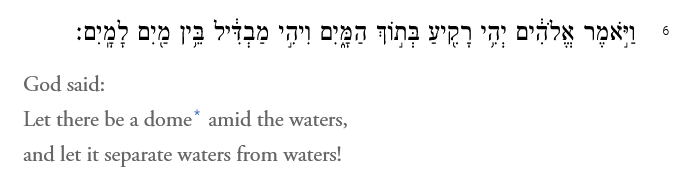
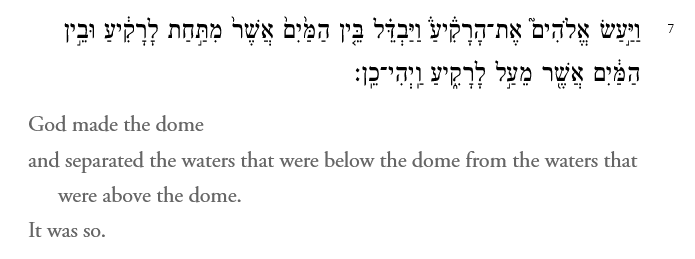
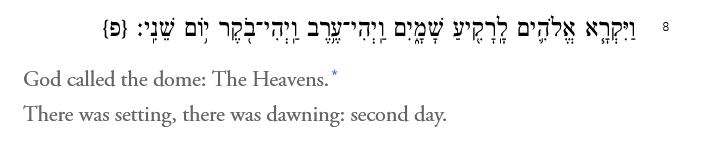
The firmament being a solid dome, setting them “in” the firmament means embedded in the dome.
There’s nothing magical about it. And the raqia can’t be the surface of the earth since the stars are embedded in it.
No, I’m insisting that you follow the text! The raqia was a solid structure strong enough to hold up a massive ocean to keep it from crashing down on the earth.
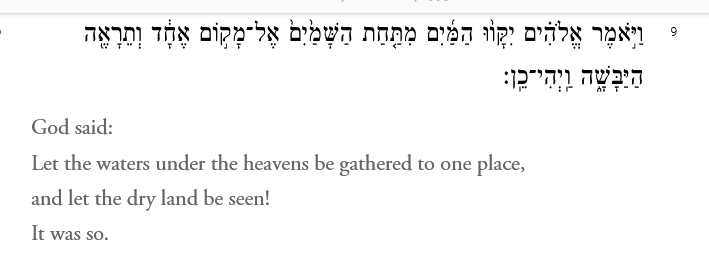
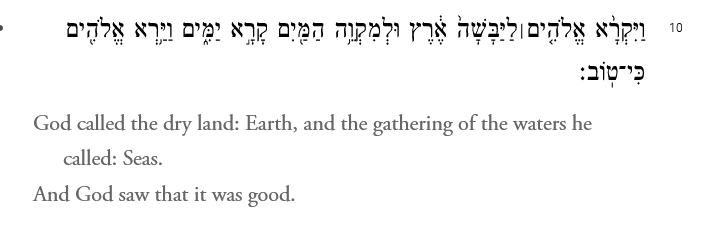
If you want to put science into the account, at least stick with the account. For example, Genesis says that God gathered the waters so dry land could emerge; given the raqia, that could be done simply by pushing the raqia lower; the air pressure would push the water under the raqia lower. That’s still a silly abuse of the text, but at least it takes the text seriously.
Right, because it was all based on observations (and a touch of mythology): The raqia is the arc of the sky, which obviously has to be solid because it is plainly holding water up there (blue => water). The raqia rests on the edge of the round earth-disk, which was plain since the sky goes right down to the horizon, and the horizon is roughly the same distance away no matter where you are.
There is no problem: the t’hom was what we would call infinite, and water falls down, so a solid dome would be the only thing holding it up.
The grammar connects “one day” with “thousand years”, so the basic structure reduces to “one day a thousand years” such that “is” goes between them: “one day is a thousand years”. “With the Lord” is a prepositional phrase that would be far more accurately rendered as “in the presence of the Lord” (or “beside the Lord”), thus “one day in the presence of the Lord is a thousand years”. The final “thousand years” is modified with an adverb, “as” or “like”, so “one day in the presence of the Lord is as a thousand years”.
No – it isn’t a relational phrase, it’s more locational (locative rather than dative); no one else has to be present at all.
And it’s not an equation; the “as” makes it a metaphor, which throws arithmetic out the window: “a thousand years” just indicates “a very long time”, and the two metaphors back-to-back are jsut saying that God doesn’t work on our time scale, He has His own. It’s no more meant literally than Jesus’ statement about forgiving “seventy times seven” times.
Actually it does – the structure of the account shows the establishment of three realms and then the filling of those realms. “Flying things” goes with “sky”, so when the sky is “filled” everything that belongs in that realm is included.
Extremely bad. The first one made me cringe back when it came out, it was so bad; the second one prompted a letter to Smithsonian admonishing them to be more precise in their terminology, not just pick up what someone else wrote.
Where in the text does it mention natural processes?
No, it isn’t – the earth is eretz, it is not shamayim or raqia.
Yes, need: if neither the rabbis (specially second-Temple) nor the church Fathers said it, it’s not even remotely likely.
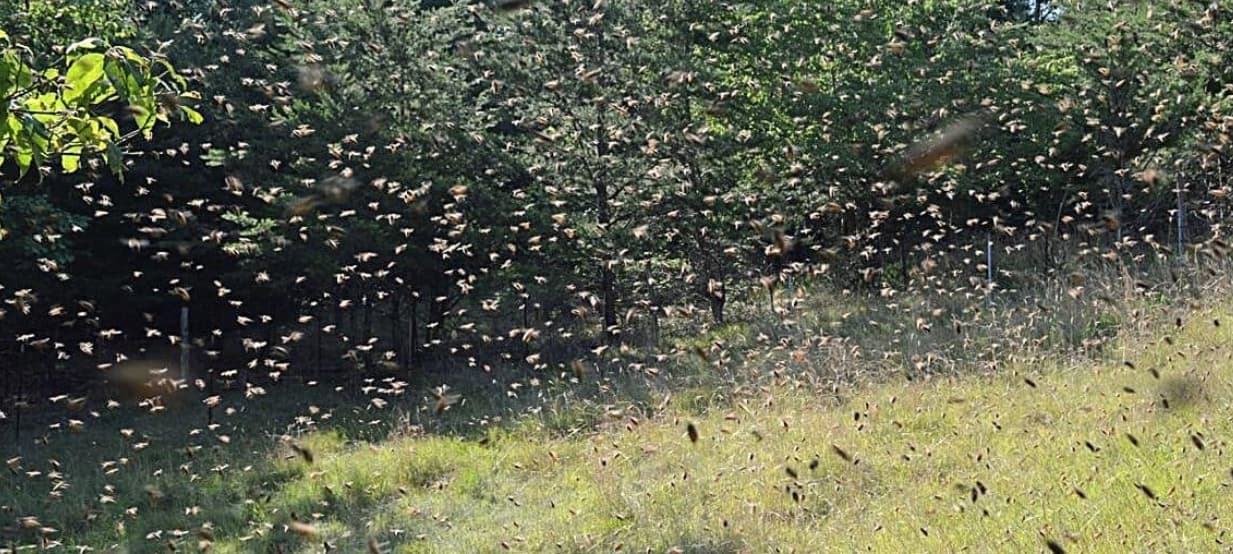
Besides which, have you ever swum through a school of fish? They swarm!
No, it doesn’t – it contains no science at all.
I expect that this will mangle the text as badly and be as ludicrous as your Genesis 1 efforts.
Only if you think that science stands above the Word and can thus be imposed on it.