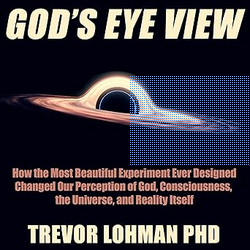
“What has quantum physics taught us about consciousness and the nature of reality? Are we living in a simulation? In order for matter to exist, does it need to be observed? Join Dr. Trevor Lohman as he grapples with these questions and others, plunging listeners into a sea of quantum strangeness while simultaneously helping them navigate these incredibly choppy waters. Through exploration of “the most beautiful experiment ever designed,” Dr. Lohman reveals how quantum physics has upended science’s classical understanding of reality over the past two centuries, causing leading physicists to question what is “real” and what isn’t.
In God’s Eye View, Dr. Lohman seamlessly weaves together incredibly complex ideas, expertly stitching history, quantum theory, neuroscience, and physics’ great hypotheses into a tapestry that listeners can admire. Ultimately, the book challenges modern science’s atheism and asks if the results from the last 200 years of quantum experimentation proves the existence of a third-person observer. Rather than attack science with spiritual conclusions, Dr. Lohman encourages us to blend scientific reason with a pursuit of God, arguing that these concepts aren’t as antithetical to each other as we’ve been led to believe. God’s Eye View is a stunning portrait of the intersection between science and spirit, and for the inquisitive, curious, and open-minded, this book is a must-listen.”
Just to clarify: I’m not trying to “straighten out” Dr. Lohman or to endorse every line of his worldview. My intention in posting was simply to inform the community that Lohman, his book, and his perspective exist for anyone who’s curious about how a neurosurgeon is connecting neuroscience, quantum puzzles, and faith.
I’m not here to teach him—only to point to a voice that some in Biologos might find interesting, whether they agree with him or not.
T_aquaticus
(The Friendly Neighborhood Atheist)
10
The views Lohman is speaking about appear to be minor positions within physics. From my understanding, the majority of physicists don’t think wave function collapse requires a conscious observer, nor do they think neural function is dependent on quantum effects. The brain operates at high temperatures (not conducive to entanglement and superposition), and the processes that happen in the brain occur over much longer time periods than what would be expected for quantum processes. Even our most precisely designed quantum computers have to run at near absolute zero and at speeds not seen in neurons.
Even if quantum effects are important in neurobiology this is still a natural process, so I’m not sure where that intersects with faith or atheism. It seems strange to try and link quantum physics and the supernatural or divine. I don’t see anyone listing the double slit experiment as something miraculous or divine. Overall, it gives me Deepak Chopra vibes.
Some people would argue that QM is essentially bringing the act and potency of Aristotle back amongst other things. This could change our worldview or epistemology. I would argue that such a change is very favorable to classical theistic thought. Even your distinction itself takes a side. It is not neutral. The idea of linking natural QM to the divine makes little sense in Thomistic thought. Everything is linked to the divine. The very distinction is made based on a mechanistic image of God. Robert Koons wrote the following in a recent work:
Here is a review of one of his books by Feser where he ends with:
Some Thomist, I’m not sure who (it may have been Ralph McInerny), once remarked that whenever you have a new idea, you should check Aristotle to see what he already said about it 2300 years ago. Koons makes a powerful case that this is true even of quantum mechanics, or at least of the heart of quantum theory’s conception of matter. And he makes it clear why this matters to wide-ranging issues in philosophy, science, and even ethics and theology.
Vinnie
T_aquaticus
(The Friendly Neighborhood Atheist)
12
In my view, this has more to do with human psychology than it does reality. In fact, that’s true for nearly all of philosophy.
From your quoted material:
When I see “common-sense knowledge” I translate that as “human bias”. Our brains don’t deal with the quantum world that well. Our brains appear to be configured to deal with the macroworld, and even then our common sense is often wrong.
I’ve also never understood why people think QM somehow doesn’t support materialism. QM describes how materials behave, so how could it not support materialism? May be I’m missing something here?
That reads like a lot of empty rhetoric and semantics. Reality doesn’t care about what words we assign to things. Either you have something that can predict and explain reality, or you don’t. Flowery words don’t get us very far.
Exactly, his doctorate, and its honorific, is his Ph.D. in neuroscience. His grandiose God’s Eye View and its impossibly yet even more grandiose ‘How the Most Beautiful Experiment Ever Designed Changed Our Perception of God, Consciousness, the Universe, and Reality Itself’ are most impressive demonstration of apophenia, evolution’s triumph of the that’ll do shortcut distortion of reality in us.
Some people like to dismiss philosophy as mental masturbation. I am not among them. Without a proper philosophical foundation, I don’t think science gets off the ground. Not to mention all the assumptions that go into science, like the reality of change, parsimony, etc.
Doesn’t all science trace back macro world observations? Macro world built equipment and macro world interpretations of said data? And we are reliant on common sense in most cases, including how we interpret scientific data (isn’t parsimony common sense?). I suppose we should we use “common sense” to accept expert testimony (especially when the person we are debating with wants us to believe their experts)?
I think most people who talk about QM on the internet don’t really understand it and the popular headlines don’t help. I think if QM leads to violations of the Law of Noncontradiction or Excluded Middle, there is something wrong with it. Act and potency are one framework for understanding it.
But I don’t think anything in QM entails anything supernatural at the moment or outside of the natural order if that is what you mean by “support materialism.” I don’t think QM supports materialism --as in–argues in favor of a matter only interpretation of all reality if that is what you mean? Personally, I’ve never understood how anyone could think (use abstract thought) materialism (matter-only) is remotely tenable or that scientific data could even in theory support a matter-only interpretation of reality.
That isn’t a very robust criticism. All of us can hand-wave away anything we want. In my view, you have slid into a self-defeating scientism here (“either you have” . . . “or you don’t”).
I am genuinely curious how far you would be willing to take what you just wrote though. Do you consider your own subjective morality empty rhetoric and semantics? Is your moral outlook just flowery words? Do you think your sense of moral justice, to use your own words, “has more to do with human psychology than it does reality?” I am not starting a debate on morality. I just want to know the boundaries of what you consider “flowery thought.” Is it just philosophy? Seems you have embraced a science only outlook to reality. I do not share that opinion.
Vinnie
1 Like
T_aquaticus
(The Friendly Neighborhood Atheist)
18
The philosophy of science is really, really simple. We assume that what we see is real, natural laws don’t change willy nilly through space and time, and your claims need to be falsifiable and testable.
We aren’t reliant on common sense in science. We are reliant on hypotheses and observable facts. The reason we have the scientific method is because common sense (i.e. human intuition) is often wrong.
Expert testimony should always be testable and checked against observable facts.
Or the Law of Nonctradiction or Excluded Middle isn’t actually a law.
Yes, it is a way for human psychology to understand reality, but it isn’t reality itself.
That’s largely an unfalsifiable position anyway because it would require complete knowledge of nature which appears to be beyond our ability. In much the same way, there is no way to rule out the supernatural. What we do see is quantum mechanics obeying mathematical laws which seems to lean more towards materialism.
Could you predict the interference pattern seen in the double slit experiment using electrons based on Aristotle’s work? No.
Could you predict the interference pattern seen in the double slit experiment using electrons based on the work of de Broglie and others? Absolutely.
Yes, my views on morality are based on rhetoric and semantics because it is subjective. Morality isn’t an objective part of reality like quantum mechanics is.
Added in edit:
Steven Weinberg’s (infamous physicist) “Against Philosophy” is a good read.
Physicists get so much help from subjective and often vague aesthetic judgments that it might be expected that we would be helped also by philosophy, out of which after all our science evolved. Can philosophy give us any guidance toward a final theory?
The value today of philosophy to physics seems to me to be something like the value of early nation-states to their peoples. It is only a small exaggeration to say that, until the introduction of the post office, the chief service of nation-states was to protect their peoples from other nation-states. The insights of philosophers have occasionally benefited physicists, but generally in a negative fashion—by protecting them from the preconceptions of other philosophers.
I do not want to draw the lesson here that physics is best done without preconceptions. At any one moment there are so many things that might be done, so many accepted principles that might be challenged, that without some guidance from our preconceptions one could do nothing at all. It is just that philosophical principles have not generally provided us with the right preconceptions. In our hunt for the final theory, physicists are more like hounds than hawks; we have become good at sniffing around on the ground for traces of the beauty we expect in the laws of nature, but we do not seem to be able to see the path to the truth from the heights of philosophy.
The philosophy of science is really, really simple. Tell that to all the people writing full length books and arguing over the subject. There are debates over “realism, empiricism, induction, explanation, theory-ladenness of observation, underdetermination, scientific change, and more.”
We assume that what we see is real, Not all scientists or philosophers accept scientific realism. Instrumentalism has its proponents as well as some other anti-realist idea. There are many approaches to the laws of nature as well. Not to mention that observations can be said to be “theory laden and what we “see depends on conceptual frameworks, instruments, and background assumptions.”
your claims need to be falsifiable and testable. Karl Popper would be proud but I don’t believe falsifiability is universally accepted. It’s important but not that clean. Real science is messier and sometimes includes lots of non-testable nonsense like string theory, and multiverses. Few bat an eye at these but if you mention the fine-tuning of physical constants, those hypocritical pitchforks come out. We need that paradigm protection in science to go with all our auxiliary hypothesis. Edited to add…not to mention inflation, which a very significant and strong minority–including a co-founder now reject as they deem it pliable and not meeting strict testability, yet still the majority of scientists scientists disregard this falsifiability problem and think its well evidenced.
Not even close. We see the microscopic realm obeying mathematical laws which leans towards or demonstrates the particles in the microscopic realm have natures capable of being mathematically modeled. You are reaching. Science is good at finding what it seeks, things capable of being mathematically modeled by reality.
That is irrelevant to the point at hand. I would not expect to find bones with a metal detector on the beach. I would expect to find metal and not be at all concerned by my lack of detecting something I did not search for nor that my instrument could even in principle find. In a rush to advocate scientism, you have missed the substance of the response. As Koons notes:
In prequantum physics, we did not need to refer to potentialities at all. We could simply describe and predict the actual trajectories of particles using deterministic laws of motion. In quantum theory, as in Aristotle’s philosophy of nature, a complete description of nature requires us to include also the merely potential states and locations of things.
It’s about how we see the world and the nature of things. Some readily see QM as moving us back towards an Aristotelian metaphysics. You don’t bat an eye in possibly dismissing the law of non contradiction (LNC) bur your feathers get ruffled by the concepts of act and potency being real components of the world? Does thinking about cause and effect do the same thing to you?
Wow, scientism is pretty desperate.
Feser: Take LNC, which is commonly taken to be the most fundamental of the laws. The traditional defense against would-be skeptics is that it simply cannot coherently be denied. As Aristotle points out in the Metaphysics, to assert anything at all is to put it forward as true, and therefore not false. But that includes the skeptic’s own statement that LNC is false. In making this assertion, the skeptic is claiming that it is true, and therefore not false, that LNC is false. If he weren’t, there’d be no disagreement between him and the defender of LNC. But this itself presupposes LNC, so that the assertion is self-undermining.
Note that it misses the point to allege that the defender is begging the question by presupposing what is at issue. For the point isn’t that the defender is presupposing what is at issue. The point is that the critic himself is presupposing what is at issue. It isn’t that the critic can coherently deny LNC even though the defender affirms it. It is rather than the critic himself, no less than the defender, cannot avoid commitment to LNC.
Denying LNC throws everything in the trash–including science. You can’t even deny this without assuming the LNC.
So you offer a subjective moral system that is not an objective part of reality or tied into the nature of things. It is expectedly not scientifically testable or falsifiable, but really consist of “empty rhetoric,” “semantics,” “human psychology” and “flowery words” that “reality doesn’t care about.” Morality certainly cannot “predict and explain reality” and thus, can’t “get us very far.” Is the team full? Where do I sign up for atheism?
Maybe useful against theories of everything and multiverses but all of science is subservient to logic and reason. That means physics doesn’t work without philosophy.
He is the one who said “Religion is an insult to human dignity" right?
Maybe he both said it and didn’t say it. Since the LNC might not actually hold up as a law, I guess we can say whatever we want.