But Pharaoh doesn’t mean simply head. It is the Egyptian word for their ruler. Please see the Net Bible Definition, which you like to quote as the absolute truth, in post 210 above.
You will have to refresh my memory. When the Hebrews returned after the exile when did they have enough contact with Egyptians to pick up the loan words?
Doesn’t your idea conflict with your view that that Exodus was
Moses knew the Egyptian terms. The return from exile wouldn’t happen for 1000 years.
We are discussing whether the word Pharaoh necessarily means Egyptian ruler. My point was that the statement “head” of the country does not disclose whether the country was UK or US. In the same vein, the statement “Pharaoh” of the country does not disclose whether the country was Indus or Egypt. Whether we use the generic word head or Pharaoh makes no difference to the argument.
As far as I can remember the Torah was lost or nearly so during the Exile. St Ezra returned to Jerusalem after the exile and found a MS and revived it. Then the Jews spread to Egypt. Alexandria became one of their centers. Then c. 300 BCE Ptolemy commissioned the 70/72 priests to translate the Hebrew Torah. My hypothesis is that the Hebrews came into Israel c. 1400 BCE from Indus Valley. The Egyptian loan words most likely entered the Torah between the Exile and LXX. Then that tradition was carried into the Masoretic.
Not necessary at all. We don’t have access to the Torah <Exile. We don’t know the terms or their meanings used by Moses. The tradition, however, carried the Torah–orally or in writing, I do not know. So the Torah is inspired and basically true but their may be change of terms–without change of meanings. There may indeed be some redactions. There is a huge literature on that. But I’d like to invoke that if and only if we find an intractable problem.
How large a group were your hypothesized Hebrews? What route did they take?
I note that in 1400 BCE Egypt controlled Canaan
The Kassite empire controlled the lower part of Mesopotamia and the Mitanni the upper part of Mesopotamia. The latter seem to have been allied at that time with Egypt. How did your Hebrews get through these empires not to mention settle in the land of one of them? How did they get through the barriers further east such mountains/deserts not to mention peoples?
How come the language they spoke was so similar to the languages around them in their new home spoken by the Phoenicians, Assyrians, etc?
Indus. First yam suf. 2 Taftan.sinai. 3. Hamun e mashkel.second yam suf. 3 paran. paran near isfahan. 40 years wandering here. 4 Tehran. Kings highway. 5. Mesopotamia.edom. did not get passage. 6. circuited around through shatt al arab.third yam suf.
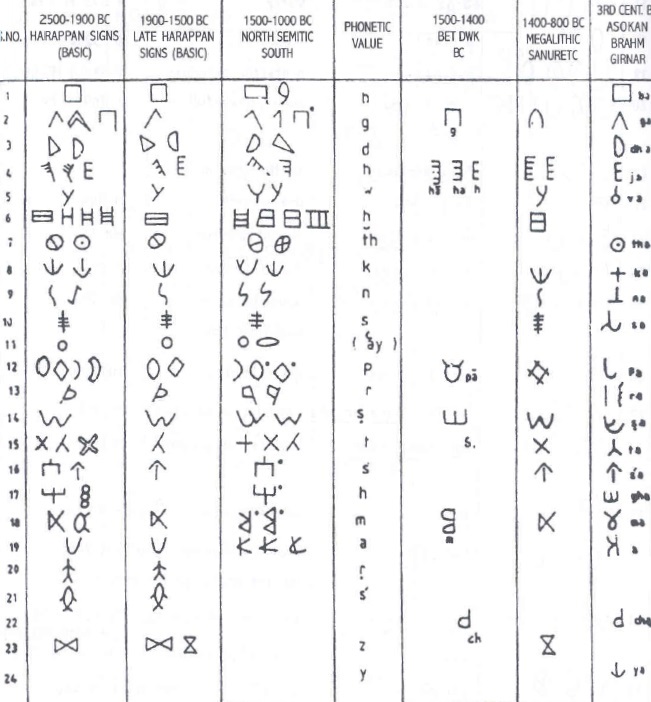
There is a huge similarity between signs of Indus valley and old Hebrew. @Erp please respond to my post. I am happy to take new issues but let us clear the earlier ones.
Jesus, if I remember, said one dot of the OT cannot be changed. The salvation brought by Jesus is anchored on the sin made by adam. As far as I know, NT cannot be read without the OT.
Since you are making the innovative hypothesis, it is up to you to answer questions.
I will note again that the Kassites from all accounts controlled the area where the waters of the Tigris and Euphrates entered the Persian Gulf (nowadays the Shatt al Arab). I can’t imagine them allowing a large number of people through without a struggle. So how large a group are you hypothesizing?
I will also note that given the number of known signs from the Indus River valley civilization (100s of signs), it is not surprising that there is some overlap with the far smaller number of signs (22) of the paleo-Hebrew script. Also there is a close connection between the paleo-Hebrew script and the older (as in pre your Exodus date) proto-Sinaitic script. Note if there is a connection between the Indus Valley script and the scripts of the Levant then you should be able to use it to decipher the language used by the Indus Valley people.
Note I think the Egyptian exodus was at most a very small group of people (on the order at most of hundreds of people).
The Hebrew פַרְעֹה, Transliteration: Paroh, comes from the Egyptian language.
Given the title comes from the Egyptian language how could it mean anything else? It is the same word the Egyptians used to refer to their ruler.
This is a myth based on the Letter of Aristeas. It has long been known to be a fake. As far back as the 17th century.
Bruce Metzger says
The loan words come from the Egyptian that was used 1,000 years before the Exile and would not have been in use at the time of the Exile.
You are thinking of Deuteronomy but there is nothing to indicate that it was the only “book” in existence. You need to research the development of the canon of the OT.
There were, but no where near the size that you are thinking.
On both sides of that question. And textual criticism is a very technical field which requires knowledge of the languages involved if you want to actually judge the correctness of that literature.
Klax
(The only thing that matters is faith expressed in love.)
242
No He didn’t. According to Paul and David, yes, Adam, of course, being fiction. Oh it can, in the sense of it being merely myth - fiction - with no theological moral authority whatsoever.
OK. So you have two loanwords Pharaoh and Habiru. Both are generic and have no connection with Moses. On the other hand you have the names Amram, Jochebed, Moses, Aaron parallel in Indus. These are from the family of Moses. So which stands taller?
Maybe. Instead of simply saying, “No, no,” why don’t you lay out when the LXX was translated and where?
No. The word was changed (and places reidentified) between the Exile and LXX. We do not know what the Torah looked like before 3c BCE.
Indeed there were other books in existence. But that is not relevant since we do not know what existed. Julius Wellhausen’s work, if I remember, places the composition of the present Torah around the Exile plus-or-minus. The reidentification of places from Indus Valley to Egypt would have taken at this time or after.
Exactly. The Hebrews asked the King of Edom to give them pathway. That was Meopotamia (between two rivers, Baghdad). Then the Hebrews circuited around south and crossed the Shatt al-arab.
I agree entirely. Unfortunately this has not been attempted. Another difficulty is that we mostly have cryptic writings on the seals; not any text, let alone a bilingual text. @Erp You wanted me to lay the evidence. I did. Now, may I request you to contest that evidence instead of bringing up newer issues?
Klax
(The only thing that matters is faith expressed in love.)
245
What evidence? What evidence that Jesus was wrong?