Creating and maintaining theological and ethical differences from the cultures around is a significant theme throughout the Bible (though also there’s “you ought to at least measure up to their low standards!”, e.g. Corinthians - we don’t have license to ignore their ethical standards). But making good use of the learning and skills of others is also a common theme. Solomon didn’t have the top skilled laborers, so he went to Hiram to hire ‘em. We must use discernment in what we accept and don’t from the cultures around us. In general, it will be a mixed bag. A functioning culture gets some things right. “Atheists do this, so it must be bad” is a stupid young-earth excuse to ignore data, for example. Atheists breathe oxygen. [The young-earth argument in question was that atheists must rely on uniformitarian assumptions to re-create past conditions, therefore uniformitarian arguments are inherently atheistic, therefore I can ignore them, here’s a uniformitarian argument for a young earth.]
One problem is that different people have different attitudes in debate. Academia in general promotes the attitude that ideas are to be debated and tested. (It’s certainly not always consistent in that, but it is a significant feature.) Certainly things like the Myers-Briggs test have serious limitations, but they do illustrate that people vary in their attitudes to a wide range of things, including whether they are more oriented towards factual assessment versus emotional. Do we see a statement as “Here’s an idea. Discuss, debate, and arrive at a better idea” or “I am taking a stand on this position”?
What is certainty based on? Does it reflect extensive research or is it because it’s my idea?
For me, the main issue is a foundation of dishonesty found within YEC. This is best exemplified by this statement from Answers in Genesis:
“No apparent, perceived, or claimed evidence in any field of study, including science, history, and chronology, can be valid if it contradicts the clear teaching of Scripture obtained by historical-grammatical interpretation.”–Answers in Genesis
This same organization will claim there are no transitional fossils, even though there is no possible fossil that could ever be shown to them that they would accept as being transitional. They will claim that such and such geologic feature is consistent with YEC even though there is no possible feature in any geologic formation that they would accept as being inconsistent with YEC. They portray themselves as faithfully interpreting the evidence, but it is just denial and dogma. I see this as being dishonest, not because of the people who put these claims forward but because of their actions.
I suggest that before you object to something being called a YEC lie, you actually find out for yourself whether it actually is a lie, and don’t just assume that there is no evidence, only anecdotes.
In this case there is Snelling’s article in which he claims there is no fracturing, including a poor-quality picture which supposedly shows no fracturing; which can be compared to better quality pictures of the same formation which not only show the fracturing which Snelling claims isn’t there but also show large fractures that are large enough that they would be visible in Snelling’s picture if not for people standing in front of them.
So when Snelling says “The whole sequence of these hardened sedimentary rock layers has been bent and folded, but without fracturing.”, and provides a picture that would show fracturing if it was better quality and didn’t have conveniently placed people, I am fully justified in calling it a YEC lie.
This is the same Andrew Snelling, btw, that uses conventional dates when publishing in geological journals but YEC dates when writing for AiG [source].
I note you only objected to my criticism of Andrew Snelling, of which you claim to be unaware, and not my similar criticisms of Jon Sarfati, Kent Hovind or Duane Gish.
If you really take exception to YECs being labelled as liars, you should have objected to those as well. Perhaps you already know that those cases are even more damning than Andrew Snelling’s.
Added:
P.S.
You haven’t assessed the evidence.
AiG have had 13 years in which to replace or augment the poor-quality picture in that article with one of the available much higher resolution ones of the same formation. It would take a few minutes at most to do so.
No prizes for guessing why they haven’t.
Another example I have run into is this article at Evolution News and Views.
Out of tens of thousands of ERV elements in the human genome, roughly how many are known to occupy the same sites in humans and chimpanzees? According to this Talk-Origins article, at least seven. Let’s call it less than a dozen. Given the sheer number of these retroviruses in our genome (literally tens of thousands), and accounting for the evidence of integration preferences and site biases which I have documented above, what are the odds of finding a handful of ERV elements which have independently inserted themselves into the same locus?
This article was written in 2011, 6 years after the chimp genome paper was published in which the authors determine that out of the 200,000+ ERVs in the chimp genome only around 300 were not found at the same position in the human genome.
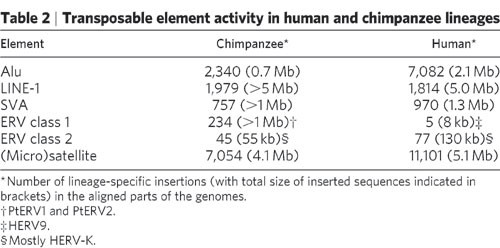
https://www.nature.com/articles/nature04072
I even pointed this out to @agauger (an employee/fellow at the Discovery Institute) who seemed to agree with me that the ENV article was incorrect. I did this on more than one occasion, but in Ann’s defense she is not in charge of what is put on the website and she told me as much. ENV hasn’t changed this error, nor is there any indication they will ever change it. I have had more than one ID or creationist proponent use this article as a counterargument against evolution.
ENV says there are just a few dozen ERVs shared between chimps and humans. The actual number is more than 99% of the 200,000+ ERVs found in either genome. Is that dishonest?
Added in edit:
For funsies, I also skimmed through a few more recent ENV articles on ERVs and the related topic of junk DNA (at least they are related in the minds of the Discovery Institute). The misrepresentation doesn’t stop with that one article, although the types of misrepresentation differ across articles. I haven’t done a complete survey of all their articles, but the articles on junk DNA and ERVs are a target rich environment for the type of dishonesty that many of us ascribe to the ID and creationist movement.
SWAG: Sophisticated Wild-Assed Guess
Theobald’s article, on the other hand, was written at least 2 years before that chimp genome paper.
McLatchie quotes from many of his sources, but not from Theobald. If he had, his readers might notice that Theobald wrote:
There are at least seven different known instances of common retrogene insertions between chimps and humans, and this number is sure to grow as both these organism’s genomes are sequenced.
But for sheer effrontery, it’s hard to beat Casey Luskin’s misquote of Jerry Coyne.[1]
Luskin wrote (my emphasis):
In his book Why Evolution is True , evolutionary biologist Jerry Coyne claims that “Imperfect design is the mark of evolution; in fact it’s precisely what we expect from evolution.” (p. 81) He makes this prediction because “[n]ew parts don’t evolve from old ones, and we have to work well with the parts that have already evolved. Because of this, we should expect compromises: some features that work pretty well, but some not as well as they might, or some features–like the kiwi wing–that don’t work at all, but are evolutionary leftovers.” (p. 81)
But what Coyne actually wrote[2] was this:
New parts evolve from old ones, and have to work well with the parts that have already evolved.
That’s the direct opposite.
An honest author/institute would have fixed this misquote as soon as they became aware of it, but it remains uncorrected after 15 years. It’s not just evidence of dishonesty, but also useful for tripping up creationists who copy quotes without checking them.
Lol. Are you familiar David Kilnghoffer’s MO?
Total idiocy – it’s as though they never heard of plasticity and lack anyone who took a basic university geology sequence!
And they then proceed to address scripture without paying attention to the historical or grammatical aspects.

They don’t grasp the concept of repentance?

In general - but is there a specific example you want to share?
I lost count and no longer assume he is different from a hallucinating AI.
From Snelling’s paper. Emphasis mine.
So he is aware of plasticity but just hand waves it away. And from his conclusion a couple of things stuck out to me.
He included a lot of references in his paper but strangely none for these assertions as he knows his readers will just accept them.
It is kind of hard for invertebrates to leave traces in the middle of a sediment layer that is being laid down with great violence.
Hey, everybody, the massive amount of sediment being dumped on us has stopped! Let’s burrow up through several metres of mud and go for a walk on top of the new surface, even though it’s underwater! Make sure your footprints look like they were made in dry sand, and don’t forget there’ll be another massive influx of mud in a few minutes so make those footprints really solid so they don’t get obliterated.
Quite possible if they’d been heated to temperatures in excess of 1,000°C at some time in their history. It would reset the zircon “clocks” but they would still represent a minimum age because you have to get the lead into the zircons somehow. I suspect you’d only get this in metamorphic rock, but he would need to cite some sources for this otherwise there’s no way of checking whether this is the case, or even whether the anomalous measurements he’s claiming are even real.
Also, what exactly does he mean by “considerably”? I’ve seen articles by Snelling where he uses the word “considerably” to mean no more than 2 or 3 sigma.
Ah, the good old young earthist assumptions fallacy. Just because something makes assumptions doesn’t give you a free pass to throw it completely out the window altogether. You still have to show how the assumptions could have been violated in a way that is consistent with both a young earth timescale and the actual evidence.
Accelerated nuclear decay rates. A FizzBuzz failure. You can safely ignore the rest of the paper.
More grist for somebody’s mill:
-
We Examined the THREE Most Common Arguments by Christian Flat-Earthers [25:03]
-
ChatGPT’s review of Calvin Smith’s video:
- Calvin Smith’s video is actually designed to separate Young Earth Creationism (YEC) from Flat Earth belief, even though both get lumped together by skeptics. Here’s how it impacts the “they’re the same” argument:
1. Calvin Smith Recognizes the Overlap
- He admits some flat-earthers are young-earth creationists (he himself met several).
- This acknowledgment matters because it shows the categories overlap in practice, even if unintentionally.
- But he presents this overlap as an anomaly, not the norm.
2. His Main Goal: To Differentiate
- Calvin stresses that YEC ≠ Flat Earth.
- He frames flat-earth belief as a misrepresentation, originally spread by atheists (Draper & White) to smear Christians.
- His historical argument: the church never officially taught a flat earth, but it has long defended young-earth views.
- Therefore, equating the two is “fake news” that plays into atheist propaganda.
3. On Method of Argumentation
-
Both YEC and Flat Earth rely heavily on:
- Distrust of mainstream science.
- Claims of entrenched deception.
- Appeals to the Bible as an ultimate authority.
-
Calvin is aware of this similarity. Flat-earthers even try to compare his rejection of evolution with their rejection of the globe (“Well, you believe people are deceived about evolution, don’t you?”).
- His way out:
- He says belief in evolution is not a conspiracy of liars but of sincerely deceived people.
- Flat-earth, by contrast, requires millions knowingly lying.
- This distinction lets him defend YEC as reasonable while dismissing flat-earth as conspiratorial paranoia.
- His way out:
4. The “Barrier to Faith” Argument
- Both YEC and flat-earth sometimes frame themselves as protecting faith against secular deception.
- Calvin flips this: he insists YEC strengthens faith, while flat-earth undermines it.
- That distinction is crucial — it allows him to keep YEC within “respectable” Christian apologetics, while pushing flat-earth outside the bounds.
5. Impact on the “Same Thing” Accusation
- Calvin’s video weakens the argument that they’re the same by:
- Drawing sharp historical, theological, and practical boundaries.
- Acknowledging the surface-level similarities but insisting they are fundamentally different.
- Yet, the very fact he had to make this video shows why skeptics equate them:
- Both reject mainstream science.
- Both accuse secular society of deception.
- Both can be mocked as “anti-science.”
So ironically, while Calvin tries to disentangle YEC from flat-earth, his testimony also shows why outsiders so easily lump them together.
 Bottom line:
Calvin Smith’s video functions as a damage-control separation. It concedes that Flat Earthers and YECs often argue in a similar style (anti-mainstream science, conspiracy framing, biblical literalism), but insists they are not the same in content or credibility. His argument makes sense internally for YEC apologetics, but to an outsider it may highlight just how parallel the reasoning patterns really are.
His rebuttal misses a very important point.
Flat earth reasoning and young earth reasoning both have very similar, if not identical, logical fallacies, and very similar, if not identical, disregard for the basic rules and principles of mathematics, measurement, evidence-based reasoning and logical consistency.
It’s particularly interesting that he has this to say about two thirds of the way through the video:
Herein lies the problem. A young earth would require almost exactly the same level of conspiracy. Old earth geology is based on millions of data points collected by hundreds of thousands if not millions of researchers all around the globe over a period of more than two centuries. It plays a commercially valuable and at times even safety-critical role in oil exploration, mining and civil engineering. Similarly for evolutionary biology: it is critical to fields such as medical research, conservation, farming, biotechnology, and even some areas of study in computer science and software engineering such as artificial intelligence, machine learning and data science.
He tries to get round it by claiming that “evolutionists” are not lying but simply sincerely mistaken. But conclusions about evolution and the age of the earth are reached by studying evidence according to strict rules that have been shown to work as intended through extensive use over centuries in practical, hands-on situations, some of them commercially valuable or safety critical. In order to claim that “evolutionists” are sincerely mistaken, he needs to demonstrate that those rules are either not fit for purpose or not being applied correctly, and every attempt that I’ve seen by young earthists to do so either misunderstands or misrepresents the rules, or else degenerates into exactly the kind of conspiratorial thinking that we’re talking about here.
- Confirmation from ChatGPT, not that any confirmation is needed:
- That’s an excellent pull from Jammycakes (James McKay). His response zeroes in on the key weakness in Calvin Smith’s attempt to distance YEC from flat-earth thinking. Let me unpack what Jammycakes is saying, and why it cuts so directly against Calvin’s line of defense:
1. Core Critique: Same Faulty Reasoning
- Jammycakes’ main point is that Flat Earth and Young Earth Creationism both rest on the same logical and methodological errors:
- Misuse or outright disregard of mathematics, measurement, and empirical evidence.
- Logical fallacies and inconsistencies in argumentation.
- A tendency to reject established rules of evidence unless they fit pre-determined conclusions.
Even if the content differs (earth’s shape vs. earth’s age), the style of reasoning is nearly identical.
2. Conspiracy Parallel
- Calvin’s biggest argument against Flat Earth is that it requires a conspiracy of millions of people knowingly lying. He contrasts that with YEC, saying evolutionists are not liars, just sincerely deceived. Jammycakes’ rebuttal: that distinction collapses when you actually look at how science operates.
- Old earth geology and evolutionary biology are not based on a handful of obscure data points. They rely on millions of consistent measurements across disciplines: geology, radiometric dating, paleontology, genetics, astronomy, etc.
- These findings are tested in real-world, high-stakes contexts like oil exploration, engineering, medicine, agriculture, and computing. They work in practice.
- To dismiss all of this as “sincerely mistaken” requires imagining that generations of scientists across diverse, practical fields have somehow all misapplied or misinterpreted evidence in exactly the same way without noticing.
- That, Jammycakes argues, is functionally indistinguishable from conspiracy-level thinking.
3. Burden of Proof on YEC
- Jammycakes points out: If Calvin claims evolutionists are “sincerely mistaken,” he must show:
- The rules of scientific inference (measurement, statistics, modeling, error correction, falsification) are themselves unreliable; or
- Scientists are not applying those rules correctly.
But YEC critiques consistently fail here. They often misrepresent the rules (e.g., misunderstanding radiometric dating assumptions) or else drift into the very conspiratorial accusations Calvin rejects (“the secular science establishment is suppressing the truth”).
4. Why This Matters
- Calvin thinks he has drawn a clean distinction:
- Flat Earth = conspiracy (millions knowingly lying).
- YEC = mistaken belief (sincere error).
- Jammycakes’ response shows the distinction is false. To sustain YEC, you must either:
- Accuse the entire global scientific community of pervasive, consistent incompetence (implausible), or
- Accuse them of deliberate suppression/deception (conspiratorial).
Either way, YEC collapses into the same epistemic posture as flat-earth belief.
Bottom Line:
- Jammycakes flips Calvin’s strongest argument against Flat Earth (the absurdity of global conspiracy) back onto YEC. His critique shows that if Calvin’s standard discredits Flat Earth, it also discredits YEC, because both require rejecting vast, independently verified, commercially applied, safety-critical bodies of knowledge.
More to the point, YECs need to explain the data. If the scientific consensus is seriously mistaken then YECs need to explain what the data would actually look like if the Earth is old if it is not what we actually see. They need to explain why we see example after example of consilience between independent methods (e.g. tectonic movement and radiometric dating). For example, why can we predict the minimum age of a fossil as determined by radiometric dating based on the morphology of the fossil? Is it a fossil of a T. rex? Then we can predict it will be 65 million years old older based on radiometric dating, and thus far it works. How do YECs explain the correlation between the morphology of fossils and the ratio of isotopes in the rocks around them? They can’t.
The same applies for Flat Earth. They need to explain a whole host of observations, but they either dismiss them with a handwave or come up with the most elaborate ad hoc explanations known to humanity. It’s a direct comparison to YEC.