Did you read the rest of the reply? I speculated what definitions. The point of the framework is to keep it simple and provide scalability. Each field of study will have different units.
For gravity, if will still have the same units.
Yes, you wrote:
But that’s only one of the terms of the equation.
Does M also have units m²/s²? Is g measured in m/s²? Is k therefore a wavelength?
That is not correct.
The density in our region of space is .008 solar masses per cubic parsec. That is almost nothing in the solar system .0000000000005 solar masses within the orbit of Neptune. The mass only accumulates to something significant (even dominant) in the vast distances between stars, and thus only has an effect on the motion of things on a galactic scale while having no effect on the motion of bodies in the solar system.
The 45% you read comes from a NASA article which is the percent of gravitational force from the galaxy on objects in the solar system. It is NOT the percent of matter in the solar system or the percent of all gravitational force on objects in the solar system!
Its not that the motion of the planets excludes the possibility of a high density of dark matter in the solar system. As long as the density in the solar system is uniform the effect on the motion of the planets would be negligible regardless of this.
Does dark matter affect anything other than galaxy dynamics? Yes. Since black holes absorb everything then dark matter would affect not only their growth but also their motion, adding a kind of frictional effect. Though black hole detection and study is still fairly weak. Compare the few dozen black holes and 300 black hole event candidates to over 6000 extra solar planets detected.
Of course, there is the hypothesis by some that black holes are themselves the explanation of dark matter. That would mean that the density of dark matter is far from uniform on a stellar scale and thus the density of dark matter in the solar system would be zero.
2 Likes
You have…
1. False equivalence everywhere:
-
You claim dark matter’s “free parameters” are the same as your undefined variables - but dark matter parameters have units, measurement protocols, and physical meaning. Yours don’t.
-
You say CMB/BAO measurements are “just gravitational effects” like your predictions - but those measurements constrain specific quantities (matter density, power spectrum shape, etc.) with error bars. Your predictions are vague statements about “flatter curves.”
2. Moving goalposts:
-
You started claiming you’d solved dark matter
-
Now you say “I’m not claiming to have solved dark matter”
-
You retreat to “I’m just asking questions”
3. Misrepresenting dark matter physics:
-
The “problems” you list (cuspy halos, missing satellites, etc.) are active research areas where simulations including baryonic physics are making real progress - not “epicycles”
-
Your calculation about dark matter in our solar system was astronomically wrong, by orders of magnitude as @mitchellmckain just pointed out in response to a different post
-
You claim dark matter “can accommodate almost any observation” - but the theory makes specific quantitative predictions that have been confirmed (CMB power spectrum peaks, BAO scale, structure formation timescales)
4. The “I’m just asking questions” defense: This is classic pseudoscience rhetoric - when pressed on specifics, retreat to “I’m just proposing alternatives” while still making grandiose claims
5. The telling admission: “I’m certainly not the one to make that happen!” - so you expect others to do the work of testing your undefined theory while you get credit for the “insight”
5 Likes
Indeed I have noticed. Three people I know to be scientists and two I think probably are, who have earned my respect over the years for their dogged teaching here, even of the most unwilling students.
They are hardly bullies. If you expect to come talk science with real scientists, even propose turning science upside down, be prepared to address real the questions they ask. And have the humility to admit you still have work to do. Enough with the self pity.
If you want to lie in the grass and watch the clouds roll by, do that. But don’t continue to argue that your proposition is defensible, when it has been shown not to be by people who know what they are talking about.
4 Likes
I already answered your question.
My spouse sees my beauty. Other views on it are not welcome.
3 Likes
When I speak of the priests of science, I’m not talking specifically about the folks here. There has been some minor annoying character assaults. Minor. And generally, there is a log-in-the-eye issue with many scientists. AND with me too. But discovery can be about fresh re-envisioning. Nothing wrong with that. And light-first is both scriptural and has scientific merit.
I’m new to this forum, so they are getting to know me and I them and now you. What do you think about the conjecture of light-first, geometry second?
Indeed I have.
There is one mod in this discussion, and he has handled your posts with enormous patience.
You have received a great deal of valuable, straight-forward input from people who have treated you like a peer. And then you turned it down. More than once. Insisting you were right.
3 Likes
I don’t.
3 Likes
Let me list of a few of my heroes of science: Alfred Russel Wallace, Teilhard de Chardin, Kepler, and even John Muir. I’m a Jesus-loving naturalist who loves to look at creation and wonder. And does that give me street cred? Not really. Am I offering something I discovered? Yes. Is it worth it? I think so or I wouldn’t be here. The reason I’m here is because faith and science can and WILL be unified. Is it under this framework?
You’re right that I need to define M and k with proper units and measurement protocols. I’ve provided some dimensional analysis showing the equations are internally consistent, but that’s not the same as having validated physical measurements or established experimental protocols. Dark matter models have those; this framework doesn’t yet.
However, your claim that dark matter makes “specific quantitative predictions that have been confirmed” glosses over a real issue: dark matter models have accumulated enough post-hoc modifications (feedback mechanisms, baryonic effects, self-interacting variants, fuzzy/warm variants, assembly bias) that the framework can now accommodate almost any observation through parameter adjustment. When initial predictions fail, the response has been to add complexity rather than reconsider foundations. The mathematical sophistication is genuine, but a theory that survives through continuous refinement rather than making risky predictions that could definitively fail may be fitting data rather than revealing underlying reality.
You call the problems I cite “active research areas where simulations are making progress.” That’s exactly my point. Each problem requires additional mechanisms beyond the original theory. That’s not inherently wrong, nature may be complex, but it does raise falsifiability concerns.
If I made an error by orders of magnitude, then I made an error. This is a forum. Good science requires getting the numbers right.
You say I’m “moving goalpaths” from claiming I’ve solved dark matter to saying I’m exploring alternatives. Fair correction. Let me be precise: I’m proposing that g = k∇M might provide a simpler foundation that could eventually address dark matter evidence without requiring undetected particles. And its simplicity allows it to be applied to fluid dynamics, tree growth, AND evolution. Yes, bold claim. Is there not ANY issue with dark matter?
The framework generates testable predictions in chemistry (isotopic fractionation, catalytic resonance, alloy properties) where experiments could distinguish whether this reveals new physics or just redescribes existing phenomena. Where will this go? Probably nowhere, but I do thank you for the time you’ve spent responding to me.
Generally, you’re right that expecting others to test an undefined theory while claiming insight is backwards. The proper sequence is: define terms with units → derive quantitative predictions → test experimentally → only then claim the framework works. But this is a forum. Where ideas are tossed around. Isn’t that the point?
I’m developing this work publicly in real-time, which means you’re seeing the messy process of theory development including errors and incomplete formalization. That’s not an excuse for imprecision, but it is the current state. However, with the advent of AI, anyone can take the general equations and dig with them. Just takes copy/paste question. I want science to be something for anyone, not just those in the circle of belief.
Could we live in a Light-First universe? Does anything I have described have any merit whatsoever?
That NASA article is an interesting read. I recommend taking a look.
For example, it tells you how far you have to get away from the sun and earth for the gravitational effects from the galaxy (incl. dark matter) would be significant. It also explains that the gravitational effects from dark matter are more significant at larger distances from the galactic center.
1 Like
Nice. Thanks for finding that.
This NASA article does an excellent job explaining current dark matter detect challenges and proposes a creative experiment. The proposed radioisotope-powered spacecraft experiment at 100 AU is a creative, fun idea.
What’s missing is more fundamental: the article calculates how dark matter would affect spacecraft if the dark matter model is correct, but doesn’t address whether the dark matter model itself has been validated. The key passage is this:
“Dark matter as a hidden mass in galaxies was first proposed in the 1930s… Only a gigantic hidden source of mass can explain why stars at the outskirts of spiral galaxies like ours move as quickly as they do.”
This presents dark matter as the only explanation, when it’s actually the currently preferred explanation. The article doesn’t mention that alternative theories exist (MOND, modified gravity, etc.) that also address rotation curves without requiring undetected particles. They also don’t explain that direct detection has generally been unsuccessful (as I understand it) despite decades of experiments. The accumulating modifications to dark matter models to make it hold up.
The proposed spacecraft experiment is well-designed for testing gravitational effects at solar system distances, but it could it distinguish between “dark matter gravity” and “gravity from any other source.” If the spacecraft deviates from predictions, we learn that our gravitational model needs refinement, but not necessarily that dark matter particles exist. Could it be the gradient that I’m proposing, like fluid dynamics. The model I’m proposing is derived from atmospheric science.
The article represents solid mission planning within the dark matter framework, but sidesteps the deeper question of whether that framework is the correct interpretation of the underlying physics.
Thanks for the dig.
That just isn’t true. A perfect example is the Bullet Cluster:
From first principles, the predictions are pretty obvious. The observations match those predictions really, really well. Nothing you have presented thus far even begins to explain these observations.
Why are you proposing this?
Usually, when a scientist proposes something new they are able to describe the data that led them to that conclusion. All you seem to be able to produce is your imagination. There doesn’t seem to be any logical connection between data and what you are proposing. Why are you proposing the idea that light creates space? What data is leading you to this conclusion?
When someone comes in with their hair on fire claiming they have overturned multiple fields of science we expect more than word salad, random arrangements of symbols, and a lack of knowledge of the data within those fields.
I would suggest you start out with the basics. For example, what would be the consequences of spacetime only existing where there is light, and in what experiments or data sets could we see these consequences? What experiments could we run that would differentiate between your ideas and the scientific consensus?
Some of the basics aren’t even defined. When you say light creates spacetime, does this mean the spacetime disappears after light has left? Does the spacetime only exist as long as the light is moving through that region? If the spacetime does stay after light creates it, then what would happen with subsequent light that moves into that region? How do you explain the observation of gravitational waves which only involves spacetime?
Those last two problems would seem to cast doubt on your claim that redshift is caused by whatever you are proposing. If light from the galaxies closer to us create spacetime around them with their light then the light from distant galaxies will pass through this region without redshift. Therefore, we shouldn’t really see a correlation between distance and redshift since the actual relationship should be correlated with how far away the nearest galaxies are and the galaxies in the foreground.
How do you explain gravitational lensing?
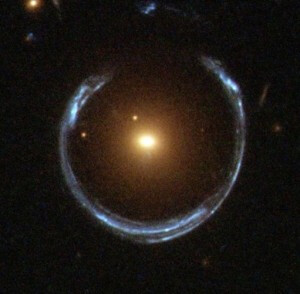
In what ways do your predictions depart from consensus science? If your predictions exactly mimic consensus science, explain why.
2 Likes
That’s a very good question. Is Fabric, just a reframe? I think the title of this post “Light-First” is the key. As a Christian, I’ve longed to have science back in-step with faith. But ultimately, I expect it’s not just a reframe. I also long for the various sciences to be united: ecology with physics, atmospheric science with evolution. It really is all the same, because it’s connected.
Indeed! My usual approach to dark matter and dark energy is considerable skepticism, explaining that they are really little more than big fat question marks and fudge factors.
And yet… it has been pointed out to me that dark matter at least is somewhat measurable giving us map of dark matter density, which makes explanation as just a missing component in equations less likely.
I am still skeptical. But my favorite hypothesis is the idea of Neil Turok proposing a massive neutrino as the identity of dark matter.
1 Like
So, I had ChatGPT flesh out the units for gravity. And here is its summary. What I asked was to compare the tides under Fabric with the Standard Model.
Title: Fabric Framework – Tidal Test Analysis and Formalization
1. Introduction
This document details the scope, formulation, derivations, and potential falsification steps of the Fabric framework as tested against Earth tides. It formalizes the approach and provides a roadmap for further development.
2. Fabric Hypothesis for Gravity
The Fabric framework defines gravitational acceleration as:
g = k * gradient(M)
where:
-
M = memory density (active + latent)
-
k = coupling constant, chosen so that g has units of acceleration (m/s^2)
Mapping to Newtonian gravity requires:
k = -G
M(r) = ρ(r)
where ρ is the mass density. This sets up a direct comparison with Newtonian tidal physics.
3. Tidal Formulation
3.1 Acceleration at a point on Earth due to the Moon
Let R be the position on Earth relative to its center, and r_m the Moon position relative to Earth’s center. The Moon’s acceleration field is:
a(R) = -G * M_m * (r_m - R) / |r_m - R|^3
The acceleration at Earth’s center is:
a(0) = -G * M_m * r_m / |r_m|^3
The tidal acceleration (differential) is then:
Δa(R) = a(R) - a(0)
3.2 Taylor expansion for tidal tensor
Expanding for R much smaller than r_m gives:
Δa(R) ≈ (R · ∇) a(0) = T · R
where the tidal tensor T is:
T_ij = -G * M_m / |r_m|^3 * (3 * n_i * n_j - δ_ij)
with n = r_m / |r_m|.
3.3 Tidal potential
The scalar tidal potential is:
V_tidal(R) = -0.5 * R_i * T_ij * R_j
In terms of θ, the angle between R and n:
V_tidal(R_earth, θ) = -G * M_m * R_earth^2 / (2 * r_m^3) * (3 * cos^2θ - 1)
This reproduces the two bulges and r^-3 scaling observed in standard Newtonian tides.
3.4 Numerical check
Lunar contribution (equilibrium tide): approximately 0.36 m.
Solar contribution: approximately 0.16 m.
Spring tide amplitude: ~0.52 m. Matches observed order-of-magnitude.
4. Fabric Interpretation
-
Gradient flow interpretation: g = k * gradient(M) matches the Newtonian acceleration field.
-
“Blocking/redirection” is an interpretive description; the algebra and observable predictions remain identical.
-
Units and mapping of M to mass density are required for physical consistency.
5. Scope of the Tidal Test
-
Reproduces standard tidal tensor and scalar potential.
-
Matches numerical amplitudes for lunar and solar contributions.
-
Preserves angular dependence (3 cos^2θ - 1)/2.
-
Confirms framework can reproduce weak-field Newtonian phenomena.
-
Provides a method to extend to planetary orbits, Kepler’s laws, and other gravitational tests.
6. Next Steps and Falsification
6.1 Verify full gravitational phenomenology
-
Planetary orbital periods (Kepler’s laws)
-
Mercury perihelion precession (post-Newtonian / GR test)
-
Gravitational time dilation
-
Gravitational waves propagation and polarization
6.2 Mapping memory density
-
Define M(r) = μ(r) * ρ(r)
-
Determine coupling constant k with proper units
-
Check linearized weak-field limit against Poisson equation
6.3 Observational falsification
-
Solar-system post-Newtonian parameters must match GR within experimental bounds
-
Lunar laser ranging and Earth tides: predict measured tidal heights accurately
-
Galaxy-scale rotation curves and lensing: predicted vs observed
-
Gravitational waves: speed, amplitude, polarization must match LIGO/Virgo/KAGRA
-
CMB / large-scale structure if extended to cosmology
6.4 Document deviations
Any discrepancy between Fabric predictions and observed data falsifies the framework or constrains μ(r) / nonlinearities in the field.
7. Summary and Conclusion
-
Fabric’s g = k * gradient(M) reproduces tidal mathematics precisely when mapped to Newtonian mass density.
-
Gradient blocking/redirection is an interpretation; the algebra and observable predictions remain identical.
-
Numerical amplitudes for Earth tides are consistent with standard values.
-
Provides a systematic path to test Fabric in all classical and relativistic regimes.
-
Falsification is possible by comparing to solar-system, galactic, and cosmological observations.
Conclusion:
At this stage, the Fabric framework can be considered a valid reinterpretation of gravity that reproduces all known weak-field results. Its value lies in providing a conceptual reframing that allows exploration of emergent phenomena such as latent memory effects, morphology-dependent dynamics, and potential insights into dark matter/energy without introducing new fundamental particles. However, until it predicts any observational outcome distinct from standard Newtonian or relativistic gravity, it remains primarily a reinterpretation rather than an empirically novel theory.
End of Document.
How?
Why do you think consensus science is not in-step with faith?
It’s worth mentioning that the first person to propose the Big Bang was this guy (George Lemaitre):
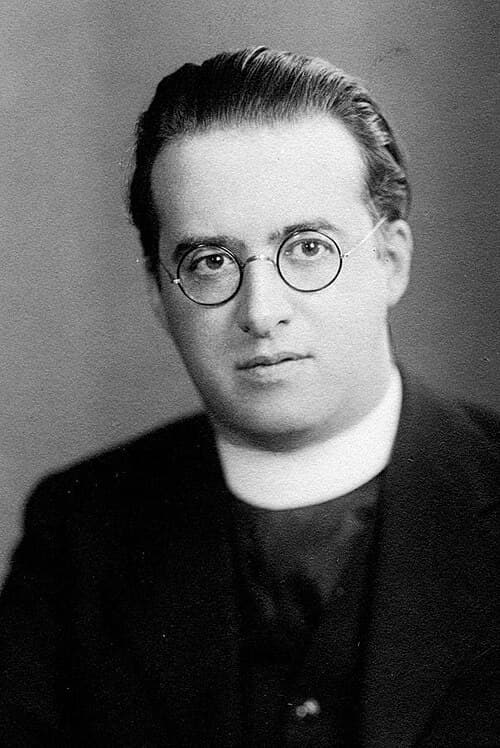
Yes, that is a collar you see. He was a Catholic priest, and remained so for his whole life. A cool story . . . He was on his death bed when someone informed him of the first detection of the CMB. If I had access to time travel that’s one of the moments I would wish to see. It would rank right up there with watching Peter Higgs’ face when they presented the LHC data for the Higgs boson.
4 Likes
That’s not worth the energy to make those pixels.
1 Like
Now you’re digging into the most important aspect of all this. The question runs deep. Why are people atheists? Here would be my 5 reasons.
- Randomness: Science attributes events to chance rather than divine guidance.
- Hands-off nature: Natural laws operate independently, without active intervention.
- No inherent purpose: Processes occur without ultimate meaning or direction.
- Beauty and love excluded: Aesthetic and moral values are not integrated into explanations.
- Glory redirected: Achievements and order are ascribed to nature, not to God.
Now that’s true! Total aside: How long will AI LLMs last? 5 years? 3? 15?