The Light-First Universe: Why the Big Bang Gets Creation Backwards

As an atheist, I believe . . .

  1. Science has not detected guidance, but I gladly admit that I can’t rule out divine guidance, nor can science be used to rule out divine guidance.
  2. Science can not detect any divine guidance in natural processes, nor can it rule it out. It is a matter of faith.
  3. Science can not detect any inherent purpose in the universe, but once again that is not evidence that there isn’t one.
  4. I fully believe in aesthetics, love, beauty, and a whole host of the subjective emotional world that is part of being a human. Science doesn’t change any of it.
  5. Once again, science makes no claim of excluding God from anything.

So again, I am curious, why isn’t the Big Bang in-step with faith? Many atheists of the day (e.g. Fred Hoyle) rejected the Big Bang because they thought it carried theological baggage, especially coming from a Catholic priest. The Big Bang has a beginning for the universe instead of the previous scientific consensus which proposed the universe was infinite and eternal.

Added in edit:

A great article on randomness in science written by a Christian scientist for fellow Christians:

3 Likes

You didn’t know how to do it yourself, and don’t know whether ChatGPT’s output is valid.

Now we’re talking!

Random musings in no particular order: It doesn’t make sense to my intuition. What was before the bang? I’m connected to all creation by something right now in my innermost being, faster than c. What is that? The light substrate or light basement Why bang? I know redshift. Bus to Abilene? Why not emergence.. Life begets life. Science isn’t about consensus. Universe experiences which time frame? Photon? Giraffe? Clockwork run down to nothing. Entropy? Really? /End random musings

Now I beg, don’t take these random thoughts, for settled ideas in my mind. I am flexible. I have been having such a fun time investigating newly. I haven’t had this much fun since my 20s. Whether it’s a diamond or a chunk of glass. I’m having a wonderful time digging. Might be because my kids have mostly grown and I have a wee-bit extra time on my hand.

1 Like

I certainly didn’t check it over! I was asked repeated to make some calcs and I certainly don’t have time to do it. LLMs are wrong that for sure. But the higher versions of these LLMs will fairly quickly let you know you are wrong. And this one just flew through the calcs.

That’s a strange take. For me, the Big Bang is one of the more intuitive theories in physics. Everything not gravitationally bound to one another is moving away from each other. If we run this backwards we end up with a really hot and dense universe. Run that a little forward from that point and we get an expanding and cooling universe which transitions from a plasma that absorbs photons to a universe of atoms (i.e. nuclei with electrons) which allow light to travel freely. That’s the CMB. It’s like a fog suddenly clearing which allows us to see for miles. There’s a long, long list of observations that only make sense within the Big Bang model.

We don’t need to know where the universe came from in order to understand how the Big Bang proceeded in much the same way that we can understand cloud formation without needing to know the ultimate origin of the universe. The Big Bang is just what happened once the universe was here. It’s where all of the evidence leads.

3 Likes

Mr Zelenka, would you please clarify what you mean by “memory.”. I’d be interested what @T_aquaticus feels about it, too.

Thank you.

Understood. I appreciate your method of interaction. Thanks.

After observation, intuition is the beginning of all science. It’s whittling from there. And sometimes the stick you’re whittling with becomes just too small and you toss it aside and get another.

I mentioned the following to our friends here. They tried correcting me, but it still doesn’t make any sense. Some things don’t make sense, because, well… Even accounting for the standard angular-diameter–redshift relation in CDM model, high-redshift galaxies often show angular dimensions that match present-day expectations more closely than the simplest Big Bang scaling would suggest, indicating a potential tension with the expansion picture. I.e., some really distant galaxies look surprisingly like the ones we see nearby: same size, same general shape. If the universe were smaller back then and we’re just seeing light from that time, you’d expect them to appear bigger in the sky. Instead, their angular size matches what we see for galaxies at their distance today. It’s as if they’ve already grown up and settled into their present form far earlier than the standard Big Bang timeline would suggest.

Yes, intuition says, nope. Maybe some funky scaling or lensing could make CDM fit, but that’s leaning on post-hoc fixes. But I suppose my intuition could fail me. It’s failed me before.

Science is about being skeptical. Asking questions and crossing one’s t’s. I’m glad there is rigor here. Sometimes I can be too creative. There’s a balance. God made us with logic and creativity.

A post was split to a new topic: A Day Age Concordance

I’m trying to be general, so this applies to all fields. The best analogy is a seed; let’s choose an acorn. An acorn is a memory of all or many of the trees (and plants) that come before it. And the oak tree is as well a memory. One is M_latent (mostly), and one is M_active + M_latent. M_total = the sum. Clearly the acorn and an oak tree has mass, so we can apply known units to the “memory.” But this gets very interesting in other fields. Hurricanes tend to follow tracks of previous hurricanes (at times). Is there a memory physically left behind in the atmosphere. When we dream, are we exploring M_latent?

Total speculation:

Physics
Quantum vacuum: M_latent = virtual particle configurations, M_active = realized particles
Superconductivity: M_latent = Cooper pair states, M_active = current flow

Chemistry
Catalysis: M_latent = reaction pathways blocked by activation energy, M_active = current molecular state
Chemical equilibrium: M_latent = reverse reaction potential, M_active = forward reaction state

Biology
Stem cells: M_latent = all possible cell types, M_active = current differentiation state
Immune memory: M_latent = antibody templates, M_active = current immune response
Epigenetics: M_latent = silenced genes, M_active = expressed genes
Regeneration: M_latent = developmental programs (blastema formation), M_active = current tissue

Neuroscience
Memory consolidation: M_latent = distributed neural patterns, M_active = retrieved memory
Learning: M_latent = skill capacity, M_active = current performance level

Geology
Fault lines: M_latent = accumulated strain energy, M_active = current stress release (earthquake)
Glacial rebound: M_latent = crustal rise potential, M_active = current isostatic adjustment

Atmospheric Science
Water vapor: M_latent = latent heat in humidity, M_active = condensation/precipitation
Jet stream: M_latent = Rossby wave modes, M_active = current meander pattern

Ecology
Seed banks: M_latent = dormant seeds, M_active = germinated plants
Succession: M_latent = climax community potential, M_active = current stage
Behavioral repertoires: M_latent = instinctive behaviors, M_active = expressed behaviors

Social Systems
Cultural memory: M_latent = preserved traditions/knowledge, M_active = practiced culture
Economic potential: M_latent = unused productive capacity, M_active = current GDP

There’s actually a reason I’m using broad general terms and trying not to just apply it to physics. Am I just reframing reality? Or is there any insight?

Spiritual world M_latent or M_active? Speculation gone too far?
1 Like

Mr Zelenka, thank you. It is beautiful. However, from a biological standpoint, I would say that that’s history, not memory; memory would be a neuroscience function. It would be metaphor, I would agree, but not a scientific one, nor a proof.

Thank you!

As in one of my favorite poets, Gerard Manley Hopkins,

As Kingfishers Catch Fire | The Poetry Foundation

As Kingfishers Catch Fire

By Gerard Manley Hopkins

As kingfishers catch fire, dragonflies draw flame;

As tumbled over rim in roundy wells

Stones ring; like each tucked string tells, each hung bell’s

Bow swung finds tongue to fling out broad its name;

Each mortal thing does one thing and the same:

Deals out that being indoors each one dwells;

Selves — goes itself; myself it speaks and spells,

Crying Whát I dó is me: for that I came.

I say móre: the just man justices;

Keeps grace: thát keeps all his goings graces;

Acts in God’s eye what in God’s eye he is —

Chríst — for Christ plays in ten thousand places,

Lovely in limbs, and lovely in eyes not his

To the Father through the features of men’s faces.

Blessings,

Randy

1 Like

Amen! Thanks, Randy. One question I have is when does symbol become reality?

I fully agree that intuition is important for forming hypotheses. Just as important is actually having a falsifiable hypothesis and the ability to test it. From what I can see, your intuition hasn’t reached the falsifiable hypothesis stage yet.

That only tells us that we don’t fully understand how early galaxies form.

The universe has expanded since that light left those galaxies. There’s a lot more distance between us and the source of that light.

Part of science is being skeptical of your own ideas. One of the first steps is to ask yourself how you would know if you are wrong, and then figure out experiments or data sets that could prove yourself wrong.

3 Likes

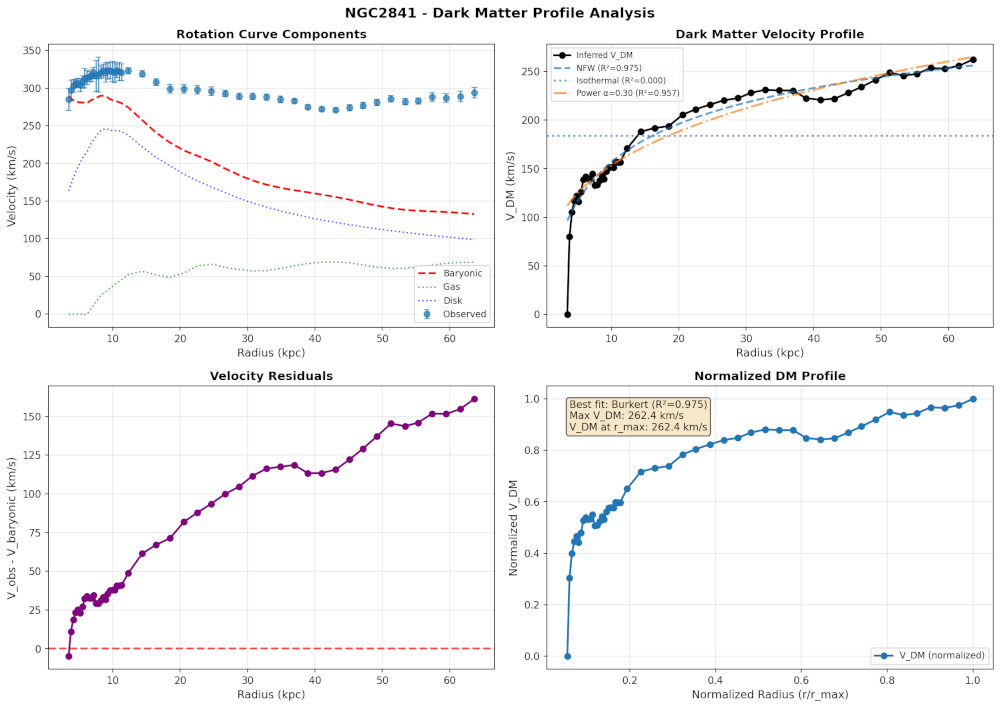
Absolutely and Amen. That’s where the shred of whittled stick gets tossed aside. There are many falsifiable tests. I’m actually working on one now in my spare time using SPARC rotmod dataset. But it takes time since I’m not an expert. Learning as I go. I’ll post the results here one way or the other, if this thread is still open.

Summary of Rotation Curve Analysis of 175 Galaxies

Data Source:
I used the SPARC database, which provides detailed measurements of 175 disk galaxies. The database includes photometry from the Spitzer Space Telescope and high-quality rotation curves that show how fast stars and gas move at different distances from the galaxy centers. Key references:

  • Lelli F., McGaugh S.S., Schombert J.M., SPARC: Mass Models for 175 Disk Galaxies with Spitzer Photometry and Accurate Rotation Curves

  • Table: Galaxy Sample / Mass Models

Purpose:
I wanted to test whether the way galaxies rotate can be explained purely by the matter we see (stars and gas) or whether extra effects, “dark matter,” are required. I also wanted to see whether more complex physics, like interactions between different components or gradients in mass, play a role.

Tests Performed:

  1. Acceleration Scale Test (MOND Check)

    • I looked for patterns in residuals, the differences between observed velocities and the velocities predicted from visible matter, at different acceleration levels.

    • Low-acceleration regions should show systematic deviations if MOND (Modified Newtonian Dynamics) applies.

    • Result: Only 3 points were in the low-acceleration regime, so this test was inconclusive. Most of the galaxies are in regions where Newtonian gravity works well.

  2. Component Interaction Test

    • I compared three models of how gas, stars in the disk, and stars in the bulge contribute to rotation:

      1. Standard addition of contributions

      2. Scaled contributions

      3. Scaled contributions plus interaction terms between components

    • Result: Interactions are statistically significant. Components don’t just add together; some amplify each other while others partially cancel.

    • Interpretation: There is non-linear coupling, something more than simple addition is happening. This could point to effects like gradient flows, turbulence, or other complex dynamics.

  3. Density Gradient Test

    • I measured how sharply the brightness of stars changes with radius and checked if that correlates with residuals.

    • Result: Where mass is concentrated (steeper gradients), the residuals are smaller. In other words, the visible matter explains the rotation better in these regions.

    • Interpretation: Extra binding effects are not needed where stars and gas are dense.

  4. Radial Pattern Test

    • I compared residuals in the inner versus outer regions of galaxies.

    • Result: Outer regions systematically show higher residuals—on average, 28% higher than inner regions. 136 out of 168 galaxies showed this pattern.

    • Interpretation: The outer parts of galaxies rotate faster than predicted by visible matter alone, which is the classic “dark matter” signature.

Additional Rotation Curve Findings (154 Galaxies)

  • Maximum radius reached by rotation curve measurements: median 12.9 kpc, mean 20.2 kpc

  • The extra velocity needed at the outer edges (V_DM_final) increases with radius approximately as V_DM_final ≈ 22 × (radius)^0.52.

  • Models: Most galaxies fit either a Burkert profile (97 galaxies) or a power law (47 galaxies); very few fit an NFW profile (10 galaxies).

  • Residuals rarely turn over at large radius—they don’t decrease as expected for a classical “dark matter” halo. Instead, the extra velocity levels off, forming a slow-rising pattern.
    Rotation Curve Residuals | Desmos

  • The pattern is consistent across galaxies, suggesting a systematic effect rather than random variation.

Conclusions and Conjectures

  1. There is a clear need for extra velocity in the outer regions of galaxies beyond what stars and gas can explain.

  2. The residuals do not behave like a standard halo that peaks and then decreases. They rise and then remain roughly constant.

  3. Non-linear interactions between galaxy components are real and statistically significant, implying more complex dynamics than simple additive gravity.

  4. Regions of high density (steep gradients) are well-explained by visible matter alone.

  5. Taken together, these findings challenge the simple dark matter halo picture. Instead, they suggest there may be a deeper underlying mechanism—something that could involve large-scale “gradient flows,” interactions, or a property of the “fabric” of galaxies.

In sum, galaxies spin faster on the outside than we would expect just from stars and gas. The extra speed doesn’t fade away at large distances like you might expect if it were a halo of invisible particles. Instead, it rises and then holds steady. The motions of stars and gas interact in complex ways, hinting that gravity or mass may behave differently on these scales than the usual textbook picture. Whatever is happening is systematic, pointing to a hidden principle or structure, rather than random noise.

Here is just one of the output graphs that show the rotation curve, just as an example. Scripts are on GitHub, if you want to play with the data: threading-dynamics/galaxy at main · davezelenka/threading-dynamics · GitHub

Here’s the full analysis. http://interactive-earth.com/downloads/Rotation_Curve_Analysis.pdf

You seem to be suggesting that the entire astrophysics community has miscalculated the impact of dark matter on galaxy rotations, and has done so decades. Is that correct?

If so, you shouldn’t be publishing here. You should be submitting this to a peer review journal.

Or . . . maybe you have it wrong? Just sayin’.

But I do appreciate your effort here. This is too far outside my field to check the calculations, so hopefully someone with the know-how will step in and check it.

2 Likes

I’m saying for the galaxies I checked, it’s not a “halo”. It’s clear to me something else is happening unless the dark matter “fall off” is way outside the bounds of the visible galaxy for essentially all galaxies I checked. This curve is the signature. I’m just having fun with data.

The main point is that really and truly, there’s a wall in all sciences, beyond which its speculation or invention of particles and forces. I think we’re hitting that wall along multiple fronts. At that point the guiding force becomes more theoretical (which I why the equations I’m offering are highly generalized).

Are astrophysicists claiming that these specific galaxies have dark matter haloes? If so, where are they getting their math wrong?

Why do you think the physics community disagrees with you?

1 Like

What are the problems with this view? I would think that the supermassive black hole in the center is dark matter.

Wouldn’t all the stars more on the interior of the galaxy be causing a sort of traffic jam? The “extra” speed on the outside is then where they can reach their speed limit.