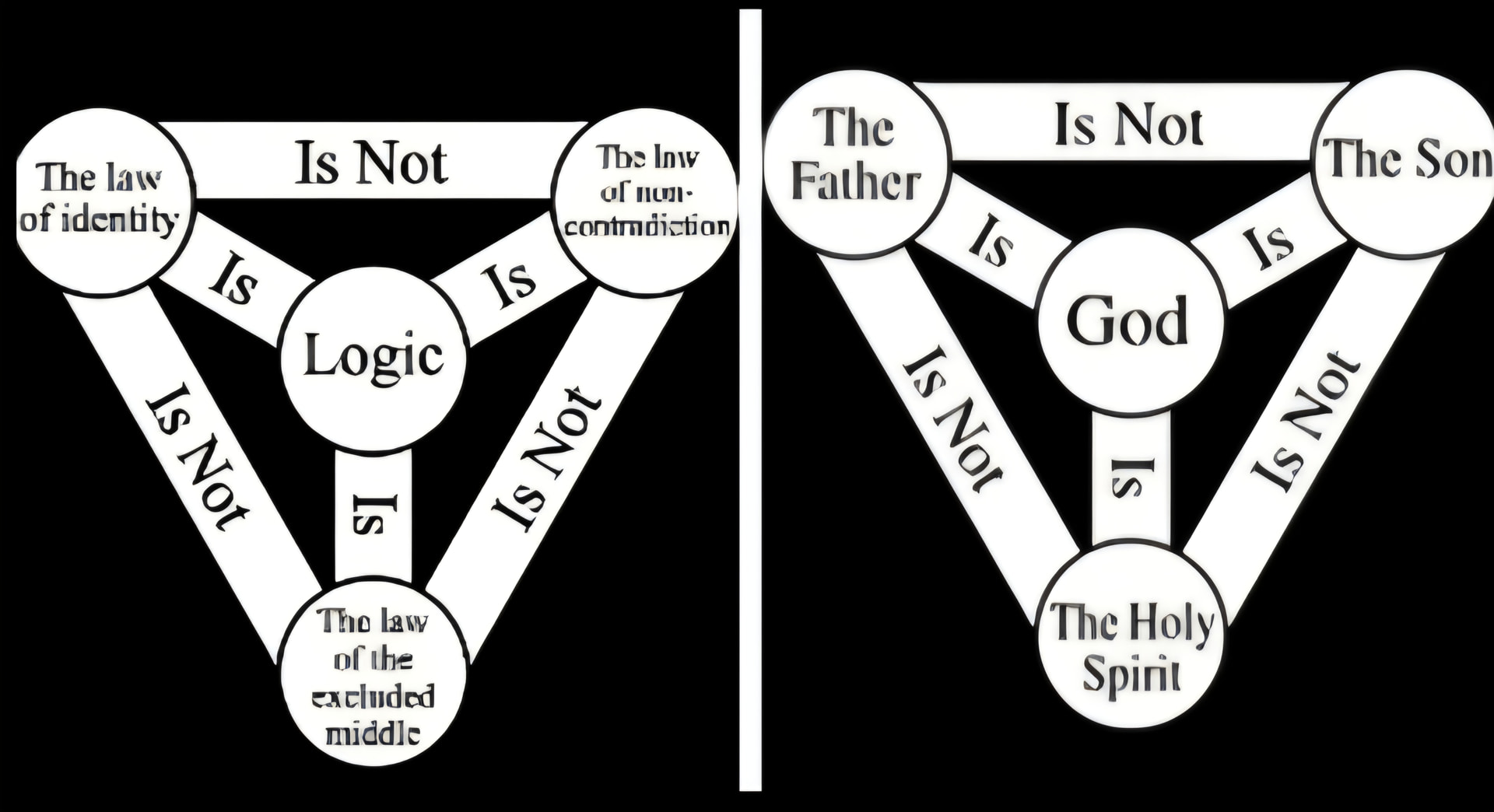
First, Google tells me that “coinherence” and “perichoresis” are synonyms: " Yes. “Coinherence” is widely used as an English equivalent and synonym for perichoresis. Both terms refer to the concept of mutual indwelling, describing how the distinct persons of the Trinity exist in, penetrate, and wholly share in one another’s lives without losing their unique identities.
Second, well-known Reformed Calvinist presuppositionalists included Cornelius Van Til and his well-known populizer, Greg L. Bahnsen (1948–1995): Van Til’s most influential disciple known for public debates with atheists and developed the Transcendental Argument for God (TAG): “The very possibility of logic, science, and morality presupposes the Christian God.”
So, are you saying that the laws of logic presuppose the Trinity or that the laws of logic manifest coinherence/perichoresis.
“The Law of Conservation of Coinherence” is something you invented and have not demonstrated. It also appears to be meaningless self-serving apologetic pseudobabble. So it can be ignored.
The 3 fundamental laws don’t manifest coinherence. Rather, they simply ARE coinherent. They exist ontologically in God’s nature and are synonymous with fundamental objective and ultimate reality.
You say that the three fundamental laws of logic do not merely manifest coinherence but simply are coinherent. What exactly is the relationship between the Law of Identity, the Law of Non-Contradiction, and the Law of Excluded Middle that justifies calling them “coinherent” rather than merely “logically related”?
If by “coinherent” you mean something analogous to the traditional doctrine of perichoresis, how does each law participate in the others while remaining distinct? In what sense does the Law of Identity exist in the Law of Non-Contradiction and the Law of Excluded Middle, and vice versa?
Put differently, what is gained by the term “coinherence” that would not already be conveyed by saying that the three laws are inseparable or mutually dependent aspects of a single logical system?
If you have determined that they are coinherent, then they do manifest coinherence, because if they didn’t you wouldn’t have been able to make that determination.
Unless you are using a different definition of ‘manifest’ than most people, in which case you have a problem beyond the fixing capability of the Royal Cavalry.
We cannot speak of any of the 3 laws in isolation. To perceive one law is to perceive them all. So each is logic in the same sense that any person of the Trinity is God, each is God because they are inseparable from one another. They exist eternally in unbroken relationship.
You make a good point. There are different ways to say the same thing.
The point is to recognize that the Trinity is logical as it shares the same structural Trinitarian relationship as logic. Not logical on the transitive level but the more fundamental level of holism.
Didn’t mean to be short with you. I was simply pressed for time.
I’m saying look at the relationship of the 3 laws. Its necessarily Trinitarian. So can there be any doubt that the Trinity is logical if coherence itself is Trinitarian?
How did we even miss this?
The answer, is that we were treating logic as if we were Greek.
By making this very distinction, you are demonstrating the exact thing you’re trying to deny.
You are a person actively making a truth claim about the nature of logic itself. You are not making a purely abstract observation from nowhere — you are personally asserting what logic is and is not.
But if logic is truly autonomous and separate from the Trinity, then you, as a person, have no grounding for why your logical claims should be binding on anyone else. You’re just one more subjective consciousness expressing an opinion.
The very fact that you expect your argument to carry weight reveals that you believe logic is universal and binding. Which means you’re smuggling in the very coinherence you’re trying to reject.
You can’t escape being a person. And persons don’t get to stand outside of the Coinherent One and make autonomous pronouncements about reality. You’re free to do so, but not on objective logical ground.
I can see a loose analogy between the Trinity and the three laws of logic. What I do not see is a one-to-one preservation of relations sufficient to justify calling the structures isomorphic.
For example, I can identify three persons and three laws, but I do not yet see what corresponds in the laws of logic to specifically Trinitarian relations such as perichoresis, consubstantiality, or the distinct relations among Father, Son, and Spirit.
(The law of identity seems not to have been formally expressed until about 1500 years after the law of contradiction was. People can, did and still do speak about the three independently.)
It doesn’t matter if you see it on the substantive level. What matters is that the relationship is logically coherent on the structural level and can be described mathematically.
We don’t see that ultimate reality is logically coherent minus the Planck epoch on the substantive level either. But that doesn’t shake our faith in describing it logically, because the Law of Conservation of Coinherence is necessarily fundamental.
You want to be rid of the theistic implications? Then solve the measurement problem. God does it beautifully in Genesis 1:1-2 by creating the primeval quantum system bound by the Law of Conservation of Coinherence in the form of the wave function equations. Its not ultimately random. Freedom of potential has strict boundaries as imposed by the wave function equations.
It is brimming with potential but void of measurement until the omnipresent observer determines it.
What’s important is not that we discern the substance of that which is necessarily not describable by natural rules of substance, but that the explanation be structurally logical.