This argument might be difficult for many creationists. If we reject the argument in the paragraph above, then we might be conceding a significant amount of ground to the secular historians who claim the ancient Jews just stole all of their knowledge of astronomy from the Babylonians in 600BC and retrofitted it into their beliefs. And if we say both are true, that they are literal ages which coincide with astronomical phenomena, then how is that not an endorsement of astrology? Furthermore, if we now say that these ages were never meant to be taken literally, then what good reason do we have to explain why God would hide this from us?
I was wondering if anyone here has any thoughts about this. I have been a creationist for decades I have never heard anyone discuss this before.
Yes that part is a little confusing. But my understand is that it’s saying that when the Septuagint was written, the dates were updated to reflect the “modern” understanding the greeks had of astronomy at that time.
That’s a good point But, It seems to me that if all of the Jews once knew that the ages were not meant to be taken literally then then knowledge of what these ages were intended to represent, would not have been lost.
I doubt the Babylonians would have been impressed at all with Daniel and his peers if they were not at least their equal when it came to knowledge of astronomy. Such knowledge would have been a litmus test of divine wisdom to the ancients back then.
Hi, welcome to the forum. What do you think about the line of reasoning in this article? I don’t think you have to conflate Hebrew numerology (which assigned meaning to certain numbers and used that meaning poetically or symbolically in literature) and pagan astrology.
I would say the point is certainly worthy of consideration. But that would make the literal ages and their correspondence to the particular lunar cycles mentioned in the paper I posted a rather unlikely coincidence, I think.
Also, it would be odd if the Bible contained no astronomical reckonings whatsoever, in particular advanced knowledge of lunar cycles or knowhow of an ecliptic coordinate system, considering how important sabbaths and other calendar events were to ancient Jews.
Maybe there is a better answer we haven’t thought of yet?
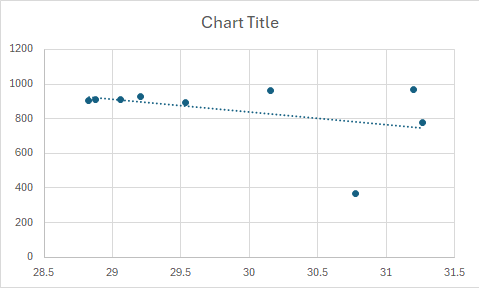
There’s no correlation between the patriarchs’ ages and the astronomical values in your table 2.
A quick bit of work in Excel produced this plot (which has a near-horizontal trend line) a correlation of -0.39 and a p-value far higher than the usual 0.05 needed to consider there might be a relationship between the two sets of numbers.
Taking Enoch’s age out makes it even worse.
It doesn’t matter how good your argument is, the data refutes it.[1]
Though it’s possible I’m checking the wrong numbers.
I do not find that the least bit odd. Counting to seven is grade one arithmetic, and ANE cosmology does not offer a promising basis for astronomical prediction.
I didn’t read the paper, is the author suggesting the “literal ages” were indeed as long as recorded or that lunar cycles were the key to unlocking the actual ages?
I think what is abundantly clear is that the numbers used to describe their ages are not normal human lifespan ages and they follow patterns. That’s more than enough to make a person think there is more going on than simply reporting ages. It makes sense to me that Hebrews followed patterns that their culture had accepted. The idea that there was cultural exchange between them and neighboring cultures or that the Pentateuch was compiled and redacted and put in its current form during the Babylonian exile are not new or shocking ideas, they are pretty well-established by Bible scholarship. So what if some of their numerological ideas were based on Babylonian lunar calculations? That was the reigning wisdom of the time. It’s no more strange than John co-opting ideas from Greek thought to relate YHWH’s spirit of wisdom to the divine Logos and desiginate Jesus the Word. Cultures in contact affect language use and conceptualizations of reality that become history and literature. I don’t see how this would be a problem for anyone unless they believed the Bible was dictated by God in a cultural and knowledge vacuum or something. Maybe that is what some creationists believe, but most people on this forum would not.
They were young boys when they were taken into captivity, they weren’t scholars. What was impressive was how quickly they learned when given the king’s internship. They were given Babylonian educations.
It’s simpler and more elegant to me to take as a given that 7 and 60 were obviously significant numbers in the ANE. (From the BioLogos article I linked which cites a much more in depth treatment of the topic published by the ASA in the footnotes)
60 was culturally significant because it was the number that Babylonian mathematics was based on (the influence of this sexagesimal system is still felt today with our 60 minutes per hour and 60 seconds per minute). And 7, of course, has a prominent place in biblical symbolism beginning with the Sabbath.
Was the sexagesimal system tied in some ways to observations about the sun and moon? Probably, that’s why it’s still used for clocks (which were once sundials), time, and circle geometry. It emerged independently in other cultures too, like China, so it had to be based on observations. The system predates Babylon, it was developed by the Sumerians, and used throughout Mesopotamia in the ancient world.
A Torah that was considered quite flexible. When you look at the history of the text changes were often made. Which is why the LXX and Masoretic text differ, especially in the ages that are under discussion. And both of these are based on even earlier texts. So what is the original version of the ages and shouldn’t they be considered the ones that are accurate?
I’m not sure what you mean by my table 2. But I realize I didn’t really do much of a job at explaining the paper properly. I had originally intended to spend several long paragraphs explaining it but I thought no one read it if had done that so I just posted a link to it instead.
I should have made it clear that I meant “begating ages”. The age each patriach was when he gave birth to the next one. I apologize.
Neither. I apologize for not giving a detailed summary of the paper. The authors main point is that the begatting ages of the patriarchs coincide with the amount of years it takes for a new moon to occur at the same celestial longitude in the next constellation of the zodiac.
Of course not. The Assyrians and the Babylonians both observed weekly sabbaths based on the lunar Calander. But do you take that to mean that the Jews did not do the same until they were captured by the Babylonians? What about before then, when David was king of Israel for example?
Bible scholarship is defined by the lack effort the average Christian puts forth into studying the Bible. Sadly, it’s a low bar.
But Daniel was a prophet, yes? Did he only become one after receiving a Babylonian education? Did the Jews learn how to more accurately put their own people to death for breaking the sabbath from the Babylonians? As God commanded?
Fine, but the constellations of the zodiac have been referred to in ancient texts, close to the dawn of recorded human history.
The Bible says the stars and such are an inheritance to all nations and that they were meant to be for signs of times and seasons.
Do you think the Jews just retrofitted these verses into the Bible after they were captured by the Babylonians?
And says nothing about their being signs pointing to any person in particular. The Jewish calendar was lunar and astronomical observations that define the changing seasons are useful to know when to plant and harvest. Why assume something that is not in the text?
The important part is Genesis demotes what were considered gods in other cultures to simple lights in the sky.
And another point if I might. Why change the ages of the patriarchs from what was recorded in earlier texts just to align with the zodiac? I can understand the writers changing the known ages to reach the alignment, but then it makes the ages “false” as we understand “true”. If the paper says
To me this says the ages aren’t the actual ages so what is the point in this exercise?
I was wondering if someone was going to ask that. My understanding is that the author is saying that in the earlier texts, they were always meant to align with the zodiac and that when the LXX was copied from these texts(ca. 300bc), it was decided to “update” the ages, to make them more accurate, using the “modern” Hellenistic astronomy of the time.
I actually wrote him an email asking him to clarify this. I guess he is retired now and doesn’t answer his email. I disagree with him on this point(that is was updated). I believe he may be operating under an outdated understanding of ancient, pre-Hellenistic astronomy. But I am not an expert..
Yes that is what he is saying. I don’t understand your question.