Takes on a Bible Study Program

Hello, again!

Our church has started a Bible study focusing on an overview of the Bible’s history, context, and purpose, and they are using a book to guide the class.

I initially didn’t intend to take part in the study due to my unsettled views on biblical inerrancy and other topics, but my husband bought two copies for us both to take part (I’ll be separated to the women’s’ study, which isn’t usually very deep given the ladies that attend, but oh well). We just had our introductory session with men and women together, and I immediately felt critical of some of the things said in the class, though that may have just been the opinions of the participants and not the fault of the book’s contents.

The program was written by a Christian missionary in 1907 and has been revised since then by some former school principals/educators and a couple of seminary professors. I have become very hesitant about selecting material to understand the Bible primarily because I feel ill-trained to discern what is accurate information and who should be given authority on such matters. Understanding God’s intentions better and getting a grasp on the reality of the Bible’s true nature is important to me, so any insight to the following questions would be appreciated!

  1. Is anyone familiar with the contents of this book, and if so, what would your take be on it’s reliability?
  2. What would be trustworthy resources to use in the event that I take part in this study and want to fact-check information?
  3. As I mentioned, my views are developing differently than others in my congregation. If I participate, should I stay quiet about my differences to keep peace, or be vocal about things that seem incorrect? Is there a way to contribute to the conversation without creating waves with my differing views?
1 Like
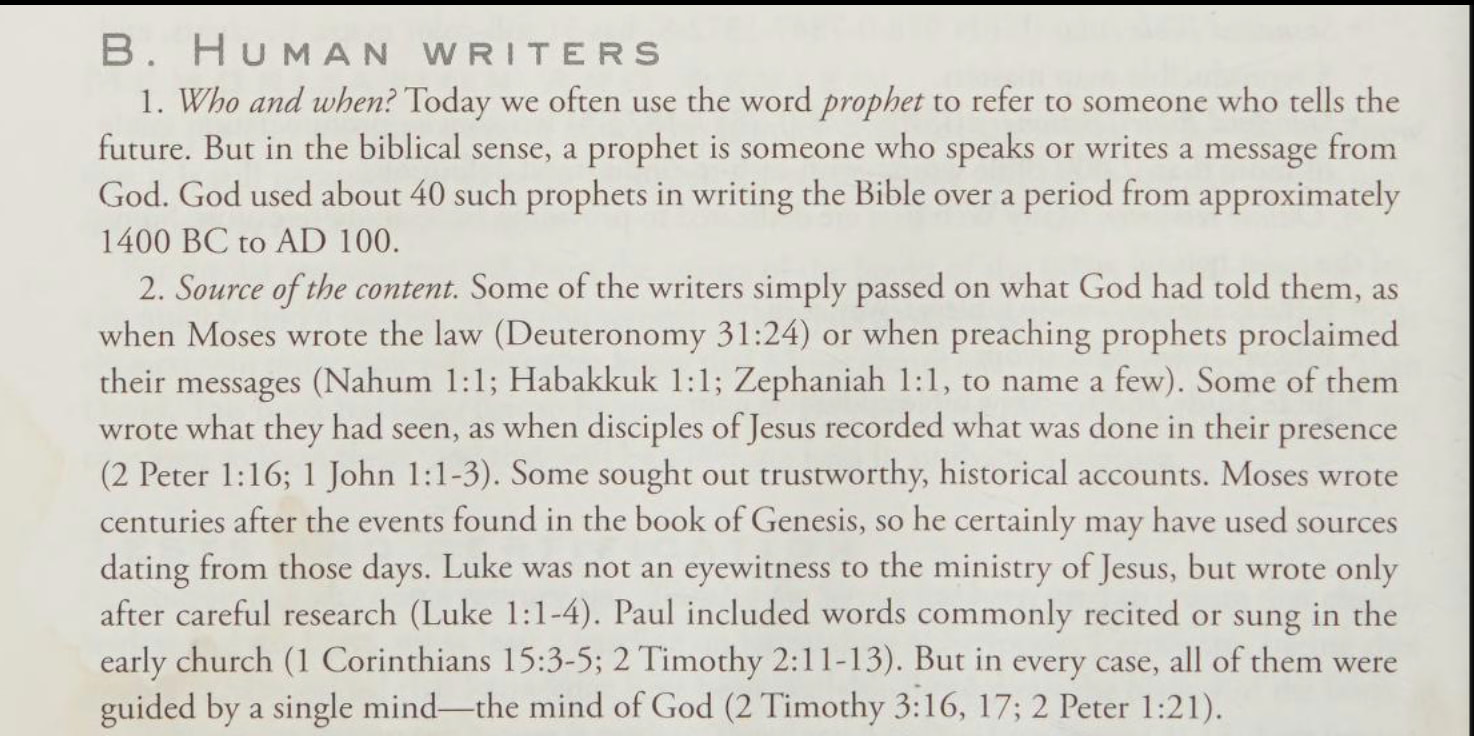
  1. I don’t recognize it, but then again, the picture doesn’t give much to go on. Author(s)? Publisher?
  2. Some of the regulars around here probably have good suggestions about this. Maybe they will have suggestions forthcoming.
  3. Bible studies can have many different kinds of leadership. How welcome other voices are will be dependent on the kind of leadership. In my experience, dissenting voices may not be tolerated, much less welcomed, in a lot of bible studies. How you experience it depends not just on the leadership but who all these people around you are … friends with whom you have deep and invested relationships? A loose coalition of folks gathered around some interest or certain book of the bible? You mentioned a church context, so I’m assuming you know each other pretty well and closely. Do you think that if you dare to disagree with something, that you’ll immediately become a “mission focus” of a group or a leadership that now wants to “fix you”? Do you anticipate your disagreement might be over fairly central kinds of things (e.g. having to do with trinity or resurrection)? Or over peripheral sorts of matters? Some kinds of leadership sees everything as important and nothing as “peripheral”. I find that if you express doubts about expressed subjects in a tone of curiosity and humility, they may continue to welcome such questions and give you their best answers, and also (best case scenario) - take time to explore any other views with you.

Maybe you can think of some open-ended questions to put to the group up front, and then their responses could be useful to gauge what sort of bible study they intend for this to be. Will it be a “here is the one biblical way to understand all this” kind of study, or a more open-ended “let’s read these passages together and share what we think the Spirit might have to teach us here” sort of approach? In my opinion the kind of people and leaders that are present will determine the sort of bible study you have even more than whatever the book is, though their choice of materials will probably be a reflection of something about them to be sure.

1 Like

The original is available on archive.org and appears to be one of those books that the main thing that is retained is the title. Current publisher seems to be associated with the Church of Christ.

I would say go with your gut.

to thine own self be true

1 Like

No experience with it, but looks like it has multiple revisions, the latest in 2011. Looks like an overview type study, so probably not real deep, but still it is good to have an overview of the whole bible before going deeper on sections. It is fine to listen to views that differ from yours just to better understand what you think. Unless those views are way out there theologically, you don’t have to argue about it, though sometimes I make statements like, “I’ve read others who hold. Blah, blah blah. what do you think about that view? Relationships are more important than winning arguments.

2 Likes

Just ugh.

If you’re going to do the study, you’re stuck with the set up. But just ugh.

This will give you an overview of what your church endorses. Participating in the class will, if nothing else, give you an opportunity to develop a list of things you would eventually like to look into. Over a very long period of time, because no one settles all of this overnight.

Reading the book and listening to the discussion, even participating in it, does not mean you are assenting to everything, or that being exposed to it will harm you. You will at least be aware of what people at your church think. It’s ok to

I glanced over the first few sections in Internet Archive. It looks like fairly standard contemporary fundamentalist, dispensationalist fare. Which is what my background really is. I’ve never taken dispensationalism seriously, but have never really studied any alternatives. My faith won’t live or die on that hill.

You can take the first chapter “How We Got the Bible” as motivation for further study later.

I don’t have those resources to recommend. But I can recommend an approach. Commit to take your time. The “project” you have already taken on is much larger than the scope of this book study. You won’t have time to fact-check the information in the book as you go, because there will be so many areas to check and each one of those is a serious area of reasearch in itself. Training for States in a few pages how we got the Bible. No footnotes. No resources. Nothing. Just:

There are whole sections of libraries devoted to answering the questions these few sentences raise. You won’t have time to study these during the duration of this book study.

Another problem you will run into , if you’re doing frantic “anti-study” in the background, is that you will be butting heads with people from your church whom you probably love, and who don’t understand what you are going through. It’s ok to remain non-committal, “I need to think this over more.” And be prepared to make that your stance. You don’t have to argue, and you don’t have to agree. “I’m thinking about this.”

This is really hard for me to do. I need to learn better strategies for myself.

From my experience, you will not change the group’s views on anything, no matter how many sources or good arguments you bring. It’s ok to be the observer and keep your peace, and remain noncommittal.

2 Likes

Here is a comment from the new “Anabaptist Community Bible” which includes marginalia and commentary from a host of different congregations. Here is one such of those comments regarding Acts 11:12: “The Spirit told me to go with them even though they were Gentiles. These six brothers also went with me and we entered that man’s house.” (CEB) [referring to the story of Cornelius the centurion.]

Here is the comment accompanying that verse:

When the fruit of our Bible study leads to purity tests, we should raise questions. The fruit of the gospel is inclusion, not exclusion. Just as Peter reinterpreted his vision after seeing God’s work among the Gentiles, so our study of Scripture should be informed by our experiences of the Spirit.

And then later in that same chapter is the observation (again from the marginalia notes) …

The ending of this story is somewhat ironic, since Cornelius has not repented of anything [not explicitly recorded for us anyway]. Rather it is Peter who has repented of distinguishing between clean and unclean persons.

Just thought the above observation might be helpful as you discern what sorts of spirits are present in any given bible study.

2 Likes

My bad! That should have been an important detail, huh?

The program was originally comprised by Herbert Moninger, who appears to have been a missionary to China. He wrote it in 1907 to “summarize the content of his popular teacher-training seminars.”

Since then, it’s been revised by Cecil James Sharp, Orrin Root, Eleanor Daniel, and Jim Eichenberger. From what I can tell, Orrin Root condensed the book from 40 lessons to 26, and Jim Eichenberger is responsible for this current revision.

The book was published by Standard Publishing.

They are people I have seen or known for years, but not people I feel particularly close to. I could sense during the first study that I felt more frustration than compassion, and maybe the relationship (or lack thereof) plays a part in that. Maybe compassion is something I’m going to have to consciously pursue here.

I can see that. I’m a bit nervous about reception to different ideas in this space. I tried to contribute when we were talking about versions of the Bible by saying “Most every version we have is going to be a transliteration to some degree, because sentences, and even words, hardly ever translate perfectly, and we have to use our best understanding. Even that can vary depending on the translator.” The leader of the study followed with “I’m not sure I totally agree with that. A word is a word.” It’s okay that we disagree, I guess, but the tone felt a little dismissive. There were a couple of other parts of the study where it felt like there was a “right” answer to a question.

2 Likes

While I have familiarity with more major categories of church denominations, ’m not super familiar with the Church of Christ. Is that relevant to the quality of the content, and if so, how?

Yeah, I suppose different situations require different responses. Maybe I need to learn how to discern when to be patient and when to be brave/outspoken.

You know the leader and are in the best position to make that call. At the same time, I want to be cautious before pushing people to become too “police-like” in their own reactions, and to model grace and patience on their own part. There are also people from whom the above words could charitably be seen as a concession on their part - as in that they managed to include any inkling of doubt in their response at all! But you know the leader (and others there) and we don’t. It sounds like you’re appropriately sensitive about some important things already - also keep in mind that any time you speak up with a question or challenge, you may also be representing others there who wish that somebody had the courage to ask such things!

1 Like

LOL! Over the last two or so months, I’ve been documenting, for personal pleasure, the fact that the single Hebrew word “nephesh” can mean:

  • life,
  • living creature,
  • person,
  • self,
  • appetite,
  • desire,
  • corpse,
  • throat,
  • soul,

depending on context.

5 Likes

That’s fair. Maybe I’ve been too critical and detached from the idea because I’m still seeking answers on so many things, and the answers from this church group haven’t resonated with me in the past. But even knowing what I don’t think about an issue can still be progress.

Amen!

2 Likes

There is an old joke about someone who was given a tour of heaven by Saint Peter and the punch line is when going by the area for the Church of Christ St. Peter says, “Be quiet, they think they are the only ones here.” They appear to be fundamental, dispensational, arminian, and KJV only (based on their web site). From what I have seen of the last version they don’t appear to be slanting the information, but just keep in mind the source. As an example, the KJV is said to be the best selling English translation, but currently that would be the NIV. KJV is in third place.

The book appears to be such a high level view of the Bible that there shouldn’t be much to disagree with. Let us know if you find something different.

1 Like

It’s not that I don’t like being with women, but women’s studies and church groups have… a certain vibe? They just don’t match my personality well so far, given the ones I’ve been part of.

That is a better approach, yeah. Like you said, the topics are so broad and deep. Sometimes the multitude of angles and categories of study make me wonder if I’ll ever be able to form an opinion. It likely wouldn’t be good for me to make bold statements in my current knowledge anyway.

What a neat perspective on that story. I’ll do my best to take it to heart. Thank you, Mervin!

1 Like

Will do! Like Kendel said, it does seem to be pretty broad on its own, so if more nuanced views are discussed, they will likely be our own church’s views.

The class has just started, so I may throw questions in here as we go if I have them.

2 Likes

Dismissiveness is inappropriate.

This is likely a mechanism for covering his own inability to support his own desired belief in light of your better and true point. Old school domination by baseless humiliation. And he is taking advantage of your position as student in the class to get out of defending his point. Knowing that you are not in a position to ask or expect him to do it.

If he is qualified to run the class, then he was dishonest. He would then know that what you said was accurate.

In either case, he has shown you his hand.

Who is leading the women’s group?

This is a good point from Merv, but it’s hard to always put yourself out there. It will also depend on your husband’s view of how things are going and what you perceive his expectations to be.

That women are segregated from serious theological discussions with men is unacceptable to me. Strikes me as cowardice on the part of men, and treating women’s intellectual concerns as second rate.

And absolutely a certain vibe in women’s groups. I think we are often willing to take advantage of it, too. “Well the book says,..” “Well, my husband says….”

I imagine you will decide to study further on your own at your own pace. This study really isn’t a study but rather a doctrinal statement. There didn’t seem to be any actual research behind it, simply elaborations on statemnents of belief.

1 Like

Are you part of the church of Christ? As in CoC or something like ICC/ICoC or even DoC?

1 Like

I really appreciate John Walton’s advice in this article to try to avoid framing people’s interpretations as right or wrong in these kinds of Bible study contexts and to learn to talk about what you think is more “preferable” or “compelling” or “supported.” It really helped me have better conversations.

https://biologos.org/articles/on-being-right-or-wrong

5 Likes

I led an adult (16+) Bible study at a Lutheran church when I was in Miami and several women were both scary and a delight. They’d been persuaded by a neighbor to “try a more ancient church” when there were some troubles at the “non-denominational” church they’d been going to. There, women hadn’t been allowed to ask questions, and they were so thrilled at being able to speak up they asked everything that came to mind! We were tackling Colossians, and due to their questions I abandoned any plan of a schedule. We covered maybe two verses a week, but boy did we cover them!

2 Likes

Ah, ignorance.
I would have grabbed a marker and hit the white board and given a presentation on how languages work. If challenged, I would use examples from Spanish, French, German, Latin, Greek, and Hebrew to show that “a word is a word” is not only not true but is dangerously not true.

Too many “teachers” have that attitude.

VERY common.

1 Like