- After the recent delightful encounter with Gary_M, I personally think the folks in charge would do well to recognize the difference between atheism and Neo-Atheism. To that end, I offer a Youtube that, IMO, reveals the difference: What is Neo Atheism?
- I like to call it: Over-my-dead-body Atheism

2 Likes
Rather a long listen; I’m about halfway way through it, but I feel like it has already spoken everything it has to say, multiple times already. The short takeaway: Atheism is the mere (and often passive) lack of belief in gods, but neo-atheism is the more active challenging of all belief systems to yield themselves to the same rigorous scientific scrutiny and doubt that get applied to everything else. Dawkins is held up as one of those recent proponents, but I wonder how Dawkins himself would respond to much of this video’s contents. He would still and always agree with the value of scientific enquiry in everything, but would he still echo the smug “religion is largely the culprit of most anti science and most of the villainy of history”? The video (the half I’ve watched so far) does offer up one brief throwaway concession that neo-atheism does not insist that religion has never been any source for compassion or a few positive things, but the tone of all the other claims being repeated here make it clear that the writer/narrator has little interest/curiosity to explore any more thoughtful or non-fundamentalist manifestations of religion other than to dismiss such things as merely “religion bowing to the pressures of modern skepticism”. The only thing that seems to get a free pass from any skepticism whatsoever in this sermon is the uncritically enacted presupposition that science and reason are the only real games in town regarding everything important - including morality. It seems to me like the article is considerably more dogmatic regarding questions of humanity than many of the more thoughtful atheists right here on our site who are able to recognize the “load-bearing wall” status of Christianity (if not religion generally) has had even in modern cultures.
There is much to agree with of course - who (except the ever-further deluded fundamentalist hive-mind of the U.S. in this present decade) can deny all the abuse and power chasing that has been fueled by religion? The article - so far- remains silent on how reason alone fails to deliver populations from tyranny and power-chasing; and therefore also neglects to explore how it might be the psychology of fundamentalism (whether bundled with explicit religion or not) that might have much higher correlation with tyranny and abuse than religion generally has had. Our present crop of U.S. evangelicals indeed would be further grist for the altar of scientism at which this author unwittingly bends the dogmatic knee. They are one and the same spirit though they cannot see that of themselves. Both oblivious to the cultural air they’ve been breathing for so long, insisting that scientific proof/evidence and materialistically literalist understandings are the only currencies of any real value to humanity or public discourse.
3 Likes
Scientism
Scientism is the belief that science and the scientific method are the best or only way to render truth about the world and reality.[1][2]
Wiki
Is that not the same thing as the description of Neo-Atheism?
Richard
1 Like
Yes, which is a major reason why sensible atheists have a low opinion of “Neo-atheism”. Science cannot tell whether science is the only way to truth; by its very premise scientism is invalid.
Dawkins does make such sweepingly wrong claims about religion; the reality is that atheism actually has a worse record than religion overall on science, evil, etc. Of course, one can be religious or atheistic while admitting that many religious or atheistic views are unsound; only the dishonest stereotyping insists that a fault of certain individuals professing religion or professing atheism can be used to smear all those in the same very broad category.
9 Likes
Apparently, some people have an aversion to watching my Youtube videos before they question my opinions.
For the benefit of those people, here is a Youtube generated transcript of the video “What is Neo-Atheism.” If you’re not even going to read it, get out of my thread.
“Neo-atheism is not simply a rejection of religion. It is a cultural and intellectual movement that emerge with a sharper edge, a willingness to confront the authority of belief systems, and a refusal to stay silent in the face of ideas that shape laws, societies, and private lives. Traditional disbelief often stayed quiet, treating faith as a personal choice. Neo-atheism turned up the volume. It asked why belief systems that lack evidence are treated with reverence, why they are shielded from critique, and why people who question them are accused of arrogance. The early 2000s gave shape to this wave. Global terrorism justified by religious zealotry, the persistent political influence of fundamentalist groups, and the rise of science as a dominant explanatory framework all collided. Books like The God Delusion, God is not great, Letter to a Christian Nation, and Breaking the Spell entered bestseller lists, not because they were merely provocative, but because they spoke to a frustration many had been silently carrying. People saw dogma influencing education, health care, and civil rights. They saw children taught creation myths as fact. Women denied autonomy in the name of scripture and minorities treated as outsiders because of ancient moral codes. Neo-atheism crystallized as the push back. It was not born in a vacuum. The Enlightenment had already laid foundations centuries earlier by defending reason, skepticism, and free inquiry. But those thinkers operated in a world where religion was still untouchable. Neo-atheism was different. It came at a time when mass communication, the internet, and global crisis made old ideas impossible to hide from criticism. If Galileo was silenced by the church, Neo-atheist voices had YouTube, blogs, podcasts, and digital communities that made them unstoppable. This democratization of critique marked a turning point. At its core, Neo-atheism asked, “Why should extraordinary claims be protected from ordinary scrutiny?” If someone claims to have a cure for disease, we demand evidence. If someone claims to know the origins of the universe through scripture, many expect difference. Neo-atheism rejected that double standard. It treated religious claims as hypotheses that deserve the same level of evidence demanded from any scientific theory. Statistics show how quickly societies change when ideas face critique. In the United States in the 1990s, only about 6% of people identified with no religion. Today, that number has risen above 30%. In Europe, disbelief is even more dominant with many countries where a majority does not attend religious services at all. These shifts did not happen by accident. They happened because ideas were challenged openly, sometimes uncomfortably. Neo-atheism was one of the sparks that encouraged people to say out loud what they had long thought privately. What makes neo-atheism unique is not disbelief itself, but its confrontation with privilege. Religion has historically occupied a a sacred space insulated from critique by tradition and taboo. Neo-atheism deliberately removed those barriers. It treated holy texts the way one might treat ancient epics like the Iliad or Gilgamesh. Interesting, historically significant, but not authoritative. It looked at miracles and asked why, if they happened. No independent evidence exists. It looked at moral codes and asked why they lag behind the ethical progress achieved without divine instruction. One example is the debate over morality. Critics often argue that without God, morality collapses. Neo-atheism turned this claim upside down. It pointed to societies with high levels of secularism. Sweden, Denmark, Japan, where crime rates are low, life expectancy is high, and levels of happiness consistently rank among the world’s best. It highlighted that in deeply religious societies, corruption, inequality, and violence often flourish. The evidence showed that morality does not require divine command. It requires empathy, cooperation, and reason. Another area where neo-atheism pressed hard was education. When school boards in the United States attempted to replace evolution with intelligent design, neo-atheist thinkers argued this was not science, but smuggling religious doctrine into classrooms. Courts eventually agreed. That victory mattered not just for biology but for intellectual honesty. It showed that belief cannot be disguised as science without scrutiny. Neo-atheism is often portrayed as aggressive but its aggressiveness lies in honesty. If someone says the earth is 6,000 years old, it is not aggressive to say geology, astronomy, and physics prove otherwise. If someone claims prayer cures disease, it is not aggressive to point out that medical research shows no such effect. The only thing neo-atheism refuses to do is stay silent out of politeness. Silence was never neutral. It allowed harmful ideas to persist unchecked. This shift in tone sparked debates. Was it too harsh? Did it alienate people of faith who might have been open to dialogue? Critics argued that persuasion requires gentleness, but neo-atheism argued back. Gentleness had been tried for centuries and harmful beliefs still shaped policies from restricting reproductive rights to blocking stem cell research. At some point, silence becomes complicity. The distinction between atheism and neo-atheism is subtle but important. Atheism is simply the absence of belief in gods. It is a personal stance, a conclusion drawn from evidence or lack of it. Neo-atheism, however, is activism. It does not remain a quiet position. It speaks, writes, debates, and confronts. It treats religious claims the way journalists treat political claims by asking for evidence, consistency, and accountability. It demands that beliefs influencing millions of lives must justify themselves publicly. The movement also changed the culture of conversation. Before many who doubted religion felt isolated, especially in religious societies where family, schools, and politics revolved around faith. Neo-atheism gave them a voice, a community, and a sense of legitimacy. Online forums, podcasts, and conferences created networks where skeptics no longer felt alone. The internet became a secular church of sorts, not in dogma, but in solidarity. People who had whispered their doubts in private now shouted them openly and found thousands echoing back. Take the rise of platforms like Reddit’s atheism forum. YouTube channels dedicated to skepticism and blogs that dissected theology line by line. These spaces normalized critique. A teenager questioning the creation and story in Texas could instantly connect with a scientist in London or a philosopher in Sydney. For the first time, questioning faith was no longer a lonely act. This global network amplified courage. Studies show that people are far more likely to leave their religion if they know others who already have. Neo-atheism multiplied that effect on a massive scale. The intellectual core of neo-atheism rested on four pillars often referred to as the four horsemen. Richard Dawkins, Christopher Hitchens, Sam Harris, and Daniel Dennett. Each contributed a unique angle. Dawkins framed religion as a scientific question. If a god exists, what evidence supports it? Hitchens attacked the moral authority of religion, calling it both man-made and morally corrupt. Harris focused on the psychological and political dangers of unquestioned belief, particularly in an age of terrorism. Dennett explored religion as a natural phenomenon, something shaped by evolutionary and cultural forces rather than divine origin. Critics dismissed them as overly combative, but their influence was undeniable. Their books sold millions. Their debates filled lecture halls. Their ideas spilled into mainstream culture. Even if someone disagreed with them, the discussion could no longer be avoided. Religion was no longer a private matter exempt from scrutiny. It was now part of the public square of ideas. One fascinating angle of neo-atheism is how it forced religious institutions to adapt. Churches launched rebranding campaigns, presenting themselves as more inclusive, less dogmatic. In some countries, religious groups shifted focus to charity and community service, downplaying supernatural claims. They sensed the pressure. Surveys revealed growing skepticism, especially among younger generations. A movement that was once considered fringe had begun shaping how even believers presented their faith. But neo-atheism was not only about criticism. It was also about construction. It asked if religion is not the source of meaning, what is? The answers came from science, philosophy, art, and human connection. The vastness of the cosmos provided all far greater than any scripture. The study of evolution revealed beauty in the slow, patient unfolding of life. Neuroscience showed that morality and empathy are wired into our brains. Far from stripping life of meaning, neo-atheism showed meaning is richer when it is real. The rhetoric of neo-atheism also shifted conversations about identity. In the past, many avoided the label atheist because it carried stigma. In some societies, atheists were viewed as immoral or untrustworthy. But by proudly claiming the term, neo-atheists reduced its stigma. Polls show a slow but steady increase in social acceptance of atheists, especially among younger generations. What was once a whispered confession became a public identity. Another dimension was political. In the United States, evangelical Christianity exerted enormous influence on policies. From banning same-sex marriage to restricting scientific research, neo-atheism framed these battles not as theological disagreements, but as conflicts over human freedom. If a law is based solely on scripture, why should it govern people who do not share that belief? This argument resonated with secularists, liberals, and even moderate believers who preferred freedom over theocracy. By re-framing politics as a struggle between evidence-based policy and faith-based imposition, neo-atheism tapped into broader democratic values. The backlash was predictable. Religious leaders accused neo-atheists of intolerance, arrogance, even hatred. Yet surveys revealed that many people resonated with the critiques, even if they disliked the tone. They agreed that religion should not dictate science education, that religious privilege in law was unfair, and that belief without evidence deserved no special immunity. In this sense, neo-atheism succeeded not just by converting people to disbelief, but by shifting cultural expectations about what counts as a valid reason in public life. The most enduring contribution of neo-atheism is the normalization of doubt. Doubt was once treated as weakness or rebellion. Now it is increasingly seen as intellectual honesty. Neo-atheism turned doubt into a virtue, something to be proud of rather than ashamed of. This cultural shift matters. Children raised in strict religious homes can now find validation for their questions. Adults burdened by guilt for disbelief can now see doubt as strength. Once normalized, doubt spreads like wildfire because it only requires one spark of curiosity. Neo-atheism also reshaped the discussion of history. It highlighted the bloody record of religious wars, inquisitions, witch hunts, and forced conversions. It pointed out that progress in science, medicine, and human rights often came despite religious opposition. At the same time, it did not deny that religion sometimes inspired compassion or community. Instead, it argued those positive elements can be found without supernatural beliefs. The question became, why credit gods for what humans are capable of doing themselves? This historical lens is crucial because it dismantles the myth that morality, progress, and meaning are gifts from religion. By showing that human flourishing often occurred in defiance of dogma, neo-atheism reclaimed the story of human achievement for reason, science, and empathy. A central theme of neo-atheism is the demand for intellectual consistency. If a society values evidence in medicine, engineering, and law, why suspend that standard when it comes to religion? If a person would never board an airplane designed by intuition instead of aerodynamics, why trust a moral system built on revelation instead of reason? These questions forced many to confront the double standard at the heart of faith. The idea that belief without evidence is a virtue collapses when tested against reality. Faith has justified slavery, crusades, and the subjugation of women. Faith has also justified acts of kindness, but kindness needs no supernatural permission. Compassion arises from human empathy and the recognition of shared vulnerability. When you strip away the divine authority, morality does not weaken. It becomes clearer, rooted in human needs rather than arbitrary rules. Neo-atheism’s critique extended beyond western religions. It looked at Islam, Hinduism, Buddhism, and other traditions with the same lens. The claim was simple. No belief system should be beyond scrutiny. In countries where blasphemy laws punish dissent with prison or death, this stance was radical. But it was also necessary. When beliefs are shielded from critique, abuse thrives. The courage to question is not merely philosophical. It is a safeguard against tyranny. Consider the example of blasphemy laws in Pakistan. People accused of insulting religion have faced mob violence, imprisonment or even execution. These laws protect not truth but power. Neo-atheism argued that ideas must never be immune to challenge because immunity is the breeding ground of oppression. This principle applies universally. If a claim about the divine is true, it will withstand scrutiny. If it is false, shielding it only delays exposure. One of the most interesting developments that came from neo-atheism was its influence on science communication. Scientists who once avoided discussing religion began speaking more openly about it. Neil deGrasse Tyson, Lawrence Krauss, and others addressed the conflict between faith and evidence directly. Popular science writing shifted from explaining facts to also confronting myths. The line between education and cultural critique blurred and science became not just a body of knowledge but a tool for cultural change. Neuroscience played a role as well. Studies revealed that religious experiences could be traced to brain activity. Temporal lobe seizures, chemical stimulation or meditative practices. This evidence undermined the claim that spiritual feelings were proof of divine presence. Instead, they were proof of how the brain creates powerful subjective experiences. If awe and transcendence can be reproduced in a lab, why assume they point to the supernatural? The moral implications of neuroscience also shook old certainties. If free will is less absolute than once thought, what does that say about sin and salvation? If morality can be explained by evolutionary psychology, cooperation, and benefiting survival, why insist it comes from scripture? These questions did not just challenge belief. They re-framed what it means to be human. Neo-atheism insisted that understanding ourselves through science is not reductionist, but empowering. We are not puppets of divine command. We are authors of our own ethics. Another area neo-atheism challenged was the role of religion in shaping identity. Many people inherit their faith by accident of birth. A child born in Saudi Arabia is likely Muslim. One in Italy likely Catholic. One in India likely Hindu. This geographic lottery exposes the arbitrariness of belief. Neo-atheism emphasized that if you were born elsewhere, you would almost certainly worship a different god or none at all. This realization cuts through the illusion that any single religion is uniquely true. It shows belief as cultural conditioning, not divine revelation. Religious apologists responded with philosophical arguments, but neo-atheism dismantled them with simplicity. The cosmological argument claims that everything must have a cause. Therefore, God exists. But if everything requires a cause, who caused God? The moral argument claims that objective morality requires God. But why assume morality is objective in the divine sense rather than a product of human nature and social cooperation? The ontological argument claims God exists by definition. But defining something into existence is word play, not evidence. Neo-atheism exposed these arguments as rhetorical tricks rather than rational foundations. Some critics argue that neo-atheism was overly focused on the negative, on dismantling rather than building. But dismantling is sometimes necessary. If a building is collapsing and dangerous, it must be torn down before something safer can be built in its place. Neo-atheism cleared intellectual space. It removed the aura of untouchability around belief, allowing new frameworks for meaning and ethics to emerge. Secular humanism, for example, gained traction as a positive vision, a worldview grounded in reason, compassion, and human dignity without appeal to the supernatural. Cultural expressions also shifted. Comedians like George Carlin and Ricky Gervais brought atheist critique into mainstream entertainment, mixing humor with sharp analysis. Films and TV shows began portraying non-believers not as villains or cynics, but as thoughtful and moral individuals. Representation matters and seeing atheists in positive roles helped normalize disbelief. In this sense, neo-atheism influenced not just academia and politics but everyday culture. One cannot ignore the role of global crisis in accelerating the movement. The September 11th attacks justified by extremist faith jolted many into questioning the power of belief. Wars in the Middle East, sectarian violence in Africa, and fundamentalist resistance to science in the West all reinforce the message. Unexamined faith can be dangerous. Neo-atheism was not merely academic. It was a response to real world consequences of dogma. At the same time, neo-atheism opened conversations about spirituality without religion. Many people crave awe, wonder, and connection, but do not accept supernatural claims. Movements like secular Buddhism or mindfulness practices provided ways to explore inner life without dogma. This showed that rejecting religion does not mean rejecting meaning. Instead, it means finding meaning in reality itself, in the vastness of the cosmos, in the depth of human creativity, in the bonds of community. The backlash to neo-atheism sometimes portrayed it as cold or joyless. But this caricature ignores the sense of liberation many felt to live without fear of divine punishment. To see life as finite and therefore precious. To recognize meaning as something we create rather than something imposed. These are not bleak conclusions. They are affirmations of human freedom. Neo-atheism insisted that joy is not diminished by the absence of gods. It is magnified by the presence of truth. Neo-atheism also changed how public debates about religion were structured. For a long time, conversations between believers and skeptics were framed as clashes of personal preference. You have your faith, I have mine. Neo-atheism re-framed the issue as one of truth claims. If someone says the earth is flat, we do not treat it as a personal taste. We ask for evidence. Religion, neo-atheism argued, must be held to the same standard. This shift in framing stripped away the shield of relativism and made faith accountable in the same way every other claim about reality is. The debates that followed were revealing. When scientists and philosophers debated theologians, the same pattern emerged. The religious side relied on metaphors, faith appeals, or gaps in human knowledge. The secular side relied on evidence, logic, and consistency. Audiences often walked away recognizing that one side was grounded in measurable reality while the other leaned on assertion. Even when people remain believers, the seed of doubt was planted. Once planted, doubt rarely disappears. One of the most influential effects of neo-atheism was its impact on young generations. Surveys consistently show that the group known as the known, people with no religious affiliation, is the fastest growing demographic in many countries. In the United States, nearly four in 10 adults under 30, identify as non-religious. This shift cannot be explained by demographics alone. It reflects a cultural change in which questioning faith is no longer taboo. Neo-atheism played a role in normalizing that questioning, offering intellectual tools and public voices that young people could look to. There is also a psychological dimension worth exploring. Many who left religion describe a feeling of relief, even euphoria. They speak of no longer living under surveillance of an invisible judge, no longer fearing eternal punishment, no longer carrying guilt for thoughts and desires. This liberation is powerful. It allows people to shape their own moral compass to explore without fear and to live authentically. Neo-atheism gave voice to that liberation, validating it as a rational and respectable stance. But the story does not end there. Some critics within the secular community argued that neo-atheism was too focused on critique and not enough on empathy. They pointed out that mocking belief might alienate those who were struggling with doubt. This internal critique pushed the movement to mature. Over time, new voices emerged who combined the sharp critique of dogma with compassion for individuals. The message shifted from religion is foolish to you do not need religion to live fully. This evolution shows that neo-atheism was not static. It adapted as it encountered feedback. The global reach of neo-atheism cannot be overlooked. In authoritarian societies where religion is tied to state power, public disbelief can be dangerous. Yet through the internet, people in those societies gained access to ideas they might never encounter locally. A teenager in Iran or Pakistan could watch debates, read secular literature, and find others questioning as well. This underground network of skepticism owes much to the courage of neo-atheist voices who risk backlash by speaking plainly. It is important to recognize that neo-atheism did not merely reject gods. It rejected the notion that faith is a virtue. For centuries, faith was praised as strength, loyalty, or moral superiority. Neo-atheism turned that upside down. It argued that believing without evidence is not a virtue, but a failure of curiosity. It is choosing comfort over truth. This inversion was radical. It challenged not just specific beliefs but the very cultural value system that elevated faith above reason. Another unique feature of neo-atheism is how it redefined awe. Religious believers often claim that only faith provides wonder at existence. Yet neo-atheism showed that science provides awe far deeper than myth. The scale of the universe, the elegance of natural laws, the story of life unfolding over billions of years. These inspire humility and wonder without requiring supernatural explanations. Awe does not vanish when gods are gone. It expands because it is rooted in reality. This re-framing of awe also affects how people approach death. Religion promises immortality which comforts but also trivializes life. If eternity awaits, this moment matters less. Neo-atheism, by contrast, insists that our finite existence makes every moment precious. The absence of afterlife gives urgency to kindness, creativity, and justice. Now life’s value is heightened when it is seen as rare and unrepeatable. This is not despair, but appreciation. It transforms mortality from a curse into a blessing. Motivation to live fully. The ethical implications are profound. If morality does not come from God’s, it must come from us. This realization can feel daunting, but it is also empowering. We are responsible for justice, for compassion, for creating meaning. We cannot outsource morality to invisible beings. Neo-atheism insists that this responsibility is not a burden but an opportunity. By grounding ethics in human needs and consequences, it builds a moral system that adapts and grows. Unlike divine commands carved in stone, secular ethics can respond to new challenges, technologies, and insights. There is also the question of community. Religion often thrives because it provides belonging. Neo-atheism recognized this and began fostering secular communities, gatherings, conferences, even Sunday assemblies where people meet not to worship but to connect. This demonstrates that the hunger for community is human, not religious. It shows that the bonds people seek, support, friendship, shared purpose, do not require gods to flourish. Even art and literature have been influenced. Works that explore meaning without religion gained popularity. Science fiction, philosophy, and humanist literature provided narratives that filled the space once occupied by scripture. Instead of stories about divine judgment, people embraced stories about human resilience, exploration, and creativity. Neo-atheism encouraged this cultural production, reinforcing that life without religion is not emptiness, but a canvas for human imagination. In the long arc of history, neo-atheism will likely be remembered not as the final stage of disbelief, but as a turning point. It was a moment when silence gave way to speech, when private doubt became public conversation, when reverence was replaced with scrutiny. It sparked discomfort, resistance, and backlash, but also courage, solidarity, and liberation. It shifted the boundaries of what could be said openly. The ripple effects are still unfolding. Younger generations raised with access to secular voices will shape the future with less deference to tradition. As societies become more pluralistic, the demand for evidence-based reasoning will only grow. The cultural privilege of religion will continue to erode, not because of hostility, but because of irrelevance. Neo-atheism played a role in accelerating that trajectory, ensuring that the old taboos no longer silence inquiry. Neo-atheism also confronted one of the deepest questions. What fills the gap left when religion fades? Critics often claimed that without gods, life is meaningless. But this assumes meaning must be handed down from above. Neo-atheism argued the opposite. Meaning is not discovered. It is created. A parent finds meaning in raising a child, an artist in shaping beauty, a scientist in uncovering truth, a friend in sharing loyalty. None of these require belief in supernatural oversight. They are grounded in lived experience. This view challenges the narrative that religion has a monopoly on hope. Hope can exist in the form of progress, justice, discovery, and human resilience. Vaccines, space exploration, civil rights movements. These are sources of hope that come not from scripture, but from human effort. Neo-atheism redefined hope as trust in our collective capacity rather than reliance on invisible forces. It shifted the focus from salvation after death to flourishing in life. An often overlooked aspect of neo-atheism is its role in promoting intellectual humility. While critics accused it of arrogance, the movement’s core message was that humans must follow evidence wherever it leads, even if it contradicts cherished traditions. It admitted uncertainty. Unlike religion, which often claims absolute answers, neo-atheism accepts that some questions may remain unsolved. This humility is not weakness but honesty. It says we do not know everything but we know enough to reject unfounded claims. This honesty extends to the future of humanity. Religion promises certainty about destiny, heaven, hell, reincarnation, enlightenment. Neo-atheism admits uncertainty but encourages responsibility. The fate of the planet depends on us, not on divine intervention. Climate change will not be solved by prayer, but by science and cooperation. Disease will not vanish through ritual, but through medicine. Justice will not descend from the sky, but be built through law and activism. By rejecting false certainty, neo-atheism embraces the real challenge, shaping a better world ourselves. Neo-atheism also confronted the human longing for transcendence. It did not deny the desire to feel connected to something larger than oneself. Instead, it redirected that longing toward reality. The universe itself is vast beyond comprehension. To exist as conscious beings in this tiny corner of space and time is already extraordinary. To participate in the story of life on Earth. To contribute to human culture, to be part of an unbroken chain stretching billions of years, this is transcendence without mythology. It is wonder without illusion. The movement also highlighted the importance of critical thinking in daily life. Religion trains minds to accept authority and suppress doubt. Neo-atheism encouraged people to apply skepticism not just to theology but to politics, media, and personal decisions. The same tools used to question scripture can expose pseudoscience, conspiracy theories, and manipulative ideologies. In this way, neo-atheism was not merely about gods. It was about cultivating a culture of reason across all domains. Over time, the sharp rhetoric of neo-atheism sparked waves of literature, podcasts, and lectures that expanded into broader discussions of philosophy, consciousness, and ethics. This expansion shows its influence was not limited to tearing down religion. It fostered deeper inquiry into the human condition. It opened space for dialogue about purpose, beauty, and morality without leaning on a sacred texts. It challenged people to think harder, not settle for inherited answers. The critics who said neo-atheism was too harsh missed an important truth. Discomfort is often the beginning of growth. When beliefs are questioned, it feels threatening. But history shows that progress often begins with those willing to confront sacred assumptions. Abolitionists once seem too radical. Suffragists too disruptive. Civil rights activists too confrontational. Neo-atheism belongs to that lineage of voices who refuse silence for the sake of politeness. Its role was to break the spell, to disrupt complacency, to insist that truth matters even when it unsettles. Looking forward, neo-atheism will not remain in its original form. Movements evolve. Some voices will continue the confrontational style. Others will emphasize dialogue and community. What remains constant is the principle that no idea deserves immunity from critique. Whether through debates, books, or conversations at kitchen tables, the demand for evidence will persist. And as more people grow up without religion, disbelief will no longer need a label. It will simply be normal. Perhaps this is the ultimate legacy of neo-atheism. to make itself unnecessary. To live in a world where disbelief does not need defending, where children are raised with curiosity instead of dogma. Where ethics are built on empathy instead of fear. That is the horizon. Neo-atheism was a bridge toward that horizon, helping countless people cross from silence to speech, from conformity to independence. It is worth pausing to recognize that many who left religion did so at personal cost. families divided, friendships strained, communities lost. Neo-atheism offered them solidarity and courage. It reminded them that they were not alone, that doubt is not shame but integrity. That act of giving voice to the voiceless is no small achievement. It gave countless people the permission to be honest with themselves. And so the question, what is neo-atheism? Can be answered in many ways. It is a movement, a cultural shift, a spark of defiance, a demand for truth. But at its core, it is simply honesty spoken aloud. Honesty that asks for evidence. Honesty that refuses to bow to tradition. Honesty that insists life is precious, not because it is eternal, but because it is fleeting. The conversation continues. Every time someone questions faith openly, every time a classroom defends science, every time a society moves towards secular freedom, the legacy of neo-atheism is alive. It is not a finished chapter, but an ongoing dialogue. A dialogue about what it means to live truthfully, to love without fear, to seek meaning in reality itself.”
2 Likes
Now, if I give an FF what someone thinks about what I believe about God, Jesus, life after death, and similar topics, what is the reasonable chance that I’ll be interested in accommodating that someone’s demand that I explain and justify my beliefs. For the Obtuse, the reasonable chance is 0.
2 Likes
I made it a few minutes into the video and scrolled a little. Seemed be a statement about New Atheism of which Dennett, Dawkins, Hitchens and Harris are sometimes considered the four-horsemen of. Gary was definitely bringing a militant --science only–new atheism here. A good resource for Christians wondering how to address the views of new atheists would be:
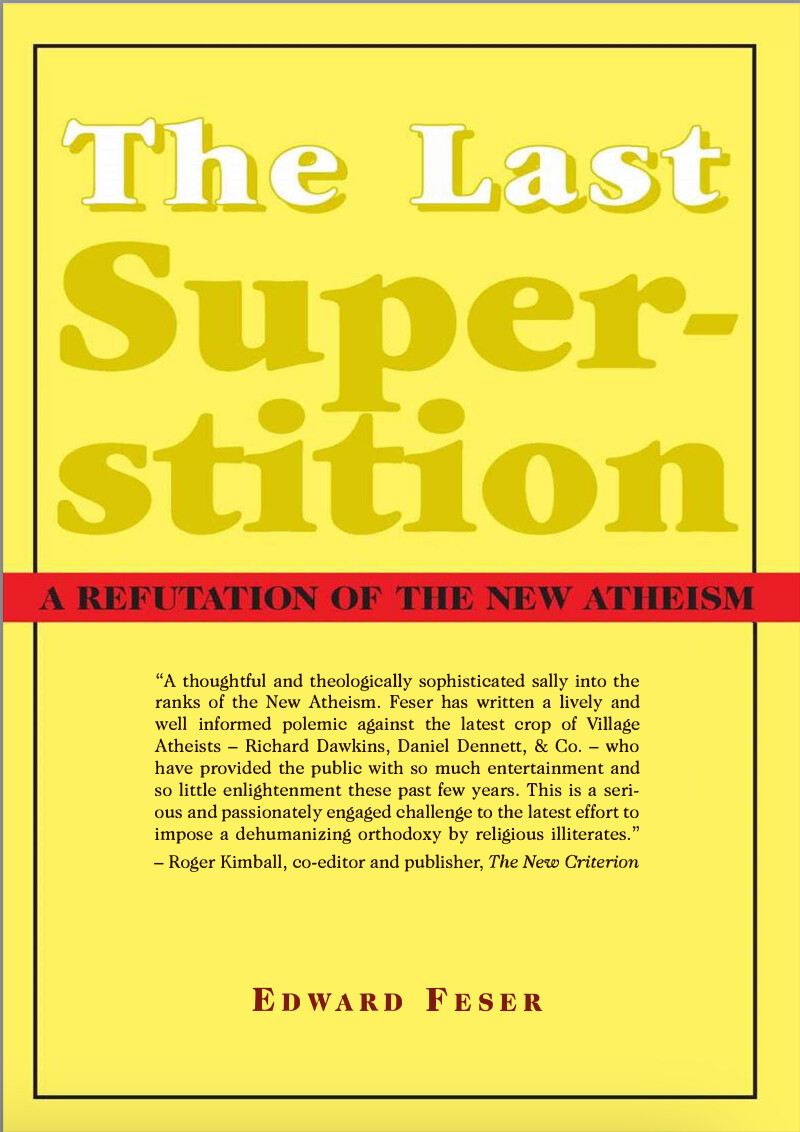
It has a polemical tone and starts by pointing out how one of the most prominent atheists in the world (Antony Flew) had a late conversion to theism in life because, despite debating for religion for 50 years or more, never actually read Aristotle. Once he did he was forced to convert. Feser does a good job depicting how new atheists show only the faintest understandings of the philosophical traditions they critique.
As an example, these new atheists love asking “what caused God” and while I can respect and appreciate that as a genuine question from a normal person, from someone writing a book that is trying to demonstrate that faith is dumb, stupid, or that god doesn’t exist, or that the classical proofs are wrong, that is inexcusable. It demonstrates they have not actually dialogued with the arguments philosophers actually make, and instead only regurgitate a caricature of them.
Feser in Five Proofs:
“If everything has a cause, then what caused God?” This may be the single most common objection against arguments for a divine cause of the world. It is routinely raised by amateurs and by professional philosophers alike. And it is a staple of New Atheist iterature.[2]
[2] See Dawkins, God Delusion, p. 77; Dennett, Breaking the Spell, p. 242; Harris, Letter to a Christian Nation, pp. 72-73; Hawking and Mlodinow, Grand Design, p. 172; Hitchens, God Is Not Great, p. 71; Krauss, Universe From Nothing, p. xii; Stenger, God and the Folly of Faith, pp. 215, 323-24.
Clearly, they have never actually read cosmological arguments otherwise they wouldn’t ask something so monumentally ignorant. I took the liberty of tracking down all these books and reading the refences myself. Note that these are not “lack belief” atheists, these are religious ones, evangelizing the world with nothingness. They think science can replace Jesus as Lord and Savior. The titles alone are telling:
The God Delusion, Breaking the Spell, God is Not Great, God and the Folly of Faith, Letter to A Christian Nation.
These types of atheists clearly have pitchforks in hand as they march to their church of naturalism where they worship at the altar of science. Here are the references:
Dawkins: God Delusion:
All three of these arguments (Aquinas’ Unmoved mover, uncaused cause and cosmological argument] rely upon the idea of a regress and invoke God to terminate it. They make the entirely unwarranted assumption that God himself is immune to the regress. Even if we allow the dubious luxury of arbitrarily conjuring up a terminator to an infinite regress and giving it a name, simply because we need one, there is absolutely no reason to endow that terminator with any of the properties normally ascribed to God:
Who created God, misunderstanding the regress as linear and thinking the divine attributes are not natural extensions of the arguments. It is no wonder Feser said of Dawkins that he wouldn’t know metaphysics from Metamucil.
Dennett: Breaking the Spell:
The Cosmological Argument, which in its simplest form states that since everything must have a cause the universe must have a cause—namely, God—doesn’t stay simple for long. Some deny the premise, since quantum physics teaches us (doesn’t it?) that not everything that happens needs to have a cause. Others prefer to accept the premise and then ask: What caused God? The reply that God is self-caused (somehow) then raises the rebuttal: If something can be self-caused, why can’t the universe as a whole be the thing that is self-caused? This leads in various arcane directions, into the strange precincts of string theory and probability fluctuations and the like, at one extreme, and into ingenious nitpicking about the meaning of “cause” at the other. Unless you have a taste for mathematics and theoretical physics on the one hand, or the niceties of scholastic logic on the other, you are not apt to find any of this compelling, or even fathomable.
Using virtual particles?.. what theist or Christian author would ever say “everything must have a cause”? None of us who believe in God believe that statement is true and it does not show up in the arguments. He also asks “what caused God”.
Harris: Letter to a Christian Nation
The argument runs more or less like this: everything that exists has a cause; space and time exist; space and time must, therefore, have been caused by something that stands outside of space and time; and the only thing that transcends space and time, and yet retains the power to create, is God. Many Christians like yourself find this argument compelling. And yet, even if we granted its primary claims (each of which requires much more discussion than ID Theorists ever acknowledge), the final conclusion does not follow. Who is to say that the only thing that could give rise to space and time is a supreme being? Even if we accepted that our universe simply had to be designed by a designer, this would not suggest that this designer is the biblical God, or that He approves of Christianity. If intelligently designed, our universe could be running as a simulation on an alien supercomputer. Or it could be the work of an evil God, or of two such gods playing tug- of-war with a larger cosmos.
As many critics of religion have pointed out, the notion of a creator poses an immediate problem of an infinite regress. If God created the universe, what created God? To say that God, by definition, is uncreated simply begs the question. Any being capable of creating a complex world promises to be very complex himself. As the biologist Richard Dawkins has observed repeatedly, the only natural process we know of that could produce a being capable of designing things is evolution.
Notice the scientism: evolution is the only thing that can make complex beings. Also “what created God” and the idea that the divine attributes don’t extend naturally from classical arguments for God’s existence. As an example, he notes “two gods playing tug of war” but as a recent discussion here pointed out, there cannot be more than one actus purus even in principle. So to even mention this questions shows that one does not even understand the basic premises of cosmological arguments and is simply regurgitating what they think they know about them from echo chambers.
Hawkins and Mlodinow: The Grand Design
Some would claim the answer to these questions is that there is a God who chose to create the universe that way. It is reasonable to ask who or what created the universe, but if the answer is God, then the question has merely been deflected to that of who cre- ated God. In this view it is accepted that some entity exists that needs no creator, and that entity is called God. This is known as
the first-cause argument for the existence of God.
Who created God…
Hitchens: God is not Great
And even the first cause has its difficulties, since a cause will itself need another cause. “It is difficult or impossible,” he wrote, “to prove against the philosophers that there cannot be an infi- nite regress in causes of the same kind, of which one can exist without the other.” Thus the postulate of a designer or creator only raises the unanswerable question of who designed the designer or created the creator. Religion and theology and theodicy (this is now me talking and not Ockham) have consistently failed to overcome this objection. Ockham himself simply had to fall back on the hopeless position that the existence of god can only be “demonstrated” by faith.
Who created God…
Krauss: Something from, Nothing (in the preface by Bronowski)
Nevertheless, the declaration of a First Cause still leaves open the question, “Who created the creator?” After all, what is the difference between arguing in favor of an eternally existing creator versus an eternally existing universe without one?
Who created God.
Stenger: God and the Folly of Faith
In his 2006 bestseller, The Language of God, Francis Collins, who, as mentioned earlier, is director of the National Institutes of Health, former head of the Human Genome Project, and an evangelical Christian, gives the typical theist view: “I cannot see how nature could have created itself. Only a supernatural force that is outside of space and time could have done that.” Strangely he seems to be able to see how God created himself. The usual theological response to this question is that God always existed and so was not created. But then, why couldn’t the universe itself have always existed and thus not have been created?
Who created God…
Richard Dawkins isn’t the only new atheist who wouldn’t know metaphysics from Metamucil.
Vinnie
4 Likes
Thanks for the text. I went through more of it. I feel that part is at play with what I see from several regular members on this forum.
I vaguely remember a while back when Biologos posted an article on a recent Nobel prize winner who was a Christian and I questioned this because when I tracked down one of their books, it indicated they did not believe in supernatural miracles or that Jesus rose from the dead. That type or Christin is not going to bridge any gaps between science and religion for mainstream believers unless it happens via deception. I’ll take Paul all day over someone that has been—regardles of how intelligent they are-- deluded to worship at the altar of science:
“And if Christ has not been raised, our preaching is useless and so is your faith.”
3 Likes
1. Comparison Table: Atheism vs. Neo-Atheism
| Dimension | “Plain” Atheism | Neo-Atheism (per Cold Reason transcript) |
|---|---|---|
| Basic definition | Lack of belief in any gods. A personal conclusion. | Atheism plus organized, public critique of religion and its social power. |
| Core focus | Individual worldview: “I don’t believe.” | Cultural movement: “Religious claims and privileges must be challenged.” |
| Public posture | Often private or low-key; may see religion as a personal choice not worth fighting about. | Explicitly confrontational; “turns up the volume,” refuses to stay silent for politeness’ sake. |
| View of religion | Varied: from “mostly harmless” to “often harmful.” | Religion is systematically harmful when shielded from critique; a major source of oppression, bad policy, and anti-science. |
| Epistemic standard | Many accept a broadly evidentialist stance, but may not campaign on it. | Makes evidence the central banner: religious claims must meet the same evidential standards as scientific claims. |
| View of faith | Often sees faith as irrational or unnecessary, but may leave it alone socially. | Faith is not a virtue; belief without evidence is framed as a failure of curiosity and intellectual honesty. |
| Morality | Morality can be grounded in human reason, empathy, or social contracts without God. | Strong insistence that data from secular societies show morality and flourishing do not depend on religion; religious morality is often regressive. |
| Attitude toward religious people | Ranges from tolerant to dismissive; many prioritize coexistence. | Distinguishes people from ideas in theory, but in practice often uses sharp rhetoric toward both beliefs and institutions. |
| Tone & style | Often conversational, pluralistic, or quietist: “You have your view; I have mine.” | Polemical, campaign-like: debates, bestsellers, YouTube channels, “Four Horsemen,” etc. |
| Historical self-understanding | Part of a long tradition of skepticism and unbelief. | Sees itself as the next phase after Enlightenment: leveraging mass media to remove religion’s cultural immunity. |
| Political goal | Varies; some apolitical, some pro-secular. | Strong push for secular public space: no religious privilege in law, education, or science policy. |
| Endgame vision | A world where individuals are free to believe or disbelieve. | A world where religious claims are no longer culturally privileged and disbelief is so normal it barely needs a label. |
2 Likes
- I have created a Non-ChatGPT-aversive thread for anyone who is not averse to reading more ChatGPT input beyond the foregoing table. Perhaps Kendel or Marta will “invite” those of you who are interested.
It would seem you are ideally fit for anti-religious discussions that proliferate at PeacefulScience.Org.
Why would you expect any interesting discussion here, whose very mission is to find a way to reconcile (a MINIMUM of ?) religious metaphysics with mainstream science?
G.Brooks
1 Like
- I’ve begun wondering, after a recent encounter in this forum with a Neo-Atheist, if I might become a Neo-Christian counter militant. Not kind to my blood pressure.
2 Likes
Thanks for that transcript, Terry! Now indeed I have taken in the content of the whole. And my original appraisal stands. The first half predicted the second.
Though in the transcript about half way through, the digital scribe began mistakenly using the word “neotheism" where it should have still been using “neoatheism”. That might confuse someone just dropping in. So much for AI understanding what it’s transcribing!
1 Like
Right, I would have been more thorough if I had edited the transcript, which I may yet do.
Such brave souls, paying the Apostasy Tax in full—families split, friendships frayed, communities forfeited.
2 Likes
PeacefulScience,org is FLOODED with non-peaceful Atheists.
I once subscribed, but left when I chose not to defend my cosmology against criticism. Has Swamidass stepped aside or let the reins drop?
He claims that he is too busy to run the group himself, so he must let the Atheists run it.
1 Like
Seems to me that there’s a moral there. Something like: “When the shepherds sleep, the wolves get fat.”
2 Likes