A claim sufficiently surprising that unless it is supported by evidence it should be rejected, and the rest of Feser’s work along with it.
I can find no evidence that Antony Flew said he had never previously read Aristotle, and the evidence available from both his career and his writings suggest that he was already familiar with Aristotle’s work and that his change of view was not a result of reading Aristotle, but a result of learning about biological complexity.
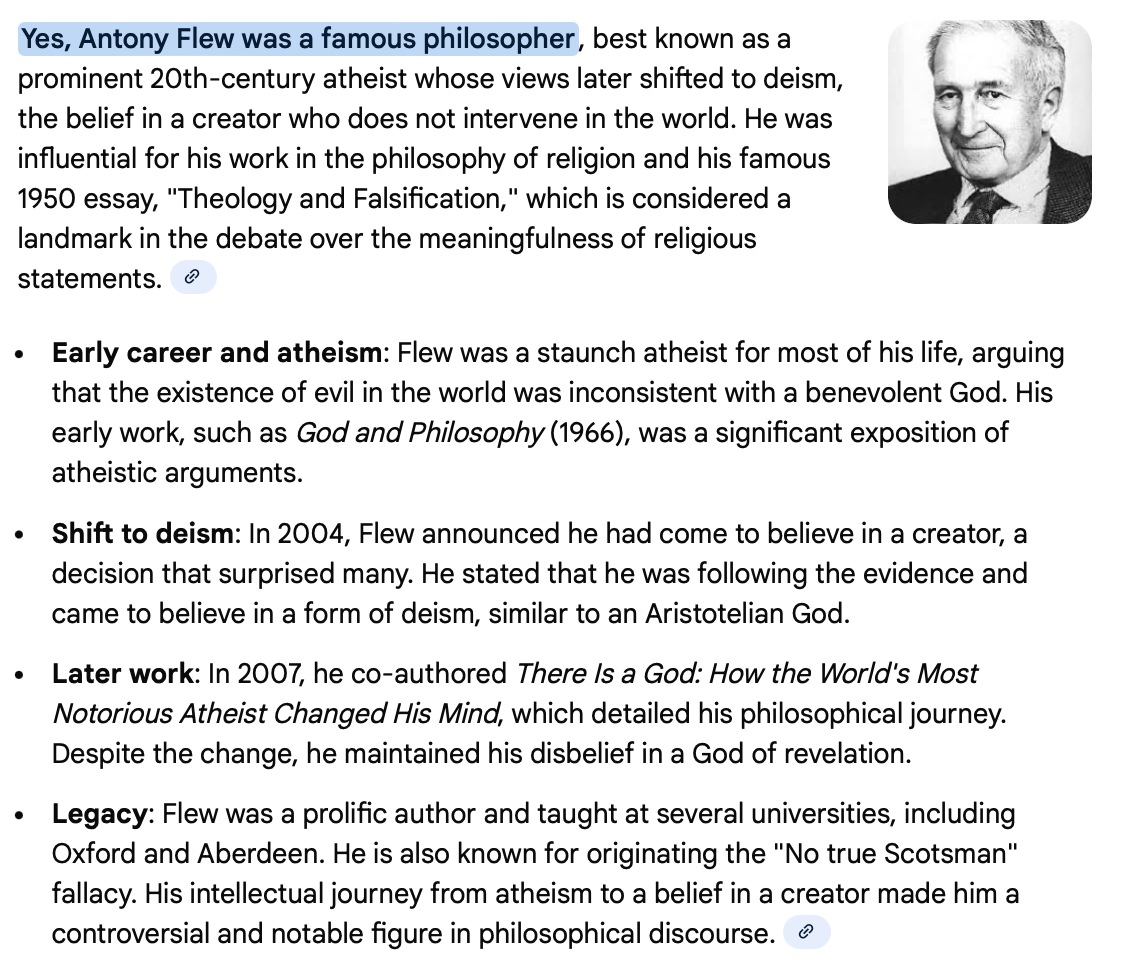
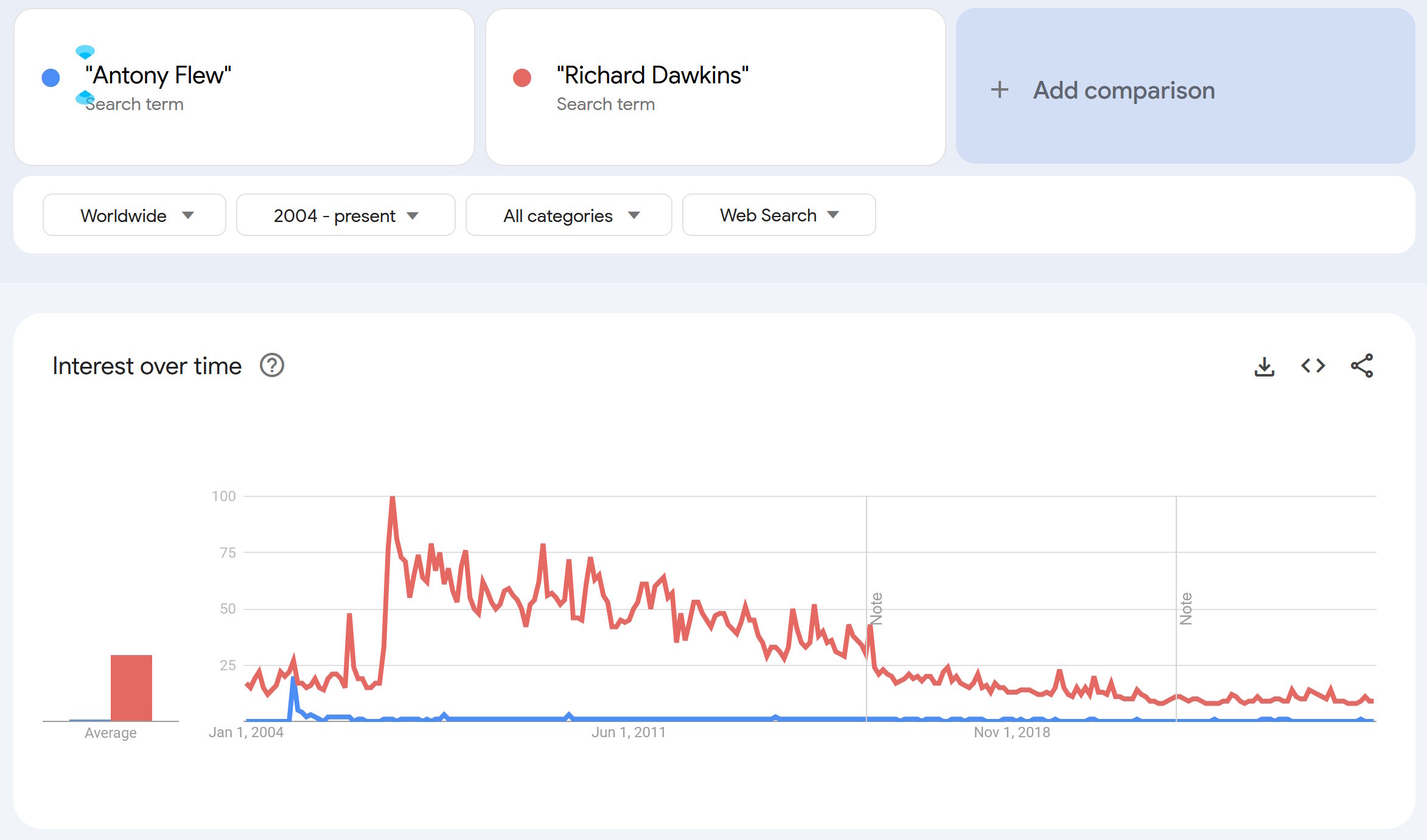
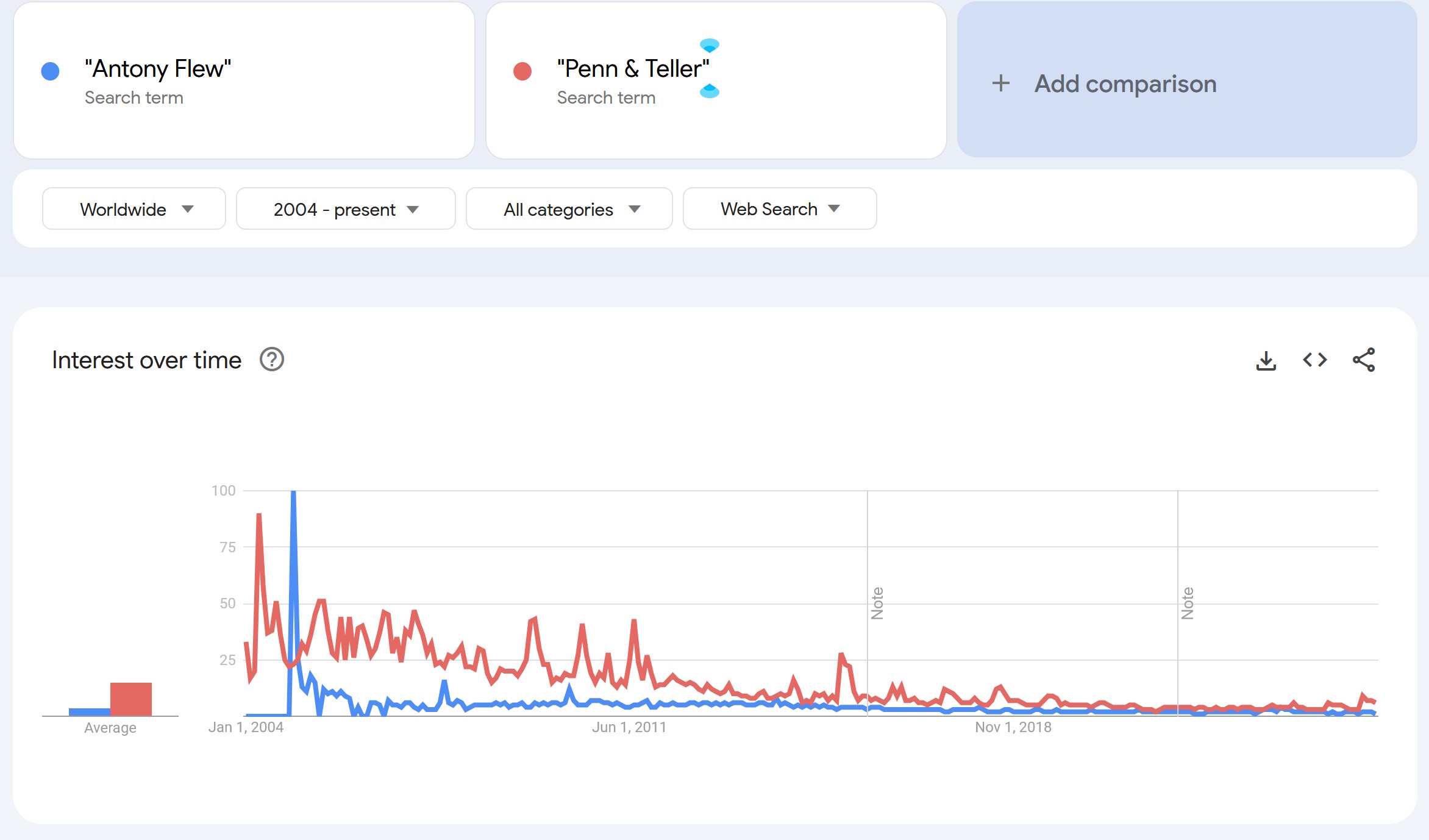
(I also recall never having heard of Antony Flew until apologists started crowing about his conversion, which seriously undermines any description of him as “one of the most prominent atheists in the world”. He wasn’t one of the most prominent from my p.o.v., and he definitely wasn’t, as several ‘sources’ describe him, “the world’s most notorious atheist”. Such hyperbole is another reason for rejecting the claims of Feser and his ilk.)
Feser makes arguments. You are free to reject his premises or whether or not his conclusion follows from them. You can always go to his blog and ask questions.
When I say “actually read” the actually was meant to stress the substance. He was obviously aware of some of Aristotle’s ideas. A professional philosopher at that age could not have never had some knowledge of Aristotle. Anything contrary is like thinking a biologist could have no knowledge of Darwin wrote. Flew himself said he was reading parts for the first time and this is material relevant for evaluating God’s existence. The same can be said of you and Feser. Maybe you should actually read him instead of regurgitating what you see in echo chambers.
Feser:
In 2004 the philosopher Antony Flew, who had been to that time perhaps the world’s most prominent atheist, announced that he had changed his mind. While he had no intention of embracing Christianity or any of the other traditional monotheistic religions, he had, he revealed, been led by philosophical arguments to conclude that there really is a God after all – specifically, a First Cause of the universe of the sort described by Aristotle. The Aristotelian rationale for Flew’s change of view might be as surprising as the conversion itself. Aristotle and his teacher Plato are almost universally regarded as the two greatest philosophers ever to have lived. Their arguments have been known and studied for over 2,300 years. Flew was 81 years old at the time, and had been for over fifty years one of the most influential and respected philosophers in the world. Surely, one would have thought, there were no arguments for the existence of God he hadn’t already heard before. And yet at the end of his career, and in the face of the atheism he had for half a century made his reputation defending, Flew found himself admitting that the ancient Greek thinker the Medievals referred to simply as **“The Philosopher” had been right all along. **“I was not a specialist on Aristotle,” Flew explained, “so I was reading parts of his philosophy for the first time.”****[1]”
Note the perhaps, not him not being a specialist on Aristotle and only having a cursory knowledge of his philosophy. That is very telling just as it is telling that so many of the authors I quoted above all revert to the “who created God” objection, telling me they too only possess superficial knowledge of cosmological arguments. Of course Aristotle has some wonky science so his metaphysics is summarily swept under the rug at times.
Speaking of bad arguments. At any rate, you aren’t the guiding authority on who is prominent in philosophy. Go do your own leg work. I doubt most people hear of any modern philosophers unless someone brings them up. Philosophers aren’t exact rock stars. His conversion did make the Jay Leno show though.
[1] “Quoted by James A. Beverley in “Thinking Straighter: Why the world’s most famous atheist now believes in God,” Christianity Today (April 2005). See also Gary Habermas’s interview with Flew in the Winter 2005 issue of the journal Philosophia Christi. As this book was being completed, Flew published There Is a God: How the World’s Most Notorious Atheist Changed His Mind (HarperOne, 2007), co-authored with Roy Abraham Varghese, wherein he sets out his current position in more detail.”
You try really hard to dismiss Feser out of hand. Why don’t you try actually reading him for a change much in the same way Flew finally, actually read Aristotle.
Can anybody find evidence, from before Flew changed his mind in 2004, of him being described as “the world’s most prominent atheist” (“perhaps” or otherwise) or as “the World’s Most Notorious Atheist”, or anything that comes close to this?
1 Like
gbrooks9
(George Brooks, TE (E.volutionary T.heist OR P.rovidentialist))
28
Roy,
Flew’s notoriety may have been a British thing. Quoting commentary from British sources without attribution is all it takes to dismiss a casual “sweeping generalization” into a catastrophically flawed Universal Sweeping Generalization.
The “No True Scotsman” discussion is certainly famous to me:
Now I know WHO started the discussion:
The description of the fallacy in this form is attributed to the English philosopher Antony Flew, who wrote, in his 1966 book God & Philosophy,
In this ungracious move a brash generalization, such as No Scotsmen put sugar on their porridge, when faced with falsifying facts, is transformed while you wait into an impotent tautology: if ostensible Scotsmen put sugar on their porridge, then this is by itself sufficient to prove them not true Scotsmen.
In his 1975 book Thinking About Thinking, Flew wrote:[4]
Imagine some Scottish chauvinist settled down one Sunday morning with his customary copy of The News of the World. He reads the story under the headline, “Sidcup Sex Maniac Strikes Again”. Our reader is, as he confidently expected, agreeably shocked: “No Scot would do such a thing!” Yet the very next Sunday he finds in that same favourite source a report of the even more scandalous on-goings of Mr Angus McSporran in Aberdeen. This clearly constitutes a counter example, which definitively falsifies the universal proposition originally put forward. (‘Falsifies’ here is, of course, simply the opposite of ‘verifies’; and it therefore means ‘shows to be false’.) Allowing that this is indeed such a counter example, he ought to withdraw; retreating perhaps to a rather weaker claim about most or some. But even an imaginary Scot is, like the rest of us, human; and none of us always does what we ought to do. So what he is in fact saying is: “No true Scotsman would do such a thing!”
From me to ChatGPT: Where did Anthony Flew write or make this statement: “I now believe that the universe was brought into existence by an infinite intelligence.”
ChatGPT’s response: “That line is authentic, and it appears in Antony Flew’s own book, not in a secondary source.
Exact Source
Antony Flew There is a God: How the World’s Most Notorious Atheist Changed His Mind
(HarperOne, 2007), Preface (page vii).
The Statement
In the Preface, Flew writes:
“I now believe that the universe was brought into existence by an infinite Intelligence.”
This line is part of his brief summary of why he abandoned lifelong atheism.
Context
It appears in the section titled “My Pilgrimage from Atheism to Theism.”
Flew attributes his shift primarily to:
the apparent fine-tuning of the universe,
the origin of the laws of nature,
and the complexity of life/DNA.
He describes his conclusion as a form of Aristotelian deism, not Christianity.
Additional Confirmation
The same sentence (or paraphrases of it) is quoted in:
Interviews Flew gave between 2004–2008
Gary Habermas’s 2004 interview
Reviews of There is a God
But the definitive first-party source is the Preface of his book.
If you want the full paragraph around that sentence, or a concise analysis of Flew’s reasoning in that section, I can provide that too.
His list is definitely not my list. I don’t find “fine tuning” very compelling.
But I do find the existence of consciousness to be the deal closer!
1 Like
gbrooks9
(George Brooks, TE (E.volutionary T.heist OR P.rovidentialist))
37
My correspondence with Joshua is personal and private.
I am more interested in the posting above about who the ACTIVE moderators have become. Certainly PeacefulScience.Org is capable of quick changes. And if my postings have contributed to that I would be surprised! - - that all my pleadings WITHIN the PS came to naught … but make a few peeps as a refugee at another camp fire …. and things start a poppin???
Did Flew say that? Or did some-one else say that Flew said that?
I’ve just skimmed the opening chapter, and it is awful. Insults galore, mangled quote-mines, and a huge amount of well-poisoning and other fallacies. Seeing Feser refer to people who disagree with him as “blowhards”, “boy”, “village atheists”, “vulgarians”, “sophomoric jackass” and more, with no justification given beyond Feser’s own opinion, gives me no incentive whatsoever to read any further. This isn’t a scholarly work, it’s table-pounding. If Feser had anything useful to say he wouldn’t write such rubbish.
Dennett didn’t.
From your post above:
Dennett didn’t ask “what caused God”. He said that others ask “What cased God?”.
Pointing out exaggerations and falsehoods is not bad argument.
First, that’s not something written by Antony Flew; second, it’s inconsistent with what was written by Antony Flew; third, it doesn’t say that Flew hadn’t read Aristotle, only that he hadn’t read all of Aristotle.
Do you have anything written by Antony Flew where he admits to not having read (parts of) Aristotle, or are you, like Feser, criticising the scholarship of others while relaying hearsay yourself?