Yeah, I think GAE would be helpful to a very small minority of YECs. Looking at this from the other direction, it could possibly appeal to YECs who default to YEC because they can’t see how evolution and original sin can work together. They aren’t necessarily dogmatic about the time frame, but it’s still a comfortable position that they haven’t given up because of more narrow concerns. How many of these YECs exist? I have no clue.
2 Likes
GAE was a lead balloon from the start. It attracted a small number of vocal adherents that I can count on one hand. The book didn’t merit a second printing and is mostly forgotten. I hardly ever think of it myself until someone like George shows up and jogs my memory.
They have bought into the premise that baptism is about guilt when they use that as basis of an argument against infant baptism.
Baptism is about covenant.
Which is not surprising since Augustine himself used it to mean two different things.
I really pissed off a Pentecostal type who harped on that view by telling him he was repeating Catholic theology. He was one of the “the pope is the antichrist” types.
1 Like
It also wasn’t even original – college students played with the notion clear back in the mid-70s.
1 Like
I am giving you a chance to mend your ways. Obviously, you feel no need to.
The error in Swamidass’s supposed solution to the Tasmania problem was wrong. And I always felt like he was trying to accommodate the extreme views of the Atheist Scientists that were surrounding him.
All Tasmania needed was one ship-wrecked survivor landing on its shore to resolve the issue. And since the whole point of the book GAE was to show how some of God’s divine interventions could easily be PROVIDENTIAL (rather than MIRACLES), there would be no reason to exclude the providential arrival of an Adam descendant prior to the birth of Jesus.
There are different interpretations and emphasis about baptism, which is not surprising because both biblical scriptures and other early Christian scriptures use a diverse set of expressions and similes to describe it. In addition, the denominational traditions may see the water baptism even in verses where other denominations do not see it.
I just wrote a course essay about the doctrine and interpretations of baptism in the Finnish Evangelic-Lutheran church, with a comparison to the teachings of my denomination. The Lutheran church started with the sacramental interpretation of Luther. The interpretations scattered later, especially after the rise of Pietism. That lead to three main lines.
One is the sacramental evangelical (type Luther, people are ‘born again’ and saved in baptism, any repentance later in life is ‘return to the mercy of baptism’);
the second one has the flavour of Pietism (you are saved by God when you turn to God and let Him save you - according to this interpretation, baptism may be seen as a ritual that joins the child into the institutional church);
the third one sees baptism through the covenant theology (baptism is a sign of a covenant, like circumcision was among the Hebrew).
During the last century, the Finnish Lutheran church has turned more and more towards the ‘original’ Lutheran sacramental theology - at the official level but not at the level of ordinary members. The official texts go to very sacramental direction, sometimes even more towards RCC than Luther might have liked, but simultaneously, an increasing proportion of children born to nominally Lutheran parents are not baptized before the child decides it him(/her)self, often at the age of 15 years, when most Finnish children attend confirmation schools or some substitutive camp.
[The tradition of the confirmation school at the age of 15 years is so strong in Finland that even the organized atheists felt that they had to invent a substitutive camp as a non-theistic alternative (called Prometheus camps). Pentecostals have ‘Fifteen camps’, we have ‘congregation schools’, etc.]
So … as long as the contagion of Adam’s sin gets folded into their ancestry, all’s good? If that resolves the issue, it shows that Adam and Eve’s story has been reduced to the wrong issue. The issue isn’t “How did sin enter God’s good creation and spread to everyone?” The issue is “Who are we as human beings?” – and one part of the answer is “sinners.” Both ways of framing the issue end up with universally sinful humans, but the first is tied to ancestry while the second is tied to the story prophetically showing us ourselves.
Consider Rahab. Would Joshua come up to her one day, saying “I know you consider yourself part of our people. I know you recite the exodus story as your own each Passover, just as we do. But if we don’t find a real Israelite somewhere in your genealogy, you’re out.” Is being an Israelite tied to ancestry, or are there other ways into their story? How does Paul identify the descendants of Abraham in Romans 4?
Consider David. Nathan told him a story of a mean guy who cooked someone’s pet lamb. “You’re that guy,” he says. Does David need to show that the mean guy lived in his kingdom, and so as king he’s responsible for the injustice, and so by the principle of corporate solidarity he is that man? Or does he need to show that the mean guy is actually Jesse (“he always did have a taste for lamb!”), and so by ancestry, as his son, he is that man? No! David needs to recognize himself in the story, directly, without any distended explanations of how that man’s sin could become his.
That’s the case for Adam and Eve, too. If we merely see them as the people who corrupted humanity, giving us a nature that can’t help but sin, we’ve lost the script. Them’s us. They didn’t need a corrupt nature to choose wrong – and to choose wrong well before they ate the fruit – and neither do we. Just as they faced an ambiguous mix of beastly, demonic and social pressure to sin, so do we. If we’ll only identify with them if the details of our ancestry confirm it, we haven’t heard the convicting truth of their story.
5 Likes
The book, “Genealogical Adam & Eve” is not designed to convince the audience that all humans are sinners. It is designed to show people - - who already believe all humans are sinners - - that Adam and Eve’s sinful nature could have spread throughout a pre-Adamite population of humans that were created by God by evolution.
But I expect he accepts that they already had a sin nature and were sinning before that ship arrived. You don’t catch a sin nature like an STD. And so, it solves a problem that didn’t exist.
1 Like
In my entire time discussing these matters with Swamidass, I never once heard or read a mention by him that he personally accepted St. Augustine’s doctrine of Original Sin. His concern was to help those who did believe such a thing, how to reconcile St. Augustine with evolutionary science.
The Roman Catholic Church does not teach inherited guilt either. The doctrine is confusing though because of their stance on infant baptism and it is often misunderstood in everyday thought. I think the sacraments are very. nuanced in Catholicism. Original sin is a loss of the supernatural grace God originally bestowed on the first couple. We cannot understand original sin without understanding human nature, what we were made for and all the details of that first sin. Feser writes:
But according to Christian theology, God offered to our first parents more than what was “owed” to us given our nature. He offered us a supernatural gift. Here it is crucial to understand what “supernatural” means in this context. It has nothing to do with ghosts, goblins, and the like. What is meant is rather that God offered us a good that went above or beyond what our nature required us to have. In particular, he offered Adam and Eve the beatific vision – a direct, “face to face” knowledge of the divine essence which far transcends the very limited knowledge of God we can have through natural reason, and which would entail unsurpassable bliss of a kind we could never attain given our natural powers. He also offered special helps that would deliver us from the limitations of our natures – that would free us from the ignorance and error our intellectual limitations open the door to, the moral errors our weak wills lead us into, the sicknesses and injuries our bodily limitations make possible, and so forth.
By definition, none of this was “owed” to us, precisely because it is supernatural. Hence while God cannot fail to will for us what is good for us given our nature, He would have done us no wrong in refraining from offering these supernatural gifts to us, precisely because they go beyond what our nature requires for our fulfillment. Still, He offered them to us anyway. But this offer was conditional.
The world is as it was according to science before Adam and Eve’s sin. Feser continues:
The condition was the obedience of our first parents. Yet they did not obey. And of course, that is the point of the account of their eating of the fruit of the tree of knowledge. It wasn’t fruit per se that was important, but rather the will to rebel against the Creator. (Recall Augustine’s youthful theft of the pears, where what was attractive about the theft was the fact that it was forbidden, not the fact that he got some pears out of it.) The penalty was the loss of the supernatural gifts they had been given and that their descendants would have been given, and a fall back into their merely natural state, with all its limitations. In particular, it was a loss of all the helps that would effectively have removed those limitations – and worst of all, loss of the beatific vision.
In short, the penalty of original sin was a privation, not a positive harm inflicted on human beings but rather the absence of a benefit they never had a right to or strict need for in the first place but would have received anyway had they not disobeyed. . . . And it wasn’t the prospect of pitchforks and hellfire that Adam’s descendents had to look forward to because of what Adam did, but rather the privation of this supernatural gift.
And finally, he offers an analogy:
You might compare the situation to that of a landowner who has sold an unimproved parcel of land to a certain family – which, just to be cute, we’ll call the Adams family. In allowing the Adamses to take possession of the parcel, he’s given them everything he owed them. But suppose he offers to throw in, for free, something extra – to plant on the land a vineyard using the finest quality vines, whose fruit will make possible the best wine. This is something that all the descendents of the original Adamses who bought the land will profit from. But the landowner makes the offer only conditionally. He wants to see how Mr. and Mrs. Adams are going to handle things before turning the vineyard over to the Adams family as a whole, including the many descendents who are not likely to do any better with the vines than their ancestors are. So if Mr. and Mrs. Adams do well with the first vines planted, they and their descendents will get to keep them and reap the benefits. If not, the landowner will tear them out and leave the Adamses and their descendents with only the original unimproved parcel, which is all they were owed in the first place.
Now suppose that Mr. and Mrs. Adams botch things up, and the landowner removes the vineyard. The fault is entirely theirs, but all their descendents necessarily suffer the penalty just as much as they do, just by virtue of being Adamses. Yet it is not a positive harm that is inflicted on them, but rather the loss of a benefit they were not entitled to but nevertheless would have received if not for the actions of their ancestors.
What do we inherit? Feser writes:
Similarly, we inherit the penalty of original sin, not in the sense that we’ve got some “original sin gene” alongside genes for eye color and tooth enamel, but rather in the sense that the offer of the supernatural gifts was made to the human race as a whole through their first parent acting as their representative. Inheriting this penalty from Adam is more like inheriting your father’s name or bank account than it is like inheriting his looks or his temperament. And there is no more injustice in this inheritance than there is in the landowner’s not planting a vineyard for Mr. and Mrs. Adams’ descendents.
Obviously the account depends crucially on the distinction between the natural and supernatural orders – a distinction that was blurred in Protestantism and has also been blurred by some modern Catholic theologians (a tendency criticized by Pope Pius XII at paragraph 26 of Humani Generis ). Part of the danger of blurring it is that doing so threatens to make a hash of the doctrine of original sin. If Adam and Eve lost for us something we are in some sense owed by nature, or if the penalty of original sin did involve some positive damage to that nature rather than merely the privation of a supernatural gift, then it does come to seem unjust that we have inherited that penalty, and the door is opened at least a crack to the caricatures of the doctrine’s critics.
This is a scholastic position on original sin and I think it provides a valid answer to what @Marshall wrote. These quotes all come from is a series of blog posts I came across where Feser is addressing biology and original sin and defending genealogical Adam and Eve long before Swamidass’s book was written. He seems to indicate this view goes back quite far as well.
Vinnie
2 Likes
Based on your opinion, it would seem NOBODY accepts St. Augustine’s Original Sin doctrine.
But we know there is SOMEBODY who does. I reject your assertions.
It’s not my opinion. It is in the Catechism and is how scholastics have understood it.
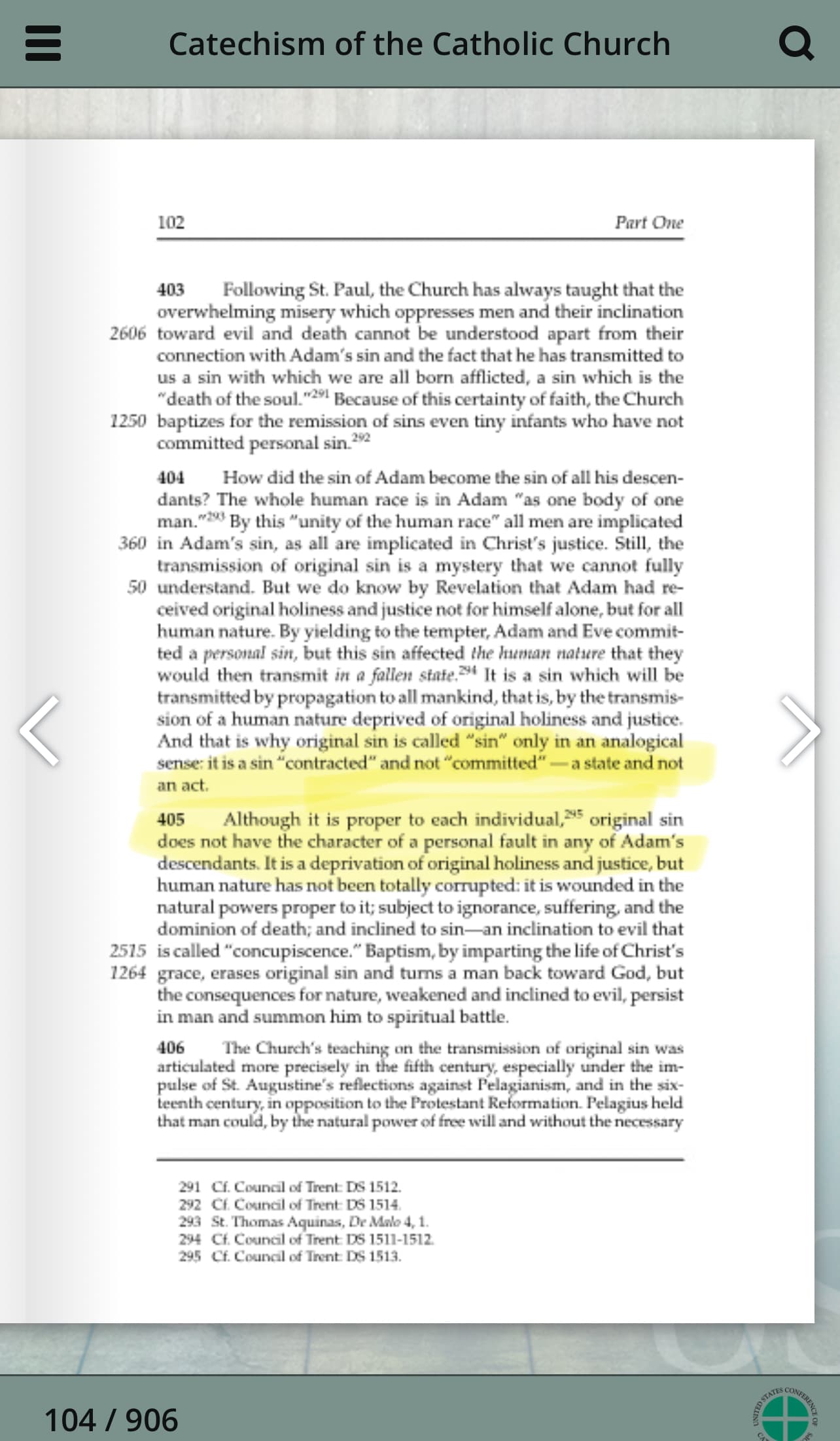
Many of us are woefully uninformed about official Catholic teachings. It’s easier for us to deal with caricatures.
And I would guess reformed individuals/Calvinists accept it and some popular formulations of the Gospel, especially from Protestant Christianity (and some Catholics as well) perpetuate it.
Vinnie
1 Like
- Caveat! “Pentecostals” and “pentecostals” may or may not refer to the same creatures.
I think the key here is “strict need for.” Did those gifts make them less likely to sin than us? If so, then this version still seems to be blaming the first humans for falling from a more privileged state. It still makes their sin worse than ours, because they had an advantage we lack (and we lack it because of them). Rather than seeing how we are like them, it’s seeing how they lost the game on a power play, so now we, shorthanded, can’t help but carry that loss to the final buzzer.
Anyway, I’ll send you a PM. I’m curious what you think of my more in-depth take on traditional views of Adam and Eve and original sin through church history. But it’s too much for a post.
1 Like
It’s a very good question. I don’t know all the ins and outs of every doctrine but I’ll share my thoughts. I think Feser is keenly aware of the issue you are raising and I think much of his discussion is partially aimed at circumventing it. He says: “If Adam and Eve lost for us something we are in some sense owed by nature, or if the penalty of original sin did involve some positive damage to that nature rather than merely the privation of a supernatural gift, then it does come to seem unjust that we have inherited that penalty.” This was the position of the reformers like Luther as is shown in a link below.
I think my biggest reservation here is calling our situation short-handed. The privation of preternatural gifts leaves us in our natural state and only deprived of excess. That is being full-handed. A full staff of teachers in a school is full. You could add 10 more teachers beyond what is needed to help out but taking away those ten teachers does not leave the school short-handed.
Were Adam and Eve’s sin worse than ours? I never really thought about that. Is is heretical to say yes or maybe? I’m not sure. The idea of our concupiscence – the inclination to sin-- might just seem to make their sin worse since they didn’t have it. But I know that we are guilty of our own sin only in the Catholic tradition. That is what would land us in hell. The catechism says our human nature has not been totally corrupted. On first glance, this does seem to go beyond mere privation but Feser refers to the Catholic encyclopedia for the difference between original sin and concupiscence and that may clear up the Catechism confusion as I think sometimes the distinction between original sin and concupiscence is mixed up. The inclination to sin, I believe, is part of our natural state. The reformers changed this but for Catholics it seems to be about the flesh vs the rational side of us which in my mind fits very well with fleshly evolutionary desires. I’d say the reformers got that part wrong and science might be on the side of the older understanding.
From the explanation given, it is plain that the opposition between appetite and reason is natural in man, and that, though it be an imperfection, it is not a corruption of human nature. Nor have the inordinate desires (actual concupiscence) or the proneness to them (habitual concupiscence) the nature of sin; for sin, being the free and deliberate transgression of the law of God, can be only in the rational will; though it be true that they are temptations to sin, becoming the stronger and the more frequent the oftener they have been indulged.
SO we are are mix of fleshly desires and reason. Evolutionary baggage will play a large role in that and though it might make sin easier in one sense, I don’t think anyone considers the pleasure of sex or desire to procreate an adequate excuse for sexual abuse. It is our rational side that is capable of sin. The article continues:
The first parents were free from concupiscence, so that their sensuous appetite was perfectly subject to reason; and this freedom they were to transmit to posterity provided they observed the commandment of God. A short but important statement of the Catholic doctrine on this point may be quoted from Peter the Deacon, a Greek, who was sent to Rome to bear witness to the Faith of the East: “Our belief is that Adam came from the hands of his Creator good and free from the assaults of the flesh” (Lib. de Incarn., c. vi). In our first parents, however, this complete dominion of reason over appetite was no natural perfection or acquirement, but a preternatural gift of God, that is, a gift not due to human nature; nor was it, on the other hand, the essence of their original justice, which consisted in sanctifying grace; it was but a complement added to the latter by the Divine bounty. By the sin of Adam freedom from concupiscence was forfeited not only for himself, but also for all his posterity with the exception of the Blessed Virgin by special privilege. Human nature was deprived of both its preternatural and supernatural gifts and graces, the lower appetite began to lust against the spirit, and evil habits, contracted by personal sins, wrought disorder in the body, obscured the mind, and weakened the power of the will, without, however, destroying its freedom. Hence that lamentable condition of which St. Paul complains when he writes: (Romans 7:21-25)
I also note for thoroughness, the article does speak of the guilt of original sin.
I’ll print it at work tomorrow. Easier to read that way.
Vinnie
1 Like
And you are woefully uninformed by how people APPLy these official teachings.
The text reads as follows:
“By yielding to the “Tempter”, Adam and Eve committed a personal sin, but this sin affected the HUMAN NATURE that they would then transmit in a fallen state. It is a sin which will be transmitted by [sexual?] propagation to ALL mankind, that is, by the transmission of a human nature DEPRIVED of original holiness and justice. And that is why original sin is called “sin” only in an analogical sense: it is a sin “contracted” and not “committed” - - a state and not an act. Although it is proper to each individual, original sin does not have the character of a personal fault in any of Adam’s descendants. It is a deprivation of original holiness and justice.”
“Original Sin” is a fallen condition. Which renders the infant helpless in any effort to exist in a state of holiness.
The Eastern Orthodox believes infants do not exist in a fallen state, but are metaphysically inclined to sin as soon as the mental tools of “moral agency” are available to the person - - whether it is claimed to be available by age 1, age 3, age 5, or the age of adolescence… because of the inherent weaknesses of human mind and flesh.
The Roman Catholic church believes the fallen state exists from birth.
Case closed.
The more official/older Reformed churches take a basically Thomist or Scotist view of original sin and predestination.
Some of the groups that take Calvin’s ideas and run to extremes with them (e.g., some Particular Baptists) may go with a view more like the caricature.
I wish I could find modernized-language versions of the confessions, but the Belgic Confession, Heidelberg Catechism, Second Helvetic Confession, Canons of Dort, and Westminster Confession (I have access to a compilation of the five) appear to all endorse basically the view outlined in the Catholic Confession there, that Original Sin in each individual is not a “true transgression”, but is an imputed nature of inclination to evil and death.
1 Like
And this is a distinction without a difference.
If an infant requires baptism because it is in a FALLEN STATE…. that is original sin that needs human cause - - as in the metaphor of Adam & Eve’s first transgression.
If the fallen nature belonged to the very nature of the flesh God gave to humanity … that is the kind of sin discussed by the Eastern Orthodox.