I think the Reformed Confessions basically say the same (an “if I’m understanding the language correctly” issue), but with “Grace” in place of “Reason”. Most of the difference between that and the Reformed confessions sounds more semantic than anything else to me (what do we mean by “[human] nature”, and “guilt” being two of the most obvious issues).
Yes, this is the privation of preternatural gifts bestowed on Adam and Eve. They lost them and as a result, their descendants live without them from conception when God creates their soul. Where did anyone disagree with that? The fall is a fall from preternatural grace, from the excess and overflowing gifts of God to the first couple. It is not a fall from some pristine human nature. It’s more of a fall back to human nature for a couple who God allowed the possibility of accessing the beautific vision. They chose the other route. Feser relays the scholastic position on infants:
Hell is the loss of the beatific vision, and while Hell can certainly also involve more than that (including the pains of sense) the standard view is that it does so only for those guilty of actual sin, and not those (such as infants who die without baptism) who merely suffer the penalty of original sin, without ever having committed actual sin. (For this reason the Scholastic tradition came to settle around the view that infants who die without baptism, and thus without removal of the penalty of original sin, probably enjoy perpetual natural happiness – the highest state we could have attained without being raised to the super natural gift of the beatific vision.)
And here is the Catechism:
CCC 1261: As regards children who have died without Baptism, the Church can only entrust them to the mercy of God, as she does in her funeral rites for them. Indeed, the great mercy of God who desires that all men should be saved, and Jesus’ tenderness toward children which caused him to say: “Let the children come to me, do not hinder them,”63 allow us to hope that there is a way of salvation for children who have died without Baptism. All the more urgent is the Church’s call not to prevent little children coming to Christ through the gift of holy Baptism.
The issue of infants in catholicism today is whether they are in a place like Eden, a very happy paradise but still denied the beatific vision, or if they can be saved and enter heaven through Christ somehow.
And as far as salvation outside the church, the catechism says this:
It seems you are approaching the RCC’s teaching on original sin with some preconceived notions and a wooden literalism. I think the Church has very reasonable views here.
Vinnie
1 Like
That’s the majority view of those who practice infant baptism. It’s not about saving their souls from damnation. It’s about bringing them into the covenant community. The Christian equivalent of circumcision, but it’s available to both boys and girls.
Why do you capitalize “Atheist Scientists” as if that slur had any weight around here?
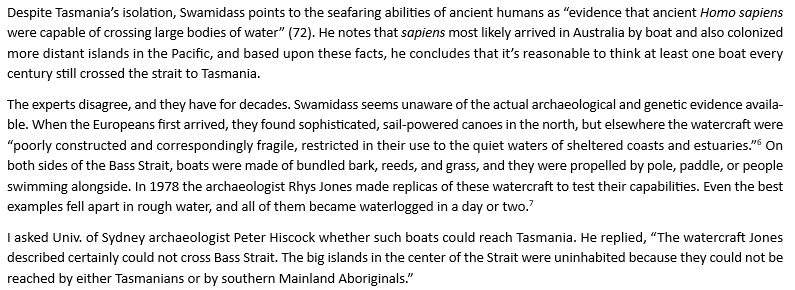
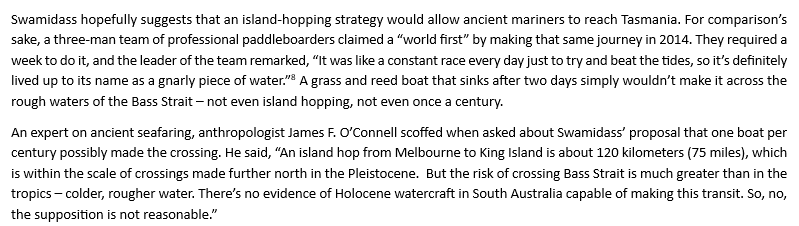
No, I feel no need to repent. Your explanation is laughable. There were no ship-wrecked survivors washing up on Tasmanian shores because there were no ships in either South Australia or Tasmania. They made rafts from reeds that were suitable for fishing platforms in estuaries or calm waters. The Bass Strait is one of the most dangerous stretches of water in the world. It’s cold, windy, and pulled by strong tides. A “shipwreck” that happened a mile or two offshore would result in the survivor being swept out to sea in freezing cold water. No amount of “providence” would keep that person alive. It would take a straight-up miracle on the level of a whale swallowing Jonah and spitting him up on the shore of Tasmania.
Here are the details from my review of the book:
That is one of the main reasons for the Eastern Orthodox community.
The Romans can claim it as an additional reason. But the Romans ALSO include the Original State of Sin that needs to be remitted by Baptism.
Keep deflecting. You still haven’t answered my question whether you personally believe in a literal Adam & Eve. It would be nice to have a conversation about what you actually think rather than a debate about a thought experiment like GAE.
Final GAE comment: It’s what @T_aquaticus said a long time ago. Recognize the scientific fact of Tasmanian isolation and simply move GAE back to 18-20,000 years ago. But no! Fight tooth and nail against it! Why? Because it doesn’t fit the YEC timeline, which is the whole reason why GAE was written in the first place. If the concept isn’t pandering to YEC, then why doesn’t it work prior to Tasmanian isolation? The answer is obvious.
Let’s talk about something relevant now.
1 Like
@Jay313
As I have said in some earlier posts, I am a Unitarian Universalist. Some U.U. folks are closer to non-theism. I am not one of those. One way of describing my form of theism is Karmic Consciousness.
1 Like
Tasmanian isolation is part of the non-theist world view. But if we are going to GAE to reconcile something miraculous with Evolution, then to include a providential ship wreck to put one or two image-bearers on the Tasmanian coast is exceptionally easy to do. Your fixation on Tasmania is an act of desperate pearl clutching….
@Jay313
When I want to criticize an atheist, I refer to him or her as an IMMATURE atheist.
I think that’s pretty much exactly what the Westminster Catechism says.
3 Likes
Earlier, in the 60s:. From Kemp’s article Science, Theology, and Monogenesis:
Francisco Ayala and others have argued that recent genetic evidence shows that the origins of the human race cannot be monogenetic, as the Church has traditionally taught. This paper replies to that objection, developing a distinction between biological and theological species first proposed by Andrew Alexander in 1964.
Feser writes:
Metaphysical considerations are at least as important – indeed, they are more important, as we shall see – and when they are factored in it can easily be shown that there is no incompatibility between the doctrine of original sin and modern biology. Nor is the biological evidence something that the Church must now scramble to “adapt” herself to in order to salvage the doctrine. In fact the subject is one that was addressed long ago, by (among other theologians) Neo-Scholastic thinkers writing in the era of Pope Pius XII’s Humani Generis , who tended to approach the issue from a broadly Aristotelian-Thomistic (A-T) point of view. (Unlike Coyne, John has knowledge of Scholastic and A-T philosophy and theology, so it is surprising that he does not consider the possibility that the answers to the questions he raises might be found in these writers.)
The basic idea can also be important to Catholics since, despite the misinformation some are peddling here, Catholicism requires an actual Adam and the doctrine of original sin. As Feser writes:
John seems to think that the falsification of the doctrine of original sin is something the Catholic Church could “adapt” to. (John’s article focuses on Catholicism.) After all, the doctrine is hardly incidental. It is de fide – presented as infallible teaching – and it is absolutely integral to the structure of Catholic theology. If it were wrong, then Catholic theology would be incoherent and the Church’s teaching authority would be undermined. Hence, to give it up would implicitly be to give up Catholicism, not merely “adapt” it to modern science.
I think the issue is relevant to far more than young earth creationists. I think your views on Catholicism and A&E are misinformed. An actual Adam and original sin is absolutely essential to the Catholic faith. Now, maybe the author in question was pandering to them but it seems a genealogical Adam predates his publication and was known at least to Catholic theologians for a long while. I actually just read a three part blog post from Ed Feser from almost 15 years ago where he argues for a genealogical Adam and Eve and he traces this much further back in Catholicism. As I just noted to @St.Roymond, a paper by Kemp traces such thinking back at least to 1964.
I think you are confusing purgatory with limbo. Infants don’t go to purgatory. That is a place for saved individuals (the final purification of the elect). Limbo is not a required teaching of the church. The fate of infants was noted above to @gbrooks9. Scholastics came to think a natural Eden-like paradise and today the Church just places them in God’s hands and hopes that somehow they can fully enter heaven and experience the beatific vision.
I think your view is remarkable similar or at least consistent with some aspects of Catholic teaching. The fall was a fall from the preternatural gifts of God, a privation of the grace they were given to a human-evolved state. There was no natural state of perfection. Above I noted that the rational side and the fleshly side of humans were at odds (straight from New Advent encyclopedia).
Again, Catholics are fine with the basics of evolution but original sin is nonnegotiable to official Church teaching. I find your gallup poll data questionable. You used to be a teacher so I am sure you know that how you phrase questions absolutely can have an impact on the answers. If you changed the questions and asked many of these Catholics: do you think Adam and Eve sinned and caused humanity to fall, I’d bet a lot of them who were fine with humans evolving would also answer yes to this. You may find this somewhat at odds with their belief in evolution but they may or may not have ever fully considered the full ramifications of it. The official position of the Church on original sin requires what it requires. A gallup poll cannot change the catechism or magisterial teachings of the Church.
In Catholic and Thomist philosophy, sin is impossible without the human soul. A dog that mauls someone does not sin. Neither does a group of chimpanzees that go on a “murderous” raid of another group. And human souls could not have evolved. Feser writes the following
However, since the intellect can be shown on purely philosophical grounds to be immaterial, it is impossible in principle for the intellect to have arisen through evolution. And since the intellect is the chief power of the human soul, it is therefore impossible in principle for the human soul to have arisen through evolution. Indeed, given its nature the human soul has to be specially created and infused into the body by God – not only in the case of the first human being but with every human being. Hence the Magisterium and Thomist philosophers have held that special divine action was necessary at the beginning of the human race in order for the human soul, and thus a true human being, to have come into existence even given the supposition that the matter into which the soul was infused had arisen via evolutionary processes from non-human ancestors.
Adam and Eve were given preternatural gifts and put in a state of grace. Given this supernatural relationship, I don’t think your last statement is a necessity. `But it’s possible God created souls before elevating an original pair that we all are genealogically related to with preternatural natural gifts. So I am not throughly opposed to your last sentence either. Chastek has suggested:
A positive monogenist would probably add to mere positive monogenism the idea that Adam was specially created and had no ancestor. He might even want to add more to this and say that this act of special creation was meant to establish Adam as the first member of salvation history, not the first being with a rational soul. The idea would be that Adam was not special by being the first being with a rational soul but by being the first person called to participate in a life that was higher than reason. True, man’s soul is made by an act of special creation, but man’s having a soul is not something that of itself makes him rise above the natural order. One advantage of the account I’m giving here, therefore, is that it locates Adam on a properly supernatural level, which we fail to do when we see the distinctive mark of Adam as being his rational soul.
This does seem to have some issues though.
It’s not inherited like a gene. It’s a privation. Analogical. More akin to taking on your father’s name than his looks. Feser again: “Similarly, we inherit the penalty of original sin, not in the sense that we’ve got some “original sin gene” alongside genes for eye color and tooth enamel, but rather in the sense that the offer of the supernatural gifts was made to the human race as a whole through their first parent acting as their representative.”
Well, I don’t think a full account of a human can be biological so it is absolutely necessary. My definition of human is metIn fact, we may use the term differently. I think our intellect is immaterial.
To make a human being, then, it is not enough to make something having all the sub-conceptual or sub-intellectual capacities of the human body. An animal having all those capacities may well look like a human being, and indeed have all the genetic and phenotypic attributes of a human being short of those phenotypic traits indicative of intellectual activity, such as language. Perhaps it would look and act like the apparently sub-rational “humans” in the original Planet of the Apes movie. But it would not be a human being in the sense in which A-T philosophers and Catholic theology understand “human being.” For our nature is simply not exhausted by whatever traits flow from our genetic endowment. “Human being” as used in A-T philosophy and Catholic theology is a metaphysical concept, and does not correspond exactly to (even if it overlaps with) the modern biological concept homo sapiens sapiens . (In fact, some A-T philosophers would hold that the specific genetic and phenotypic traits typical of homo sapiens sapiens are not even essential to human beings considered as a metaphysical category: Anything that was both animal and rational would arguably be “human” in the relevant sense, even if it had a body plan radically different from ours. See Oderberg’s Real Essentialism for a useful discussion.)
3 Likes
All of this and forever more to justify the Crucifixion without YEC?!
Surely, one can justify the Crucifixion without any divine intervention [apart from the Incarnation] above the eternal grounding of being? Nature alone has damned us? We’re saved from nature; better, just; barely, imperceptibly, unmeasurably, because we accept Jesus as out personal saviour? Regardless of every evil we perpetrate in his name? Despite actually being worse as a result?
I quote (above) a good section of your very comprehensive post. I would call it a master piece of word smithing!
@Jay313 seems insistent on eliminating the doctrine of Original Sin. Naturally, my being a Unitarian Universalist, I have no inclination to embrace Original Sin, nor have millions of Eastern Orthodox Christians - - for about 1,500 years.
@Vinnie you have done a great job explaining the unique situation into which Original Sin has put students of human psychology and metaphysics! And you comprehend how GAE attempts to reconcile Evolution with this unique situation!
Original sin is a Christian doctrine, according to some an empirically verifiable one, but my understanding of UU is that is not Christian per se, so I would not expect you to embrace the finer nuances of Catholic teaching here. But that doesn’t mean you only have to consider a caricature of it. You keep falsely asserting that Eastern Orthodox does not accept original sin. They do. They absolutely do.
They don’t accept inherited guilt. But they certainly accept the consequences of this ancestral or original sin.
I think the problem is one of miscommunication. You define original sin as “imputed guilt” and I’m not sure anyone else here is doing the same. The truth is, the difference between Catholic and Eastern Orthodox on original sin is very minimal when you understand the analytical language of Catholic thought on this and read a wider body of literature as opposed to proof text-hunting something from the Council of Trent.
This redditor post is actually pretty comical but it sums up the situation.
At any rate, I’m not a fan of this army of modern theologians, that like to instantly cave in the face of scientific pressure, as they parade around with their sola scripture doctrine thinking they can believe whatever they want about Christianity’s essential doctrines and disconnect themselves from the historical Church—often based on caricatures. If people want to invent their own religion, have fun. I want no part of it. For me, Adam stays or Christianity goes.
Vinnie
1 Like
The only Eastern Orthodox community I know that appears to embrace original sin is the Russian Orthodox.
Greek Orthodox clearly labels their stance as ANCESTRAL SIN:
Ancestral Sin says that all humans will sin (some younger or older than others) because flesh God gave us is not perfect enough to avoid it. That is not the Roman Catholic position of Original Sin.
Yes, Humani Generis §37 makes that clear. You can’t maintain original sin as traditionally understood (note the citation to Trent in that paragraph) without a literal, actual Adam. But this traditional understanding is that original sin passes down through the process of generation – that is, like a gene.
But no, this is a caricature, says Feser:
If original sin passes down by generation, then you need a literal Adam and Eve at the head of humanity for it to come from. If original sin is like a last name or something acquired from our representative, then it doesn’t matter if Adam and Eve were physically related to us. One can be a representive for more than one’s kids, and adopted kids can get the same last name. Feser’s nuanced take on original sin doesn’t need an actual Adam (at least not here). But the “caricature” in Trent and Humani Generis most definitely does. So which is the real Catholic view?
And how can a non-Catholic understand what Catholics teach when their apologists imply that official teachings (Trent, etc.) are a caricature?
For the longest time, views like Feser’s position were the only ones available to BioLogos to explain how Adam and Eve were not historically necessary to Christianity. That is certainly closest to my Unitarian views.
But it wasn’t much help when confronted by an evangelical who justified his/her entire Christian faith on the presence of REAL ORIGINAL SIN.
We can criticize the doctrine all we want … but GAE does help play the metaphysics cards in our favor. It seems contrived to some. But I think a global flood is just as contrived.
Back in Darwin’s day, GAE would have been the right response to fit an evolved pre-Adamite population onto the moral agency of Adam/Eve. But the Darwinists had no patience for what they thought was legend or myth.
But Biblicists know that even early Christians found the differences between Genesis 1 and Genesis 2 perplexing. The text seemed INTENTIONALLY inclined to have us wondering about a possible pre-Adamite population!
I knew you were a U.U. I just wanted to hear you say out loud that you don’t personally believe in a literal Adam & Eve or, by extension, GAE. I’d much rather hear what you personally believe about original sin or early Genesis than hear about a dead idea like GAE. You are actually more interesting to talk to when you’re speaking from the heart.
That’s ludicrous. It’s a fact of history until disproven by a future discovery, which is less and less likely as the centuries pass. Common things like the boomerang and the domesticated dog never made it to Tasmania. Accepting facts of science and/or history is neither theist nor non-theist. Truth is truth no matter the source.
That’s called “special pleading, and it’s also an ad hoc auxiliary hypothesis. There’s no reason for pearl clutching about GAE. It was a colossally bad idea from the start, and it never appealed to YEC, which I predicted from the start. It’s pretty much a dead idea that I’m tired of rehashing, despite this trip down memory lane.
What I’m fixated on is that neither you nor anyone associated with GAE will recognize the historical fact of Tasmanian isolation. It doesn’t invalidate the theory. All it does is push the timeline for his hypothetical Adam & Eve back 10,000 years. So why the resistance? Simply because it no longer fits the YEC timeline. The facts of history don’t fit the YEC narrative, so deny the facts. Sounds like MAGA to me.
Thanks for the link. Another trip down memory lane. I read that article in 2019 or so and briefly corresponded with Kemp via email. I mainly wanted to know whether my solution to the peccatum originale originans was acceptable within Catholic theology. (Polygenesis and a collective “fall”.) The short answer was “yes” with a whole bunch of objections and caveats. The main thing came down to the fact that Catholics insist upon every individual soul being directly created by God. I don’t have a problem with that. The only question is when it happened.
My speculation is H. erectus about a million years ago, maybe earlier. They weren’t just a biological species. They could plan and reason and, while they didn’t yet have modern language, they spoke words and possessed culture. Chimps don’t fit Thomas’s description of a “rational soul,” but neither do immature H. sapien children or the intellectually disabled. Do they lack souls? I think Thomas made a mistake to equate reason and the soul.
I’m always capable of misunderstanding a different faith tradition, but while original sin is essential to the Catholic faith, a literal Adam & Eve aren’t. Some selections from Kemp:
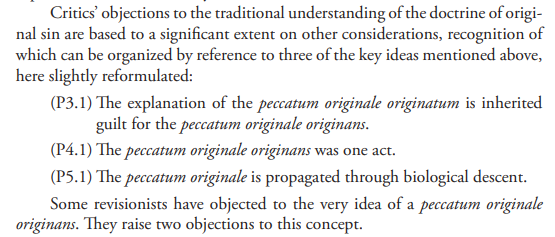
First, note that the “revisionists” are Catholic theologians in good standing with the church. Second, note that I’ve written a quite lengthy peer-reviewed article to solve the peccatum originale originans in the context of evolution (a population).

Note that the Catechism doesn’t explicitly require the historical existence of Adam and Eve.
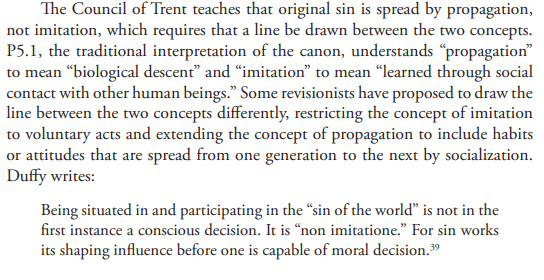
I disagree with the Council of Trent and totally agree with the Catholic theologian Duffy here.
Yes, my mistake!
Oof. I prefer to regard them as innocent and, in any case, trust that God is more merciful and just than we are.
No one will ever accuse me of 100% originality, and like I said, I ran a summary past Kemp and a couple of more Catholic theologians (whose names escape me) just to see whether it was compatible or heresy.
Or I would ask: Do you think the first human population sinned and distanced themselves from God? Same result.
I understand. We just disagree. I think sin is impossible without acquiring the “knowledge of good and evil,” which is mature human morality. I think infants and children and the intellectually disabled possess souls without having the capacity to understand abstract concepts like good and evil. There’s a reason societies don’t put 6-yr-olds in jail. So, let them all go to heaven in my humble opinion.
Yes, I get that. But it still assumes the premise: some prehistorical state that can never be proven nor disproven.
Pay closer attention.
3 Likes
George, I quoted the New Advent encyclopedia above which said basically this. Without the preternatural gifts we are screwed. Hence the need for Jesus. The views are not that far apart, if at all.
Feser: “ But according to Christian theology, God offered to our first parents more than what was “owed” to us given our nature. He offered us a super natural gift. Here it is crucial to understand what “supernatural” means in this context. It has nothing to do with ghosts, goblins, and the like. What is meant is rather that God offered us a good that went above or beyond what our nature required us to have. In particular, he offered Adam and Eve the beatific vision – a direct, “face to face” knowledge of the divine essence which far transcends the very limited knowledge of God we can have through natural reason, and which would entail unsurpassable bliss of a kind we could never attain given our natural powers. He also offered special helps that would deliver us from the limitations of our natures – that would free us from the ignorance and error our intellectual limitations open the door to, the moral errors our weak wills lead us into, the sicknesses and injuries our bodily limitations make possible, and so forth.
I think they are the same view to be honest. I can’t speak on every issue for Feser but I think there are a few ways to respond to this. I think they all require an actual Adam and not a group of Adams.
-
One reason is simply scripture. Romans tells us sin and the consequences of Adam’s disobedience spread to all humans. Neither Feser nor the Church, nor any other Christian, to be quite honest, should disagree with this without hefty consideration and very serious reasons for believing otherwise.
-
Trent makes it clear that this sin cannot be due to imitation. Catholics seem bound to that.
-
Feser’s view is based on what a human being is and this ties in with the scriptural argument just mentioned. Those humans who coexisted with Adam are not necessarily human beings as understood by the Church. Feser is careful to point out that God creates souls at conception.
-
I think implicit here is that only the children of Adam and Eve and everyone else in that genealogy going forward were given souls at birth or at least extended God’s hand. There would be full metaphysical humans alive with biological human animals. Thus it would be impossible for there not to be a literal first Adam, because all humans (true metaphysical humans) only come from that lineage. There are no humans not genealogically related to Adam. Any alternatives would lack a human soul (or maybe theological gifts) and be biological animals . Feser and many other theologians are careful to lay out arguments on human nature before addressing these issues and he did so. So how do we know this is the case? Think about the problem if we did not have a single human pair. From Kemp’s article that Feser references:
And even if we were to consider the possibility of a smaller population, another problem that confronts theories of a collective original sin is the problem of the small children. A group of any significant size wil contain children below the age of reason, who are not capable of committing any sin. What would be their relation to original sin? Original sin is in all human beings. These children could not have participated in the commission of the original sin. It cannot, according to the Council of Trent,
have been infused into them by imitation when they attain the age of reason.
It cannot have been transfused into them by propagation, as they would have
been conceived in the pre-lapsarian world.
[@Jay313 we posted at the same time, as you are aware, this above was Kemp’s response below the Duffy line you quoted --seems to be a strong argument for monogenism]
Not having an original couple we all come from undercuts the doctrine of original sin itself. I am guessing Feser is aware of this but I cannot give his opinion on the issue. Kemp also writes:
The distinction between the biological species concept and the theological
one si important, since they are not necessarily co-extensive. Two individuals, one theologically human and the other not, would remain members of the same
biological species as long as they were capable of producing fertile offspring. While ti would certainly be a theological error to exclude any members of the biological species now living from the philosophical or theological species man (i.e., to hold that they lacked rational souls, or that they were not among those to whom God had offered His friendship), there can be no theological objection to the claim that some one (or two members of a prehistoric, biologically (i.e., genetically) human species were made sufficiently different from the others that they constituted a new theological species, e.g., by being given a rational soul and an eternal destiny.
It’s one of those, in the fullness of time God chose two individuals. As far as I can see, this makes sense of the most evidence including all the biological evidence, all the scriptural evidence, a very extensive Church history and belief, metaphysical and philosophical arguments for rational nature of humans and souls that could not have evolved. It’s almost too good to be true.
It’s not the easiest thing in the world to wade through the beliefs of almost 2 billion people today, and arguably, the greatest and most extensive intellectual tradition there was the last 2,000 years. The apologists teach that Trent used analogical language but also I think privation was there. If you want to know what Catholics believe, today at least, the Catechism and New Advent are good places to start. Privation is clear in both.
But to muddy the waters some, Pope Pius XII was not speaking ex cathedra in Humani Generis, and though we give him utmost respect and due reverence as the Pope, that teaching is not necessarily considered infallible. Some Catholics do not think polygenism is definitively ruled out since he said, “Now it is in no way apparent” as opposed to “it is not possible.” Kemp also wrote:
I should be noted, however, that Pope John Paul Il’s comments on evolution ni his Address to the Pontifical Academy of Sciences of 2 October 1996, though they followed Pope Pius XII’s encyclical on many points, were silent on the question of monogenesis. A 2004 study prepared by the International Theological Commission entitled Communion and Stewardship: Human Persons Created in the Image of God is pointedly non-committal, referring to “the emergence of the first members of the human species (whether as individuals or in populations)” (International Theological Commision: Texts and Documents, vo.l :21986-2007, ed.
I think these (what I suspect are fringe or a minority of) Catholic theologians are on the wrong track.
Vinnie
1 Like
Did you mean to say local flood?
Sorry, just noticed that. I’ll also note that Kemp had this to say, which I find morally and theologically monstrous. He tries to wriggle his way out of it in the next few sentences, but it’s the same reasoning that has been used throughout history for racism and genocide.
“The distinction between the biological species concept and the theological one is important, since they are not necessarily co-extensive. Two individuals, one theologically human and the other not, would remain members of the same biological species as long as they were capable of producing fertile offspring.”
Humans and not-quite-humans living side-by-side and interbreeding, yet one is “fully human” and the other isn’t despite being members of the same species. It’s morally repugnant to me.
I’ll come back tomorrow and reply to @Marshall and the rest.
1 Like