gbrooks9
(George Brooks, TE (E.volutionary T.heist OR P.rovidentialist))
141
Swamidass did NOT require the de novo couple was created “just prior to 4,000 B.C.”. He has a preferred range extending from the usual Biblical time frame (circa 6000 years ago) - - back to 10,000 BCE (aka 12,000 years ago).
If some evangelical INSISTED that Adam and Eve were created 40,000 years ago, he might likely say “Fine. How do we spell your name for the theistic evolution certificate?”
T_aquaticus
(The Friendly Neighborhood Atheist)
142
Does Swamidass require A&E to exist at 4,000 BC? I thought it was more flexible than that, but could be wrong. Putting A&E at 50,000 BC would probably work. [and what @gbrooks9 said]
From my understanding, the main push for the genealogical A&E was to preserve original sin, not to necessarily support YEC. It is often considered an accommodation within theistic evolution for those who think original sin is an important part of theology. In this set up, A&E are created separately from all other existing humans, and then their children interbreed with existing humans. At some point, everyone would have A&E as one of their direct ancestors.
The temples of the Gobekli Tepe archeological site would indicate a highly developed social spirituality going back to that time frame, which is pre-literate and pre-agriculture.
I’d forgotten you were a Thomist. I’ve had about as much luck persuading y’all as I have persuading YEC.
Okay. Getting serious. Infant baptism has as more to do with Catholic tradition than Catholic theology. In Catholic theology, unlike pure Augustinianism, an unbaptized infant would go to purgatory, not hell. Why? Because they may be “guilty” of inherited sin, but they aren’t capable of willful sin at that age. More on that later…
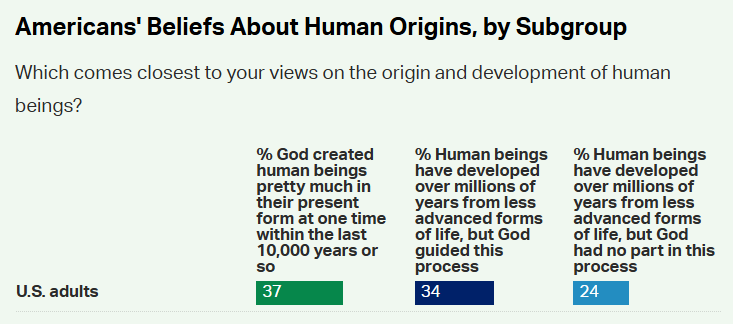
Catholics are fine with evolution. In fact, a plurality accept God-guided evolution and a minority insist on a literal Adam and Eve, despite your link that claims otherwise.
Catholics are 100% onboard with each individual soul being specifically created by God. Okay. That can be reconciled with evolution among a population, but it’s a non sequitur to tie that to original sin. What does the creation of a soul have to do with a sinful nature? In the story, didn’t ha’adam and ha’issah receive souls before they’d sinned? Clearly, becoming a “sinner” isn’t the same as being “ensouled.” It’s a category mistake to confuse God’s creation of a soul/body with sinfulness, which comes later as the result of maturation and conscious choice. “Ensoulment” comes long before any person’s “first” morally culpable sin, whether we’re talking about the first human beings or one born yesterday.
Hans is a Protestant Fundamentalist. Not sure what he has to do with Catholicism.
I disagree. It’s not irrelevant when one claims that an immaterial concept like “sin” can be physically inherited. It’s categorically different than the Trinity or the existence of the soul. Revelation isn’t clear and neither is “Church” teaching.
Appeal to “miracle” only when necessary. In my view, “sinfulness” is entirely mundane and banal, as Arendt would say.
Okay. Still silly. His preferred range is 12,000 years ago. So the claim is still that humanity prior to the invention of agriculture and city-states was somehow without sin. That goes against every scrap of archaeological evidence we have. Would you like me to detail the evidence of murder, idolatry, divination, cannibalism, etc., prior to that point? He also claimed things like bigotry and slavery didn’t exist before 12,000 years ago. Another silly claim without evidence. Should I go on?
The main push was to create a plausible scenario that would allow YEC to reconcile with evolution. That required a timeframe acceptable to YEC, which is why Swamidass blew his lid when I pointed out the isolation of Tasmania starting at least 12,000 years ago. His claim in the GAE book was earlier. He responded by emailing every scientist I cited in my article and libeling my professional reputation as a journalist. All of them emailed me back and supported my reporting. I seriously wish Swamidass would challenge me publicly on this. I would sue his ass off, and he would lose.
It’s a card trick.
@gbrooks9 , do you believe the GAE scenario is historically true? I know you don’t. Neither does Swamidass. He’s never once said he personally believes his own scenario. I know you only talked up GAE because you believed it was the best chance to get YEC to believe in the science of evolution. That didn’t work out, like everyone knew it wouldn’t. So why come back here talking that same old nonsense?
gbrooks9
(George Brooks, TE (E.volutionary T.heist OR P.rovidentialist))
146
You sound exactly like someone who hasn’t read “Genealogical Adam & Eve”.
Of COURSE sinful ways existed in the pre-Adamite population. If he actually wrote that, then he is mistaken. Evolution is FULL of sin….. because sin is the way of the flesh. Not because of Adam & Eve made a bad decision …. but because moral awareness and moral agency are divine attributes given to humanity according to the Augustinian metaphysical model.
If you don’t like the Augustinian metaphysics, I would congratulate you. So, if you were Christian, you would be a member of the Eastern Orthodox communion…. with a totally different metaphysical stance.
But, instead, you are an atheist …. MOCKING THEIST problems.
Well, Eastern Orthodox is not the only denomination having a different stance than Augustinians. The second largest Christian movement globally is the Pentecostals. Some parts of Pentecostal teaching are closer to the Eastern Orthodox than the western tradition - there exists a hidden Orthodox in the heart of every Pentecostal, as one of my teachers said (she is a Pentecostal theologian specialized in systematic theology).
Basically all churches having Eastern Orthodox, Arminian-Wesleyan, or comparable theology refute the Augustinian teaching and thinking (‘metaphysics’). Probably also several other Christian denominations and movements would prefer to leave Augustinian ‘metaphysics’ to the dusty darkness of history.
2 Likes
T_aquaticus
(The Friendly Neighborhood Atheist)
148
There’s obviously some history I am inserting myself into, so I will just offer my own view. If original sin is the last hangup a YEC has with evolution then a genealogical A&E set farther back in time (say 50,000 years) would work.
3 Likes
gbrooks9
(George Brooks, TE (E.volutionary T.heist OR P.rovidentialist))
149
Do tell! Can you provide ANY documentation of a pentecostal (or any other non-Eastern denomination) that rejects Original Sin? This is the first I’ve heard of this possibility and so I think - - if we can find that evidence - - it would be important to expand the evidence base on “rejection of Original Sin”!
G.Brooks
gbrooks9
(George Brooks, TE (E.volutionary T.heist OR P.rovidentialist))
150
@knor
I’m following your lead…. I had never encountered this before… and I see now that Protestants can vary widely on what I thought was a unified endorsement of original sin doctrine. Here is a Google summary:
There are Protestant denominations that reject or hold a different view of original sin, particularly in how guilt is inherited. Denominations like many Baptist and some Anabaptist groups believe infants are born without the guilt of Adam’s sin, but with a propensity to sin. They teach that individuals are responsible for their own sins and are not condemned for Adam’s transgression.
Baptists: Many Baptist churches, including Southern Baptists, do not believe individuals are guilty of Adam’s sin. They hold that everyone is born with an inclination toward sin, but not with inherited guilt. This view is a primary reason they do not practice infant baptism.
Some Anabaptists: Early Anabaptists believed that baptism is a conscious, adult decision after an informed confession of faith. This is consistent with a view that a person is not born a sinner in a state that requires immediate baptism to remedy.
Arminianism: Some Protestant traditions, following the theology of Jacobus Arminius, deny that Adam’s sin is imputed to his descendants. They believe that humanity retains some free will to follow God’s law and accept God’s grace, which is different from the Calvinist view of total depravity.
Pentecostal and Charismatic: Some Pentecostal and Charismatic churches also teach that humans are not born with an inherited guilt of sin from Adam.
The irony here is that the explanation of this “primary reason” buys into a Roman understanding of baptism – they’ve accepted one premise but haven’t questioned the other.
A key source of confusion is how ‘original sin’ is defined.
If you define it just as a propensity to sin, then the vast majority of denominations would agree. But is ‘original sin’ a good name for the propensity to sin? I would answer ‘no’.
If you include inherited guilt into ‘original sin’, then there is much more disagreements. I assume that Augustinian theology is practically the only tradition supporting it.
With inherited guilt, even newborn children would be doomed. Therefore, such an interpretation about original sin is associated with the interpretation that being ‘born again’ happens in baptism - baptism saves. Basically, the denominations that practise believer’s baptism deny the inherited guilt although they usually agree that we have a propensity to sin.
Of those churches that baptize even newborn children, all do not accept the hypothesis of inherited guilt. Eastern Orthodox church is probably the largest example of that.
Good gosh, George. I wrote a two-part review of the book, and yes, he actually wrote that.
I don’t like Augustine in general. I’m an atheist? What on Earth are you on about, besides violating the BioLogos’ rules for gracious dialogue?
Please review the rules and guidelines for gracious dialogue before you post.
Focus on discussing other people’s ideas, not on evaluating their character, faith, communication style, or perceived “tone.” Please avoid attributing beliefs, motivations, or attitudes to others.
Assume legitimate Christian faith on the part of other people, unless they identify otherwise. The purpose of discussions here is not to judge the legitimacy or efficacy of anyone’s faith or lack of faith.
I suggested that option too. But the fact is the idea was presented to YEC over and over, and none of them could swallow evolution and give up their literal interpretation of Genesis.
1 Like
gbrooks9
(George Brooks, TE (E.volutionary T.heist OR P.rovidentialist))
157
Your grasp of what he wrote in GAE seems fairly weak …. otherwise the objections you make wouldn’t use the words that you use.
It makes you sound like an atheist…. if you are not, my apologies. Otherwise, I am quite surprised that you are not an atheist. It’s not like being an Atheist is an insult or a crime. It’s just a viewpoint that is particularlly irrelevant to BioLogos.
Do you actually endorse a “god-guided evolutionary” viewpoint?
While this is a novel interpretation, I see the rational possibility of solipsism as a defining feature of original sin. Even the serpent in the garden used the plural pronoun to mask the loneliness of what it would be like for someone to be God. “You all are capable of it.”
Lol. Is your memory really that bad, George? It’s only been 5-6 years. You act like you don’t know me. You make me want to repost my reviews here.
Part One pointed out the scientific problem with Tasmanian isolation due to sea-level rise from 12,000 years ago until the 19th century. For GAE to fit the YEC chronology, that meant disaster. Swamidass had to post a whole essay trying to hand-wave the problem away. It’s still up on his website.
Part Two pointed out the theological problems with GAE; it was titled “Genealogical Adam & Eve Makes God a Monster.” His last solution to the Tasmanian problem was that original sin didn’t quite reach Tasmania before the time of Christ. Ummm. Okay. Did Christ not die for them, since they were untainted by original sin via genealogy, or did Europeans raping and impregnating Tasmanian women cause all the inhabitants to be “infected” with original sin?
The whole thing is nonsense, which is why his numerous symposia and repeated pleas for theologians to take up the problem rang on deaf ears, with the exception of Jon Garvey, who ran off the rails on Covid conspiracy theories. Remember me yet?
Yes. If you bothered to read anything I’ve written on the subject, you wouldn’t have to ask.
Now answer my earlier question: Do you actually believe in a literal Adam & Eve, a la GAE? Be honest. I have a hard time thinking the George Brooks I know, who doesn’t believe in a literal Moses or a literal Exodus, somehow believes in a literal Adam & Eve.
For the record, I don’t believe in a literal “fall.” There never was a state of perfection from which humanity “fell” from grace. It’s a misnomer. The first humans reached moral maturity and chose selfish interests. Simple. Here are the links.
Layperson’s version:
Peer-reviewed version:
Feel free to tell me where I’ve gotten anything scientifically wrong.