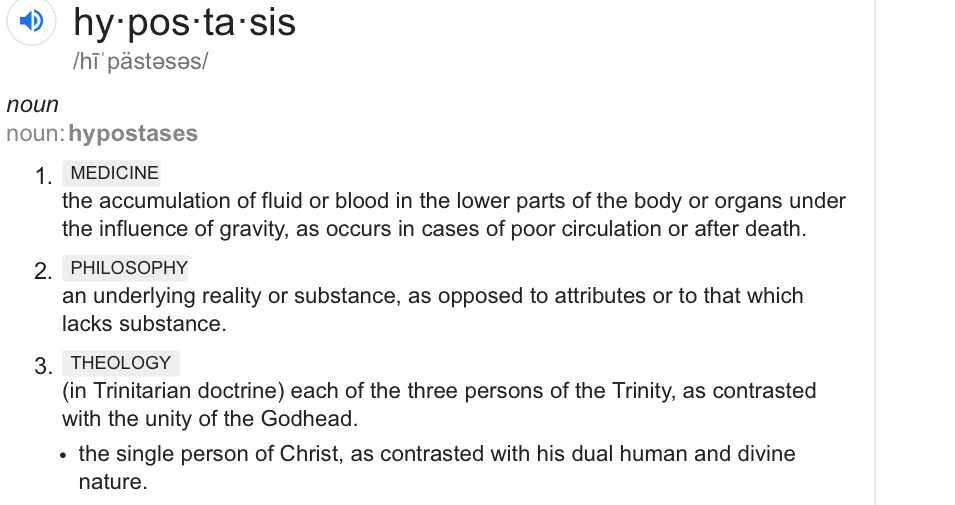
I see. I searched this up and “hypostases” is just a technical term for one of the persons of the Trinity, whereas “consubstantial” refers to the common properties of each person of the Trinity, that is, they are of the same “essence” or something. Do you disagree with that?
Are you absolutely positive that Jesus did not have a dual human and divine nature? I’m not. I don’t think humans are qualified to make that differentiation.
I don’t think that is clear in scripture, and people who saw a dual nature of Jesus, human and divine, were excommunicated by the Roman Church.
That’s right. Only Jesus is a people. The Bible uses pronouns for God and the Holy Spirit. As a matter of fact, a familiar/informal form of address is used to address God (thou, thy, etc.), e.g. “Hallowed be thy name.” But we know God has no gender, yet he’s not a thing.
The orthodox position is that Jesus has a divine nature and a human nature, and the two cannot be separated. This view is held by Eastern Orthodox,Roman Catholic, and mainline Protestant churches.
Another group (can’t remember the name) believes Jesus has both a divine nature and a human nature, but the two are not blended. So, for example, when it says that Jesus wept, that comes from the human nature.
And the Monophysites believe that Jesus has only one nature–a divine one. An example of a Monophysite church is the Armenian Church. These guys rejected the 4th ecumenical council. Was it just a misunderstanding? The singing in the Armenian church is very beautiful. The Armenians have the dubious distinction of being the first people targeted for genocide, perpetuated by the Turks, Turkey denies it to this day. Armenian vestments, chalices, etc. and also quite gorgeous, and the American Museum of Natural History has a nice display of these things in one of their cultural halls.
My brother-in-law’s grandfather was hanged by the Turks because he was a member of the clergy. I am well aware of the Armenian genocide.
Are you aware that the Armenian Church was not in complete agreement with the Roman Catholics? For example, the Armenian Church did not accept the book of Revelation until 1000 AD.
People communicate online through words. Terminology and posts are the evidence and arbiters of what is presented. Many of us can’t guess your post is in jest.
This is why the definition of the doctrine of the Trinity is important and can’t simply be winked at and its specific words ignored.
This creed was the agreement by the leaders of the churches gathered from all over Christendom in 325AD to decide what it was that constituted the beliefs of their religion. It was a similar gathering 57 years later which decide which books would be included in the Bible. The gatherings and decisions were proven necessary to prevent others from hijacking Christianity with their own personal beliefs.
The trend of later such gatherings were to add more beliefs to the creed and thus a narrower definition of Christianity. Thus we can say that the earliest of these is the broadest definition of Christianity as agreed to by all of Christendom at the time. Of course I quite understand that many people reading the Bible may come to different conclusions. In that case honesty requires us acknowledge that we have stepped outside of traditional historical Christianity. This is not a uniformity of belief in Christianity for there are many other issues not covered by these agreements and thus they are part of quite a diverse spectrum of beliefs within Christianity.
None of this is say anything about which is true or which has the approval of God. That is for God to say. But every religion has the right to decide how their religion is defined and what are the bounds of their beliefs. This is required for effective communication at the very least. Since I reject the Gnostic gospel of salvation by knowledge then these bounds of belief have nothing whatsoever to do with saying who is saved or not.
I think you have overestimated the representation with your statement that the leaders came from “all over Christendom.”
The churches in Persia, China, India, Northeastern Africa, and Armenia were not well represented, if at all.
“Traditional Christianity” is more than the practices and beliefs of churches within 200 miles of the Mediterranean Sea, but the church history in the west is so Roman Catholic-centric that people are ignorant of the broader traditions.
 after I say something, I’m probably being facetious.