I agree with you.
Unfortunately, the doctrine of the Trinity is more specific.
I agree with you.
Unfortunately, the doctrine of the Trinity is more specific.
You seem to have gone off on a tangent. Three tangents, actually.
The doctrine of the Trinity is more specific than scripture as to the relationship between the Father, Son, and Holy Spirit.
It sounds like you don’t know that you don’t believe the doctrine of the Trinity.
I acknowledge 1 Cor 8:6 and the Old Roman Creed, “one God, the Father”
Humbly offer we’d all do well to distinguish two distinct notions:
[The] God is unitary according to His Person. His Godhood is trinitary, and extends from Himself into His Word & Spirit who share His fully divine essence & nature & being.
The Son, as the Word incarnate, was Godhood incarnate (Col 1:19, 2:9-10, “in him the fullness of Godhead dwelt bodily”). But the Son was not [The] God the Father in His Person incarnate (John 3:16 = Parable of the Wicked Tenants, “God sent His Son” but not Himself directly).
Only for non-Trinitarians. That is the minimal statement of the doctrine of the Trinity.
The official agreement and most minimal definition of Christianity is the creed of Nicea 325 AD.
We believe in one God, the Father Almighty, Maker of all things visible and invisible. And in one Lord Jesus Christ, the Son of God, begotten of the Father [the only-begotten; that is, of the essence of the Father, God of God,] Light of Light, very God of very God, begotten, not made, being of one substance with the Father; By whom all things were made [both in heaven and on earth]; Who for us men, and for our salvation, came down and was incarnate and was made man; He suffered, and the third day he rose again, ascended into heaven; From thence he shall come to judge the quick and the dead. And in the Holy Ghost. [But those who say: ‘There was a time when he was not;’ and ‘He was not before he was made;’ and ‘He was made out of nothing,’ or ‘He is of another substance’ or ‘essence,’ or ‘The Son of God is created,’ or ‘changeable,’ or ‘alterable’— they are condemned by the holy catholic and apostolic Church.]
To be sure the focus in this first agreement is very much on the Father and Son as distinct persons but only one God. And many prefer the updated version from Constantinople 381 AD, which says a bit more about the Holy Spirit.
Such doctrines have been largely spelled out by what is being rejected:
Polytheism - more than one God
Arianism - Jesus as a created being.
Sabellianism - the Father, Son, and Holy Spirit are not separate persons.
So the doctrine of the Trinity is in direct opposition to these: One God, all of them God, distinct and separate persons.
The overstated version of the doctrine of the Trinity is found in the Athanasian creed which although popular among a large portion of Christianity was never actually agreed to in an ecumenical council.
No that is Wikipedia – not the almighty final authority on the definition of words and statement of doctrines you make it out to be. It is not a terribly bad statement of the doctrine but neither is it the earliest or most minimal statement of the doctrine.
I’m toying with changing the title of this thread to “Hung up on terminology.” 
Unfortunately, the doctrine of the Trinity is more specific.
What is it about this doctrine you don’t accept?
He was echoing you, to show you why that just because particular labels of concepts don’t appear in the Bible doesn’t mean that they are not taught there. Remember the distributive property.
Ha. I am not sure it is possible to have an honest discussion about the Trinity or any theological concept without getting specific about definitions.
Maybe “Hung up on labels”? 
Or maybe to borrow from the phonics program, call it “Hooked on Semantics.”
Or “Tripped up by…”
Absolutely. Though getting specific without getting hung up can be the difficult part, otherwise things go around in circles. 
Thanks for asking.
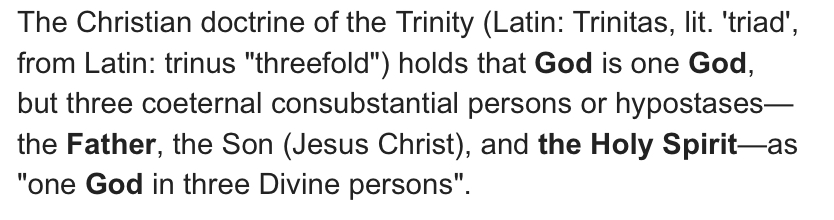
I disagree with the specificity, in particular with the certainty of calling them “consubstantial persons or hypostases.”
This is much farther than what is clearly revealed in scripture.
It is clear from scripture that there is God the Father and that both Jesus and the Holy Spirit are God. To be more specific, and to call unorthodox or heretical those who disagree, is unnecessary and divisive.
Wow, that’s quite an admission.
The “essence” of the Father and “being of one substance with the Father” are more specific than what has been revealed in scripture and more divisive to the body of Christ than necessary.
Trip wires were set by those thought they could define God. You don’t appear to have noticed you tripped and fell into the trap.
You’re going to have to do better than that if you are trying to insult me, since you didn’t even recognize that @ErikNelson was echoing you. Merely recognizing scriptural attributes is not ‘defining God’, and somehow in your mind limiting him. Would I be limiting your breathing by recognizing and stating that you have a nose?
How is reading the details of the doctrine and recognizing that some details cannot be justified as certain getting “hung up?”
Shouldn’t we assess these extra-Biblical assertions for validity and truth?
I did not intend to insult you, only to review your situation.
As to your making pronouncements as to what others are doing and how I view their response, you are free to express opinions but don’t think you know.
…is making a “pronouncement as to what others are doing.” 
“Let your conversation be always full of grace, seasoned with salt, so that you may know how to answer everyone.” -Colossians 4:6
This is a place for gracious dialogue about science and faith. Please read our FAQ/Guidelines before posting.