Denying that God is triune puts you outside orthodox Christian teaching?

Look at definition 3.

It’s exactly as I said. One of the persons of the Trinity.

Are you absolutely positive that Jesus did not have a dual human and divine nature?

You’re completely misreading the definition. The definition is clarifying that the term focuses on the personhood of Christ, and not focusing on his dual nature. The word does not deny the dual natures of Jesus.

Not disagreeing with your citations of creeds

Do understand that the EO strictly maintain the Monarchy of the Father, such that the entire triune trinitary God[head] of shared divine nature essence being is rooted in the unitary Person of the Father himself, and extends from his Person “outwards” into His Word & Spirit, all three of which Person-ified entities collectively comprise the triune trinitary God[head]

whereas western Christians, characterized by the “Athanasian” creed you mentioned, are wont to “invert divinity”, and claim that the God[head] of shared divine nature essence being is the actual source of everything, even of the Father himself in his own Person

Despite what they agree to in writing, what they say in practice implies that (according to them) the unitary Father’s Person is generated by the trinitary shared God[head] of divine nature essence being

that verges on being almost indistinguishable from modalism, one God[head] which manifests in three different modes (generated Father, begotten Word, proceeded Spirit)

But I do feel clear, that even Christian scriptures as they survive today, do not justify this “quasi-modalist” perspective

The Father’s Person is not caused, but rather causes & generates all else that exists, in eternity (Word & Spirit) and creation (angels & humans)

It says more than that, but I can’t make you read or recognize what it actually says.

Was this a basis for excommunicating Nestorius? And doesn’t the actual doctrine of the Trinity (not these simplified understandings derived by avoiding the specifics) require that people view Mary as the “Mother of God,” another basis for the excommunication of Nestorius?

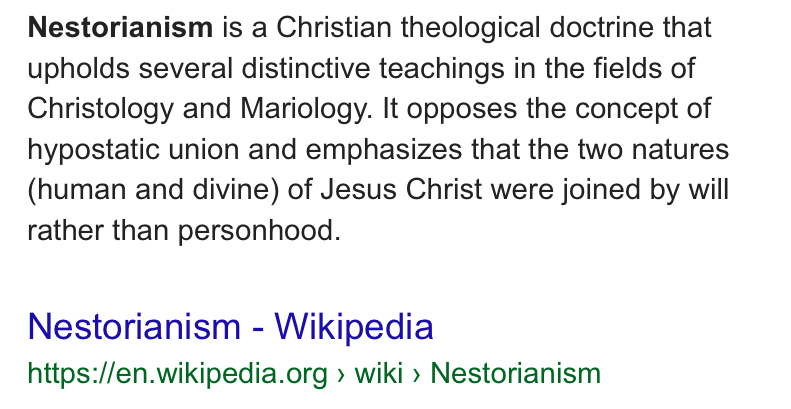
It literally does not. Maybe a different source will help us here. According to the Cambridge Dictionary of Christianity,

Hypostasis (Gk for the reality underlying appearances), a key word in the trinitarian∗ controversy, first used as a synonym of the term ousia (nature) to mean a self-subsisting reality. The Cappadocians∗ made a distinction between the two terms: “one ousia in three hypostases” – one “nature” in three “realities” or three “persons” – became the accepted view of the Trinity for many churches. Hypostasis became a focal issue in the christological∗ controversies, when the Council of Chalcedon∗ declared that Christ was “one person (hypostasis) in two natures,” while the Miaphysites∗ spoke about Christ as “one incarnate nature of the divine Word.” (pg. 579)

Here, the Cambridge Dictionary of Christianity is accessible right here if you want to double check me. I even bolded the part where the text directly equates the term person with hypostasis. They are synonyms. Nothing more, nothing less. This is a verifiable fact from any reputable text on the topic.

Was this a basis for excommunicating Nestorius?

Why are you jumping topics? Nestorius was considered a heretic for denying that the persons of the Trinity were one in nature. To Nestorius, the relationship was between their wills.

1 Like

Christianity in China appeared in the 7th century, during the Tang dynasty, but did not take root until it was reintroduced in the 16th century

All the bishops of the Roman empire (which is where roads were built) were invited. That is always the case with a democratic process. Those who don’t vote are effectively abstaining. In any case, bishops from Armenia, India, Persia, and Africa did attend. So all in all I think you are just making stuff up. Regardless, yours is a typical gaps argument where instead of projecting you want to be the case on the gaps in scientific discovery you are projecting them on people who supposedly did not attend the council. Not interested.

Yes I am aware of the disagreement between EO and RC. There are differences on many doctrinal issues and I frequently agree with the EO in those cases. Like I said, there is a spectrum of beliefs within Christianity. This particular issue is gobble-dee-gook to me, arguing about things I seriously doubt they are capable of understanding correctly.

Arguments between EO and RC making tenuous connections of the other’s position to modalism sound outright absurd to me – nothing but empty rhetoric posturing. The plain fact of the matter is that both EO and RC reject and oppose modalism – end of story. Frankly I believe that the conflict between EO and RC was really about power and disagreement about the distribution of power in the church. The EO kept the ecumenical council as the ultimate authority and the RC made the patriarch of Rome the ultimate authority. It was democracy versus monarchy.

It seems like one of the arguments is was Jesus, the son of God, also God. So what does scripture say about if. Some parts are worded funny and uses metaphors based on understanding the Torah in depth. I’ll go into them later. But understanding Son of Man vs Son of God is important. Jesus uses both to refine him. Son of Man is actually associated more with spiritual stuff and a stronger claim. Many from people , and angels, were referred to as sons of God but not so much with son of man.

Anyways scripture says this about Jesus.

John 1:1-5 New American Standard Bible (NASB)

The Deity of Jesus Christ
1 In the beginning was the Word, and the Word was with God, and the Word was God. 2 He was in the beginning with God. 3 All things came into being through Him, and apart from Him nothing came into being that has come into being. 4 In Him was life, and the life was the Light of men. 5 The Light shines in the darkness, and the darkness did not comprehend it.

  • Here it says in the beginning was the word and word was with God and the word was God. So whatever the word was the word was with God and also the word was God.

John 1:14 New American Standard Bible (NASB)

The Word Made Flesh
14 And the Word became flesh, and dwelt among us, and we saw His glory, glory as of the only begotten from the Father, full of grace and truth.

  • That word that was with God and was a God became flesh and dwelt among us. That means God became flesh and dwelt among us. The only begotten son is a different phrase than the son. Monogenés is the word and it implies a unique position of being the single one ( only one of its kind). Such as a man having just one daughter or one son. So it’s putting The Son in a state saying the only son out of the sons of God. This son was distinctly different from any one else called the son.

Philippians 2:5-11 New American Standard Bible (NASB)

5 Have this attitude in yourselves which was also in Christ Jesus, 6 who, although He existed in the form of God, did not regard equality with God a thing to be grasped, 7 but emptied Himself, taking the form of a bond-servant, and being made in the likeness of men. 8 Being found in appearance as a man, He humbled Himself by becoming obedient to the point of death, even death on a cross. 9 For this reason also, God highly exalted Him, and bestowed on Him the name which is above every name, 10 so that at the name of Jesus every knee will bow, of those who are in heaven and on earth and under the earth, 11 and that every tongue will confess that Jesus Christ is Lord, to the glory of God the Father.

  • Here it says that Jesus existed in the form of God. But Jesus did not consider himself equal to God when he emptied himself into the form of a bond servant. He took on the form of a man and obeyed his form that was still God ( signifying two separate personhoods which is also clearly shown through his prayers and temptation). So Jesus existed as God , but became human and humbled himself to a being lesser than God.

Hebrews 2:9, New American Standard Bible (NASB)

Jesus Briefly Humbled
9 But we do see Him who was made for a little while lower than the angels, namely, Jesus, because of the suffering of death crowned with glory and honor, so that by the grace of God He might taste death for everyone… 14 Therefore, since the children share in flesh and blood, He Himself likewise also partook of the same, that through death He might render powerless him who had the power of death, that is, the devil, 15 and might free those who through fear of death were subject to slavery all their lives. 16 For assuredly He does not give help to angels, but He gives help to the descendant of Abraham. 17 Therefore, He had to be made like His brethren in all things, so that He might become a merciful and faithful high priest in things pertaining to God, to make propitiation for the sins of the people. 18 For since He Himself was tempted in that which He has suffered, He is able to come to the aid of those who are tempted.

  • Why did God become flesh and humble himself as a person of flesh and blood? In short because it was necessary in order to take away the power of death in a justifiable way. He needed to complete something so that his father could grant grace and mercy though him.

Matthew 1:23 New American Standard Bible (NASB)

23 “Behold, the virgin shall be with child and shall bear a Son, and they shall call His name Immanuel,” which translated means, “God with us.”

  • The angel said to Joseph his son will be called Immanuel that means God with us linking further the fact that Jesus was God and God became flesh to be with us. The name is clearly being treated as a title and not a birth name.

So dispute some things being very confusing such as when Jesus said, “ why do you call me good only one is God and it’s God” , it can be cleared up as scripture progresses and it’s hammered out in more digestible ways for us to understand. It’s scripturally clear that Jesus was the flesh that became God among us. It’s clear Jesus existed as God prior to becoming flesh and blood and humbling himself. It’s clear that despite being God, in his humbled form as a man, he had to grow up exactly like a man and face the war of flesh vs spirit and overcome Satan to overcome death and fulfill the law so that through his grace and mercy can be given to justify saving mankind instead of destroying them.
2 Likes

The use of the definite article “the” is absolutely mission critical

The original inspired 1st century Greek reads:

“in the beginning was the Word, and the Word was with the God, and [a] God was the Word. Himself was in the beginning with the God…”

The use of the definite article “the” denotes a distinct divine Person, whereas the lack of the definite article, implying some in-definite-ness “a” not “the”, denotes the common shared divine substance essence nature of being aka Godhead / Godhood

Hence,

“in the beginning was the Word [2nd Person], and the Word [2nd Person] was with the God [1st Person], and [a] God [substance essence nature of being of Godhood Godhead] was the Word [2nd Person]. Himself [2nd Person] was in the beginning with the God [1st Person]…”

The Word is fully divine according to essential nature, but is not “the” Deity Divinity = “the” God = “the” Father Himself directly in His own Person

We seem to disagree both on the reason Nestorius was excommunicated and whether this excommunication is a different topic.

I did not refer to Eastern Orthodox, but to the Church of the East.

As for your Roman Catholic-centric view of only a church around the Mediterranean during the early centuries of the church, a little snippet:

“I. THE SYRIAN CHURCHES
The fact that during the first six centuries of the Christian era five or six separate versions of the Scriptures in Syriac were produced is testimony to the vitality and scholarship of Syrian churches. Indeed, as Eberhard Nestle has reminded us, ‘No branch of the Early Church has done more for the translation of the Bible into their vernacular than the Syriac-speaking. In our European libraries we have Syriac Bible MSS from Lebanon, Egypt, Sinai, Mesopotamia, Armenia, India (Malabar), and even from China.’17 As we have seen earlier (chap. V. I), the earliest canon in Eastern Syrian Churches consisted of ‘the Gospel, the Epistles of Paul, and the Book of Acts’. That is, instead of the four separate Gospels the Diatesseron was used, and the Catholic Epistles and the Book of Revelation were lacking.18”

Excerpt From
The Canon of the New Testament: Its Origin, Development, and Significance
Bruce M Metzger

This material may be protected by copyright.

John 3:16 (NIV2011)**
16 For God so loved the world that he gave his one and only Son, that whoever believes in him shall not perish but have eternal life…

If the way to eternal life is belief in Jesus Christ, then we need to know Who Jesus is. Is it right to believe in Jesus if He is not God? Jews and Muslims say emphatically, NO. If Jesus is God, how can the Father also be God?

Is Jesus the Savior or Not? If yes, the He is God. If not, Christianity not a faith, but a philosophy. If Jesus is not the same essence as God, but not the same, what does that mean? How then would Jesus be different from humans? .

We seem to disagree both on the reason Nestorius was excommunicated and whether this excommunication is a different topic.

Oh come on dude, what sources are you reading? Here’s the entire entry from the Cambridge DIctionary of Christianity on Nestorius:

Nestorius (c351–c451), patriarch of Constantinople (428–31). A native of Syria∗, he entered a monastery in Antioch, where he assimilated the Antiochene∗ tradition in biblical interpretation and Christology, probably studying under Theodore∗ of Mopsuestia. His reputation as a preacher led to his being appointed patriarch of Constantinople (428). He supported a member of his clergy who preached against calling Mary “Theotokos∗,” or “Mother of God,” because for him Jesus’ humanity and divinity were joined by will, not by nature or hypostasis, although the conjunction is so intimate that Jesus and the Word become one person, not two. Eusebius∗ of Dorylaeum accused him (wrongly) of Adoptionism∗. His position was attacked by Cyril∗ of Alexandria, who issued 12 anathemas, and by a council in Rome (430). At the Council of Ephesus∗ (431), Nestorius was removed from office and his doctrines condemned. Upon returning to his monastery, he was banished (436), supposedly to Petra but actually to Upper Egypt and the Great Oasis, where he wrote his Book of Heraclides, responding to the two Councils of Ephesus∗ (431, 449) and arguing that his views agreed with those who were now condemning Eutyches∗ (pg. 862)

A lengthier description of the theology of Nestorius can be found in J.N.D. Kelly’s Early Christian Doctrines (1968) pp. 310-314.

:slightly_smiling_face:

And above he was denying the very personhood of God. :roll_eyes: :slightly_smiling_face:

And why should we believe God is a person?

Other than the desire to support the “God in three persons” extra-Biblical descriptions, of course.

Are you saying God the Father is a person?

What’s wrong with saying that?

And how do you know Nestorius was wrong and the Western Mediterranean Church was right?

Or how do you know that either one was right?

The Church of the East took in Nestorius and consider him a righteous believer, so the ancient church was not unified in the views of Jesus.

What is wrong with declaring Almighty God, creator of the Universe, to be a person?

It does not seem to be man’s place to define God. Why would you think we are qualified to define God?

We been here before and I’m not going to rehash the obvious.

Also reread the surrounding posts.

Jesus told us to call God our Father.

Who told you to call God a person?

Many fathers are not persons. Consider the animal kingdom.

Am I defining or limiting your breathing by saying you have a nose? Scripture says God is knowable, not an encompassing and comprehensive knowledge, to be sure, but certainly an apprehensive one. If he is not knowable as a person (or Persons), then he is not knowable at all. Jesus loves. That is something a person does. Father loves. That is something a person does. He is lovable in return. I am loving a Person, not something abstract and undefinable.