Are christians called to imitate Jesus or perhaps not?

Recently, I was intrigued by the thought of “imitating Christ”. Like many other christians, I always assumed that we as christians are called to be like Christ. If we are following the teaching in “spiritual formation” circle, then we are familiar with spiritual disciplines of christian life which are basically the disciplines to help us to be more christlike in our characters. This is of course a wonderful endeavour as a christian. However, is it possible that that kind of goal is never meant for us?
The passage that intrigued me was the passage from Paul in 1 cor 11:1, “Be imitators of me, as I am of Christ.” Why did Paul encourage us to imitate Paul instead of Christ directly? Even, in greek, Paul didn’t say that he imitated Christ, but he just said that he was of Christ. (perhaps “owned” by Christ)

Perhaps, imitating Christ is never a goal for Christian because of who Christ is and what we are not. Christ was God in human flesh and we are not. All we can do is to follow Christ’s teaching.
Imitating Christ has turned out to be an impossible joke for us to bear, not an easy yoke.

For your broader question about imitating Jesus, 1 John 2:6 answers it directly. “This is how we know we are in him: 6Whoever claims to live in him must live as Jesus did.” Jesus also told us to take up our Cross and instructed His followers (FOLLOWERS!) on how to live properly (like Him). We are to imitate his love, compassion, self-sacrifice, mercy, etc., not be him. He is God. We can only imitate how He lived His human life in service to others.

As for Paul, it’s hard for me not to understand Paul as saying imitate me as I imitate Christ. That is how the NIV, NRSV, etc., translate 1 Cor 11:1.

NIV: Follow my example, as I follow the example of Christ.
NRSV: 1 Follow my example, as I follow the example of Christ.

To this verse you can add 1 Cor 4:16 , Gal 4:12 and Phil 3:17 where Paul also seems to talk about imitating himself.

Here are some quotes from the Baker Exegetical Commentary on Corinthians 4:16 which should be super helpful:

“Paul stresses his unique relationship to them as the one who “fathered” (ἐγέννησα, egennēsa, begot) them “through the gospel.”[1] Holmberg (1978: 78) finds that Paul reminds his readers of his fatherhood (or motherhood) in all his letters except Romans and that the concept “expresses the fact that he has begotten them or given them life by the transmission of the Gospel of Christ.” Paul refers to “the gospel” without a qualifier, which shows that he assumes they know what he is talking about. It is shorthand for the underlying gospel narrative of God’s salvific acts on behalf of humankind through Christ’s cross and resurrection and assumes that the Corinthians are thoroughly familiar with it (see M. Mitchell 1994). He uses the same verb to describe his relationship to Onesimus, whom he “begot” while he was in chains (Philem. 10). It is tied to bringing them to faith (2:4–5), planting (3:6), and laying the foundation (3:10). In rabbinic literature a proselyte is likened to a “child just born” (b. Yebam. 22a; b. Sanh. 19b; see SB 3:340–41), but this concept also would have been familiar from the mystery religions.

It goes on and this is more directly about what you are asking:

“It should be remembered that these first converts had no precedents or heritage to coach them on how to live out the radical demands of the gospel. They had only Paul’s verbal instructions and what they could witness firsthand of his own behavior and attitudes. Paul’s request that they imitate him, however, strikes many today as egotistical, but such criticism should dissipate when one traces what he could expect them to imitate. They are to give up their hankering for high status and accept the lowliness that Paul models. They are to welcome being regarded as fools for Christ, and as weak and dishonored. They are to return abuse with blessing, slander with conciliation, and to endure persecution (4:10–13). They are to recognize that all that they are and have comes to them as a grace-gift from God (3:10) and that they are not “inherently extraordinary (4:7). They are to think of themselves as no better than menial field hands (3:5) and servants (4:1) awaiting God’s judgment to determine if they were trustworthy (4:5). They are to rid themselves of all resentments and rivalries with co“workers so that they can toil together in God’s field (3:5–9). They are to resist passing themselves off as wise or elite by using lofty words of wisdom or aligning themselves with those who do and to rely instead on the power of God that works through weakness, fear, and trembling (2:1–4). The ultimate aim is not to be Paul-like, but Christlike (11:1). The Corinthians are to imitate him only insofar as his behavior corresponds to the gospel (cf. 4:9–13, his suffering; 9:19, his becoming the slave of all; 2 Cor. 12:9–10, his weakness; 2 Cor. 12:12, his patience).”

Yup, he is saying imitate me as I imitate Christ and His teachings.

Vinnie

4 Likes

If you want to see the commentary and discussion on 11:1 here it is:

On 11:1 the commentary reads:

“Paul often calls on his charges to follow his example or commends them for already doing so (4:6, 16–17; 7:7; Gal. 4:12; Phil. 3:17; 4:9; 1 Thess. 1:6; 2 Thess. 3:6–9). This appeal was a common literary and hortatory motif in antiquity (B. Dodd 1999: 16–18; see also Fiore 1986: 26–163), but it takes a different twist in light of the divine command “Be holy, for I am holy” (Lev. 11:44–45; 19:2; 20:26; cf. Matt. 5:48) and Paul’s assertion that he follows the example of Christ. He is to be followed only insofar as he adheres to the divine stan“dard set forth by Christ. As the Corinthians’ founding apostle, he revealed that stan . . .

“might benefit others, so Paul does not please himself (1 Cor. 10:33) but endures anything (9:12) and punishes his body to enslave it (9:27) that he might save others. Christ’s self-sacrifice for others becomes the norm of Christian behavior and the pattern for Christian evangelism (Ruef 1977: 106).”

Hope this helps.

Vinnie

2 Likes

It seems to me that not following Christ’s example has become the default position of most evangelicals in the U.S. They value him only as a political mascot rather than as an example to follow or listen to. So you have lots of company in questioning whether Christ should be followed, imitated, or even just listened to at all!

Among those who attend to the gospels, epistles, and prophets - it’s pretty hard to avoid the messages that “we need to take up our crosses and follow him” (in Matthew 16), that we “are not waging war as the world does” (2 Corinthians 10), that we “do justice, love mercy, and walk humbly with God…” (Micah 6) - just a few off the top of my head - not to mention the Sermon on the Mount. You have to work hard to miss all these themes, but there are many that seem up for the job!

3 Likes

Thank you Vinnie for referring to this passage. “walk in the way of Jesus” is of course does not mean automatically that we are to be like him in every way, but if we follow Jesus, we should expect that our walk would be hated by the world and face many hardships as Paul did. I refer basically to the notion of “imitating Christ” which has become an impossible yoke because perhaps it is not our goal in the first place. We are to obey Christ teachings and to abide by Him.

I am referring to the greek text of that passage. μιμηταί imitators g3402 μου of me g3450 γίνεσθε Be g1096 καθὼς as g2531 κἀγὼ I am g2504 Χριστοῦ of Christ g5547 Be imitators of me, as I am of Christ.

As you see in the greek text, Paul didn’t say that that he imitated Christ, but more toward “I am of Christ” which could also mean he is imitating Christ or maybe something else. The point is why did Paul commanded us to imitate Paul (who was a sinner and flawed person like us), but not to Christ directly (who is perfect and sinless).

agreed. However, take up our crosses and follow Jesus is not the same as imitating Christ.

So when Jesus teaches things like “It is enough for a student to be like their teacher, a servant like his master …” (Matthew 10) or to “be perfect as your Father in Heaven is perfect…” was he just kidding around? If they were right about this, we’d have to pretty much just throw out the entire New Testament biblical narrative (and much of the old as well).

1 Like

Yes, the the scholar who wrote the New Baker Exegetical commentary on 1 Corinthians and all the committees who translate the different versions of Bible that say “as I imitate Christ” are all aware of the Greek. The context of Paul and his broader message indicates he is saying follow me as I have followed Christ and the Gospel. He is their spiritual father in that he first brought the gospel to them.

The people lived in Corinth. They did not know Jesus. The Gospels were not yet written. They would have only heard select stories. They knew Paul in the flesh. He imitated Christ and lived out the Gospel. He was the model (Phil 3:17) for them to follow insofar as he followed Jesus. They were to imitate him and the Lord (1 These 1:6).

1 These 1:6: You became imitators of us and of the Lord,

Phil 3:17 (but see the context before) : “and just as you have us as a model, keep your eyes on those who live as we do.”

Fitzmyer from the Anchor Bible commentary:

11:1. Be imitators of me, as I am of Christ. Paul’s final impv. repeats what he said in 4:16 (see Note there), as he urges Corinthian Christians to follow his example, now in his unstinting service of all. He has already proposed himself implicitly as a model in the matter of not eating meat in 8:13; now he repeats that even on a broader scale. The subordinate clause that he adds to his imperative finds its ex- planation in what Timothy would explain to them in 4:17, “my ways in Christ [Jesus].” It also eliminates any suggestion of pride or arrogance on Paul’s part, be- cause he acknowledges that he himself is an imitator. Cf. Phil 3:17; 1 Thess 1:6.

Note that right after 4:16 Pauls says : 17 For this reason I have sent to you Timothy, my son whom I love, who is faithful in the Lord. He will remind you of my way of life in Christ Jesus, which agrees with what I teach everywhere in every church.

Here is Fitzmyer on 1 Cor 4:16

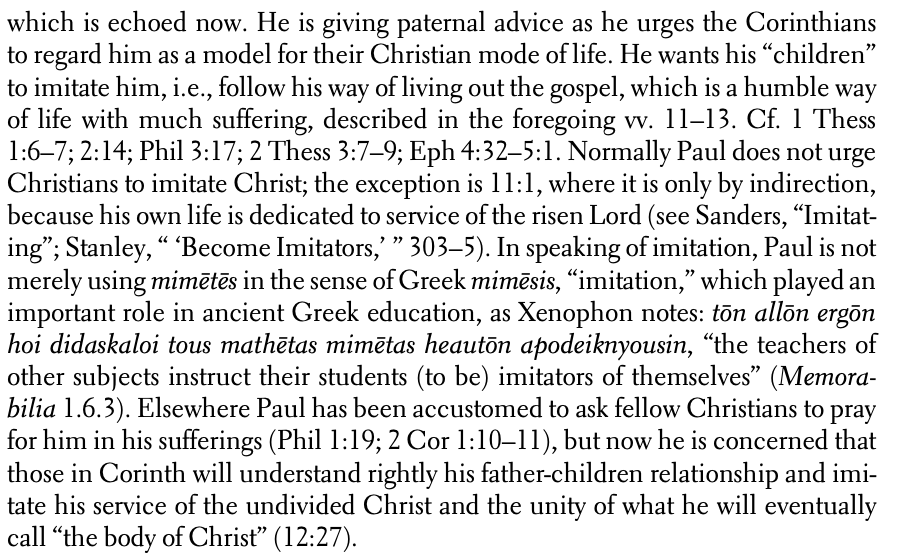
Therefore, I urge you, be imitators of me. Paul will repeat this exhortation in 11:1, where he adds, “as I am of Christ,” an addition that some inferior mss (104, 614, 629) have added even here. Paul employs the verb parakal∑ again; see 1:10,which is echoed now. He is giving paternal advice as he urges the Corinthians to regard him as a model for their Christian mode of life. He wants his “children” to imitate him, i.e., follow his way of living out the gospel, which is a humble way of life with much suffering, described in the foregoing vv. 11–13. Cf. 1 Thess 1:6–7; 2:14; Phil 3:17; 2 Thess 3:7–9; Eph 4:32–5:1. Normally Paul does not urge Christians to imitate Christ; the exception is 11:1, where it is only by indirection, because his own life is dedicated to service of the risen Lord (see Sanders, “Imitat- ing”; Stanley, “ ‘Become Imitators,’ ” 303–5). In speaking of imitation, Paul is not merely using mim≤t≤s in the sense of Greek mim≤sis, “imitation,” which played an important role in ancient Greek education, as Xenophon notes: t∑n all∑n erg∑n hoi didaskaloi tous math≤tas mim≤tas heaut∑n apodeiknyousin, “the teachers of other subjects instruct their students (to be) imitators of themselves” (Memora- bilia 1.6.3). Elsewhere Paul has been accustomed to ask fellow Christians to pray for him in his sufferings (Phil 1:19; 2 Cor 1:10–11), but now he is concerned that those in Corinth will understand rightly his father-children relationship and imi- tate his service of the undivided Christ and the unity of what he will eventually call “the body of Christ” (12:27).

Screenshot since the greek copy/pasta did not render properly.

Vinnie

1 Like

Please state what imitating Christ means for you. That might help us reach some common ground. Because to state the obvious, I assure you that if it means doing all that Jesus did, such as trampling the sea, controlling the weather, multiplying fishes and loaves, healing people at a distance, pronouncing a person’s sin forgiven of my own authority or dying asacrificial death for the sins of the world, I assure you that I cannot imitate any of that.

Vinnie

2 Likes

If we start by obeying Jesus’ commands, I think we are well on the way of doing what we’re supposed to do. If you want to call that obedience or imitation, I think they’re pretty much the same thing in this case.

2 Likes

Show me where the evangelicals hurt you…seems a bit of a jaded direction to take the OP.

Vinnie

I suppose Corinthians 4:15 is important as well:

4: 15 Even if you had ten thousand guardians in Christ, you do not have many fathers, for in Christ Jesus I became your father through the gospel.

“Each person can have countless teachers, but only one biological father. So Paul observes that the Corinthians could presumably have innumerable pedagogues to lead them to Christ, but each one could not have many spiritual fathers. For eighteen months Paul labored to plant the church at Corinth (Acts 18:11). Hence, he could truthfully say that in Christ Jesus he was the spiritual progenitor of the Corinthian church. From a Jewish perspective, a teacher who taught students the content of the Torah (the Old Testament Scriptures, other Jewish sacred literature, and oral tradition) was considered a father.45 In that capacity, Paul asserted his apostolic authority with respect to those members of the church who questioned it.”

1 Corinthians New Testament Commentary, Simon J. Kistemaker

I think it’s easy to forget that Paul founded many of the churches he wrote to and labored in them extensively. He felt an intimate connection to them and a clear vocation from Jesus who appeared to and blinded him on the road. The Corinthians didn’t have a New Testament. They didn’t have the Gospels. Paul would have learned the teachings of Jesus from His original followers and those they taught. he would presumably be relaying these in person as there are echos all throughout his writings. He sees himself as their spiritual father. He does expect them to imitate him but only insofar as he is living and preaching the Gospel of Christ. I can’t see getting anything else out of the big picture of Paul.

Vinnie

1 Like

We can be the Perceiver of what Holy is, I have felt what Holy is. The Song O Holy Night by Nat King Cole is an example of the Spirit which brings that Loving Feeling of All to each other. The Righteous Brothers sing “You lost that Loving Feeling” is the feeling the loss of Holiness. We don’t have Holiness for We are all in a Battle with each other with competition. In the US, We have Republicans fighting with Democrats, constantly criticizing each other. Jesus said My kingdom is not of this World, so We keep trying to make all different methodologies to create His Kingdom and We can’t. All We can do is behave as Holy as We can and know We are and will be in His Kingdom like Him.

Christ quite often said, go and sin no more…i think that is the aim.

Thing is, whether or not we sin in the future is irrelevant…we are already condemned and our wages are death.

This is why reading the books of Romans and Hebrews are so important…they both explain the principles of justification, righteousness, and sanctification very very well.

The interesting thing about judgement and death is this…all creation is condemned…animals, plants, and mankind.

We know this historically because of Noahs flood (everything outside the ark was impacted), and we know from the destruction in Egypt in about 1450 bc when the land and the animals were all affected in the judgement of the 10 plagues. For example even all firstborn cattle died in plague 10…it wasnt only people who were affected.

Evangelicals hurt everyone. There again the Church of England was always been characterized as the Conservative Party at prayer. All religion that does not proclaim AND implement the one and only gospel of social justice hurts everyone. And they all fail. They all do everything else but. To maintain party-line identity.

When the pendulum swings, it swings the wrong way. The CoE is now ultra righteous Net Zero. So we cannot replace our 3 / 4 failed boilers.

An additional comment:
during the times of Paul there were many wandering teachers who proclaimed a somewhat different message and also differing interpretations of the (oral) teachings. I largely agree with what Vinnie wrote but there can also be seen an underlying message that do not live like these ‘self-appointed’ teachers behave, live like you see me teach AND live.

Another comment is that Paul truly teached and expected that we should live our life like he did. It does not mean that we should seek suffering, it means we should live like Jesus and his apostles (including Paul) told us to live.

It also sent the message that we should live as examples for those who listen to what we tell. Being ‘a saint in Christ’ is not just for some, it is the expectation for all the followers of Jesus.

It is another matter how well we manage to live up to that expectation.
I see it as a life-long journey towards that goal. We are not perfect but we can transform slowly, step by step, towards the goal if we live with Jesus and let the Holy Spirit guide and transform us. We will not become perfect before our death but we can reflect more of the character of Jesus and his followers, like Paul.

1 Like

This is the Method of Alcoholic Annomous, “Drink Alcohol No-More”, or Sin no more. Articles indicate Atheist don’t care for the idea of a Higher Power requirement. This is a copy of Jesus command to Sin no more without indicating Jesus.

Others are our higher power. Being accountable, walking naked, before others, is our higher power. We barely ever reach for it here, let alone touch it.

Oops, sorry if I didn’t make it clear from the beginning. I am referring to the spiritual formation movement that is gaining popularity in the present christian movement with the writing of Dallas Willard, Richard Foster, etc. The aim is to be Christlike, that is to train oneself thru spiritual disciplines such as silence, solitude, worship and many other disciplines to form the habits of life such that one is transformed to be Christlike in character and thought life. The goal is of course a wonderful goal. However, as you dwelt on the kind of disciplines and the hard work, then you realise that it is becoming impossible yoke. I am not saying that to approve the kind of carnal christians that is pretty common in the church nowadays, but I am also not sure that this kind of discipleship is the goal that Jesus wants us to achieve in this life. Jesus never gave a command to imitate Him in our lifestyle though he did command us to love others as he had loved us.

That is what I think is a more appropriate response a followers of Christ.

I am not sure if I make a big deal of the word “imitation” and make it different from “obedience”. From my perspective, I think “imitation” carry a much higher goal than “obedience”. “imitating” Paul is achievable as he was human like us, a sinner struggling with the flesh, progressing and growing. “imitating Christ” is aiming for the impossible in this life. Not only it is impossible, it might also play a part in how some christians felt hopeless in achieving that and rest on just the assurance that we are secure in our salvation.

1 Like

I think this is the easy yoke that Jesus talked about.

2 Likes