I’ve had time to reflect on my own faith and was hoping to share my view on God and science in this post.
I’ve been told a few times that I’ve backed myself into a corner with my faith, and at times it does feel as so. I’ve had an uneasy relationship with “believing” that Satan exists, partly because of some things I’ve learned in a humanities course (that early Christianity was influenced by the idea of the duality of good and evil) and partly because I don’t see Satan having much power over creation (and thus isn’t worth pondering much). On top of this, I’ve kinda grown tired of Satan just being used as an excuse to prompt Christians to oppose any one thing by more extreme groups, whether good or bad. Politician doing something bad? You have to blame Satan. Corporations treating employees bad? Satan’s at fault! LGBTQ community (the biggest ick for me)? Must be the Devil. To me, simply taking any mention of the Devil out of the equation opens things up to allow us to make problems about humans and human actions (and thus human solutions with human responsibility) rather than trying to make things seem impossible for humans to try to sort out among themselves by making every bad thing seem like the responsibility of Satan.
I’ve also had an uneasy relationship with trying to overly reconcile God with science. I’ve always wondered where the line should be drawn between things that we can explain with natural process and things that can only be explained by Divine intervention. I don’t want to inadvertently use a sweeping generalization, but I can somewhat understand why many hyper-intelligent scientists (such as deGrasse Tyson or Sagan) may not believe in God; I enjoy seeing natural things as something that can be explained, and something I can understand. Every planet, plant, bug, and every other thing in the Universe follows its own little rules and doesn’t deviate (too much). I find comfort in the concept that our little planet, Earth, has nothing crazy going on; God sent His Son here to die for our sins, and minimal supernatural stuff has happened since, and the real supernatural stuff begins after life. What begins to make me a bit off is when people start injecting God into more natural processes, or sometimes paint life as though supernatural things happen under our nose al the time. I guess this is to say I would prefer a mostly natural and orderly world (where I can point to some thing and say “these laws explain how they work” with great confidence) rather than a supernatural world where the humble human cannot explain what goes on.
I recall hearing someone make a one-off joke against Christian hypocrisy, where they said that Christians say magic is bad except for their own (I didn’t really stick around that guy’s works for long though). To an extent, I would say (although not with the same tone) that too much magic can make life seem overwhelming.
This is the theology that I use when looking at Christian arguments (like the recent Meaning of Life discussion). Sometimes I wonder if I border on agnostic thinking (and sometimes I feel oddly at peace with the thought, and I guess with its implications of a “normal” Universe). I would rather be a Christian where I can have hope in a Savior for my life. Recently I don’t think that I have devoted enough time to my faith but want to try and work towards it. This was more of a stream of consciousness post, where I just wanted to get some stuff off my chest to people with common ground to me, or to explain my feelings in a few other posts. I suppose I was hoping to start up discussion on how much the views of the people here line up with mine.
I guess that’s a good question. I guess I mean something like a system that can run on its own (like how evolutionary creationists usually explain the Big Bang as God setting up a system to be self-sustaining) rather than needing input for every single thing as some Christians paint it.
To be honest, I haven’t really pondered God being behind everything in THAT manner, though I will give it more thought now. Thanks for the input!
That’s pretty in-line with my thoughts, too, though I haven’t ditched divine intervention or even Satan quite yet. Most of my stances are pretty suspended right now, and I doubt most will ever settle down into an extremely confident position again. But I’ve come to see that not all of them are super urgent or demanding of my answer, like how you view the concept of a devil.
The onslaught of questions and the digging for answers really does disrupt spiritual practices. I’m in the same boat—wanting to turn my eyes to God himself and commit energy to the pursuit of his concerns. But I think my own frazzled, strained (and trained) way of thinking after so much obsessive seeking for answers, my focus and trust have eroded. I’m sure it will take time to repair, and it won’t be rosy and comforting whenever I get down to pray. Changing one’s way of thinking and direction of focus is hard
I haven’t ditched divine intervention (and I have to stop and ponder Satan occasionally, not because I believe his evil is everywhere but because of mentions in the Bible). What I was saying is how many Christians would claim that even something like evolution has God’s meddling at every step of the way. I don’t know 100% when God has performed Divine Intervention (Jesus is certainly an obvious one) but usually I find it more easy to assume that God’s regular process is behind a particular phenomenon than jumping to the conclusion that God himself had injected Himself into this mundane question.
I’ve come to realize that trying to take a definitive stance on any particular view and not giving any ground, especially for matters that don’t matter to the principle tenants of the faith (and especially for matters less important in life, such as politics or even fictional media) takes far more energy than needed. Plus, often these arguments lead to more pain and hardening of the heart than is worth it. I enjoy living a life of passive avoidance.
Another bit of @buffalomax17 lore: I don’t know where exactly I derived it from Jesus’ teachings (maybe the golden rule), but another reason why I try to avoid coming so confidently against a viewpoint is because I’m afraid I’ll look back and see that I had a lack of understanding. I’ll take a more random example from my life: around the internet, people often say this one particular artist is “cringe,” or essentially stupid or enjoyable to listen to. The amount of times I’ve seen this argument made me wonder if I should hold this view too. Fortunately, I was given a moment of revelation when I saw someone say something against the grain: “At least he’s putting himself out there.” Who am I to give someone labels when those same labeled probably apply to me too (sometimes I have difficulty talking with people, and sometimes try to joke and fall flat)? I couldn’t even do what they do, and make all this music and successfully market it! You may feel like you are a part of this group when you make fun of the same thing they make fun of, but what if you were put in the opposite position? I find it unfortunate that I sometimes have to remind myself of this, but I always try to work hard on it. For example, I didn’t laugh at a somewhat bad drawing when looking at the art on the hallways of my high school because, as someone who likes to doodle in their spare time, I know that drawing is hard.
I find drawing that line creates a deistic false dichotomy. Intelligent Design proponents adopt a mechanistic view of the world where God occasionally drops in like a mechanic to assemble (sometimes irreducibly) complex parts. Atheists are quite happy to argue against such a sloppy form of theism. It is child’s play, especially with the overwhelming evidence for evolution on their side. But they are not cogently arguing against God (classical theism). That they cannot do in my experience. What they critique are 17th century philosophical errors that many modern theists have been infected with. A “natural explanation” simply describes how God normally sustains the world. Divine intervention is just God acting beyond that normal order.
To claim a cause is “purely natural”—meaning it operates without God upholding it—is to assume one can disprove God, refute the cosmological argument, and demonstrate that the regularity of nature and the existence of something rather than nothing requires no cause. Instead, one should “lack belief” in the idea of an independent, un-sustained uncaused nature. Naturalists have no explanation for why nature is regular, why it will persist, why it does exist or why anything continues to exist in this exact instant. “Natural explanations” only exclude God if you restrict Him to the gaps in human knowledge. This is why we often say science is neutral. It just explains stuff and neither includes nor excludes God (methodological not philosophical naturalism). The method works but the ultimate nature of reality is beyond its purview.
The reality is God through nature, not God versus nature. Doubt your doubts. The skepticism you have is trained and learned and it’s not neutral or the unquestionable default position of human thought. Your view of the world is influence heavily by a mechanistic philosophy a few hundred years old. It’s part of a philosophical system that you should question like anything else.
Edited to add: And you give guys like deGrasse Tyson way too much credit. He is good at science (a brilliant communicator and a capable astrophysicist–I watch/listen to star talk sometimes) but an utter hack and clown-show when it comes to serious philosophy which he has disparaged in the past. I think Feser’s line about Richard Dawkings would be appropriate for deGrasse Tyson. He wouldn’t know metaphysics from Metamucil.
My situation and faith is a bit different and an odd combination of solid and shallow.
It is shallow and superficial in the sense that Christianity is only my outermost layer. All my reasoning is built from other frameworks like psychology and existentialism. On the other hand, this is also what makes my faith rather resilient. I feel quite free to doubt at any time but the logical construction of my Christian belief and faith just reassembles itself.
For example, consider how I ended up giving meaning to the word “God.” It comes from an equivalence between “faith in God” and “faith life is worth living.” If I doubt God exists and wonder why I go to church singing all these songs praising God… well then it is all still a reaffirmation of the value of life and thus still worth doing. And then I am back to considering what kind of God (thing to have faith in) best serves this purpose of giving us a faith that life is worth living. And I just cannot see anything which does better at this than the Christian God.
Well first of all as a simple question of existence, we are talking about a created being and this prompts the question of how Satan is different than any other created entities from drop bears (LOL) to honey badgers. Just because I haven’t seen them doesn’t mean they don’t exist. On some level it is just a matter of fact and not theology. What role they play is completely different matter and there I agree with you. So I see a reason why God might have created such an entity but I don’t see much value in attributing much blame/responsibility to the thing.
In my case, science comes first. Not saying it is more important. It is just how my mind works. Thus I simply don’t believe any understanding of God and Christianity which conflicts with science.
I have no problem with this because science does not explain everything and the gaps established by science in our quantum reality are everywhere (right under our nose indeed). The most I can say is that it does limit probabilistically what sort of interventions God will make and this matches what we see. Because we don’t see massive violations of the laws of nature. We just don’t. I am not saying God cannot do it, but I also don’t see why God would break the laws of nature He created.
Don’t believe in magic: Christian or otherwise – at least not any different that what we see magicians do. And what magicians do is quite astounding demonstrating no violations of the laws of nature are really needed.
Oh I think I am definitely a Christian agnostic. I don’t believe that an objective knowledge of the existence of God is possible.
That’s a nice analogy! This would be good to remember in my own life—I can be quite the critic, and even a buzzkill when it comes to entertainment. I don’t go see many movies or listen to many popular artists… I think I project shallowness onto a lot of things before really giving them a chance . As a casual artist AND frequently awkward conversation partner, this resonates a lot.
So true! They kind of numb the brain after a while. I’m trying to figure out how to re-engage with things like theology and science now that the numbness has interfered, which is sad since I do genuinely find both topics to be interesting. Going back to things taking time, removing baggage from things requires our patience.
I am glad you are putting yourself out there. You seem to have a much better handle on things than I did at your age. And, I think a lot of us in the sciences are a little on the socially awkward scale, I know I am and was. Perhaps the neurodivergent spectrum runs though us all. It is interesting that sometimes I do better at a table of strangers than a table of acquaintances, as have learned how to ask questions etc. But that is learned behavior, not natural for me.
I agree. I may need to read a bit more to understand why at all God would have made Satan, but I completely agree that attributing too much to it would be giving it too much power.
I feel this is also how my mind works, and like you I don’t necessarily want to make it more important, I just want to have a more accurate and honest understanding of God.
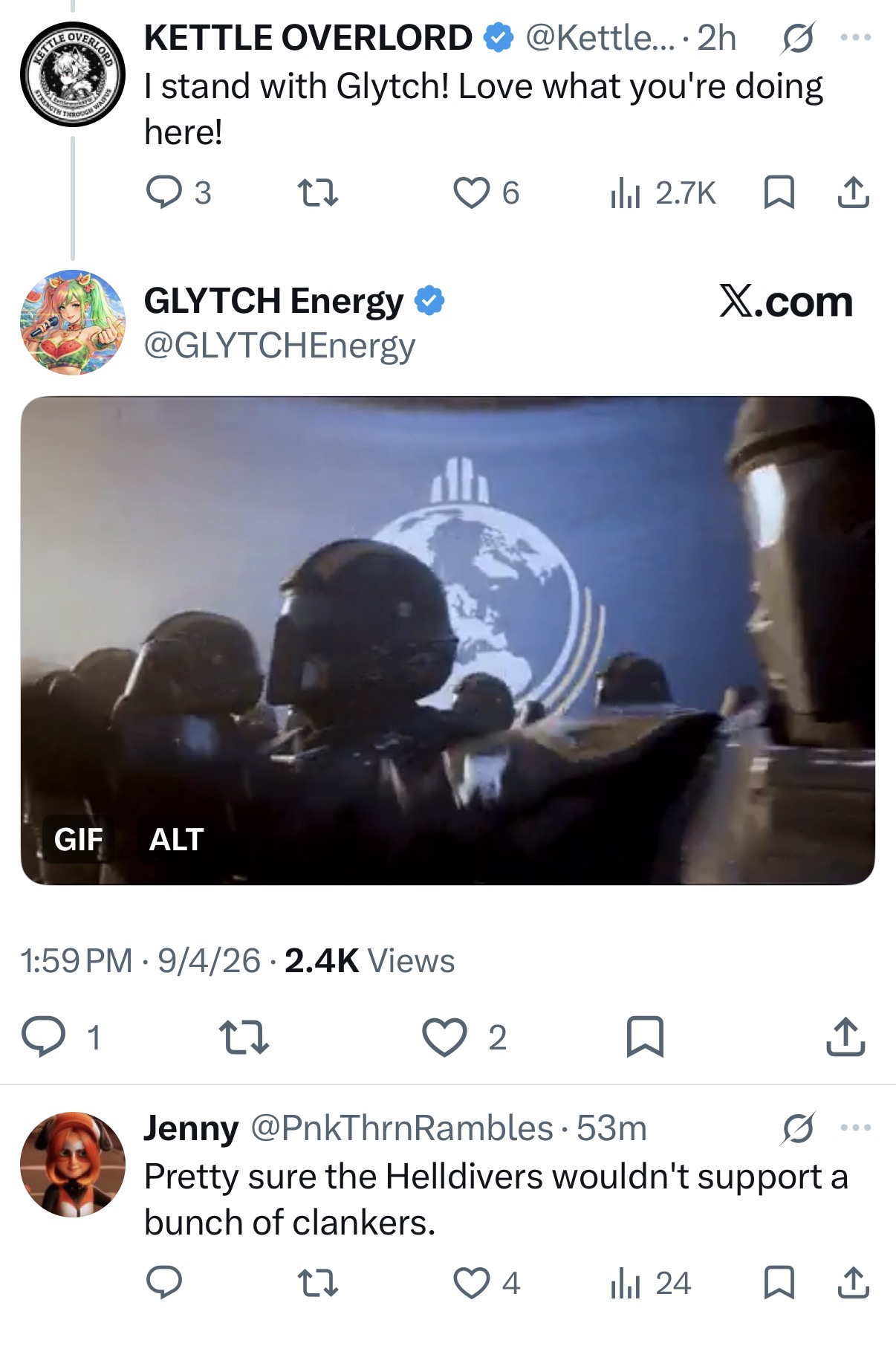
Somehow or another, I ended up on Twitter with this giant thread about this company, GLYTCH Energy, promoting AI art and usage. This particular post was about how they saw all the backlash and said that they were disappointed that only 1.5 million people saw it and that they had hoped for 5 million people crying. So, already I was on edge. I know everyone has their own opinions for AI on this forum but, personally, I think AI is best used as a tool for research but I cross the line at using AI for art. I don’t mind other people doing so but I generally don’t like the aesthetic. I also think that trying to replace human art (especially in professional settings) with AI art is a bit cheep and soulless. I appreciate that other people have their own opinions but was put on edge when they came off hostile for an already unconventional opinion.
Anyway, I was on edge. Then I see this response above. This other account gave their support to the GLYTCH company and GLYTCH responded with a Helldivers GIF. Now this really icked me. I’m a huge fan of the Helldivers franchise and appreciate the human creativity behind it. So, I thought it was kinda weird that GLYTCH would respond to the support post with a GIF of a definite example of human creativity (that is famous for their hate for the in-universe robot race whom they are at war with, as the last comment points out).
I had pondered showing my support to the anti-AI comment. But, then I thought better of it. I’m almost certain that pro-AI folk would probably go to that comment and everyone would duke it out regarding AI and whether or not we should be shunning it. I decided to just leave it alone and not get involved.
I suppose it not being as neutral as I usually claim to be, but I guess sometimes I just need to vent.
I shared your post and this comment with ChatGPT: “I have no clue what BuffaloMax17 is venting about.” There was a response which I won’t bother posting, to which I replied: “I still don’t get it.” And there was another response which I still won’t bother posting.
And I’m still clueless, and grateful that my wife and I never had grandkids.
2 Likes
Gerhard
(Gerhard Nebe-von Caron, formerly "Marvin", Sceptic Christian)
17
A guy that refers to the reproductive organs as the “recreational department” and demands that humans like other mammals -e.g. the dolphin - should have a separate breathing and eating hole is clearly not “hyper-intelligent”
What you might need to consider that the supernatural is not the unnatural or paranormal but the best or foundational of natural.. After all, superglue is just exceptionally fast glue, not magic glue. You might do better to refer to the theological sphere as the metaphysical to avoid the confusion with magic as in its original meaning that is what the supernatural meant, that what is beyond (or above) the physical. Look for the information / intelligence beyond the physical/natural and your conflict resolves.
The current hot topic in the social media apologetics circles is the (re) conversion of a popular agnostic atheist to Catholicism, explicitly the recognition of Catholicism as true due to the “catholic miracles”. It looks more like a publicity stunt to me, but indeed the Mary apparitions are often declared demonic by the opposition (especially when suggesting the self infliction of injuries to minors in order to partake in the suffering of Christ) and the Stigmata appearing in the wrong place, e.g. the palm as in later Catholic icons, were they are visually more impressive instead of the wrist which is where the nails were placed. A miracle is a sign pointing at God, a natural anomaly or a statistical improbability, e.g. the expression of love and logic. If it takes an act of magic for someone to believe in God instead of an act of love and logic one has to question ones concept of God.
sounds different when you express it as “metaphysical things happen under our nose all the time” as they do indeed. The whole of reality we experience is logic, e.g. comprehensible, which is not a material / natural / physical but a nonmaterial of metaphysical thing. As Lennox says - no physical chemical or biological analysis will explain to you the meaning of the word Chicken on the menu. You might find out the composition of the ink and the paper and its origin… but not it’s meaning.
For most of us our understanding of Christianity and the concept of God has become materialised to such an extend that it is difficult to understand that it is not about our selfs. We read the word of God in the same selfish way as we look at the resurrection that has become the selling point of modern Christianity like the snake sold the fruit of passion to Adam and Eve. “Want to be like God - want to be the judge of god and evil?” has been sold to us as “Want to be like God - want to be an eternal self?” I call it the “Fall 2.0” Other religions sell it even better, not only being in the presence of the Lord but also having your personal slaves / servants for your efforts to do as you are told.
so to align ones philosophy or worldview to see a God that is coherent with our scientific investigations to understand material reality brings you to a God that is far more powerful that one that does acts of magic as he does acts of love and logic - and that beats magic anytime
2 Likes
Gerhard
(Gerhard Nebe-von Caron, formerly "Marvin", Sceptic Christian)
18
good point. If you replace the word natural with material it already becomes obvious that “natural selection” is not a material process but that the selection process is a metaphysical one. the Enlightenment has a lot to answer for the mixup as using the word natural instead of physical as it integrates the metaphysical element into the physical. If you think about the word natural selection you see how it hides the metaphysical meaning of the sort criterion (e.g. to be useful for the overall propagation of creation) into something that works without a complex expression of intelligence which is “natural” but not a physical property
To summarize it: some folks on social media have an entire marketing campaign set up around AI art-based advertising, and when people criticized them for it, they doubled down and began mocking the criticism. A few other peoples showed their support and the first channel in question used media from human-made content (in this particular instance a clippet from a video game), all of which made me ick. However, I decided that trying to put my two-sense into the mix wasn’t going to do anything, so I stayed out of it.
1 Like
Gerhard
(Gerhard Nebe-von Caron, formerly "Marvin", Sceptic Christian)
20
I always say that the demand by the likes of Hume and atheists in general to demand that God breaks the logic on which he built reality is revealing their intellectual bankruptcy. A God that cannot pursue what he willed in existence is an impotent God, not an omnipotent God. It is like they Declare Boris divine for he could ignore the laws he put upon the public and they think this to be a sign of power. So far for the “Brights” and their logic.
The question is “Has God violated the integrity of his creation principles by interfering with it to show his power?” Blessed are those who believe so - they need all the blessings that they can get - but cursed are those who demand him to do so in order to judge him powerful according to their standards.


 . As a casual artist AND frequently awkward conversation partner, this resonates a lot.