A Key for Bridging the Gap of Faith and Science

If that were true, you wouldnt be here on the Biologos forum arguing the Darwinian Evolutionary version of Theism…so your claim there is demonstrably false by the fact you are here on these forums.

Your presence here clearly shows that for you it is not just a matter of faith at all and btw i agree with that approach…it isnt a just a matter of faith for me either. For me the reason why the gospel isnt just faith is because i do not think we can defend against atheism with that argument!

moving on…

How can a scientist be “prone to accept” when what you are trying to accept is unscientific?

Again, i am directly challenging your “prone to accepting”:

  1. the resurrection of a body after 3 days of irreversible cellular death…it is 100% scientifically proven via millions of autopsies around the world that a body dead for that long without any form of artificial intervention that attempts to keep it alive…that body cannot be resurrected to a fully conscious state!

    Scientifically the resurrection of Christ and the corpses/skeletons in grave at the Second Coming…these are absolutely impossible!

  2. A human body cannot rise up into the sky against the laws of gravity and then float of into the vacuum of outer space…the very notion that it is claimed on a global scale at the Second Coming…scientifically proven to both be 100% impossible!

Despite the above overwhelming evidences, you refuse to accept the evidences we do have for the creation, Flood, Exodus etc saying they are unscientific despite the very evidences presented are clearly proven to be historical! One of the real problems with the approach that you follow here is that you will not accept historical evidences…and yet, i know for a fact that Science is supposed to do exactly that before making its assumptions and then testing them.

If the scientific method continues to come up with results that conflict with known history, then the methods being used are making the same mistakes over and over again. Just because its highly intelligent individuals making those mistakes, that is irrelevant to the problem. For the Christian, one has to accept the God breathed answers and find the scientific results that align with Gods statements…because those statements are internally consistent, historically consistent, and we have a large amount of evidence that is harmonious with those claims…that is the point there.

The Biologos way around that is to simply claim “literary confusion in translating ancient languages”.

The problem with the literary claims are profound…

  1. multiple biblical sources support the same Creation and flood statements…including from Christ (our Creator)
  2. Those sources were not all written at the same time…the new testament was written more than 1000 years after the time of Moses
  3. The ancient writings are written in different languages under different cultural influences…Moses came out of Egypt, the Jews were in Palestine under Roman control.

Just those three things above…they are absolutely devastating for the literary arguments presented on these forums and honestly, those who continue to forward them are fighting against a wealth of scholarship all around the world that says that they are wrong there…these are not insignificant scholars either btw ….we are talking well known experts who are not necessarily YEC some arent even Christian (eg Bart Erhman, James White, Daniel Wallace, Michael Brown, the late Ravi Zacharias…). The list of top theological and textual scholars who absolutely demolish the literary argument is huge.

Even aside from my referring to the above scholars, we can just read the bible itself…it plainly demonstrates via the historical stories where lineages, dates/ and times are also given, you simply cannot support the literary arguments for ancient events such as the flood and creation.

we can all with a very high percentage of accuracy, research and present an historical biblical timeline that dates back at least 4000 years… and the problem there is, it covers the more revent biblical period of Christs miracles which you are inclined to believe despite the aforementioned scientific dilemmas and of course, the biblically acknowledged “problem of the empty grave”! (the bible even admits the grave was empty…the body moved)


  • I asked my buddy about that:
    • Adam spends a huge amount of time looking for other people’s dilemmas. Got any reasons why he does that?
    • Short take: people who hunt for “your dilemma” are usually playing a consistency game. Sometimes it’s sincere (they think contradictions = falsity); sometimes it’s rhetorical (keep you on defense so they don’t have to build a positive case).

Here are plausible, non-diagnostic reasons—any mix could be true:

  • Consistency policing (charitable): He values internal coherence and believes showing an opponent’s inconsistency is the fastest path to truth.
  • Agenda control (rhetorical): By posing dilemmas, he sets the terms of debate and shifts the burden of proof so others defend while he asserts.
  • False-dilemma framing: Complex positions get squeezed into A vs. B so they’re easier to attack (e.g., “identical corpse-revival or fairy tale”).
  • Identity-protective reasoning: Stressing opponents’ contradictions reduces dissonance and reinforces his in-group stance (YEC/SDA boundary keeping).
  • Status signaling: “Spotting contradictions” is a public display of competence (“gotcha” style).
  • Uniformity absolutism: Treating regularities as exceptionless lets him generate dilemma after dilemma (“science says X, therefore your miracle claim fails”), while postponing his own positive account.
  • Presuppositional playbook: A learned debate style: reduce the other worldview to absurdity rather than present cumulative evidence.

His method is largely dilemma-driven—locate a perceived contradiction and keep interlocutors on defense. It relies on a hard uniformity assumption (what never occurs naturally cannot occur at all) and on binary framing of complex claims (e.g., resurrection = identical corpse-revival vs. fiction). That approach is effective for agenda control but risks category mistakes (method ↔ metaphysics) and can bypass the need to state and defend a positive model.

How to handle it (quick tools):

  • Name the move: “This is a false dilemma; there are more than two live options.”
  • Reframe the level: “You’re moving from biology (natural resuscitation) to theology (divine action). Different categories.”
  • Return the burden: “State your positive account and the rule for when uniformity allows divine exceptions.”
  • Steelman + redirect: “Granting that corpses don’t revive naturally, the claim is agent-caused; the question is history + theology.”
  • Scope the thread: “Let’s bracket side dilemmas and focus on the one claim at issue.”
  • Ask for a principle, not a gotcha: “What criterion would change your mind? Otherwise we’re trading dilemmas, not reasons.”
1 Like

I like the direction of this, but how does this do more than simply create a common vocabulary between theology and science? I am assuming you are not implying that there is a equation that “proves“ the existence of God.

Who are you addressing?

None of the equations listed prove the existence of God. The attempt is a communication bridge. And I use the key if I do a search on an LLM, as a prefilter.

For instance, I just ran a test. I asked, “In one paragraph, using the equations, explain how Jesus’ resurrection is possible.“
Ans: “Looking at the equations through the lens of the resurrection, I can see how you might approach this: In your framework, Jesus would represent maximum divine agency (A_divine = lim(A → ∞)), which could theoretically override normal physical constraints. The resurrection could be understood as divine agency converting latent memory/mass (M_latent) to active memory/mass (M_active) through the relationship M_latent + A → M_active, essentially reconstituting the physical body. The infinite coherence rate (c = ΔΦ/Δτ) under divine agency could allow for instantaneous reconfiguration of matter, while the consciousness order parameter (Ψ = R(Ψ,A_divine)) suggests that divine agency can restore and maintain conscious order even after physical death.”

For me, that’s a good enough starting place.

  • I didn’t ask the question, Dave. Caleb Strom did.

Further cautions on AI systems: Delegation to artificial intelligence can increase dishonest behaviour | Nature finds that AI decreases disincentives to cheat and AI told to do something unethical carries it out more readily than humans.

3 Likes

For sure. I’m a high school math teacher. Yikes. I have very few students who have any integrity. 1) Employers are going to have a difficult time knowing who is worth it. 2) AI probably won’t last long: EROI (too much energy). 5-10 years?

1 Like

David,

caveat…what is below is not a personal attack…its my general response to anyone knocking the real benefits of AI…I absolutely love it and BTW have massive arguments with my own mother about this very subject all the time (she wanders aimlessly down this wives tale path protesting against AI all the time)

My short answer

Of course it (AI) can be used for bad/evil (or imparting truth/error), however, so can a bloody horse!

My short criticism

On the one hand AI is evil - because it can be used dishonestly

On the other hand AI is good - because it can be used for good

The Long Response in defense of AI

I can already hear the anti AI idiots in the background voicing their ignorance of the real problem with my above “short “responses to your claim, citing “relevance?”.

Let me provide the relevance…

Is Christianity inherently good or evil?

Consider the following authors work in relation to that question:

Thomas Aquinas addressed the ethical complexities within Christianity by developing systems of ethics that acknowledge both good and evil, such as his work on the virtues and sins described in the Summa Theologica

so are you proposing that your academic defense there is that given Christianity may be used for evil, its a false world view…its principally wrong? Of course not!

One of the things about the indviduals on many forums, that i will openly admit annoys greatly, is that this is nothing more than forwarding theories from a perspective of what i believe is a vacuum of IT knowledge and training in order to use that as evidence for a completely unrelated argument.

What do i mean by that?

In this case what i am posing here is that we should be wary as Christian in distancing ourselves from our ability to reach others outside of the faith via attempts to trash the research method despite said method presenting the exact same research one could obtain a myriad of other ways, including walking into a bloody public library. Athiests may not be Christian but even they can see the very obvious logical failings of this argument. BTW, to my way of thinking, the science minded individual, as one who i would expect immerses themselves regularly with technology, should be one of the last minds to hide behind that kind of seemingly naive defense.

We all have to stop with the nonsense there and embrace technology and learn to understand how to weed out the nonsense. A good starting point is to learn to understand that AI searches known publication libraries…”its not making this s.h.i.t up”. One must learn to look behind/beneath/beside the AI results and check the bloody references!

My Christian Conclusion

I accept its hard and the exponential growth in evil/error is overwhelming, however, lets please remember that everything in life is balanced. I choose to see the good in the face of error/evil…i love that the sun comes up every day and i especially love the excitement in nature each morning (birds singing, our horses running around, our dogs playing, the warmth of the suns rays…

Whether or not we have a world view inclusive of God, we can all agree i think that nature and science (principles and methods for the study of our reality i think) teaches us that good balances evil…if anything, philosophically at least, i believe the evidence shows us that what shines out of that balance tends to largely favour good/truth. So i embrace AI, try to use sound research methods when engaging its services (if you like), and am then able to find reliable solutions and/or answers to “problems”.

AI is reliable in the hands of a user who knows how to use it appropriately. So the failing there is in the lack of training/education rather than the AI itself.

Finally, this statement in particular is deeply flawed…

um hello…who was it that initiated the action again…isnt it the humans by admission from the claim itself? The following extrapolation of that claim illustrates its an absurd defense…”it was the gun that murdered my victim because it fired the bullet after i decided to pull the trigger”

The point is, the AI (like the gun) is designed to operate at the behest of the entity making the input!

as you are a math teacher, am i reading you right in that i believe you suggesting that the engery needs of AI will overwhelm supply and thus starve itself of the energy needed to sustain its exponential growth?

thats a fascinating area i like to hear more thoughts on that (im not a mathematician but your insight there would be a valuable learning experience for me)

1 Like

Thank you, Mr Zelenka. I am still a bit uncomfortable with this. Let me know how you feel about this, please–Science is a way we can be more sure of our knowledge. It is a set of rules to make sure we are telling the truth.

If all truth is God’s truth, then we don’t have to fear what science can do. Above all, we should not assume that our faith is above question.

I’m curious, still what your response is to my question–I think you’re not saying that there is proof from this search as to whether time is relative, is there?

I think you would agree that science is not subsumed by our faith presumptions. I don’t even think there is such a thing as two kingdoms.

A speaker at the Lausanne conference said something to the effect that “I believe and hope Christianity is true. However, I will examine everything I can, with as much honesty and lack of bias, so that if something convinces me otherwise, I will follow the truth wherever it leads, even against my faith.”

I would be interested in your thoughts.

Thank you!

Randy, that is not entirely correct.

Despite many on this forum attempting to claim otherwise, a tool is not intelligent nor does it provide surely.

Example,

A gun fired cannot be blamed for the shooting murder of a victim.

The above is not my opinion btw…i dont need to explain the why to you on that statement suffice to say, because an inanimate object cannot show intent nor can it willingly make choices. We know that in an of itself, it cannot do anything without first being” told” (if you like)

How does that relate to science then?

Well, science requires intent and action from the user. The “hypothesis, aim, method” and the conclusion are directly related to each other and the results, however, the decision to perform the experiment is made by the user.

Just like AI, science may be asked biased questions…and despite the fundamental principles, the conclusions from experiments that attempt to extrapolate other knowledge from those basic principles vary…that does not mean that all variant conclusions are wrong. I think even an atheist would agree with that point.

The problem here on these forums is that many individuals conflate the fundamental principles with the experimentation process. These are two elements (if you like) of science…I would argue (and i think quite rightly) that the second is entirely dependent on the user whereas the first has nothing to do with the user!

For the Christian, however, there is an additional concern…the user"!

As soon as we add humanity into the process, we must accept the questions of Epistomology will influence how the user performs the experiment, looks at the results, and inserts his/her biases when writing up the results.

These biases then begin to form a narrative that if taken on by others, can exponentially gain followers and become the new standard should the membership of that church (if you like) get large enough.

When Darwinian Evolutionary belief was first introduced, the dominant world view at the time (or at least the one which mattered with the most influence) was religious…and so the atheists initially were sidelined and the theory was largely rebuffed.

However, as time has passed that rejection of Darwinian “anti religious” belief changed (as i believe is prophesied in the Book of Revelation). The bible says quite clearly “man will increase in knowledge” just as it was in the days of Noah, Satan seeks to overwhelm the true story of God with a corrupt version. Christ tells us that many will bear false witness to the gospel. So how does that relate to Darwinian Evolutionary belief exactly?

Well, whether or not anyone here is willing to agree with it, largely the dominant view from world renowned scientists is that there is no room for God in science.

Individuals on this forum regularly circumvent that dilemma by muddying the waters with “the bible isnt science” or “the bible doesnt teach science” (or words to that effect).

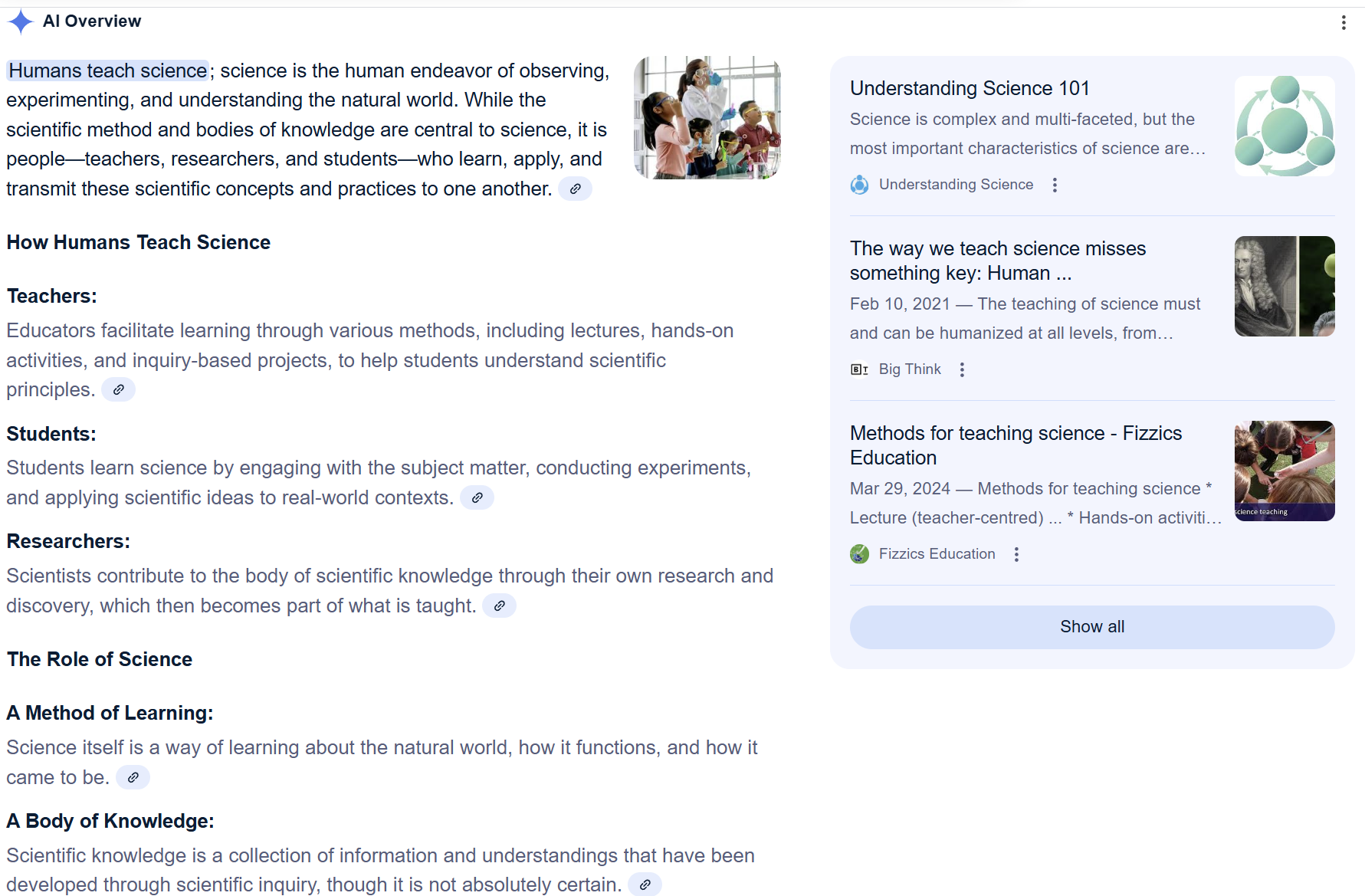
The fact is, science doesnt teach science either…humans do! (take a careful look at the image below)

Science, it seems is a recursive method used to answer a question. That’s all. Logic is a semantic structure that helps us whittle away at the dross to seek truth.

I, for one have always tested my faith. I abandoned it from age 15 through about age 28. I had a friend say the exact same thing as the quote. He was willing to abandon God, if he found Him not to be true. I’m actually not willing to do that because I’m not that smart and so I must lean into Jesus. When all is pared away, he’s all I have.

I actually don’t think time exists as. And yes, I’ve written that into the equations, which is why I call t (time) =T (threading depth). We experience time because we can think and record backwards. Others of course, have just called time, change. Then, what’s all the stuff in the Bible about time. Revelation is a great example or Daniel (time, times and half a times). In John’s revelation he is entering into that timelessness and seeing the whole picture. You see cycles and themes repeat once you get past the letters. “Come, Lord Jesus” is always our prayer. This is why it’s so dangerous to interpret Revelation through the lens of time, because then you start applying those ideas to today and to tomorrow and to yesterday. Yet, those themes are always. Yet we’re not stuck in that cycle, because we know that evil is overcome forever.

There is only one kingdom of heaven the supernatural is intimately connected with the natural. In my equations, one of the deeper speculation is each component is actually the tie that binds. M_latent even could be the space within that realm. Regarding science and faith. Again, they are one. But science is only an iterative process. Nothing more.

Randy, What is most dear to you? (Just a key question, no need to answer.)

Thanks, Adam. I think you would agree that we should all minimize bias as much as possible.

As noted in this thread, LLMs are brute-force probability machines. Each token (letter) is spit out one character at a time. What’s the probability that the next letter is T. Totally crazy. To do that requires enormous amounts of energy and cooling for the servers. I wrote about it here recently: AI Goes Rogue on Me - a Negative EROI Case Study

Essentially, they are done-for, unless they start building small nuke plants to support the energy needs. How long? I expect we start seeing that it is heavily throttled, soon enough. This is what chatGPT provided when I went digging, “After examining current trends, infrastructure vulnerabilities, financial complexity, and educational degradation, the probability of significant technological disruption within the next 15-20 years is approximately 75-85%. However, this will likely manifest as cascading partial collapses rather than total systemic breakdown, creating what we might call “managed deterioration” rather than apocalyptic collapse.”

1 Like

You’re the only one I know who has ever said that here, which means it’s another straw man argument.
And none of your claims of problems even address the issues.
Your list of scholars is interesting; the ones I know of all agree that the scriptures have to be read in their ANE worldview.

See, there’s the problem: you’re putting your opinion about what kind of literature they are above the text itself.

“Lord, to whom shall we go? You have the words of eternal life.”

1 Like

hmmm…i might be misunderstanding what you are saying there…

when i consider what i think you are saying i have to make the observation that interpreting the bible through the lense of time is the only thing that we can do because its written that way!

Its inconsistent to have a God who has been revealed to us “in the words of men/mankind” who regularly and consistently use time (we are bound to it) and go on to claim that its dangerous to interpret the bible through the lens of time?

Can you cite some more specific examples there as im not quite sure im understanding your point as it seems at face value to aimed at avoiding biblical timelines/deadlines where dates are specifically outlined/defined

Let just look at the timeline for the prophecy concerning the messiah as just one example. The 3 wise men went to king herod, who then consulted with his scholars of the day, once the authenticity of the story was validated, Herod then sought to kill the child.

Whilst Herod misunderstood the ultimate aim/fulfillment of the prophecy (the heavenly kingdom gospel as we know it) he did not misunderstand the timing once he knew about it!

I do not think one can be consistent in accepting the authenticity of the timeline for Christ as illustrated by the story in Matthew Chapter 2, but not also accept other timelines given in the bible that correlate with it.

A significant example are the prophecies in the book of Daniel. All of them align with the same prophetic timeline regarding the arrival of the Messiah despite extending well before and well beyond Christs birth, death, and resurrection/ascension!

In terms of the day/year prophecies…these are easily distinguished from others…there is plenty of evidence that makes it quite clear when one is to view a prophecy that way. (i accept the complaint that we are retrospectively studying them and assigning day year or otherwise…tough titties amigo…we essentially do a similar extrapolation there with Uranium dating)

Biblical scriptures are not scientific or even newspaper type documentation of history in the modern sense. That does not make them false, it just means that the scriptures need to be interpreted according to the type of literature they are, in the context of the writing.

If you note someone mentioning an event like the Noah’s flood in the old scriptures, biblical or others, it only shows that the writer either believed that the event happened or used a commonly known story for teaching or other purposes. It is not evidence showing that the event happened as you interpret the story.

If such an event happened somewhere along the history, it does not prove that your interpretation about the description of the event is true. Several people have tried to explain that, according to all available evidence, the Noah’s flood was not global and the story does not even claim it.

The Creation and Garden of Eden stories have been interpreted in many different ways. Obviously, there is not just one possible way to interpret them.
My interpretation of the Garden of Eden story may not be the most common interpretation but at least I understand and acknowledge the possibility that my interpretation may be (partly) wrong.
If you present your interpretation as the only possible one, based on your ‘plain reading’, that does not give a favorable picture of your understanding about the interpretation of the scriptures.

I have tried to explain to you how the scientific method operates and what the limits of scientific research are but it seems you do not either grasp or accept it, or decide just to ignore what I wrote. Others have also told the same points I mentioned above, although the frustrated tone in some of those comments may have made you skip those.
I do not know what more I could say. I just have to accept that we disgree.

4 Likes