It affects how they see the text, too – they cannot see how relying on English that they can make say what they want denigrates the value of the actual text.
We see it here: despite how many times I and others have explained the grammar and word use in the Hebrew (or even in English!) YECers will come right back and claim that their distorted and inaccurate use of language is “ordinary use”.
1 Like
Morton should have given credit to Simon and Garfunkel:
“A man sees what he wants to see and disregards the rest.”
– from The Boxer
3 Likes
The various ages of the younger magnetic reversals were determined from rocks on land before the seafloor pattern was identified. Thus, when the symmetric magnetic banding was found to either side of mid-ocean ridges, it was recognized as evidence of plate tectonics.
The fundamental reason why flood geology can’t explain coal layers is that it can’t explain anything. There is no coherent model with specific information that could be used to predict what would happen in flood geology. The goal of flood geology is not to honor God by carefully examining the evidence from His creation and seeking to understand it; flood geology is entirely for the purpose of arguing against the evidence for the age of the earth.
Although there are coal beds of various ages, the major Northern Hemisphere coal beds are generally from the Carboniferous. At the time, North America and Europe were attached, so similar beds forming in both places would not be surprising, though identifying these as the exact same bed in both places is rather challenging, given the separate histories after the breakup of Pangea.
A flood geology model needs to specify which beds were formed before versus during versus after the flood. The fact that there is no agreement on setting those boundaries among young-earth advocates, when flood geology claims that conditions during the flood were wildly different from before or after, is a major problem for the credibility of flood geology. Coal beds frequently have roots extending down into the layers beneath, showing that many of them formed in the place where the plants were growing. Coal beds alternate with other styles of sedimentary deposits, reflecting cycles of rising and lowering sea levels. There has to be time for multiple forests to grow, get buried, and new ones to grow. The cycles of sea level rising and lowering resemble the modern climate cycles that are driven by the Milankovitch cycles. These are slow wobbles in the earth’s orbit (similar cycles apply to other orbiting objects). Currently, these cycles take 20,000 to 400,000 years to complete. The Carboniferous is long enough ago that the cycles could have noticeably shifted, but still representing long periods of time. Coal beds have changes in the types of fossils present in them, pointing to change over time. Many coal beds are on top of marine beds, yet the coal itself generally reflects deposition in a freshwater swampy area. Having land deposits on top of marine does not fit well with a flood geology model. Conspicuous by their absence from coal deposits are any flowering plants (including their pollen), dinosaurs, mammals, birds, oysters, and many other groups of organism found in younger deposits.
If the flood were as violently energetic as most flood geology advocates claim, coal deposits could not form- the plant material would be broken and thoroughly mixed in with other sediments. If the flood were calm enough to have floating mats of coal forests, as some propose, then coal deposits should be distributed globally, rather than only in continental deposits.
Coal deposits, and all other features of the geologic record, plainly tell us that the full display of God’s creativity has required a vast amount of time.
4 Likes
It doesn’t show much respect for God, does it?
And given that there are coal deposits with sand or silt mixed in, the absence of sand or silt in most deposits is strong evidence that the majority of deposits were accumulated in reasonably calm conditions.
Which is what I would expect of a “cosmic Artist” – detail by detail building things up.
1 Like
Thanks for the explanation, David…er, paleomalacologist!
This confuses several different issues relating to the evolution of animals. “Primitive” is a problematic term. Evolution can proceed to more complex or more simple. Anything alive today is just as different in time from its ancestors at the same time in the past. Each kind of invertebrate alive today has its own specializations. Most invertebrates do have developed organs; the butterflies.org post does not display a great grasp of comparative zoology. However, many invertebrates (and many vertebrates) do display features that are more typical of the ancestors of other groups. Sponges, jellyfish, and other simple animals have more primitive structure than vertebrates, for example. All animals have relatively complex cells; to understand the origins of those, we need to look further back than the late Precambrian, but the increasing complexity of arrangement and differentiation of cells in animals can be traced with changes from the late Precambrian to the present.
Some living forms do retain features that have been lost in others; such features can be considered primitive in certain ways. Cambrian organisms are often simpler than later ones in certain ways but not particularly simple in others. Many Cambrian organisms are intermediate in form between various major groups of modern organisms, reflecting evolutionary connections. The late Precambrian animals are simpler still.
More complex cells go back rather over a billion years further than the earliest animals, but conversely over a billion years after the first simple prokaryotic cells. Molecular data and organelle morphology support the idea that an archaean, perhaps one with many extensions from the cell, similar to the known Lokiarchaeota, surrounded a bacterial cell that became the mitochondrion. Bacterial cells are relatively simple, though certainly they are a long way from individual molecules. The patterns in DNA and other molecules suggest simpler forms before any modern life. Although we don’t have a full connecting sequence between complex molecules and simple life, ideas and experiments are tending to fill in the gaps. Given the available theological and biological evidence, I would expect that God did create cells using natural law patterns, rather than miraculously, but at present that’s an impression.
“no one comments in the hope that this will go away.” Ignoring the problems that are pointed out for one young-earth claim and jumping to posting another does raise doubts as to whether there is a serious effort to consider the evidence and assess the possibilities. Reality is complicated. Accurately summarizing the evidence and discussing alternative views will require taking some time; trying to sell an argument to the public can be done superficially.
4 Likes
It’s rather difficult to understand how the Cambrian could be evidence for YEC. Their model has modern biodiversity emerging in just 6 days (actually 3 days). So why would we see layers in the geologic record that are devoid of many of these animal groups? There aren’t even any bony fish in the Cambrian, much less mammals, insects, reptiles, dinosaurs, birds, squid, or snails. As far as vertebrates go, the most advanced species is similar to the lancelet:
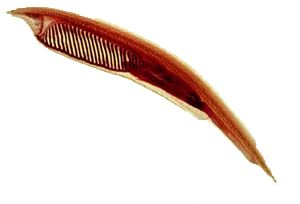
If YEC is true, we should be seeing the most modern animals in the very first layers, but that’s not what we see.
3 Likes
There probably are snails in the Cambrian, but simple ones difficult to tell from non-snails. The key distinguishing feature of Gastropoda is torsion, a twist in the soft parts, which is often difficult to infer from shells, and some of the snail-looking shells from the Cambrian turn out to be extinct groups of worm-like animals, not even mollusks.
The multiple claims about Cambrian faunas in YEC and ID sources leads to some confusion. Adam was passing on the claim that Cambrian organisms are complex when they should be simple evolutionarily. In reality, Cambrian organisms often are simpler in certain ways than later related life forms, but have varying complexity levels. The level of complexity in Cambrian life is not surprising to find over 3 billion years after the first life. There’s also the claim that the diversification in the Cambrian happened too fast, and the claim that the Cambrian is a fiction invented by evolutionists (before the acceptance of evolution, in reality).
3 Likes
The professional YEC/ID proponents want the confusion, IMHO. I have often heard claims like “20 entire phyla suddenly emerge in the Cambrian”. First, we should see the earliest branches of the animal tree of life emerge in the earliest animal fossil bearing strata, so not a surprise at all. In fact, it’s what we should see. At the same time, I often get the feeling YEC’s think this means the entire phyla, as in every genera found in a modern times. I don’t think they would be as eager to talk about the Cambrian if they understood the actual pattern of biodiversity. For vertebrates, we can’t even find anything with a moveable jaw or ossified bones.
2 Likes
While confusion about real geology may be to their advantage, confusion about what the YEC/ID advocates are saying seems potentially counterproductive for them. It doesn’t help that a lot of popular science sources aren’t too accurate, either. For example, many animal phyla are not known from the Cambrian; only one phylum that often has hard skeletons is not confirmed in the Cambrian, but rather just after, in the Ordovician (Bryozoa)/ Several of the soft-bodied phyla are not known until considerably younger layers.
In addition to the misconception that the phyla appear in their modern forms and separate (when in reality the Cambrian has many intermediates between modern phyla, as well as between lower groups), another erroneous claim is that the pattern of appearance in the fossil record, with most phyla earliest, followed by the appearance of additional classes somewhat later, etc. is contrary to evolutionary expectations. The reality is that the pattern should occur to some extent under any pattern of origination, but should be much more prominent in an evolutionary system. Because classification is hierarchical, if you find a representative of a particular lower category, you have automatically found all the higher categories that it belongs to. [Ignoring the minor exceptions of “we gave this a scientific name but don’t know what higher group it belongs to.”] The first snail, for example, cannot be before the first mollusk because it also is a mollusk. Also, broader categories tend to have more possible ways to recognize them, so a fossil might not be confidently placed at a lower level but can be assigned to a higher group. “It’s a footprint with three large, clawed toes. It’s a theropod dinosaur of some sort.” Both of those apply to any pattern of origination. But evolution gives additional reasons to expect to find the average date of origins of higher taxa before that of lower taxa. We call things phyla because they are very different from other phyla. Evolutionarily, that would imply that they are rather deep divergences; classes are more recent divergences, and so on. Similarly, the shared features of a phylum evolved before the split into classes, and so on. So an early fossil might be assignable to a phylum but not yet having the key features to assign it to many lower levels.
4 Likes
I would say that that is what should be expected if some new level of complexity was reached – it would offer the possibility of a whole range of new forms branching off relatively quickly.
1 Like
But also the “suddenly” is actually on the order of at least 10 million, and probably at least twice that, if not much more. We do have evidence of intermediates in many cases. There are several proposals for how the phyla originated; evolutionary models exist, though as of yet we haven’t been able to determine the full role of different proposed causes for the observed pattern. A major complication is that there is also a significant environmental change that leads to different patterns of preservation. The Cambrian has a burst of extremely good preservation of fossils, which makes them a lot easier to assign to groups than the older fossils.
2 Likes
Something I’d love to have would be a video that shows the movements of the continents matched with the different evolutionary periods. I’ve wondered if perhaps the Cambrian was during a split-up of continents, which would drive diversity.
1 Like
The best current answer to that is “probably”. There seems to be some uncertainty about how much Laurentia actually joined Gondwana before drifting away and opening the Iapetus in the Cambrian.
Www.scotese.com is a classic site for plate configuration reconstruction. A lot of plate reconstructions have sea level rather low.
2 Likes