Life as an Emeritus Professor (i.e. “retired’“) has provided time to revisit old data in binders collecting dust on the shelf. The lost dogs that, for whatever reason, never saw the light of day of publishing. In 2003-2004 I was drilling holes through the sides of tree trunks and inserting small cameras in order to observe parent Northern Flickers (woodpeckers) feeding their small chicks. How does food get allocated within a large brood of 7-8 nestlings? How many offspring does a parent feed per visit? In a dark cavity does a parent choose to feed certain nestlings over others? Do runt nestlings lose out? Do the strategies of nestling feeding differ between male and female parents? Since flickers have partly reversed sex roles with the males providing more parental care than females, I am predicting males will allocate food more evenly across the brood than females and will take more time to do so.
So I dug out the old hardrives last week and watched some amusing “flicker flicks” of parents regurgitating ants into the throats of wildly teetering naked nestlings begging for all they’re worth. Now I need to extract some empirical variables from that chaotic scene.
Other aspects of scientific research are not so fun. This week I need to fill out a slough of “Animal Care” forms to submit to the ethics committee. Am planning some experiments on anthropogenic material (plastic and other garbage) that get incorporated into the nests of birds in my fieldwork on bluebirds and swallows next summer. Lots of red tape!
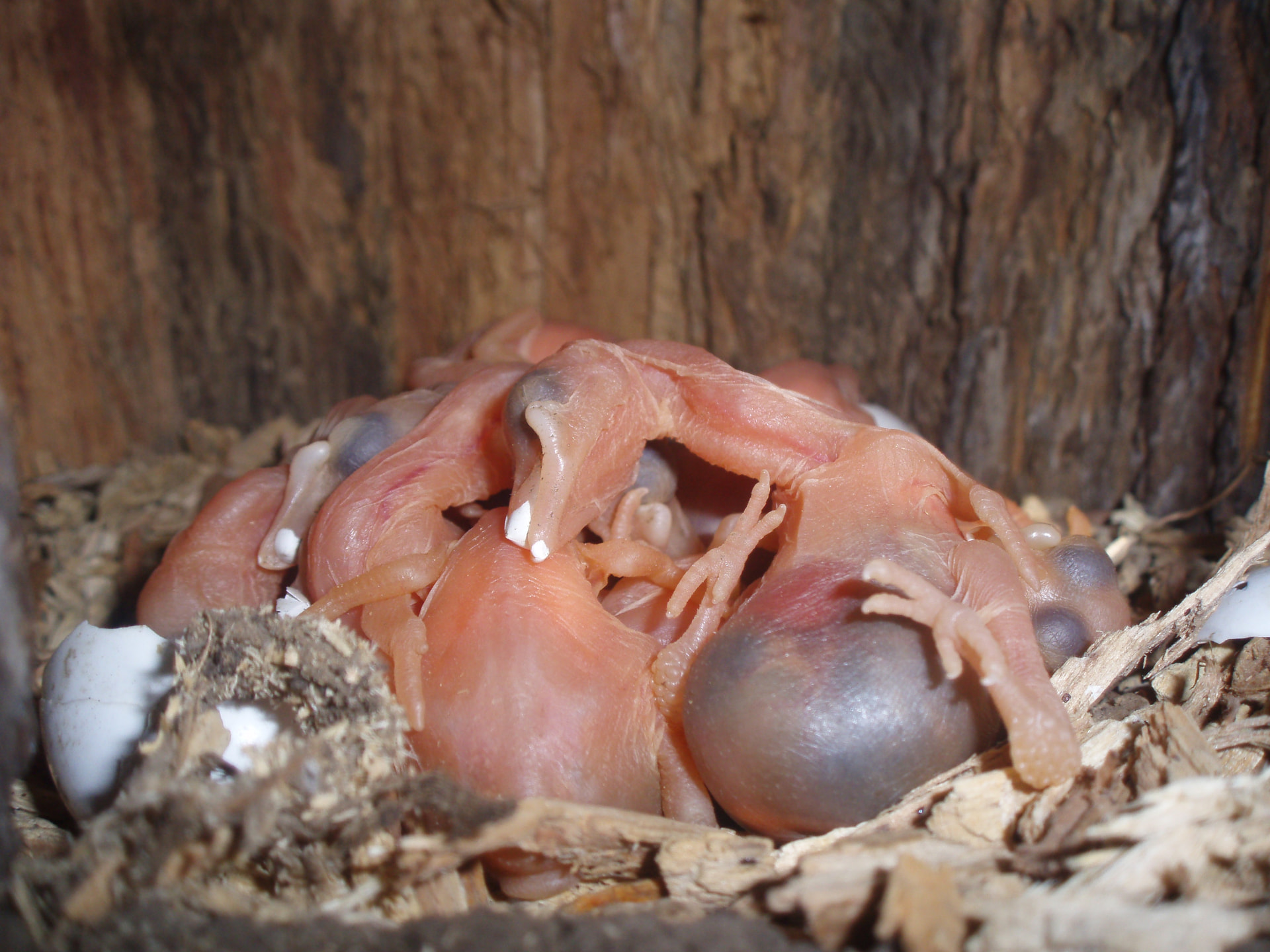
some eye candy– newly hatched flickers… cute little things, eh?
Teaching has gotten to energy processes in the cell for gen biology and the history of figuring out earth history in historical geology, after their tests and trying to catch up from the labs missed due to snow and ice.
For research, I need to get together with a student to wrap up data analysis and start preparing a poster on molecular for freshwater snails, organize my talk for that meeting on molecular phylogeny of a superfamily of mostly marine bivalves, and prepare a talk and revise a paper on the Pliocene to early Pleistocene biostratigraphy of the Carolinas and nearby states.
I confess I lack the aesthetic foundation to appreciate their physical beauty or cuteness. I am even a bit baffled, trying to figure out which parts are which and how they fit together.
Yeah, woodpeckers are among the most “altricial” of birds, hatching at an extremely undeveloped state with no down feathers whatsoever and blind. Very odd looking. The skin is really thin (the bluish mass is the intestines seen through the one nestling’s stomach). They have very long necks and note the calcareous white “egg teeth” on both the upper and lower mandibles. Most other species have one egg tooth on the upper bill to crack through the egg shell and it is shed a couple of days after hatching. Young flickers retain both egg teeth through the whole nestling period–in a dark cavity it helps parents see where the sides of the mouth is, to help parents find the mouths to feed..
They eventually look cuter but not until 14 days old when they have grown a short coat of feathers.
I strongly encourage celebration of minor victories to help keep a clear perspective and positive morale.
My Home Assistant automation system has been stable and continuously running for 2-3 weeks, post-installation. Huzzah! Next step: Some DIY sensors to monitor the garden and birdhouse activity. If anything of interested gets made, I’ll post the designs to Github for open source.
I’ve had a couple of sizable challenges in the garden this year. The most recently completed was the replanting of my favorite rose, Royal Sunset. A large deck I built with cheap red wood in the 80’s was beginning to bounce and be unsafe to walk on so this past summer we had it removed. Lia insisted on keeping the gazebo so we got them to re-support the deck beneath it and give it a better roof. All I had to do was dig up this rose that grew on the side closest to the driveway, seen here from inside the gazebo.
The rose had been growing in a bottomless planter I had built when I put in the deck.
Finally a couple of weeks ago I scraped away the DG they had spread all around that area and built a frame of old 2x6 Trex to give it s much lower rise. Then I set that aside, borrowed a Bosch Hammer drill with a spade bit and dug out a roomy hole through what looked like compacted gravel for a road bed.
It wasn’t easy but I did tease the rose out of its temporary pot and into bed of improved soil to bring it to the right height.
The little building on the left is our new outdoor bathroom and my dog Ember. Maybe some day this rose will reclaim its old territory and glory.
Just went back to reread the OP. Apologies to @jammycakes as this is clearly not much about science though it was an exercise in faith to move that rose.
Haha. Agree wholeheartedly, and I’m unfortunately of the age (or fortunately, considering the alternative) to participate in your trial. I golfed regularly prior to the pandemic, but from 2020-24 I played exactly four times, an average of once a year. In 2025 I started playing again, and I lost an average 10% distance across the board from the age of 58 to 63. Also went skiing last spring for the first time in 5 years. I was gassed by lunchtime. Bought some rubber band exercisers to see if I can regain a little bit of strength.
All worthy goals. Regarding No. 3, I would encourage you to contact a research clinic in your area where you could refer patients. I say that as the husband of a clinical research site director. She is constantly on the lookout for physicians who can refer patients for clinical studies. Participants are paid and she also covers transportation most of the time. It’s a win-win and gives you an opportunity to have a dialogue with your patients about vaccines.
My wife looked at this and said there might be some clinical research sites that are doing device studies for BP monitoring, glucometers, etc. The sponsor pays for all the supplies and time for each participant. It’s worth looking into. You could consider being a Principal Investigator for a study related to hypertension, congestive heart failure or diabetes. Send me a private message if you want info.
yeah I always wanted to be able to put buttons in the image that would cause the image to move or change in someway but I’m working with inscape and the website where I upload the images doesn’t allow complex stuff anyway so it’s never happened. Anyway the only thing on that image that would move would be the paddles.