If you want to hear some intelligent commentary about the place of history among the academic disciplines (especially as it has related to science) then you could do worse (a lot worse) than tuning into what N.T. Wright has to say about that in this - the third of his 8 Gifford lectures from 2018. All eight lectures would be worth your time and I think you’d be interested; you’d be hearing from real scholarship about quite a broad sweep of things as they relate to Christianity, but this third one is where he specifically addresses history and historicism as people have attempted to use it over the last few centuries.
Bart D. Ehrman, Did Jesus Exist? The Historical Argument for Jesus of Nazareth (New York: HarperOne, 2012) p. 222: “the onetime commonly held view that dying-rising gods were widespread in pagan antiquity has fallen on hard times among scholars” and then in the following page “do not think that the category is of any relevance for understanding the traditions about Jesus.”
And Ehrman is, as you said, certainly not a Christian apologist, and he also holds some ridiculous claims about Paul and the beliefs of early Christians which aren’t mainstream at all among critical historians.
When I talk about ridiculous claims I’m talking about, for example, Ehrman‘s “angel Christology” reading of Paul.
Ehrman argues that Paul may have understood Christ as a pre-existent angelic being who became human. In his own summary of the view, he says Galatians 4:14 should be read as equating Christ with an angel, and he treats that as a key to Paul’s Christology.
Larry Hurtado argues that this reading of Galatians 4:14 is grammatically possible but not compelling, and says “most scholars” do not think it works. He also argues that Paul elsewhere distinguishes Christ from angels, especially in Romans 8:38–39 and 1 Corinthians 6:3, and adds that there is no evidence that angels were worshipped in Jewish circles of Paul’s time, which weakens Ehrman’s attempt to explain early devotion to Jesus through angel categories.
James McGrath makes a similar point from a different angle: since Galatians 4:14 is the only explicit Pauline passage in play, it is risky to build a whole christology on it, and angelos there may simply mean “messenger,” not necessarily a heavenly angelic ontology.
The other claim which I find very disputable (to say the least) is Ehrman’s claim that the earliest Christology was “exaltation Christology: Ehrman argues that some of the earliest Christians thought Jesus began as a human being and was then exalted by God at his resurrection, with later Christians moving toward a pre-existence/incarnation model. He explicitly presents Romans 1:3–4 as an example of this very early exaltation pattern.
Most critical scholars argue that this developmental scheme is too linear. Simon Gathercole, as summarized in the response volume How God Became Jesus, argues that the Synoptic Gospels already contain a strong sense of Jesus’ divine identity and pre-existence, not merely a later “upgrade” from a purely human Jesus.
These are just a few examples showing that Ehrman is certainly no stranger to pushing minority or heavily contested proposals. And yet even he finds the claim that Jesus’ story was copied from other gods ridiculous. That says a lot, considering how often he likes to take shots at Christianity whenever he (thinks he) can.
No, that is too broad, too vague, and historically under-argued.
The first problem is the word “matriarchal.” In scholarship, matriarchy is usually treated as a hypothetical social system rather than an established description of the ancient religions surrounding Israel. Britannica literally defines matriarchy as a “hypothetical social system,” and a standard reference on goddess worship notes that the old matriarchy concept was discredited long ago in anthropology.
The second problem is that nearby religions were not simply “matriarchal religions.” They certainly included goddesses and fertility cults, but that is not the same thing as female social rule. For example, Britannica describes Canaanite religion as centered primarily on El, Baal, and Anath—not as a matriarchal system. It also notes that ancient Israel at times absorbed Canaanite fertility motifs and that there was even a cult of Asherah in Judah/Israel before later reforms suppressed it. So the careful historical claim is narrower:
The religion of ancient Israel developed in tension with neighboring polytheistic and fertility religions, some of which included prominent female deities. But that is not the same thing as saying the Abrahamic religions were “basically a reaction against nearby matriarchal religions.”
What is fair to say is that biblical religion defined itself against idolatry, polytheism, and competing cults, including some associated with fertility symbolism and goddess worship. The Hebrew Bible repeatedly presents Israel as being pulled toward Canaanite religious practices and then called back to covenant loyalty to Yahweh. That is a real pattern. But the target is better described as surrounding polytheistic cults than as some sweeping “matriarchal religion” thesis.
"There were goddesses nearby” does not equal “the region was matriarchal,” and “Israel rejected some neighboring cults” does not equal “Abrahamic religion was basically an anti-matriarchy project.” Those are leaps, not arguments.
Nothing was making me think that - quite the opposite in fact. I was recommending him as a source. My (admittedly vague) impression is that you have lots of sources that are not people like him - hence my steering you in his direction.
“The inference that the deification of Jesus was the culmination of evolutionary processes as different Christ associations adapted their beliefs to changing social circumstances used to be the critical consensus.1 Beginning in the 1880s, a team of Protestant scholars at the University of Göttingen formed the Religionsgeschichtliche Schule (history of religions school) and aimed to contextualize the Christologies in canonical and non-canonical Christian literature in light of the wider cultic practices of the ancient Mediterranean. Given the supposed monotheistic scruples of Second Temple Jews, some scholars supposed that the largest leaps in christological thinking occurred in predominantly non-Jewish settings. Regarding the relationship between historical criticism and theology, some scholars accused the creedal expressions of Christ’s dual nature of distorting Jesus’ legacy, while others saw no conflict between the growing retrospective evaluation of Jesus’ divine identity and traditional Christian dogma. The landscape of the academic study of Christian origins has shifted. Many exegetes now date a “high Christology” or a form of “christological monotheism” to the formative years of the incipient Jesus movement. In scholarly parlance, a “high” Christology is distinguished from a “low” one often on the basis of whether or not divinity is imputed to Jesus.”
Then he goes on to say the following
“Some might characterize the work of the EHCC as instigating a paradigm shift. Thomas S. Kuhn elucidates how a paradigm is a broad conceptual framework agreed upon by scholars that consists of both theory and practice. It bears upon the research questions brought to the data and the instrumentation for carrying out one’s research program. An overarchingframework is able to accommodate minor anomalies with ad hoc modifications, but the accumulation of anomalous data leads to a crisis when the prevailing paradigm ceases to be viable.Meanwhile, a new paradigm may not be instantly acknowledged at the time of its conception and is shaped before the advancement of the crisis. It may be debatable whether the widespread postulation of an early high Christology and the primary relevance of the Second Temple literature amounts to a “paradigm” in line with Kuhn’s definition, but the scholarly pendulum has swung in the direction of the EHCC. “
And Kok is someone who is critical of this approach; yet even he recognizes the newly emerging consensus.
The increasingly common historical-critical view is that the earliest Christians, while remaining Jewish monotheists, nevertheless gave Jesus a place within the worship and honor reserved for the one God. That is why so much recent scholarship speaks of “early high Christology,” “christological monotheism,” or a “dyadic devotional pattern.” Michael Kok explicitly says that “the landscape of the academic study of Christian origins has shifted” and that “many exegetes now date a ‘high Christology’ or a form of “christological monotheism” to the formative years of the incipient Jesus movement.” And Larry Hurtado * has been enormously influential with his works in the paradigm shift I’m talking about.
Once those historical premises are granted, the logic is fairly straightforward.
If the earliest Christians remained monotheists, then they didn’t think there were separate gods and, If they also distinguished Jesus from the Father, then they were not collapsing Jesus into the Father. But if, at the same time, they included Jesus within the worship, honor, prayer, and divine status belonging to the one God, then Jesus cannot be reduced to a merely exalted creature either. Logically, that leaves you with a proto-binitarian shape of belief: distinction without separation, divinity without ditheism. That doesn’t mean they already possessed later Nicene terminology or metaphysical precision, it means the basic pattern was already there in lived belief and worship, even before it was conceptually systematized.
*Citing Hurtado from here (Warning: rather long citation incoming, the bolded emphasis is mine, what follows are Hurtado’s words ) https://larryhurtado.wordpress.com/wp-content/uploads/2010/07/revelatory-experiences-and-religious-innovation-in-earliest-christianity.pdf : “I turn now to consider some specifics indications that revelatory experiences in earliest Christian circles were factors helping to generate religious innovation. In my view, perhaps the most remarkable innovation that characterized earliest Christianity was the inclusion of Jesus as recipient of cultic devotion, along with God in the devotional practices evident in earliest Christian texts. This produced what I refer to as a distinctive “dyadic devotional pattern” in which these two figures were both distinguished and uniquely linked in religious discourse and, as or more importantly in historical terms, linked in a constellation of devotional practices. Moreover, despite the best efforts of some earlier scholars, including the influential Wilhelm Bousset, to attribute the origins of cultic Jesus-devotion to the influence of pagan religiosity in diaspora settings, the devotional practices in question seem in fact to have originated in earliest circles of Jewish believers (including Aramaic-speaking circles) and characterized them as well as the predominantly gentile circles such as Pauline congregations.
That is, we are dealing with a noteworthy innovation or “mutation” that originated (or, to put it vividly, erupted) among Jewish believers, whose traditional religious scruples would seem to have made this development unexpected and even improbable. In a number of publications over the past couple of decades, I have emphasized how remarkable this is, especially in light of the second-temple Jewish emphasis on the “one God,” and the accompanying stance against offering worship to any other being.
The historical question, therefore, is what could have generated this development.
More specifically, what might have prompted Jewish Jesus-followers who seem previously to have shared the ancient Jewish stance against worship of figures other than the biblical deity to embrace so readily this novel “dyadic” devotional pattern, in which Jesus was accorded the sort of place that seems otherwise firmly reserved for the one God? I cannot see that they would have done this easily, whether from sentiment or as some sort of experiment. Instead, they must have felt obliged to incorporate Jesus as recipient of the devotion that quickly. In some earlier publications I referred to a “binitarian” devotional pattern, but, to avoid any implication of reading back into earliest Christian circles/texts the philosophical categories of later Christian theologizing, I have adopted the term “dyadic”, intended here simply to indicate the distinctive linkage of God and Jesus in earliest Christian devotion that quickly marked them.
That is, they must have come to feel strongly that God now required this, and that failure to respond would be disobedience to God. Perhaps the most explicit statement of this conviction (but not the earliest indication of it) is in John 5:22-23, which proclaims the intention of “the Father” that “all should honor [ινα ιμωσι] the Son just as they honor the Father. Anyone who does not honor the Son does not honor the Father who sent him.” So, to sharpen the question still further, how might these early circles of Jewish believers have come to this conviction, which involves “christological” ideas of Jesus’ status, but is also fundamentally about what God has done and requires?
Revelatory Experiences and Jesus-Devotion
I contend that the most reasonable answer to this question requires us to include as a major factor powerful religious experiences that conveyed the specific conviction to early circles of believers that it was proper, even necessary to treat the risen Jesus as rightful recipient of their devotion.
Of course, the authors of our earliest Christian texts were more intent on other matters than preserving for our historical interests a record of how they came to reverence Jesus. Nevertheless, I think that we have some indications, and in what follows I will suggest some specifics of the religious experiences in question and how they served to generate the conviction that was expressed in the devotional practice of earliest Christian circles. In chronological terms, it is likely that among the earliest of these revelatory experiences were encounters or appearances of the “risen” Jesus, by all accounts very soon after Jesus’ execution.
The reports do not, however, reflect the sort of experiences that grieving people sometimes have, e.g., a sense of a deceased loved one or friend still “there” in some vague and undefined sense, or even “sightings” or auditions of the spirit/ghost of a deceased person giving assurances and comfort from a realm “beyond”.
The variations among the resurrection-appearance narratives in the Gospels probably reflect adaptations and elaborations of these accounts arising from a prior tradition-history and the authorial purposes of the Evangelists, making it unwise to base too much on the details. But the main emphases shared by these narratives are that these were experiences taken as resulting from a new and remarkable act of God, specifically the eschatological resurrection of the embodied Jesus, and also entailing a commissioning of the recipients to serve as witnesses of this divine act.
In an epistle written a couple of decades earlier than the Gospel narratives, there is Paul’s list of those who experienced the risen Jesus (1 Corinthians 15:1-11), a text which is all the more important for historical purposes because Paul says that he recites here tradition that he in turn had received from predecessor-believers, i.e., likely from circles of Jewish believers in Roman Judea. I handed on to you as of first importance what I in turn had received: that Christ died for our sins in accordance with the scriptures, that he was buried, and that he was raised on the third day in accordance with the scriptures, and that he appeared to Cephas, then to the twelve. Then he appeared to more than five hundred brothers at one time, most of whom are still alive, . . . Then he appeared to James, then to all the apostles. Last of all, as to one untimely born, he appeared also to me. (1 Cor. 15:3-8) Except for Paul, the others all seem to be associated with the Jerusalem church, which takes us back to the earliest stage of what became Christianity. Although his report here is brief, these early appearances of Jesus seem to have been such as to generate the strong conviction that he had been raised from death by God, and, thus, singled out uniquely to receive the resurrection-life now that some circles of second-temple Jews held out as the future divine vindication awaited by those who were faithful to God.
Also, of course, as indicated in this same passage, this conviction that God had vindicated Jesus uniquely in this manner in turn meant that Jesus held a special status with God, and likely also triggered the retroactive understanding that Jesus’ cruel death had not been simply a miscarriage of justice or even simply a gallant martyrdom, but was part of the divine redemptive plan: “Christ died for our sins according to the scriptures” (v. 3). Paul includes himself last in the list of those to whom the risen Jesus appeared in this special manner (vv. 7-8), an experience that he likewise refers to very briefly earlier in 1 Corinthians: “Am I not an apostle? Have I not seen Jesus our Lord?” (9:1).
In both of these texts in 1 Corinthians Paul likely refers to what is now known as his “Damascus Road” experience, which he also points to in Galatians 1:15-16, describing it there, as noted already, as God’s revelation of “his Son” to him. Further, Paul’s statement in his epistle to the Philippians about his forsaking his previous reliance on Torah-observance in favour of “the surpassing worth of the knowledge of Christ Jesus my Lord” (Philip. 3:8), and his reference there to being “apprehended/taken hold of [κατελημφθην] by Christ” (Philip. 3:12) may well be additional allusions to the cognitive content and powerful effect of this revelatory experience. Moreover, it seems to me that in 2 Corinthians 3:12‒4:6 also, Paul’s extended treatment of the inability of fellow “sons of Israel” to recognize the glory of Christ, in contrast with the unveiled perception of his glory that accrues when “one turns to the Lord,” must draw upon his own experience, the “christophany” that turned him about from opponent to avid proponent of Jesus.
To be sure, however, although this experience was revolutionary for Paul, the unexpected “revelation” of Jesus as God’s Son and the glorious Lord exalted to God’s “right hand” was not really a disclosure of a radically new view of Jesus. Instead, I regard it most reasonable that in this christophany-experience Paul felt compelled (by God) to accept personally a high view of Jesus and a corresponding devotional stance that characterized the Jewish believers against whom he had directed his “persecution,” and that likely comprised a major factor that had prompted his opposition to them.“
When you ask about movements away from religion in the Enlightenment, I think the right approach is to evaluate them case by case, not as a single unified “pro- or anti-Christian” project. Some Enlightenment developments were understandable reactions against real problems: abuse of authority, superstition, lack of critical inquiry, and political entanglement of church and state. To that extent, the push for careful reasoning, historical investigation, and limits on arbitrary power can be seen as legitimate corrections. But other strands of the Enlightenment go much further and become philosophically loaded, for example, treating reason as self-sufficient, dismissing revelation in principle, or assuming that anything pre-modern is automatically unreliable. That’s not just reform; that’s a redefinition of what counts as knowledge. So the answer is not “accept it” or “reject it” wholesale. It’s: separate the legitimate critiques from the overcorrections.
Exactly. Biblical revelation understood itself as a revelation from the one true God standing over against idolatry, polytheism, and false worships, and that’s why Scripture consistently treats rival cults not as parallel anticipations of Christ, but as corruptions of true worship. An example of what you are talking about is Astarte (biblical Ashtoreth/Ashtaroth). In the biblical world, she wasn’t some harmless symbolic figure, nor a dim foreshadowing of Christian truth, but one of the rival deities associated with the pagan religions against which Israel was repeatedly warned. From a Christian standpoint, that already tells us something important: biblical faith defined itself by rejecting such worship as idolatrous, not by placing it alongside the worship of the God of Israel as though they belonged to the same spiritual family. And later Christian tradition made that judgment even more explicit, because figure as Astarte were not merely remembered as “foreign gods,” but were retrospectively understood within a demonological framework.
That is where Astaroth comes in. Historically speaking, Astaroth is a later form, not the original biblical name; but from the standpoint of Christian tradition, the deeper point is that what pagans had worshipped as a goddess came to be recognized as something demonic. * In other words, the Christian reading didn’t move toward synthesis with pagan cults, but toward unmasking them.
And Astaroth not only appears as a major demon, but the name surfaces even in the famous Loudun possessions in seventeenth-century France, where Astaroth was among the demons allegedly identified in the exorcism accounts.
*Citation from L. B. Paton, “The Cult of the Mother-Goddess in Ancient Palestine” (1910), page 34The Cult of the Mother-Goddess in Ancient Palestine on JSTOR : “Since 'Ashtart was the goddess of fertility, the
giver of the increase of the flocks and herds, the first-born of all domestic animals were sacred to her and were brought to her stone to be slaughtered. The first-fruits of the ground were also presented to her. Through constant use for sacrificial purposes and for the
reception of libations the smallest of the standing stones at Gezer was worn into its present smooth condition. The ground in and about the high place of Gezer furnishes evidence of another sort of sacrifice that was offered to the mother-goddess with appalling frequency. Here hundreds of earthenware
jars have been found containing the bones of newly born infants.
The bones are unbroken and there is no evidence that the bodies have
been mutilated in any way. Except in two cases, there is no trace
of fire. The jars have been filled with fine sand, apparently brought
from a different locality, and with the bones are found two or three
small vessels for food such as are placed in tombs. The fact that
none of the infants are over a week old shows that we cannot be dealing with an ordinary place of burial, but that these babes must have
been slain, presumably by smothering in the sand, as sacrifices in
honor of the mother-goddess. Just as the firstlings of animals were
devoted to the giver of life, so the first-born children were surrendered
in order to secure increased fruitfulness. “
Ah ok, I see what you meant now, Mervin (I don’t know why but I interpreted your post, which is quite clear I have to say, in the opposite direction, LOL, I guess that the fact that I’m not a native English speaker sometimes resurfaces). The thing is that, while I know Wright and i agree with a lot of his conclusions, I tend to prefer citing scholars who are perceived as less confessional and less polarizing in critical-historical terms.
So it’s not really his conclusions that make me hesitant, but his methods and the rhetorical situation: if I can make a strong case through people who are harder to wave away as “just defending orthodoxy”, that’s usually the wiser route, in my opinion.
That’s really all I meant. I would rather appeal first to figures such as Hurtado, Dunn, Bauckham, Fredriksen, or even critical voices who concede the relevant point, because that makes it much harder for the other side to dodge the substance by focusing on the messenger. In other words, it’s not a rejection of Wright, but a matter of prudence.
To put it in biblical terms, this is one of those cases where it is worth remembering Christ’s instruction to be “wise as serpents and innocent as doves.”
At least, that’s how I behave even in other contexts when talking about these matters.
Luke 16:8: “For the people of this world are more shrewd in dealing with their own kind than are the people of the light.”
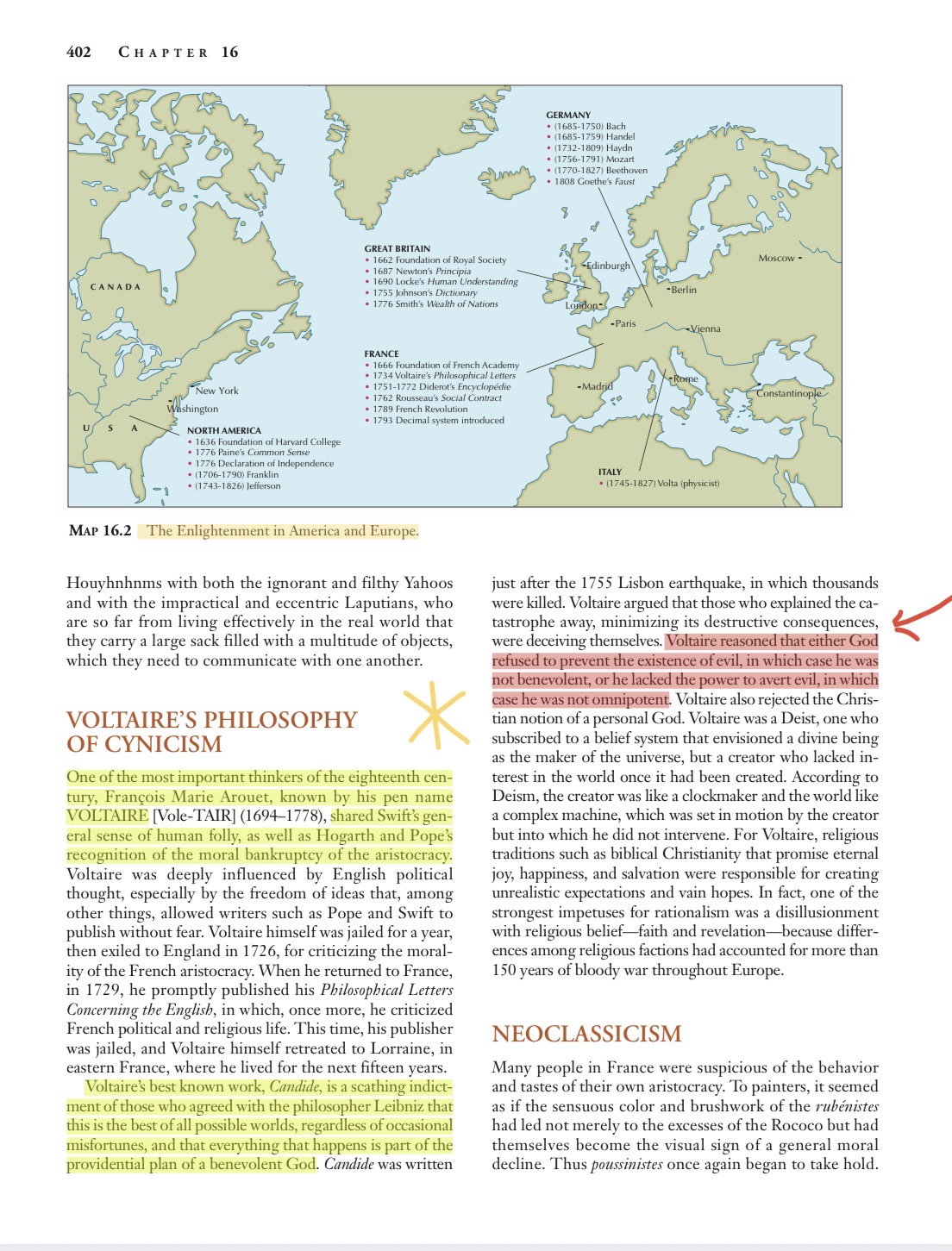
In Candide, Voltaire is not just telling a story; he’s attacking a very specific idea, namely that everything that happens, no matter how bad, is part of the best possible plan. That view is usually associated with Leibniz, and Voltaire thinks it collapses when you look at real suffering. But here’s the important point:
Voltaire is critiquing one version of theism, not all of theism. The dilemma your textbook highlights–“either God is not good or not powerful”–assumes that if God is good, He must prevent all evil immediately, and if He doesn’t, then something is wrong with Him. But that assumption is doing a lot of work, and it’s not the only way Christians have thought about the issue. For example, Christian thought has often said:
God may allow evil for reasons that are not always visible to us
Human freedom and a structured world can involve real consequences
Not all goods are immediate; some are long-term or relational
And importantly, Christianity does not say suffering is trivial or “just fine” — it takes it seriously (which is why the cross is central)
So Voltaire is right to reject the idea that we should just shrug and say “everything is obviously for the best” in the face of suffering. But it doesn’t follow that theism collapses into “God is either not good or not powerful.” That’s a stronger claim than his example actually proves.
A simpler way to put it: Voltaire shows that naive optimism doesn’t work. But he does not prove that theism itself doesn’t work.
They’re not “supposed” ANE religions. They pre-existed both Abram, who was called from Ur of the Chaldeans, where he worshipped other gods, and the invention of Hebrew writing, which lagged a couple of thousand years after the invention of cuneiform. Oral traditions preceeded both written languages.
It’s also worth noting that human notions about gods and spirits date back to at least 40-50,000 years ago, long before organized religions appeared on the scene. “Venus” fertility figurines appear about then and proliferate across Eurasia. The head is missing in this oldest example, but note the protruding breasts and belly of pregnancy. These figures persisted until about 10,000 years ago.
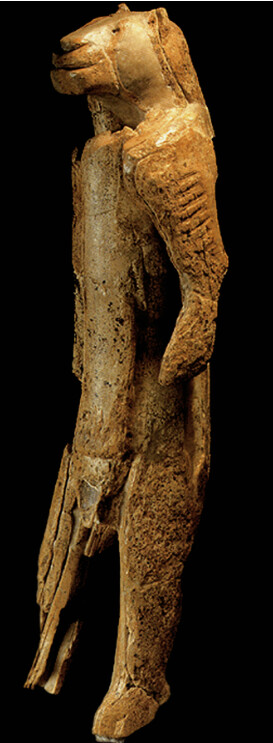
Or there’s the “magical creature” of a man with a lion’s head sculpted from mammoth ivory 40,000 years ago. It’s thought to be based upon a shaman wearing a mask or headdress, but who knows? At the least, it indicates some sort of primitive animism.