David Bentley Hart gave words to a lot of my own experience in this substack essay,
This sums it up: “my most sincere and spontaneous experiences of a sense of the transcendent have as a rule come about from encounters with nature and the arts rather than from anything remotely like formal worship.”
I was reading it as you made this post, and thank you for posting, as it resonates with me in my own experiences. He does a much better job of expressing his thoughts and faith than I could, but certainly is a kindred spirit.
While I have that irreligious streak, I do seem to strive to be religious, for whatever reason, perhaps to feel a part of the community of believers, even if a bit on the outskirts of the village.
Its a lonely road as Hart notes with some very brutal honesty:
>I should say that I am not proud of my irreligious nature, and it certainly is not some kind of defiant attitude on my part. I know I am lacking some capacity that others possess in abundance, one that often bespeaks an admirable absence of self-possession. I have also discovered, however, that I do not really care. God shines out in all beauty and all love, and every devotion of the heart—including a love of Proust or Turner or the Baltimore Orioles—can be worship. . . . All that said, though, I am not going to make any more vigorous attempts to justify my condition, let alone glamorize it. I am sure that those who are borne up by corporate worship, prayer gatherings, and daily offices enjoy richer and stabler spiritual lives than mine. I would never recommend that anyone imitate my style of faith, or wish anyone else to be confined within my emotional and spiritual limitations.”
I am irreligious at times so I can relate. Sometimes worship songs really move me. Other times it looks like a bunch of mindless robots offering praise to an already perfect God. I just don’t think Jesus appointed specific disciples, left behind an authoritative community he commissioned to preach his name, or gave us the Eucharist for nothing. I’m a mixed bag. I am moved by “formal worship” and “encounters with nature and the arts.” Christ left behind a Church, and though I am guilty of this, I suspect, ideally we should be active members of it in good standing which is the exact opposite of being an “irreligious Christian.” Hart is correct. It is nothing to celebrate. I view this as some sort of deep pride that is hard to let go of but we are fortunate for grace and that despite ourselves, God will find a way (eat your heart of Jeff Goldblum). I also suspect Hart lets his political views influence him here too much (based on one line there and some of his prior feuds with Ed Feser).
I can relate, though I would say your mileage may vary since I know people who have experienced the transcendent most intensely during formal worship. This may have more to do with how ritualized and formulaic a lot of formal worship can become than a problem with formal worship itself. I go to an Anglican church so I have no problem with ceremony and symbolism but I also think that said ceremony and symbolism need to be connected to live spiritual and theological truths to avoid becoming empty ritual.
Another way to look at it is that the earliest church buildings were meant to be a miniature cosmos. God’s actual temple is the entire cosmos, so it makes sense that you would experience less in the church since it is supposed to be a model of the whole thing.
The confessions of DBH felt honest. It was a description of personal experiences, yet it included aspects that felt familiar for a person that has been a believer for 40+ years. I assume that all the tones would not have been as understandable for me 30+ years ago but life experiences open up a broader view to the life.
The linked description of an irreligious Christian seems to have positive sides. We tend to focus on the visible instead of the invisible God. A strong emotional reaction to the visible or a focus on how well we manage in our religious efforts may divert our mind to the created instead of the Creator - what is potentially good may make us loose the direct connection with God. If being irreligious saves us from this trap, then irreligious is better than religious.
How we experience and feel the sacred is dependent on our personal history but there are also other factors involved.
Life experience and age play a role - me 40 years ago experienced everything in a somewhat different way than me today.
Education and training affects our responses. Academic researcher training acts like keeping a small part of me in the role of an analytical observer, even when I worship. Theological education added another layer to the analytical observer - the observing looks now also at how the messages relate to the different theological interpretations and doctrines.
Brain chemistry affects the experiences. I tested an antidepressant with mood dampening effects and noticed that it affected the way how I experienced the worship during services. As the feelings were greatly dampened, my attitude switched to strongly rational. My faith was not affected but praise became a rational choice instead of an emotional reaction. As I have experienced both a strongly emotional approach (me as a young believer) and a strongly rational approach (me during the testing of the drug), it has helped me to understand both the emotional and rational reactions to the sacred.
We are a diverse group of persons and therefore, the reactions towards the religious, sacred and acts of God are diverse. I think that this diversity is basically positive, although extreme reactions and attitudes may cause problems. We need diversity to build a balanced whole. It would be terrible if all Christians would be like identical clones in our behaviours and feelings. I think it is a great mercy of God that you are not like me.
More true in my later years than it was in my youthful ones. I resonated with a lot of what Hart wrote in the whole essay. I’m currently reading “What Grows in Weary Lands” by Tish Harrison Warren. It also is a plunge into the world of aging and middle-aged Christian devotion/passion (or the want of sustained passionate devotion) in the hearts of aging believers. Hart’s reflections are a more intellectually ‘dressed up’ version of what Warren also offers in more accessible ways, and through quotations of the early desert fathers and mothers who early on faced the same seasons of long-term faith.
Oh … and if the lack of mention of Augustine in Hart’s other essay was a mystery to me then, it is no longer. From Hart’s “Confessions” that Jay linked to above …
I was drawn eastward by the Greek and Syrian fathers, and by the total absence of any element of the late Augustine’s theology in the Orthodox tradition, far more than by the clouds of incense, jangle of thuribles, sheen of satin, and ululations of chanters.
And in case one hasn’t yet tasted Hart’s unapologetically polemical edges, then just sample the bottom sentences of this extended paragraph of his from later in the same essay. (The whole paragraph is worth the read though).
I should say that I am not proud of my irreligious nature, and it certainly is not some kind of defiant attitude on my part. I know I am lacking some capacity that others possess in abundance, one that often bespeaks an admirable absence of self-possession. I have also discovered, however, that I do not really care. God shines out in all beauty and all love, and every devotion of the heart—including a love of Proust or Turner or the Baltimore Orioles—can be worship. I have learned to stop worrying about my essential worldliness, and to accept that temperament is destiny. I could go on trying my damnedest to make myself able to tolerate the daily recitation of offices, as both my brothers are, but I would have no better hope of succeeding at that than of learning to adore the Yankees. Rather than to the psalter, I shall continue to return with regularity to Keats or Yeats for spiritual succor. Above all, I have realized that there is not one way of being a Christian, and that Christ plays in ten thousand places. And there are, it occurs to me, certain advantages to my irreligion. For one thing, the old atheist cavil that one believes because one has some great emotional attachment to one’s religious upbringing and the consolations of faith is wholly without force against me. I know that my beliefs are not prompted by any sentimental attachments to the hymnal or the kindly smile of a parish priest, or by some desperately fantastic desire to elude the Reaper’s scythe. So, really, it should please those who are more adept at religious sentiment than I am to know that there are believers like me, who are persuaded that Christ rose from the dead even though they are not moved by any pronounced will to believe. Most important of all, it seems to me, is the absence of any interest in ‘Christian identity’ on the part of someone with my irreligious tendencies. In fact, I suspect that it is sometimes harder for the religious to be coherently Christian than for the irreligious, precisely because the former often turn out to be more attached to the religion than to the one to whom it points. One hardly has to call attention to the atrocities to which devotion to ecclesial institutional power or to Christendom or to Christian identity can lead, and how far it can lead one away from the teachings of Jesus. (Just consider the voting habits of millions of ‘conservative’ American Christians.)
If Hart was a singular and solitary figure expressing this stuff, it might be dismissible. But when the growing chorus of scripturally articulate and aging wisdoms all seem to be echoing these things from so many disparate corners, one has to be willfully blind not to notice. Eventually one could despair of finding fault with all the apparent evangelical ‘bashers’ and wonder instead how American evangelicals can be so fatally effective in bashing their own piety in front of the watching world.
But back on Augustine again … this too from Hart’s essay.
Of course, Christianity comes in so many varieties that one can generally wriggle off the hook of any particular dogma or theological system without renouncing one’s faith; moving to Eastern Christianity long ago relieved me of the burden of pretending patience for such abysmal nonsense as the ideas of inherited guilt or penal substitutionary atonement or predestination ante praevisa merita; but even that did not allow me to escape vague but seemingly binding notions of God’s limited will to save or of an ultimate division between the blessed and the damned (which to me makes the blessed seem peculiarly damnable and the damned boundlessly pitiable). In any event, too long a study of scripture and early Christianity inevitably disabuses one of the illusion that later doctrinal history is quite the natural and ‘Spirit-breathed’ unfolding of the original kerygma that it frequently presents itself as being; and, once one realizes this, dogma as such, solely on its own authority, loses its power to command unqualified assent.
A very Augustinian “ouch!” there I suppose. But even after all this - Hart’s Augustinian vitriol notwithstanding (not entirely anyway) - I think I’m with you in not wanting to be hastily dismissive of Christian debt to Greek Platonism or to Augustine through whom much of that was apparently curated.
Indeed there are many Good Books and inspired authors.
Hear, hear!
The idea that one would believe because one feels they should is a little irksome. It might lead some to think they could also coerce others to believe. I don’t think belief is restricted to what one has evidence or objective reasons for as atheists are always clamoring for. But I do think it arises naturally in response to hearing the truth, as when reading a novel, play or poem. You have to read or listen from your whole body, not in an abstract Cartesian manner.
And I think my writings have a lot of hot air….Hart is rough especially when he starts cracking the whip. As Feser said: “D. B. Hart’s predilection for gratuitous invective is so central and well-known a feature of his style that no reviewer can entirely avoid mentioning it.”
I will say that if Hart intends to compare formal worship or something like the Eucharist with baseball fandom, he has jumped the shark (lost his ■■■■ mind). Yes, God can be found in all of creation but that is just silly. Might as well say we don’t need Christ because God can be found anywhere just the same. Who needs Christ when I have manure or hay to lead the way.
Hart doesn’t seem to limit his vitriol (your “polemical edges”) to evangelicals though. Evangelicals are products of the enlightenment and a mechanistic image of God, the same as those who embrace scientism, and materialism today. Regular people pigeon-holed by modernity and capitalism. Their intellectual theological mistakes can be forgiven. As can Harts which are no better. The former is too blind and literal in its woodiness whereas the latter is too loose in making up his own irreligious religion where everyone lives happily ever after.
Though morally speaking, I can’t justify the lack of empathy or the hatred some alleged Christians tend to have towards say immigrants. This is not just a feature of conservative Christians as so many new groups to this country faced abuse and discrimination. But many conservatives certainly love the “rule of law” route. These well-to-do conquistadors of their own destiny, masters of their own fate, and to channel Billy Zane from Titanic, real men who make their own luck, would of course come here the right way–through the letter of the American law. Because it’s so easy. The sarcasm is dripping here in case it was missed. All the while disparaging the actual law giving by God to Moses on Sinai. Many hate-filled people taking the name of Christ will be turned away. Just not according to Hart since he is a universalist (see here for a critique of his thinking). Evangelicals (and people in general) often let fear take the wheel (certainly happened to many during Covid) with the aid of algorithms and corrupt teachers and politicians helping to justify it. In reality, immigration is a very difficult and complex subject. Can’t have wide open borders (we certainly don’t run our homes this way) but these are real people, often in real need. If someone went through great risk to bring their family to America (illegally), I applaud their courage. That is what good fathers and mothers do for their children. I wouldn’t vilify them as “criminals” if they came here outside the law. They are people trying to help their family live a better life. I wonder how many of these evangelicals speed when driving – even if slightly But in the end I don’t want to get political but I err towards compassion over rule of law but how does that work in the real world? In the end I think immigrants are a smoke-screen for wealth disparities. A deflection used by the rich and powerful so that the attention isn’t on them. But non-evangelicals are easy to critique as well. I think about 2/3 of nonconservative Christians are pro-choice. Not sure your stance on this but nothing conservative evangelicals say or believe surpasses this in terms of moral bankruptcy to me. They may equal it but it’s just comparing different types of rotten fruit in my mind. In my mind, abortion advocates might as well use the spirit of the age, the meaninglessness of human life and start arguing for exposure next. If we dig hard enough, we will find plenty of planks in non-conservative eyes. They are just harder to see for some of us because of our Disney princess theology—we are Israel , the conservatives are Egypt. We are the slaves, not the slave owners etc. etc. So as much as I don’t vibe with evangelical thinking, I have tried –repeat tried–to get away from bashing and tearing down. And who people vote for in an election doesn’t define them. That is a pretty stupid thought to be honest. I face it from both ends. The evangelical bashers and the evangelicals who told me Joe Biden wasn’t a Christian because he supported pro-choice. Everyone has their own litmus test I guess. But in the end this is a mess for God alone to sort.
Sounds like a high school student that says “as long as I pass” or asks “does this standardized district evaluation count towards my grade.” I think we should set the bar higher.
Yes, Augustine has many well known problems. The privation form of original sin is a major step up from how his traducianism framed it. I side with Aquinas in that the soul is created ex-nihilo by God. I think Augustine was correct to accept a literal fall in history and some serious consequences that extend to all of humanity though. The modern predilection to reject both goes in the wrong direction in my opinion and is too loosey goosey with scripture. Platonism was the bees knees in Augustine’s time so when he baptizes Greek philosophy and introduces it to the incarnation and the “Hebrew spirit” (whatever that is), he is doing the entire Church and subsequent Western Christianity a tremendous service. Augustine made it much easier to be a high level intellectual and Christian. Biologos itself seems to do the same just in the capacity of pure science as opposed to philosophy. Augustine didn’t corrupt Christianity. He gave it wings but yes, he also has some major issues such as infants and inherited guilt. At any rate, Aquinas fixed everything and Gavin Ortlund has a nice piece on Augustine on Biologos:
Of interest to me here: “Augustine vociferously affirmed the goodness of animal death prior to the fall, in opposition to the Manichaean criticism that animal death is evil. He was particularly fascinated with insects and carnivorous animals, and spent a great deal of time reflecting on why God made them as a part of his good creation.”
Bravo to whoever made it through the long post. When it came to his 3rd or 4th compound sentence with allusions to philosophers and thousand dollar words I barely could guess at, I gave up.
Maybe someone could summarize it for me.
I do enjoy this poem, which likely resonates with more people than expected–but being a people person, I think I also like the synthetic sanctuary at times, too.
Hart is arguing that many people mistake Christianity for “religion.” By “religion,” he means things like:
tribal identity,
cultural tradition,
moral rule-keeping,
political allegiance,
social belonging,
comforting myths,
or a system for explaining the world.
Hart argues that Christianity is not primarily any of those things.
Instead, Christianity is a response to a person—Jesus Christ—and to the conviction that ultimate reality is revealed in Christ. A major theme of the essay is that Christians should not confuse faith with ideology, nationalism, culture-war politics, or institutional loyalty. Those things may attach themselves to Christianity, but they are not Christianity itself. Hart also argues that genuine Christianity should produce humility because Christians do not possess God as an object of knowledge. God always exceeds our concepts, categories, and systems. So when Hart calls himself an “irreligious Christian,” he is not saying he rejects Christianity. He is saying that he is suspicious of many things commonly called “religion” and wants to distinguish them from the radical claims of the Gospel itself.
Whether one agrees with him or not, the essay is less about attacking religion than about asking what Christianity becomes when all the cultural and ideological baggage is stripped away.
P.S. Speaking aloud extemporaneously, he is forced to explain himself. Writing, he can indulge every allusion, every subordinate clause, every rhetorical flourish.
I don’t want to go off the beaten path too much here. However, I find this point of view very interesting.
Some of us, particularly (perhaps) those with autism and difficulty with interpersonal relationships, find this concept difficult–to base their belief on an interaction with a human, whether abstract or not (one of my children is autistic, and does struggle, for example).
Also, when one interacts with the working out of faith–such as for slaves (freedom; eg “Reading While Black,”)_it’s a tough sell to separate it from a given struggle–as much as I hear what he’s saying.
I can see that. My 11 year old autistic granddaughter was baptized this weekend at camp, and I had a good discussion as to with her mom, my daughter as to what that looked like. She was concerned with her ability to know what baptism and being a Christian meant, and I reassured her that I have my questions as well, old as I am, so it is fine to not have all the answers, as Christianity can be seen individually as different things, and we all relate to Christ as we are, and are loved by Christ as we are. To make God in our image and expect others to conform to that image is not Christianity, as I see it. And, as we mature, how we relate to Christ is subject to change.
But my actual faith—my connection to God in a typical day—felt wavering. God began to seem less like a kind, present friend and more like a corpse on a table that we, like medical examiners, analyzed and debated in the comment sections of my articles. Less like a being of overwhelming beauty, the Maker of heaven and earth, and more of a sociological artifact used to track American voting blocs.
Tish Harrison Warren / What Grows in Weary Lands, pg. 6.
Hart’s entire article resonated.
I’m between DBH and Warren here. Warren seems to have a greater capicity for spiritual experience than I do. But, at the same time, like Hart, I do little of what is normally seen as essential to bring it about.
I appreciate Warren’s point about the way we discuss God and things of God as if we’re doing an autopsy. I value theological study and discussion about doctrine, but eventually it feels like we’re just discussing ideas with nothing behind them. Except more ideas. References all the way down. Actual spiritual practice seems to be driven from the room by the same people who insist on them.
Like Hart, I often feel more connected to God out in the woods, in a Great Lake – where I feel physically, directly the world of which I am a part. It’s vastness and power and intricate detail. I can think about how the God I believe is somehow responsible. Without caring how the mechanics or metaphysics work. But I am no mystic.
I can see the world entirely naturalistically as well. I don’t ask to do this; I just can. I take grief from every side for it as well. Too gullible, or too tainted by my secular education, too rational and mechanical. I find it harder all the time to care (to conform to) what others think. I wonder now if there is care to be found for a soul like mine, something that is not simply care for someone’s pet idea that I can’t/won’t conform to. It certainly limits approaching church leadership. Some of the best soul care I’ve found is from Terry Eagleton - a Marxist atheist, who at least respects Christian belief and the indivuals who hold it. See Radical Sacrifice for an outstanding example.
I find “issues” in the church and theological whirlwinds “spiritually discouraging” as it were. Where does one go within the church that is quiet and peaceful. When every sermon and hymn is a potential battleground for my own faith. Who does one talk to, when one is not interested in being convinced of something but rather heard and accepted in spite of a different view.
I tend to think in terms of a knight and a king; I can conceive of myself and Jesus in that way more easily than anything. Occasionally my thoughts of Him are of a friend.
When I think of Jesus as a friend, which is often the case, I harken back to how C. S. Lewis described friendship in The Four Loves, when he describes friendship as standing shoulder to shoulder looking outward with a common purpose and desire, as opposed to gazing into each other’s eyes.
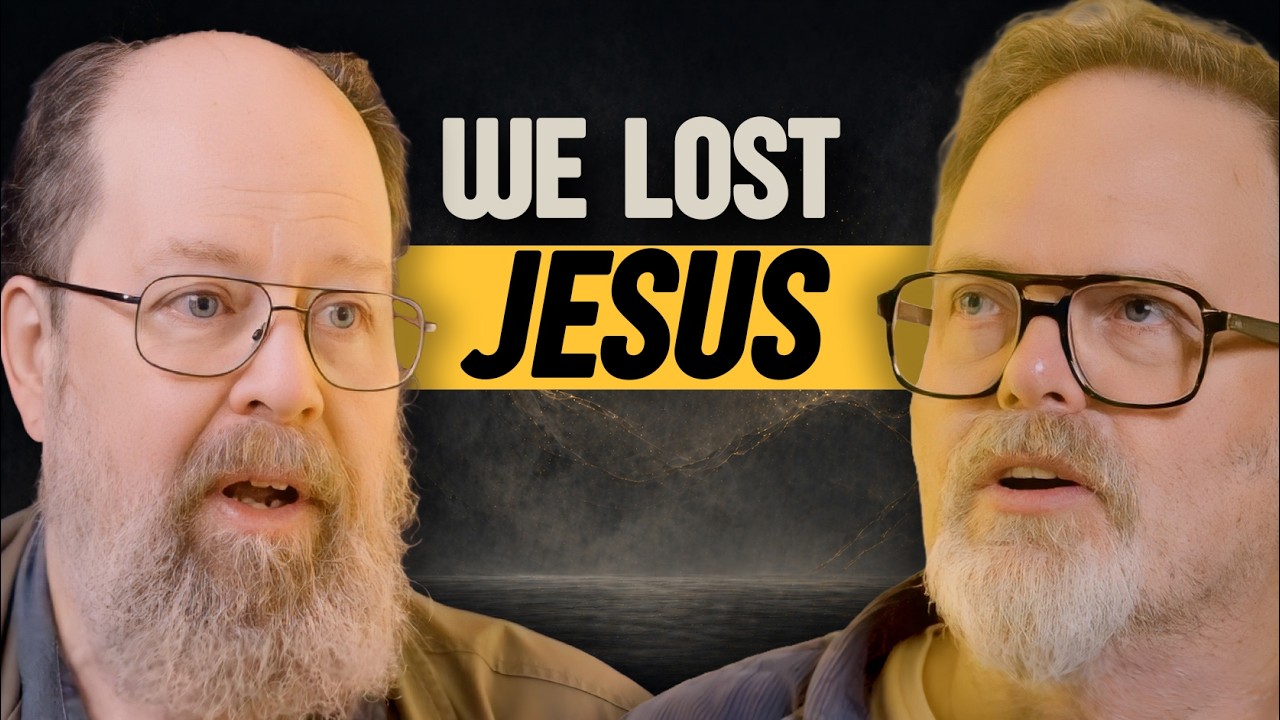
I wonder if anyone else has come across this interview of DBH by Rainn Wilson? If you aren’t familiar with his irreligious nature this will catch you up. I liked the spirit of all he had to say here though the first 2 minutes will give you the gist.