Thank God for that.
Richard
Thank God for that.
Richard
Why do you need a name. I gave you the arguments against it. is that not enough?
You seem to accept AI as valid.
And by now you should know that I do not quote people as proof of anything.
Richard
Priest always tended to give me headaches.
I can relate. My Bishop though is genuinely one of the best persons I know. I have met him personally and we talk very often, genuinely a great guy and a great man of God,
There is always an infallible remedy to headaches, though.
The “illuminists” ( Enlighteners) apparently liked this remedy an awful lot. 
You are in good company, Jesus agrees with you!
“And call no man your father upon the earth: for one is your Father, which is in heaven. Neither be ye called masters: for one is your Master, even Christ. But he that is greatest among you shall be your servant. And whosoever shall exalt himself shall be abased; and he that shall humble himself shall be exalted. But woe unto you, scribes and Pharisees, hypocrites! for ye shut up the kingdom of heaven against men: for ye neither go in yourselves, neither suffer ye them that are entering to go in.” (Matthew 23:9-13)
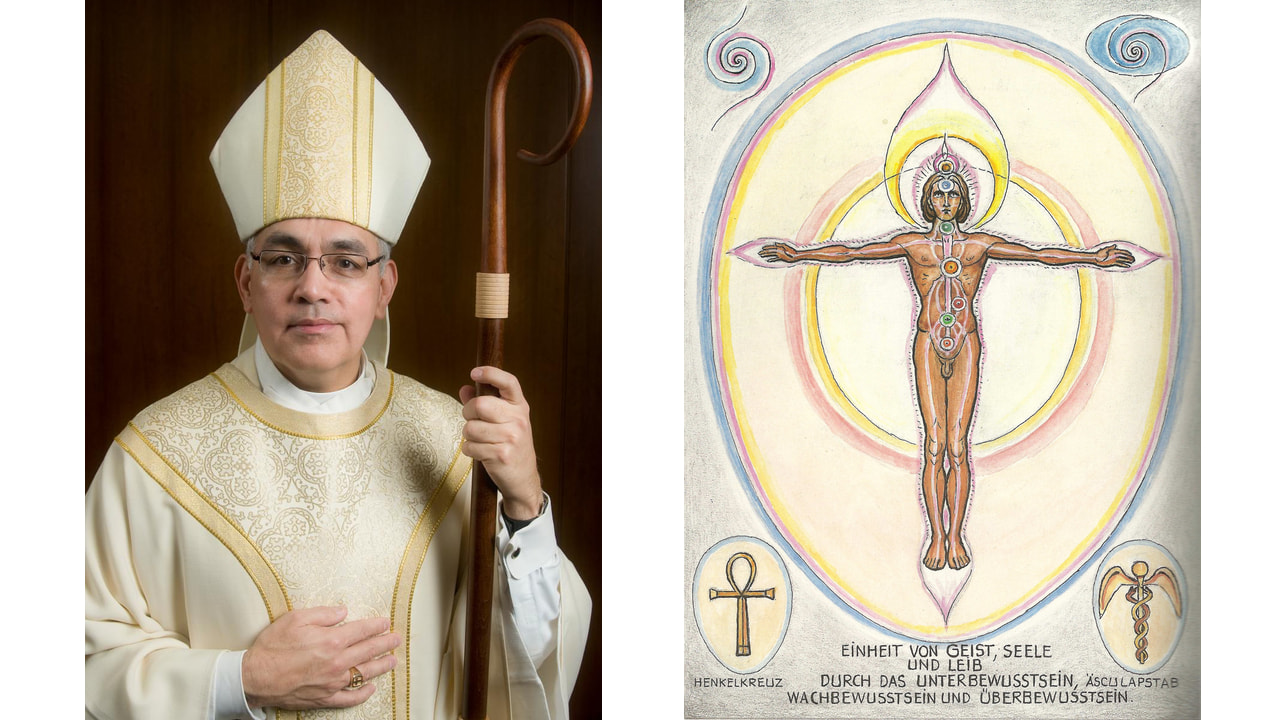
Note: The first bishops, in the time before Nicea, were filled with a holy spirit (right image), but they stopped following the teachings of the spirit of truth because of what Jesus said to disciples - it is unbearable. (John 16:12) When the holy spirit abandoned the “bishops” created the disguise to fool their followers into thinking that the spirit was still preaching through them.
Two reasons not to listen to priests and to call them the heretics.
I was hoping to get the views of people other than “The usual suspects”.
The underlying reason for this thread was that the Logic of Contradiction would imply that there is a single truth (or view) to which any contradiction would be a falsehood or lie (depending on the amount of contradicting involved). So:
Can this logic be applied Universally, so that there is always a specific truth?
and,
More poignantly to this Forum, can it be applied to all theology and faith, as the Catholic Church would seem to suggest (judging by the posts from Catholics here)?
Richard
Logic follows that if there is one Creator, then there should be one Truth, otherwise the Creator is schizophrenic. If you look at the commonality between the major religions, you should find agreement. Where you don’t, it can be explained by a lack of human understanding. The Golden Rule, for example, is universal.
What a comfortable and simple response. It makes life simple and thinking unnecessary.
I have been having a little Chat with ChatGPT
Here are are a few interetsing examples
Consider the statement:
“This sentence is both true and false.”
If the statement is true, then it must also be false. But if it is false, then it appears to be true.
This is a philosophical challenge to the Law of Non-Contradiction, which states that something cannot be both true and false at the same time and in the same sense.
However, it is not universally accepted as a refutation; some philosophers (dialetheists) argue that genuine contradictions can exist.
“The only constant in life is change.”
Would appear to be contradictory or paradoxical at least.
1. The Earth is moving.
2. The Earth is not moving.
Both are true: the Earth moves relative to the Sun, but is stationary relative to someone standing on its surface (ignoring its rotation and other motion).
The contradiction disappears when you consider the reference point.
Witness 1: “I heard only one gunshot.”
Witness 2: “I clearly heard two gunshots.”
Both can be true if the second sound was an echo of the first gunshot.
Truth can depend on perspective and/or context. It might even depend on personal knowledge and understanding.
It can also be affected by hyperbole or intent, even social or practical considerations.
Therefore, a specific requirement in one faith or context might not be valid in another one. Any apparent contradictions become irrelevant to the practicalities and realities of the religions in question.
To claim that contradictions in religion, if true, would make God schizophrenic would appear to ignore such things.
Richard
We are talking about two separate concepts. I am talking truth and you are talking about perception.
Finding truth is not a simple process! Truth has nothing to do with blind faith.
If I was to claim you were wrong, would that be an absolute contradiction and view of truth?
Cannot concepts intersect or collide?
In terms of the truth in that scenario.
There was one gunshot and one echo. So the firsts statement is correct and so is the second. it is nothing to do with perception. Both statements were correct (true)
The underlying principle here is whether truth is absolute or can be partial without being false or a lie.
Richard
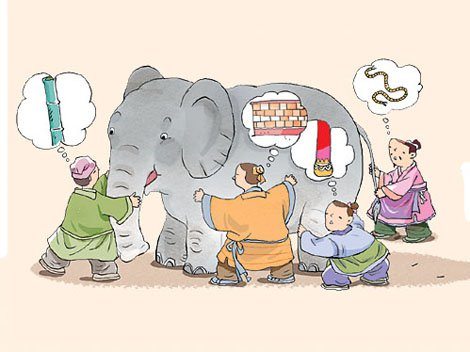
Truth, for me, is absolute. In your example, the truth was that one shot was fired, but there are many perceptions of that event. Also, I perceive that the earth is standing still, if I look down. If I look up, I might perceive that we are moving relative to the cosmos. The truth is the earth is rotating around its axis, orbiting around a sun that is orbiting around a galactic center that is travelling away from the Origin of the big bang.
There is one truth, but many perceptions. So what happens when the truth is that there is a spiritual world from which we come from, but the majority of us cannot perceive it? How do we demonstrate that it is true? The answer is, we cannot, but we can find evidence of it.

That would be a belief or maybe an assertion.
And that there was an echo.
But the earth does not move in relation to us. That is also a truth.
That does not apply to everything.
You would not expect a pole vaulter to run 100m in less than 10 seconds. They have different skill sets and abilities. Why would God have one set of expectations and rules that fits everyone?
I prefer Mature Cheddar, that is the truth, but that does not mean that Mature Cheddar is the best or even most tasty cheese. Yes that involves perception but it also is a matter of truth. There is no truth about which is the best cheese.
Religions have different views of God and what He expects of them. Who are we to claim that God has not given those expectations?
And closer to home:
Why should God expect exactly the same views and perceptions of His Truths that can easily be relative to the individual.
There is a human need for consistency, and there is a human view of logic. It is much easier t o consider truth as an absolute. Once you have found it you can defend it at all costs, and justify it 'til the cows come home.
Exclusivity is human comfort and vanity.
The “Narrow Way” is to be able to accept variance and differences.
Richard
It’s false. No paradox.
I gave the explanation
If the statement is true, then it must also be false. But if it is false, then it appears to be true
It cannot be just false because it states that it is also true.
Your logic and assertions have let you down.
Richard
It doesn’t appear to be true to me - it appears to be false, because it says it’s true and it isn’t.
Which is false. So it’s false.
Not at all. It’s basic logic:
False AND True → False.
You realise that you are basic contradicting AI and not me.
However,
would be the truth of the matter and maybe where we should stop.
Richard
I’m refuting AI as understood by you.


If you say so
(I just asked the questions and gave the AI answers)
Richard
“Let your conversation be always full of grace, seasoned with salt, so that you may know how to answer everyone.” -Colossians 4:6
This is a place for gracious dialogue about science and faith. Please read our FAQ/Guidelines before posting.