The archeological results I read about are presented at least in Amiran 1978 (Early Bronze age) and Sapir-Hen et al. 2013. Below is one citation from the article ‘Pig taboos in the ancient Near East’ by van Wyk 2014. Figures are percentages of pigs among the faunal assemblages (proportion of all animal remains).
These are just to show that there are published findings. The experts could probably give a long list of publications presenting some of the archeological findings.
Multi-cultural Canaan with Egyptian imperial domination (van Wyk):
Middle Bronze Age II: Northern Israel highland (Shiloh). Pigs are in high percentage of 3.5 percent (Sapir-Hen 2013: 9-10).
Israel in Canaan since 1410 BCE (van Wyk)
Late Bronze Age II-III: Northern Israel lowland (Megiddo, Lachish, Ekron). Pigs were raised (Sapir-Hen 2013:9).
Egyptian administration and military presence sites: Aphek (2.4 percent) and Beth-Shean (11.75 percent). Beth-Shean is the highest in the Late Bronze Age (Sapir-Hen 2013: 10).
Late Bronze Age II-III: Northern Israel highland (Shiloh and Tell Dōthan). Pigs are absent (Sapir-Hen 2013: 9-10).
Late Bronze Age II-III: Neighboring sites (Near Megiddo and Beth-Shemesh and Ekron). No interest in pig husbandry (Sapir-Hen 2013: 9-10).
Late Bronze Age II-III: Judean sites. Nearly absent (Sapir-Hen 2013: 9).
Late Bronze Age II-III: Shephelah and Beer-Sheba Valley. Low frequency of pigs (Sapir-Hen 2013: 9).
Late Bronze Age II-III: Aroer is an exception because it is a trading highway site (Sapir-Hen 2013: 9).
Late Bronze Age II: Pre-Philistine site. Ekron (2.7%) (Sapir-Hen 2013: 10).
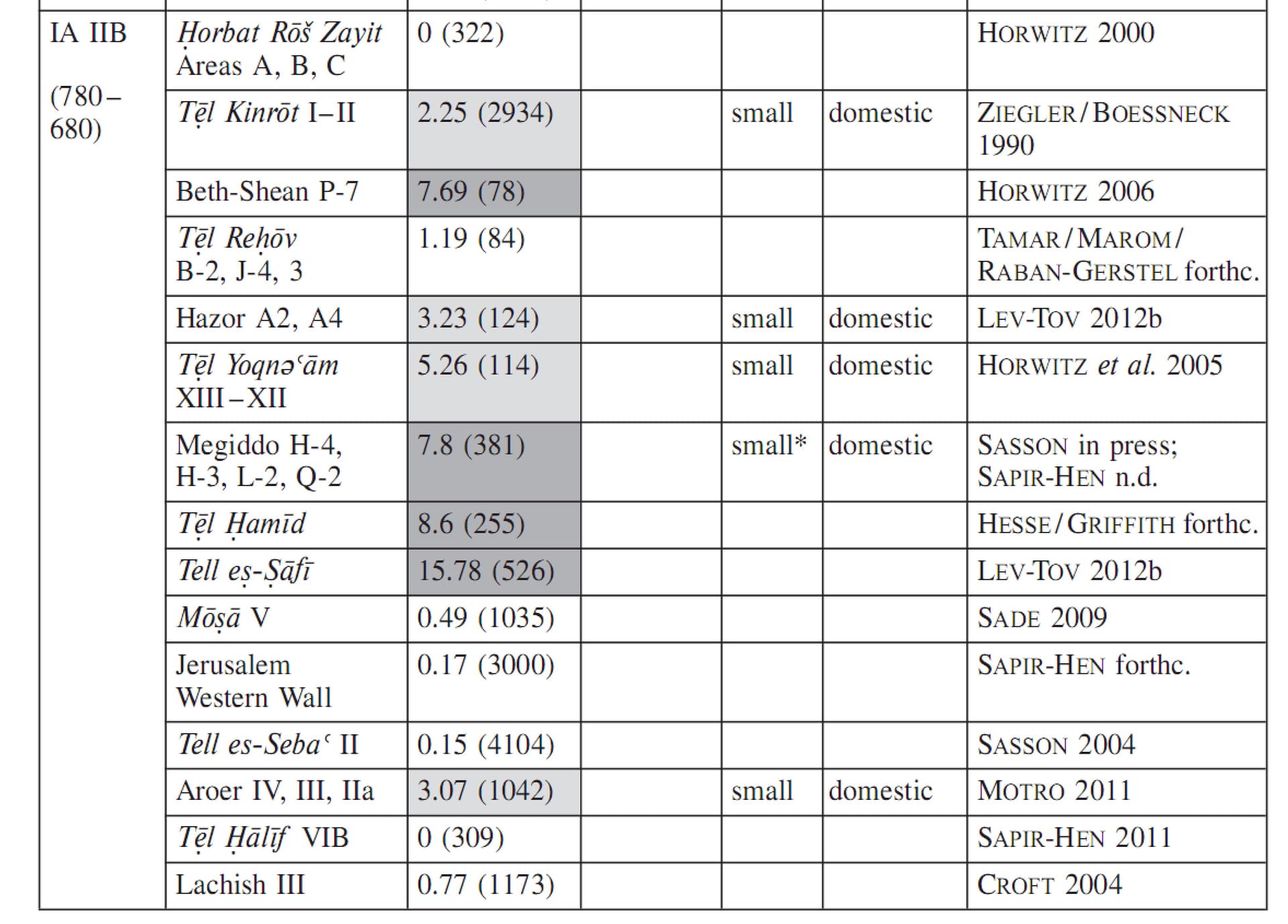
I’m finding van Wyk 2014 to be more than a little problematical. Here, they are citing commentary by Sapir-Hen et al 2013 that discusses the data in generalities, and does not clearly differentiate which of LB IIB and LB III are under discussion, rather than citing Table 1 (on page 4) which actually gives the data. This shows that they have only have Shiloh and Tell Dōthan data for LB IIB (1300-1200), and that they had no data for either for LB III.
Given that you have previously given “c. 1290-1250 BCE” as the “hypothesis of a late date”, it is also unclear that the LB IIB strata is purely Israelite, even under this hypothesis.
This is why I find it important to get back to the actual data – not van Wyk’s discussion of Sapir-Hen et al’s discussion of the data.
Also, I would like to return to your comment:
So what?
When I cited:
Yet, the data collected demonstrate that dichotomy in pig consumption did occur – between sites located in the kingdoms of Israel and Judah during the Iron Age IIB.
… I was not claiming it to be “something Kai wrote about”, but of evidence of my claim that:
It does not matter whether this evidence is from the Bronze Age that you wrote about, it is still relevant to my claim, and thus evidence.
I would note that Sapir-Hen et al 2013 say something very similar, in discussion of “Pigs in the Iron Age IIB”:
But the most drastic difference is the one between Israel and Judah.