I am not doing book sales. I also would not know about e-copies. But I gave you a source, and there are libraries. I would not know when the “flood” occurred —that region had a history of that sort of thing–so hard to guess a date. And because flooding seemed to be an event of some regularity, there were other flood stories long before the Epic of Gilgamesh was composed – and the epic added a flood story to its length late in its history, it seems. The name you and I are talking about goes back at least to Ethiopic, which, like Hebrew, is part of a larger linguistic family. You can find THAT, if you want, on the internet.
I think this conversation has run its course. But perhaps it has given several people something to think about.
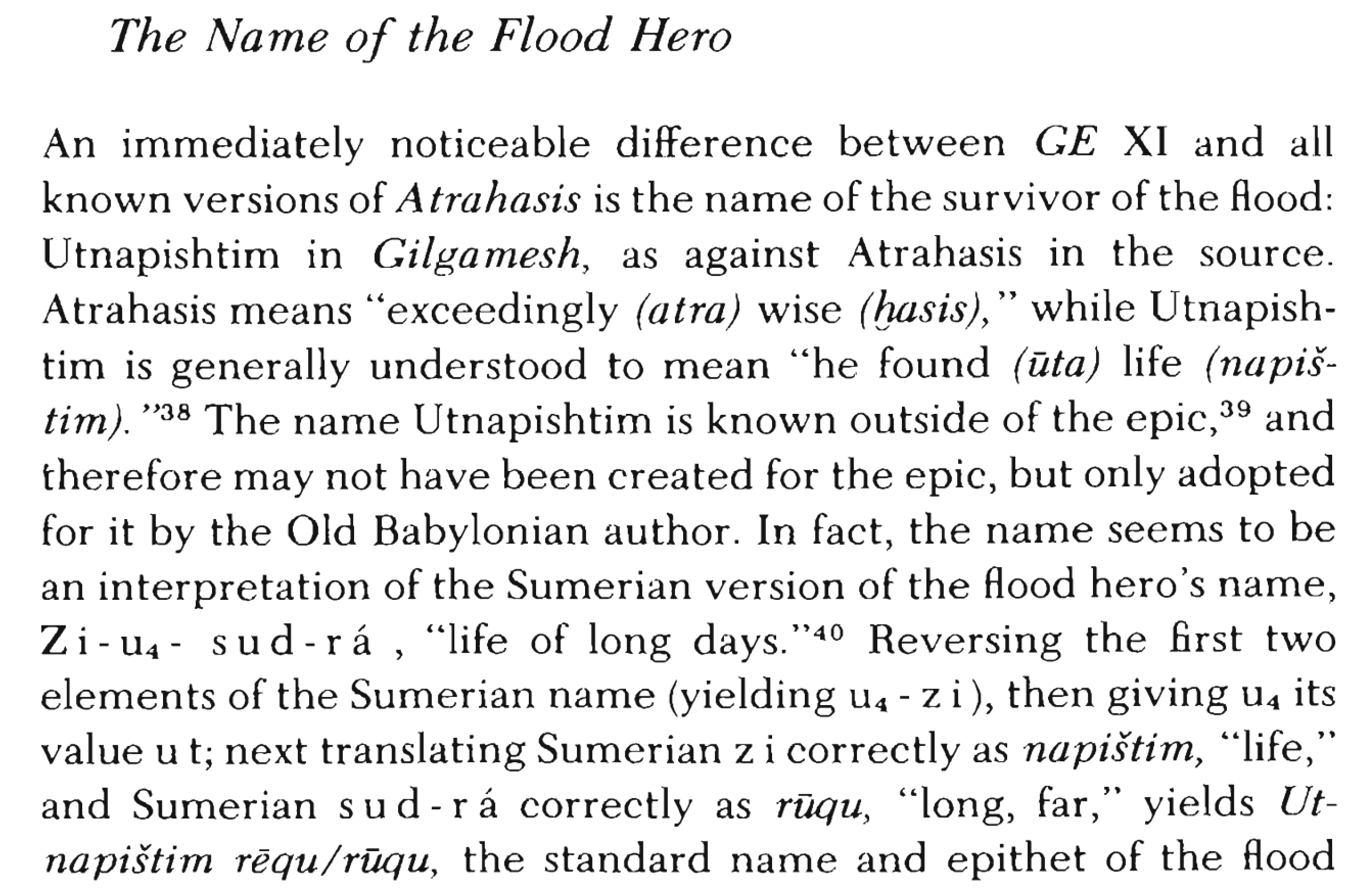
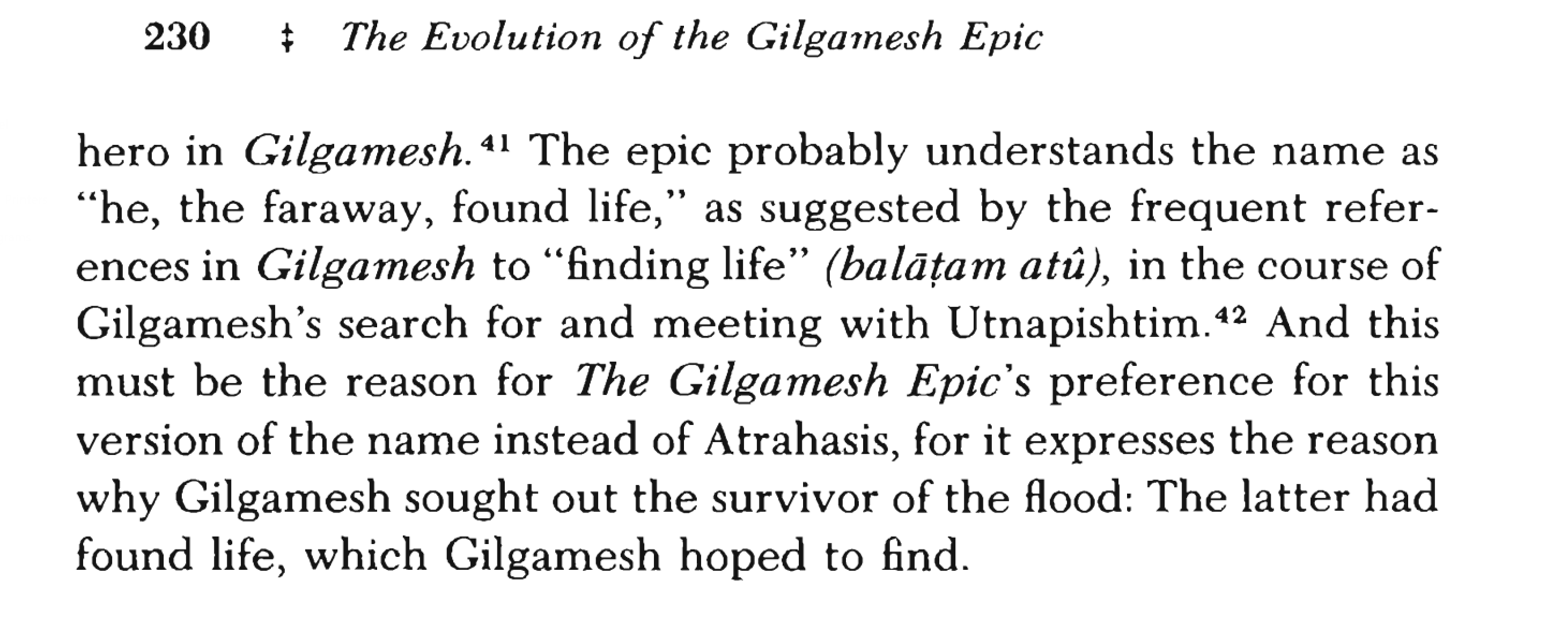
There appear to be three editions of this book (1982, 2002, 2022). The 2002 has a footnote 41 that refers to Noah:
Reversing the first two elements of the Sumerian name (yielding u4 - ζ i ), then giving u4 its value u t; next translating Sumerian ζ i correctly as napištim, “life,” and Sumerian sud-r á correctly as rüqu, “long, far,” yields Ut-napištim rēqu/rūqu, the standard name and epithet of the flood hero in Gilgamesh.41
See Komoroczy, Act. Ant. 23:60-61; Oberhuber, pp. 309-10. In this connection it is interesting to note a suggestion by G. R. Driver explaining the biblical name Noah on the basis of Ethiopie nohä, “be long” (cited by Barr, Comparative, p. 48, n. 1). However, in view of Akkadian and Amorite personal names based on nwh, “rest, be satisfied” (APNM, p. 237; Stamm, Namengehung, pp. 79, 85, 168-69, 291), Noah is more likely derived from the latter root.
(Note, the formatting in the original is complex, so I’m not sure if I’ve captured it correctly. However, the quote runs over two pages, making it complicated to paste an image of it plus the separated footnote to it. If the above is insufficient, I can attempt that.)
Another rumour of a claim quashed by the searing light of disinterestedly reasoned truth. Another biased belief relegated by coherence, warrant and justification. From rumours, claims of knowledge.
To such an extent that even AiG et al don’t, can’t use it.
I understand the desperate need to reach for what cannot be grasped. Because it isn’t there. Yearning for it to be makes it true, not to be denied, like the Holy Grail, Eldorado, Jesus’ return, Love as the intentional ground of infinite, eternal being.
On further reflection, my response to this would be the following:
No Willy (you don’t mind if I call you Willy do you? Your comment was sufficiently flippant that I don’t wish to dignify it with a “Dr Dever”), we would first have to invent an economic model that demonstrated that all the “known archaeological remains” people are trying to attribute to him could have been possible within the reign of a single monarch in Solomon’s circumstances.
This endeavor would be made especially difficult by needing to graft such a massively productive economy onto David’s legacy of a plunder-and-tribute, ‘Bandit King’, parasitic economy.
To accept the Biblical account of either David’s military, or Solomon’s economy at face value, I think I would first require a detailed explanation of their feasibility by a first rate Military Historian or Economic Historian, respectively. I have seen nothing to date that would lead me to consider that either Kenneth Kitchen or William G. Dever qualify as either specialised expert. And lacking such, I am not particularly interested in ambiguous and disputed claims from either the High or the Low Chronologies as to which structures were built when.
This means that I’m no longer so much “withholding judgement” on Kitchen’s On the Reliability of the Old Testament, as ignoring it as irrelevant to my concerns.
Likewise, differences in names and the representation of the gods suggest a religious adaptation, in which the Hittite pantheon replaces some of the Mesopotamian gods. These changes not only indicate an appropriation of the myth but also a reinterpretation that allowed its integration into Anatolian oral and written tradition.
The discovery of the Hittite version of Gilgamesh highlights the incredible ability of ancient stories to travel and transform. The epic was not confined to its place of origin but was absorbed by different civilizations, each of which left its own mark on it.
The above found online via jstor.org and others…interesting. It does seem to go along with some of what was orginially being discussed above…But also see below quote from NBD, p. 838…
The name in Genesis 5:29 “is associated with nhm…The element nhm is associated with Amorite personal names and in the fragment Nahmizuh which figures in a Hurrian fragment of the Gilgamesh epic found at Bozaskoy [sp], the Hittite capital in Asia Minor…”
I must say that I’m with @Apistos in finding your claims too-frequently … shall we say far-less-than-tightly-argued. It often comes across more as ‘flow-of-consciousness’ than presenting a coherent point. The former can make for great song lyrics, but as a basis for intellectual discussion … not so much.
Well Tim..in your case the only thing I ever tried to make as comment to you was (I think) with relation to ONE thing—the matter of the existence of a Solomon or Solomon-like character. I quoted Dr Dever --who is no raging fundamentalist–as having said, in the book cited, that if there were not a Solomon, then one would have to invent some such personage to explain the construction projects in those three ancient cities. I know that you challenged that. But I am not Dr Dever. I just quoted the guy. The sort of questions you asked in response were mostly good and were the sort of things that required the good Dr’s presence…maybe even the close reading of some ancient construction document (that may have been read by Dever and others for all I know). "Solomon-style’ bits of construction…similarities to similar gates or etc in other cities…you wanted to argue this as though it were I (me, myself, and I) who had made the claims and been in the dusty trenches of ancient Megiddo, Hazor, and more. I did try to cite a couple quotes from other archaeologists or etc —all from articles in a particular biblical archaeology source…However, there is not the room here…Yes, I know that there is much discussion in dating, but Dever DID do the fieldwork. I was just in London. When I asked people about building styles, I presumed in part that they knew a particular building style simply because it was pretty ubiquitous in a region. When you and I drive down certain streets, I will bet that we can.–at times–pick out a store in the distance (“OH! That looks like a Best Buy
!”) and be pretty accurate in our assessment because we are familiar with architecture, layout of their parking lots etc)…We see a connection in styles due to a store’s original marketing plan or preference in store styles. I would presume that some of that lies behind assertions that there would need to be an invention of a Solomon-like character to explain them (in those ancient cities)—were it not that there were no actual Solomon.
You disagree evidently. Thus, I suggested naming this “mystery builder” Tim since you do not like the name “Solomon.”.
I was joking about that last part. OK… That does not sound like “flow of consciousness”…it sounds like making a point.
Ummm … whatever gave you the idea I had the slightest problem with the name “Solomon”? Prove that something existed, and you can call it by any name you choose – “A rose by any other name …” and all that.
It is however wild digressions like this that make me feel like I should be nervously backing away whilst checking carefully that you don’t have any sharp objects within your reach.
Evidence about Solomon does not say anything about the Exodus, any more than a camper sitting on the side of a highway says anything about what the traffic was like two hours earlier.
Not true – it’s a matter of where/when one looks.
Sorry, but no: evidence of something being the case in one decade does not prove or even say anything about what is the case in an earlier decade, let alone several centuries.
Which only says that the writer (or editor) indulged in anachronisms so his audience would follow what he was talking about.
It’s a good one, too.
But it conforms to how “hero” tales were told in the ANE.
That claim is as fallacious as what Adam is saying.
Natives in the Pacific Northwest carried down accurate stories about the eruption of Mount Mazama circa 5700 B.C.
Though it is also a derivative form of “nu-ach”, which means “rest”, and so may be symbolic.
No, it isn’t – you’re talking about significantly different types of literature.
BTW, you have never responded to the fact that you definition of what counts as historical includes books by Tom Clancy and John Grisham.
No, it isn’t – that requires a shallow and rather ignorant view of the Bible.
That’s similar to claiming that because there are no dishes in the sink then no one ate breakfast.
More accurately, “there is no evidence for an Exodus” is dead. Some scholars insist there were actually two and the accounts were woven together.
For example, a pharaoh needed to demonstrate he was a good leader by going and trouncing some peasants.