The Bronze Age Noah character never existed for absolute certain.
1 Like
Neither did the Bronze Age Adolf
Which Bronze Age Adolph?
Never say never. Your reasoning for denying there ever was a guy named Noah was that the biblical text shows him acting like a robot. But the Bible is, as someone else once said, “bare bones” in its telling of things. Later in the story–that is, Genesis 9:18-29 for example–you have one of many descriptions of one of humanity’s earliest dysfunctional families. Just read it –his sons’ disrespectful behavior when they found their father drunk. Sons were supposed to protect their father’s honor–including cleaning up after him when he was drunk. This is hardly a robotic character who said “Yes Lord” and automatically and unquestioningly did as he was told. There seems to be more to the story, and perhaps the “real Noah” (whomever he is) is happy to have it left untold.
So if that is your main reason for not believing in his existence – that he is too obedient–it’s a thin reason. Granted, the idea of a worldwide flood has no support geologically …but local floods of greater impact than normal – not an impossibility. When I was travelling through the SE Arizona some years ago, I found a book which carried local Native American myths and (possibly) legends–including one of a flood that killed everyone save a small group of people who found escape on the surface of a mesa. Can’t say whether this was an adaptation of something they heard from missionaries and transferred into their own culture–or just an account of an ancient local flood, but it was interesting, nonetheless. And lest we think otherwise, one Native American activist that I can think of —wrote a volume demonstrating (at least to his own satisfaction) that Native Americans had carried stories of accurate historical events and kept them going for thousands of years. Accurately….If Native Americans can do it, why not the people of the ancient Middle East? As I said earlier, the name “Noah” has some history in the epics of neighboring Near Eastern societies—so at least we can say that the name may not be entirely fiction.
2 Likes
My main reason is because it’s set in the Bronze Age, by people who didn’t know that that had happened, due to its collapse, not just pre-history, but non-history, un-history, pure myth, nearly two thousand years before it was written.
I understand that. It is impossible (I think) to know when something like the Noahic Flood occurred–or whatever event the account refers to. But this is not for lack of trying –even by people with no real interest in tying much of the story or event to the biblical account.
And don’t knock the Bronze Age. It began about 3300 BCE when the first big civilizations began to form and some level of writing developed. I did read something by a man with no real biblical interest who dated the Flood to May 2807 BCE which he said was the date of the “last real change in worldwide climate”–and that was his assertion.This may be some effort by the climate-change crowd, for all I know.
The point I made is that the name Noah–in some form – got attached to some Middle Eastern accounts of it. No reason to think the name did not exist or that the bearer of that name was a robot. If the biblical account holds any water (metaphorically speaking), the guy had serious family problems. And people in early times did have ability, if they wanted to , to pass stories down–with some cultures insisting on word-for-word accuracy, crazy though that may seem.
OK…we are meandering here. But have a great evening.
1 Like
Well, to be fair - it probably isn’t so much ”Mr. Bill” who is on trial in the minds of these enthusiasts as it is “Mr. Secular Historian” who formerly assumed and confidently asserted (under oath as it were) that Mr. Bill never existed at all. They are excited to see star witness Mr. Historian charged with perjury.
1 Like
Except that we don’t have (analogically speaking) evidence that “Mr Bill” existed, so much as that the purported brother in law of the guy that Mr Bill is purported to have chased out of the country, did. Charging poor Mr. Secular Historian on that basis does seem a tad unfair.
2 Likes
You may be right. I am a bystander who caught a few headlines, and have not even been present in the courtroom (i.e. - not having even read all of this thread from the beginning) to have much to say about that. All I claim here is at least some insight into the excitable motivations of others like me who only just “caught a headline” or two which was all they needed to hear to galvanize them to choose sides.
The parallels with the Epic of Gilgamesh are pretty hard to ignore, and most historians think the Epic of Gilgamesh predated the Genesis account by quite some time.
Just speculation, but the part about a drunken Noah may have been there to knock Noah down a few pegs compared to the hero of the Sumerian story where Utnapishtim was deified and granted immortality.
Now then take counsel in regard to him!’
Thereupon Enlil went aboard the ship.
Holding me by the hand, he took me aboard.
He took my wife aboard and made (her) kneel by my side.
Standing between us, he touched our foreheads to bless us:
‘Hitherto Utnapishtim has been but human.
Henceforth Utnapishtim and his wife shall be like unto us gods.
Utnapishtim shall reside far away, at the mouth of the rivers!’
Thus they took me and made me reside far away,
At the mouth of the rivers.
2 Likes
Yes we do! I am standing right here.
At work, my nickname was Mr. Bill, which the younger members of the staff didn’t get.
1 Like
Oh no!
[filler]
3 Likes
A cautionary tale. Be very careful when you use biblical text to prove biblical text. Can you establish by non-biblical sources your assertions with respect to the Exodus? If so, please give all of us the references you have.
2 Likes
Thanks….Interesting take on the meaning of the drunken Noah. I think the fact that he got drunk and was disrespected by his sons–in the biblical account–leaves him with few other pegs to be knocked down from. But that is just my view.
And we were talking (originally) about Solomon as a historical figure ( I think). As Dever said, if Solomon was not the monarch behind certain known archaeological remains, then we would have to invent a man named Solomon –or maybe some other sort of name–to attribute it to…..
Noah as a name, is something that someone also found unbelievable. But it’s not unbelievable. It’s been around as a name in some contexts evidently.
So, if we are strictly talking about names….Noah…Solomon…they existed as names at least.
As for comparisons between the flood in EG (Epic of Gilgamesh) and flood stories in the Bible and elsewhere—those are interesting. Heidel (and probably others) said the flood tale in the Epic was older than the Epic of Gilgamesh itself. . The late Egyptologist Kenneth Kitchen (who would disagree with Adam’s dating of the Exodus) said that the earliest document of the Epic which contains Tablet XI (flood story) goes back only to the 7th century BCE. The Gilgamesh who is part of it was an historical figure from about two millennia prior (that is about 2700 BCE).
Tigay and others thought the Flood account was inserted about the 12th century BCE–but only in the Standard Babylonian Version (see Biblical Archaeology Review article 2012) Even so, we have an historical name mentioned centuries after the fact.
Parallels between one version (the EG) and others (AEp or the Genesis story) only allow that flooding was a relatively common occurrence in parts of the Mediterranean –and thus tales developed which included such events.
And this is largely my point – and the point of others. The biblical flood (bare bones in details though it may be) just gives a theological spin on a major flood event, which was part of their thinking. See for example the Sumerian king list where “before the Flood” and “after the Flood” kings are listed with different time spans…see also Kramer, Hallo, Mallowan, Maier, Oppenheim etc who also asserted that the region had a history of floods.
If there is/was such a history, then a flood story in one society or another …is just a discussion of one or more of various regional events….and the meaning of same.
There are disagreements, but they do not dispute the reality of flooding. Andrew George and also Tigay link both the Epic and the biblical flood to the Atrahasis story–but some like Enns think it is not related to nonbiblical flood events.
2 Likes
Sure. Paul Bunyan stories may have been originally based around a real lumberjack named Paul Bunyan, but even if that is true there is no reason to think the modern stories are true. In the end, the importance of Paul Bunyan tales are what they say about us.
It goes way beyond that. For example:
When the seventh day arrived,
I sent forth and set free a dove.
The dove went forth, but came back;
There was no resting place for it and she turned round.
Then I sent forth and set free a swallow.
The swallow went forth, but came back;
There was no resting-place for it and she turned round.Then I sent forth and set free a raven.
The raven went forth and, seeing that the waters had diminished,
He eats, circles, caws, and turns not around.
The I let out (all) to the four winds
And offered a sacrifice.
I poured out a libation on the top of the mountain.Seven and seven cult-vessels I set up
Upon their plate-stands I heaped cane, cedarwood, and myrtle.
The gods smelled the savour,
The gods smelled the sweet savour,
The gods crowded like flies about the sacrificer.
As soon as the great goddess (Ishtar=Ninhurti) arrived,
She lifted up the great jewels which Anu had fashioned to her liking:
‘Ye gods here, as surely as this lapis
Upon my neck I shall not forget,
I shall be mindful of these days, forgetting (them) never.
Let the gods come and to the offering:
(But) let not Enlil come to the offering,
So we have the release of birds to look for dry land. We also have “She lifted up the great jewels which Anu had fashioned to her liking” which is understood to refer to a rainbow.
I view it as something similar to the movie “Oh Brother, Where art Thou?” which was used Homer’s stories as obvious inspiration.
2 Likes
actually, in more recent years and given the search inside the correct Egyptian dynasty, yes we can provide quite a deal of evidence that does exactly that!
Whilst not directly a finding of artefacts in the “Reed Sea” (and no, i havent mispelled that). For example:
- Boils found on the mummies of Thutmose 2,3 & Hatshepsut
- The defacing of Hatshepsut’s temple by likely Amenhotep - very strong case there for her grandson being really pissed at her given what the Israelites did to Egypt during the Exodus… that she was the princess who adopted Moses, so the defacing was payback…btw the, one of the important doctrines (if you like) of Egyptian afterlife was that these images were not defaced in the tombs (so thats significant)
- The fall of the Hiksos aligns with the biblical narrative statement that a new pharaoh came to power who did not care for Joseph (the Hyksos were Asiatics from the north of Egypt…Abraham came down from that area)
- The 3600 slaves that Amenhotep took back to Egypt after his second campaign into Palestine (46 times more than any other campaigns by his forefathers combined) during the 7th year of his reign (1446 BC), that aligns closely to the year of the Exodus where the Egyptioans had just lost the entirety of the Israelite population that had been their slaves for more than 200 years.
- The salves that Amenhotep brought back…they were called Apiru
- That second campaign by Amenhotep was in November (winter)…a very unusual time for kings to launch those kinds of efforts…it was usually a springtime venture, so this was very unusual…why would he do that. Well, given he had just lost all of his Israelite slaves 6 months earlier that same year..? So why is this so important? Well, the bible actually provides a historical background on this during David’s time as king:
1 Chronicles 20:1 "Then it happened in the spring at the time when kings went out to battle
Kings didn’t usually make a habit of waging wars in the winter…for rather obvious reasons!
- Now remember the rebellion in Israelite ranks…it may very well be that some from that rebellion left the israelite ranks and made their way back to Canaan…the 3600 number certainly lines up with biblical numbers from that rebellion…so it could be that these are the slaves Amenhotep captured from the Levant (southern Canaan) and took back to Egypt.
- The Abiru were almost certainly the Habiru (Genesis 14:13)…these are ancient Hebrews…however they are not necessarily of the lineage of Jacob…but they are likely related to Abraham. So who were these people?
- Note what the Bible has to say there:
“and he [Abraham] was descended from Eber” (Genesis 10:21, 24-25 & Genesis 11:16)
- So who was Eber? Well, we have the answer to that as well…Eber is from the Eberrite peoples, and these are all know as Habiru. Note the biblical lineage for Abraham:
- Eber >Nahor > Terah > Abram
Now what is incredible about the above is that we now have a direct connection from Eber to Abraham to Joseph to Moses and the Exodus!
Eber was Shems Great Grandson and Shem was, even by modern standards, almost certainly still alive at the time Eber lived…so Eber would have known Shem personally.
Take a look of the following family tree from Noah to Abraham
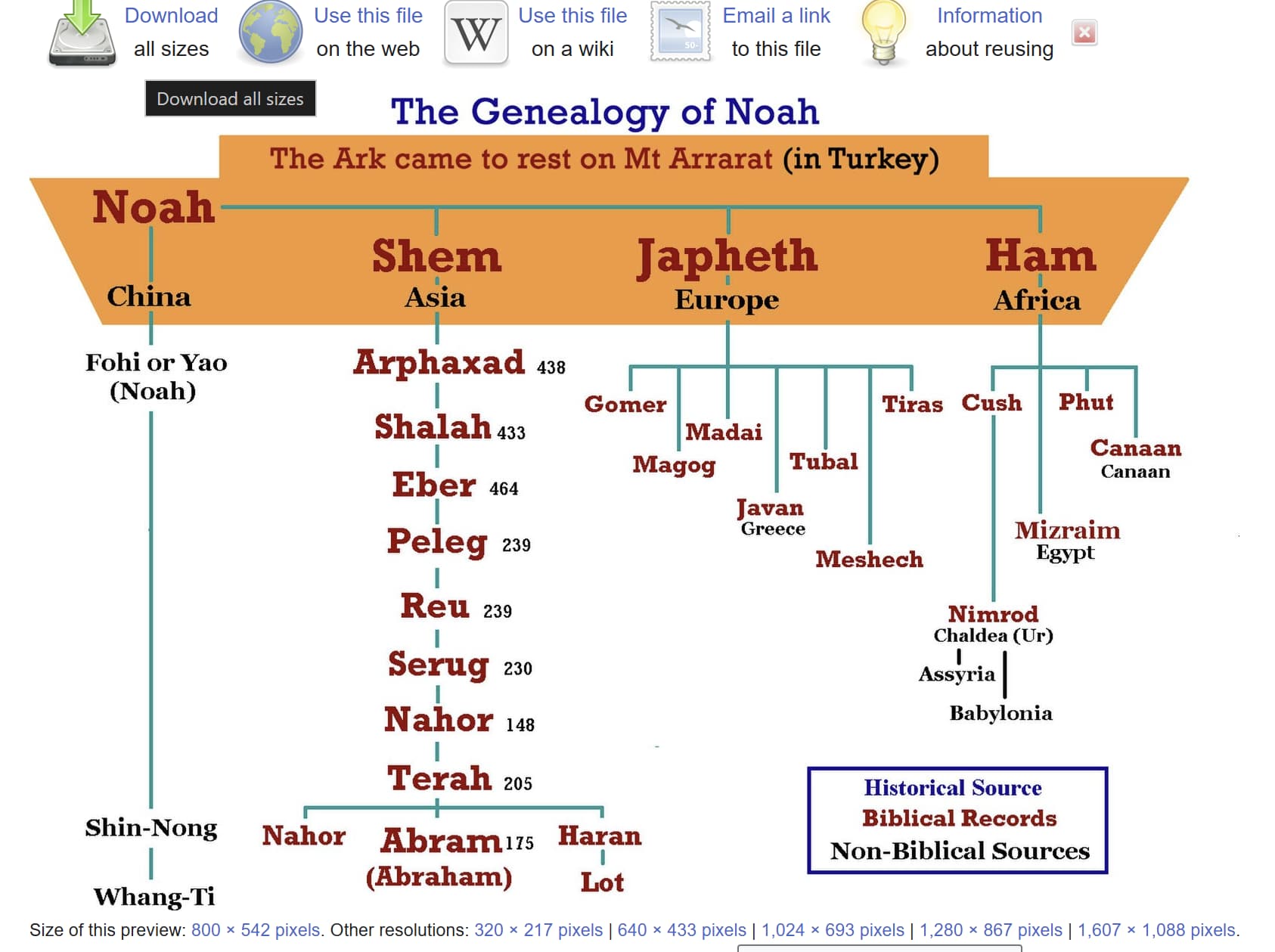
The above is devastating scholarly evidence for those who claim that the lineage from Shem to Moses isnt real and that the story should be symbolic or metaphorical…it is also devastating evidence for any Christian that believes that we need not take a literal approach to the biblical account of the flood.
The reason why? Because we have strong external evidence that directly correlates with biblical evidence from the time of Moses, right back to at least Eber (Shem’s great-grandson whom he would have known personally) and we can now provide external evidence from King Solomon to at least Eber (Shems great grandson) !
It’s not my reason at all. I don’t know why you think it is. Where is Noah named in other ANE epics?
It’s certain that it didn’t. (I know.)
Neither do I. By Biblical chronology the Flood was 4004-1656=2348 BC. But as a member of the global warming crowd, I can only use science.
The name Noah was attached possibly over 2,000 years later to Utnapishtim. Who was no robot either. But a character from a much older Babylonian myth. The Biblical account dates from as late as 250+/- BCE. Oral tradition over these vast spans of time and culture is meaningless.
That strikes me as a very weak argument – requiring a leap from somebody (or somebodies plural) built these structures to ‘a (single) king of a united Israelite kingdom centered in Jerusalem built them’.
Do we have any solid evidence that would point to this having been done at the command of a single individual of this specific polity?
Otherwise any major building project, by any competing polity, during the centuries approximating to Solomon’s purported rule could be taken as ‘evidence’ of Solomon’s existence – and given the frequency of warfare in that region in that time period, the probability of major fortifications being built would seem to be high.
1 Like
There are a few additional points in favor of a reasonably united (i.e., at least comparable to the later divided monarchy kingdoms) and reasonably wealthy person in place-- the level of building in Jerusalem attributable to c. 950 BC looks to have been on par with or greater than that of later times with stronger Judean kings that have external corroboration. Also, there was something there valuable enough for Shosenk to raid it c. 930 and for his son to spend lavish amounts of gold and silver on building projects compared to his closer predecessors. There is also a general tendency towards increased building in important centers in Judea c. 1000-c. 900. (Those come from Kitchen, 2003, On the Reliability of the Old Testament)
Also, to counter a possible future counter from anyone, given that there are no Assyrian records of anything that far to the southwest from the right date and no Egyptian records that list anything beyond place names defeated in the area, an absence of external records for Solomon is more expected than problematic.
1 Like
Well…it looks as though you have had a response. Dever made that claim referring to the fact that three cities of that era –Hazor, Megiddo, and Gezer– have gate architecture that is identical, which presumes the same architect, if not builder. And Solomon was known for big building projects. Thus, he (Dever plus others) linked all three projects to the inspiration or orders of the same person. There is some logic to this in the sense of common construction methods or designs. You and I would propose similar connections if the same thing occurred today.
There have been questions since then, of course. One archaeologist named Ussishkin said that the projects at Hazor and Gezer were Solomonic but not Megiddo. So I suppose that you at least have two communities of that era firmly linked to Solomon.Yigael Yadin disagreed with Usshushkin about Megiddo. Thus he would link all three to one builder–or planner. There are arguments about the stones used in casemate walls (common in Solomonic projects) – and the mention of wooden beams in 1 Kings 7:12..plus the mention of blocks in the gates in I kings 7:9.
So your question of “evidence” pointing to “a single individual” or polity --would be the similarity of style and the use of materials mentioned in the biblical text…and the fact that casemate walls contained stone that–very common in that era --could have been stolen and reused in later projects.
P.S. Most of the above info comes from various articles in a magazine that focuses on biblical archaeology–just fyi
2 Likes