spontaneous reactions are usually understood as those energetically favoured (ie Gibbs free energy must be negative), and chemical kinetics deals with the rates and activation (think of iron rusting, decomposition of H2O2). In your example, I cannot detect anything that would conform to these.
Be that as it may, if the Gibbs factor is negative, these mutations should accumulate, and the rate would determine how many mutations have occurred, without the influence of the phage.
Again I cannot see how the data would conform to these requirements.
T_aquaticus
(The Friendly Neighborhood Atheist)
385
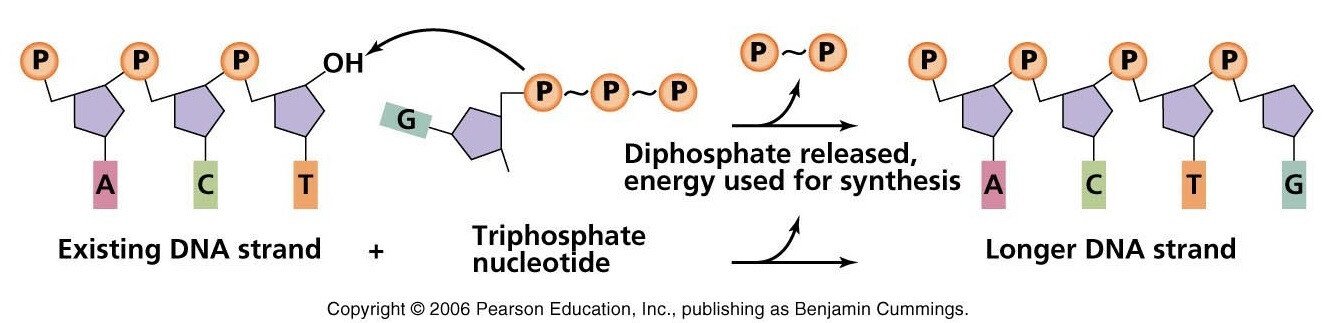
If memory serves, losing two phosphates is usually considered to be energetically favored.
Complementary hydrogen binding between the incoming base and the opposite DNA strand that is being copied usually favors a specific base, but going from a triphosphate to a monophosphate should drive that reaction with no problem.
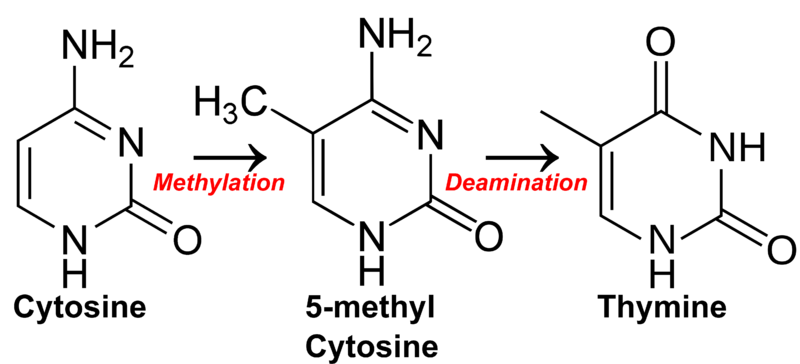
The other mechanism is deamination of methylated cytosines (although I don’t know how common it is in bacteria). We know this happens, so I would assume the thermodynamics works out. It’s not as if cells are violating thermodynamics.
We observe mutations accumulating in replicating bacteria, so the observations match your prediction. This was seen in Lenski’s famous long term evolution experiment.
The data conforms to spontaneous mutations because of the high variance between the number of phage resistant bacteria in independent experiments. This is because each cell division has a probability of producing the phage resistance mutation. If this happens in an early generation then there will be many resistant bacteria. If it happens in a late generation then there will be relatively few resistant bacteria. This is a perfect example of a Poisson distribution that will lead to large variance between experiments.
Added in edit:
Found a decent online book at NCBI on the mechanisms of mutation, if you are interested:
This area is fascinating but I do not have the time and energy to read this book with the attention that it deserves. But getting back to the argument regarding randomness, I am more inclined to remove such a notion as I see more and more data (and although some of these schemes are general, further studies point to incleasing complexity of fantastic mechanisms).
Statistical treatments have been around for donkeys years. As our understanding grows, we get closer to comprehensive mechanistic insights. e.g. something as complicated as combustion (solids, liquids, gases) can be simulated using a scheme of ordinary differential equations - this is because of improved experimental techniques, great computer power and advances in theoretical treatments. I hope the same can be said for molecular biology.
ok, you postulate selection, then a reasoable response would be that if the conditions are sufficient, the experiments should result in a totally resistant strain (the hypothetical A’).
Randomness is in conflict with detailed mechanistic schemes. Complexity and insufficient understading requires stochastic treatments and usually with general simplifications.
Perhaps, but it is not so straightforward. Resistance to an acute factor often requires compromise to general fitness.
BTW, relevant to the topic of phage resistance is the book, The Perfect Predator, which chronicles a dramatic life or death struggle with a pan resistant bacterial infection, and the race for a phage cure. Intensely gripping story.
That might work as a response if the corrections of your posts concerned subjective differences that might be based on opinion or worldview.
But they concern matters such as whether there are freshwater flying fish, or how probabilities are represented, or how many differences there are between the human and chimpanzee genomes, or whether birds need to be taught migration routes, or if domesticated species can go feral.
You can claim that such questions might be subjective rather than objective, but that would mean e.g. wild horses exist for some people but not others, or that some birds live longer for you than they do for most people.
If that was the total content of your responses there would be no problem, but you have to lace it with personal overtones. You are out of your depth You do not understand… You.…
(and the converse meaning about your own knowledge, status and superiority)
There are ways of speaking that avoid such things
But you seem to be on a crusade to discredit me.
Richard
Edit.
@T_aquaticus & @St.Roymond please note. This applies to you although maybe not in the same intensity.
T_aquaticus
(The Friendly Neighborhood Atheist)
396
What data is showing you non-randomness with respect to fitness?
We have many, many mechanistic insights into how mutations happen, and they are pointing to random mutations with respect to fitness. None of these mechanisms are able to sense a challenge from the environment and mutate a gene at a specific base in order to overcome that challenge. Mutations are stochastic in nature and there is nothing mechanistically that is tying them to specific responses to the environment.
2 Likes
T_aquaticus
(The Friendly Neighborhood Atheist)
397
Stochastic processes require stochastic treatments. We could construct a complex computer that spits out random numbers, but I wouldn’t cite the complexity of the computer as a reason for doubting the randomness of the numbers. I’m with @rsewell on this one. Complex and non-random are not synonyms. Something can be complex and still produce random results.
It is also important to note that mutations are observed to be random with respect to fitness. This is an empirical measurement.
T_aquaticus
(The Friendly Neighborhood Atheist)
398
That’s exactly what happens. The colonies that grow on the plate with phage are a totally resistant strain. All of the bacteria that were not resistant were killed off by the phage (i.e. selection). You start with single bacterium that reproduces for a few generations which introduces mutations that results in an increase in genetic diversity across the population. The bacteria are then challenged with phage, and those who have the mutations necessary to resist phage infection are the ones that survive and make up the new population.
T_aquaticus
(The Friendly Neighborhood Atheist)
401
The single bacterium that serves as the founder for the entire population is phage sensitive. It is the descendants of that single bacterium that are exposed to phage. If that founding bacterium was phage resistant then nearly all of its descendants would also be phage resistant, but that’s not what we see in the results. Only a few hundred out of billions are phage resistant at the end of the experiment.
There are several key concepts within chemical kinetics:
Reaction Rate: This is the speed at which reactants are converted into products. It can be measured in terms of the concentration of reactants or products over time.
Rate Laws: These are mathematical expressions that relate the reaction rate to the concentrations of the reactants. They often take the form of rate equations, which can be determined experimentally.
Activation Energy: This is the minimum amount of energy required for a reaction to occur. It can be thought of as an energy barrier that reactants must overcome to transform into products.
Catalysts: These are substances that speed up the reaction rate without being consumed in the process. They work by lowering the activation energy needed for the reaction to proceed.
Reaction Mechanisms: These are the step-by-step sequences of elementary reactions by which a chemical change occurs. Understanding the mechanism helps chemists design better catalysts and optimize reaction conditions.
Chemical kinetics plays a crucial role in various fields, including biochemistry, environmental science, and industrial chemistry.