One last online vigilante question

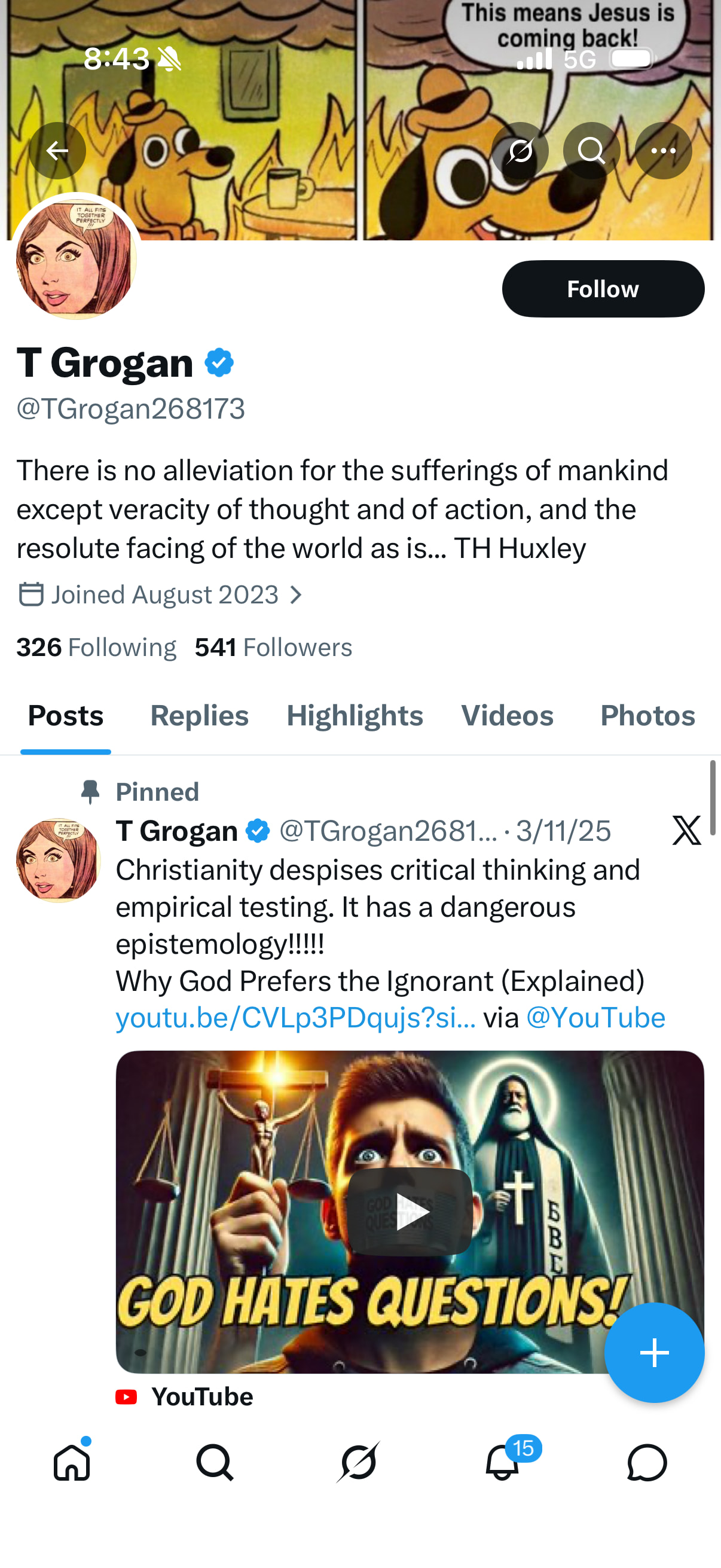
I’m still a bit anxious when I ponder the things that opposing sides online say, but mostly because of one last account (the other beast that had haunted me, that one angry Spanish guy, has since been vanquished in my mind). I still recall one social media account that sternly subscribed to the notion that Christianity was a completely and utterly false belief. It had posts like “Apologests: if you throw stuff at the ground, it won’t create order.” And then shows a neat and orderly arrangement of atoms (which I think was a dumb argument because ignores the premise that the argument is meant to question where the order came from). I think I’m having a problem swallowing the fact that there are accounts out there that pump out/constantly repost arguments against Christianity and, to my weak mind, there seems to be no other way to deal with it except pretend it doesn’t exist. I think there is still just a lot in deal with as I’m working through some things.

This is actually that account I’m talking about. I had accidentally stumbled upon it when looking at the social media of Hugh Ross (founder of Reasons to Believe):
IMG_6583

If any of you guys have any tips for stuff like this, please let me know.
Here is my tip. The best witness for Christianity is not making people who pump out anti-Christian content look stupid on the internet. It’s getting out in the world and loving people going through your daily routines being filled with the joy and peace and grace and awe of creation and goodness that the Holy Spirit empowers you with. No one gets argued into faith. Some people do get loved into the family of God.

11 Likes

Yes, remember these guys are making money and will do whatever they think will generate the most interest/money. There are some Tube channels I am about ready to drop. The content is good but the title cards are pure click bait.

3 Likes

For the most part I’ve been trying to do this (thank you again everyone for the help!) but I think small pet peeves like this occasionally resurface.

1 Like

One thing I ask myself when I am feeling angry, is whether I am actually angry about injustice or whether I am just annoyed that people I identify with are being disrespected. A lot of the disrespect directed at Christians these days is deserved, it’s not an injustice. And there is plenty of real injustice to direct your righteous emotional energy at, so don’t waste it on internet clown shows. It’s not worth your investment.

5 Likes

Max, you’re basically like an unfiltered processor in a high-noise environment. That’s not a weakness—it just means you haven’t installed enough filters yet.

Here’s a really important one to start using:

Ask of anything you read/watch:

  • Does it rely on mockery instead of reasoning?
  • Does it ignore its own assumptions?
  • Does it oversimplify something complex?
  • Is it designed to provoke rather than explain?

If the answer is yes, install this response immediately:
“This is not worth my time.”
Then dismiss it.

Also remember:
10,000 bad arguments ≠ 1 good argument.

When something does seem worth engaging, slow it down:

  • What is the actual claim?
  • What assumptions are hidden?
  • Does the conclusion actually follow?

And just as important—be intentional about what you let in:

  • Limit exposure to adversarial, rapid-fire content
  • Replace it with slower, higher-quality sources
  • Avoid meme-level discourse altogether

Keep this in mind too:
“Not being able to immediately answer something does not mean it’s true.”

And one more practical filter:
If it’s coming from a YouTube clip, Twitter/X account, random forum post, or someone you don’t personally know and trust—Ignore It. You are under no obligation to engage it at all.

You don’t have to process everything. You just have to learn what’s worth processing.

7 Likes

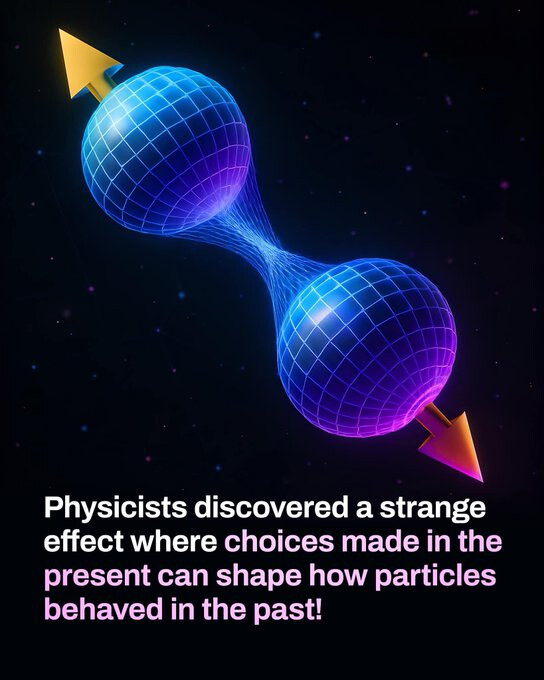
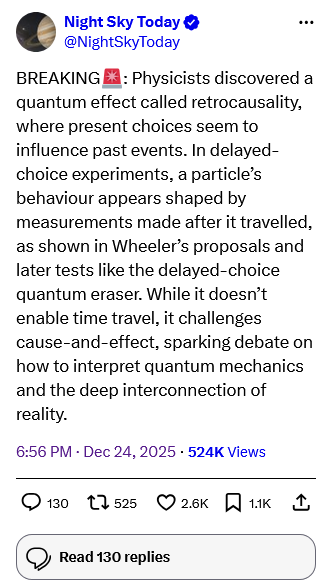
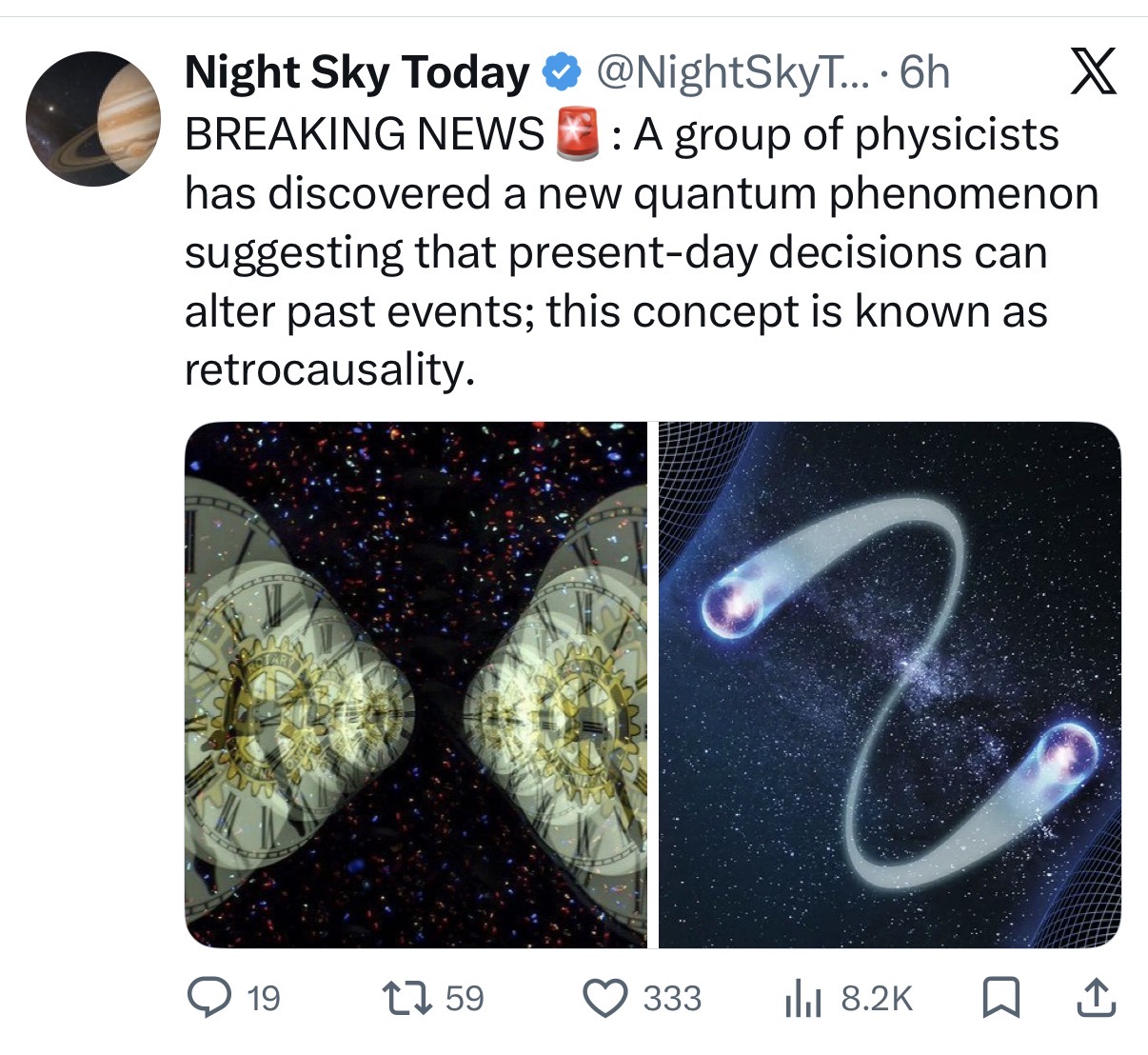
I just saw this today. Got any thoughts?

1 Like

Initially, I had no clue what you posted, which as far as I can tell is precisely the kind of stuff which doesn’t make sense to me. Doing my own research, apparently Retrocausality is

  • Retrocausality, or backwards causation, a concept of cause and effect in which an effect precedes its cause in time and so a later event affects an earlier one. In quantum physics, the distinction between cause and effect is not made at the most fundamental level and so time-symmetric systems can be viewed as causal or retrocausal. Philosophical considerations of time travel often address the same issues as retrocausality, as do treatments of the subject in fiction, but the two phenomena are distinct.” None of that makes any sense to me.

  • Personally, I’m not a fan of time travel and other things that screw around with “The Past”, “The Now”, and “The Future” and that suggest that the order of those can be “The Future”, “The Now”, and “The Past”.

  • I found this:


  • Now you know what I personally am not very interested in.

2 Likes

You could try laughing at their idiocy. It works for me.

(If you throw a bunch of magnets at the ground they will arrange themselves in a neat pole-to-pole line. If you throw potassium iodide and lead nitrate into a bucket of water they will arrange themselves in hexagonal crystals.)

4 Likes

That is great stuff for science fiction writers but not so much for others, except those interested in theoretical quantum physics.

I like to read speculative science fiction because it may give interesting ideas and viewpoints but speculative fiction is speculative fiction. Speculative work in quantum physics is also interesting to read but there are always the questions of (1) does it affect our reality in significant ways and (2) does it affect our life? In many cases, the answer is ‘no’ to at least the latter question: interesting ideas but they do not change our lives.

I just read a science fiction series that built much of the stories on interesting quantum phenomena. These were treated with the liberty of a fiction writer and the worldview of the writer (atheist) was clearly visible. It was interesting to read what kind of speculations the writer had invented but I did not swallow the wild speculations that were written through an ‘anti-God’ worldview.

Many sources and posts in the net can be compared to such science fiction stories. They may discuss interesting findings but what is written is often as credible as speculative science fiction. Unfortunately, even some popularized articles in apparently semi-credible journals suffer from the same weaknesses.

A critical approach to all these sources (and media in general) has become a very important skill. Here (Finland), schools invest in teaching that attitude and skill to all students, starting from elementary schools. One reason is that one of our neighbouring countries is creating plenty of such material, apparently with the purpose to create divisions and strife within the nations.
It is good to remember that we all need such a critical attitude when we surf in the net or read media, no matter where we live.

3 Likes

In terms of online discourse from militant nonbelievers, I see this as a case of the pot calling the kettle black. And I’d say being disrespectful —as the term is normally used—is always an injustice, whether we think a person deserves it or not.

Vinnie

2 Likes

There has been much worse opposition to Christianity than what you’re encountering online. From the beginning. It didn’t start in your lifetime, or with the Internet or some subset of it. No Christian has been able to prevent it. You won’t be able to, either. And with or without any of us, it will continue.

No one is recommending you pretend it doesn’t exist. Many of us are recommending that you not focus on the opposition, and focus on building the faith you seem so concerned about.

It seems to me that your concern isn’t so much that there are people “out there” who are opposing Christianity or Christian apologetics, but that you fear they might be right.

If you are looking to science for confirmation of Christian faith you aren’t going to find it. Jesus himself never attempted to show that.

If you’re looking for rational confirmation of Christian faith you’re not going to find that, either. Jesus himself never attempted to show that.

Jesus and the Apostles reasoned from (not to) the Scriptures. Jesus identified himself as the person who fulfilled the Scriptures, but even in his lifetime, most peoople who could talk with him didn’t believe what he said. Particularly the most educated.

Christianity is about Christ, not absolute proofs that it’s true. I know that’s hard to take. It has been for many of us. But it’s why focusing on The Debate and apologetics and arguments and counter arguments will always fail. There is always another counterargument.

The best argument that Christianity is true or even likely true is the way Christians obey Jesus. My friend talks about a Christocentric hermeneutic. If your focus is on Christ, what he taught, demonstrated and commanded, you will do much better. If you must comb YouTube and discussion boards, then look for ways to do that better.

In what way are you demonstrating and practicing the love and grace you have received from Christ out into the world?

6 Likes

Max, I think Knor gave you a very helpful “use filter” here. [Thanks for that, Knor.]

Let me add two questions that helped me sort this out:

(1) What can you actually do with retrocausality?
As far as I can tell: nothing. It’s a speculative way some physicists interpret quantum experiments. It doesn’t let you change the past, send information backward, or guide decisions in real life.

(2) When does the past become fixed and useful?
In ordinary reality, once something is measured and leaves a stable record (written, stored, observed), it’s effectively fixed. Later choices don’t rewrite that.

So when you see posts like this, ask:

  • Is this giving me something I can use?
  • Or is it a speculative interpretation dressed up to sound dramatic?

If it’s the latter, then Knor’s filter applies:
interesting idea—but not something that affects your life or needs to be resolved.

1 Like

This may be nitpicking but what if, say, we could change how the discipleship of Jesus went through current events?

What do you mean by “the discipleship of Jesus”? “first-century historical events”?

Like, (and I know this is stupid but this thought popped in my head and don’t want it to take more real estate than needed) if we could change events in the past, could we change events like “Roman crucification never existed” and thus could threaten Jesus and the resurrection. I know he is God in Man form but I just wanted to rule this out before it caused more stress.

Max, thank you—that helps clarify what you’re actually worried about.

Short answer: No. There is nothing in physics—retrocausality included—that allows past historical events to be changed or erased.

Even the most speculative interpretations of quantum mechanics:

  • do not allow rewriting history
  • do not allow removing events like the crucifixion
  • do not allow altering recorded reality

Once events have happened and left historical traces, they are fixed.

So the idea:

“Roman crucifixion never existed”
is not a physics possibility—it’s a pure hypothetical, like science fiction.

Also, notice what happened here:

You saw a confusing post about quantum physics →
your mind jumped to →
“Could this undo Christianity?”

That jump is the thing to correct.

There is no pathway from those experiments to rewriting first-century history.

So you can safely rule this out:

Nothing in modern physics threatens the historical events your faith is based on.

2 Likes

A Sound of Thunder Ray Bradbury

1 Like

Sure. But children are being raped in concentration camps in the US right now, so we all need to assess our injustice priorities.

1 Like

Children are always being raped, trafficked or starving somewhere. Everyone, always, everywhere, needs to assess their injustice priorities.

Vinnie