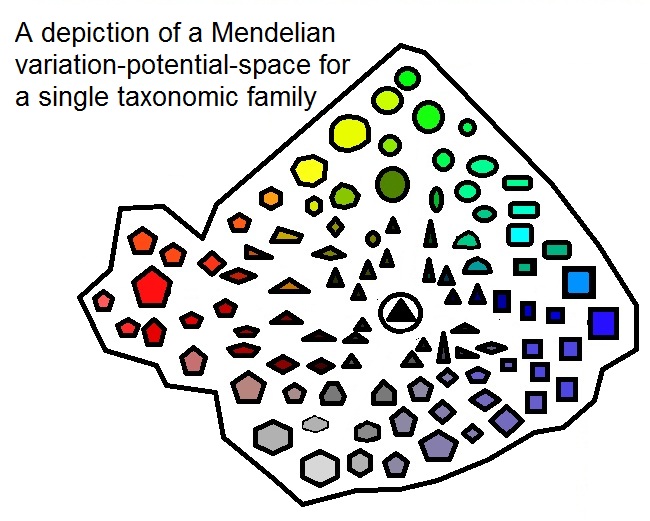
For sure not. I’m the first who came up with that idea because I stumbled upon it while implementing mendelian recombination into the digital realm. Nobody has ever heard about that idea except for those I told it.
There are >no< papers about overlapping variation ranges. Because nobody ever modeled different genotypes that can bring forth same phenotypes! I’m a primer in that area. But I didn’t choose to be. It’s mere coincidence.
I can’t recall having said anything to the contrary. I said that mutations are >assumed< to be the driving force behind evolution. But nobody can prove that scientifically watertight! I stand by my guns. Evolution by mutation is in as much a belief as variation by design! My case.
You also mentioned earlier that you believe humans did not originate with an earlier primate family. That there is not genetic cousin aspect to humans and chimps for example. If I read that right.
With the idea that all came from these family heads it makes me wonder how your view would fit with clades as we go further and further back. Such as Therapsid which were a proto mammal. If you keep climbing up the taxonomic system of clades it would require such a overlapping variation that it seems you would disagree with it. Such as the idea that fossils show the transformation of spiny fish to tetrapods and so on.
Your evolutionary mind-set dictates that the genetic similarities and dissimilarities phylogeny is based on point to common ancestry of all life forms. That’s why you draw ancestory lines inbetween them.
I use >the exact same similarities and dissimilarities< to locate individual life forms within their respective variation-landscape in relativity to one another.
Same evidence - different conclusion. Why? Because our mind-set-dependant premises are different from the beginning!
It’s not an evidence-issue. It’s an issue of the underlying assumptions at work when interpreting the observable data. That easy.
Interesting example, Henry. I wonder, please can you be more specific so that I can test your claim. Which flies, wasps, and hoverflies did you have in mind? There’s no denying that you’ve given this a lot of thought, so I’m guessing you have more in mind than a handful of individual species? If you have a list of genera (or even families) that’d be great. Thanks in advance.
Well, again this would depend on the width of the variation range of the kind the hoverfly belongs to. Presupposing a relatively narrow variation range, it would include all Syrphoidea.
Providing a wide variation range, it would even include wasps. Could be - I don’t know. Determining the width of variation ranges would be a great field of research, I think. I wouldn’t commit myself to claim that it’s possible to exactly tell which taxonomic levels belong to a kind and which don’t.
Sure, we bred all phenotypes within the variation range – by starting with a population with zero genetic diversity. Take a clonal population Plasmodium falciparum parasites, expose them to drug pressure, and watch as they develop the phenotype of drug resistance because of mutations.
All mutations we observed so far had negative side effects and narrowed further adaptability. You bring up a happy accident with loss of adaptability to make a case for ascending evolution, here. That’s like sayin’ it’s a beneficial adaptation to cut off your arms so you can’t be handcuffed. Make my day.
Gene expression of genes within the variation range, as you use in your example, will crystallize out certain phenotypes. But you don’t know if you have seen the rest that’s encoded in the variation range also, to compare them with the drugresistant phenotype caused by mutation.
Epigenetically caused RNA-splicing could eventually produce all necessary code for the expression of drugresistance, also.
You’ll have to explain what you mean by it. Overlapping phenotypic ranges for different species or different genotypes within a species are both very common.
Sorry, we have abundant evidence that that’s not true. Mutations that produced lighter skin in humans, for example, did not have negative side effects.
It’s finite because recombination doesn’t produce new genes.
Now, two sexually reproducing life forms would have two differently looking variation ranges or landscapes or parameter spaces, so to speak.
My model says that, if the variation ranges are wide enough, they can phenotypically overlap and therefore explain shared traits - completely without mutations necessary.
Now, presupposing a young earth and a global flood, I can explain all life forms in the fossil record by my model - without evolution. So basically, the only two arguments against my model are deeptime and the fossil order in the rock layers.
Lighter skin is an effect possible by recombination and epigenetics, too, so it doesn’t evidence a gaining of new information, if mutations just cause the same phenomenon.
Show me the models that show that >separately designed< kinds can bring forth same phenotypes and I’ll agree. I know that phenotypes of different taxonomic families show similar traits if under same selection pressure / criteria, but you cannot prove they had a common ancestor.
You may see some indications that lead you to interpret the observable data that way, but the very same data can equally be interpreted in accordance with my model, as well.
Please provide some evidence that a Nigeria could have skin as light as a Norwegian without a mutation having occurred. Also, please define ‘information’ as you are using it.
I don’t care whether you accept common descent or not. I’m asking you about a statement you made, the one I quoted above. You said that nobody had ever modeled different genotypes producing the same phenotype. That statement was wrong.
Strong electrostatic fields seem to reset the gene expression to the original generic form of the created kind. That has of course never been tested with humans, but it’s demonstrably possible with plants, amphibians and fish. If the gene expression of humans could be set back to a lesser specialized ancient - maybe even a prototype form, colouring could be bred from there, again - indicating that all shades of colouring have always been encoded in humans since their creation.
Check out this page (you will have to copy-paste it into the Google Translator):
Well, then I’ve been expressing myself unclearly. There’s - as far as I researched - no model suggesting an overlap of variation ranges by recombination and epigenetics alone.