I got a bit of an odd set of questions tonight. On a recent trip to a Barnes and Nobles, a brief browsing of books brought up a couple of questions I was wondering if you guys could analyze.
First of all, let me say that the science section here was immaculate. I walked out of there with a thick Smithsonian book on the Universe. Unfortunately, the exoplanet section was lacking. Regardless, a book bursting with information on God’s amazing Creation. I was given a glance at a couple of novels that my amazing physics teacher recommended, including Cosmos by Carl Sagan and A Brief History of Time by Hawkings. However, I have a bit of a queasiness considering purchasing these novels, as I remember reading an article from a Christian site (I think from Reasons to Believe or Biologos) that said that, in his book Cosmos, Carl asserts that there is nothing but the cosmos; no God. Now, I’m still working some kinks out of my faith but am also trying to expand my horizons with science. My first question then is:
- Those that have read Cosmos, would you recommend it for a beginner Evolutionary Creationist like myself?
- Similar to a question I read on another thread, with what level of caution should I approach books written by militant atheists, such as deGrasse Tyson?
Second question comes from a glance toward the religion section of the store. Quick side note, I was a bit concerned about the amount of Satanic-adjacent literature there, including a book on the history of witchcraft and the occult (which I had originally thought was J.K. Rowling’s “A History of Magic,” based on her book series Harry Potter). Speaking of interesting book placing, right next to the science section was the ghost/conspiracy discount section on a small table, which I thought was pretty funny. Anyway, I found the section on religion and was hoping to find The Language of God, to which I was disappointed to find no luck. Alternatively, I did find a bit of an odd and surreal sight:
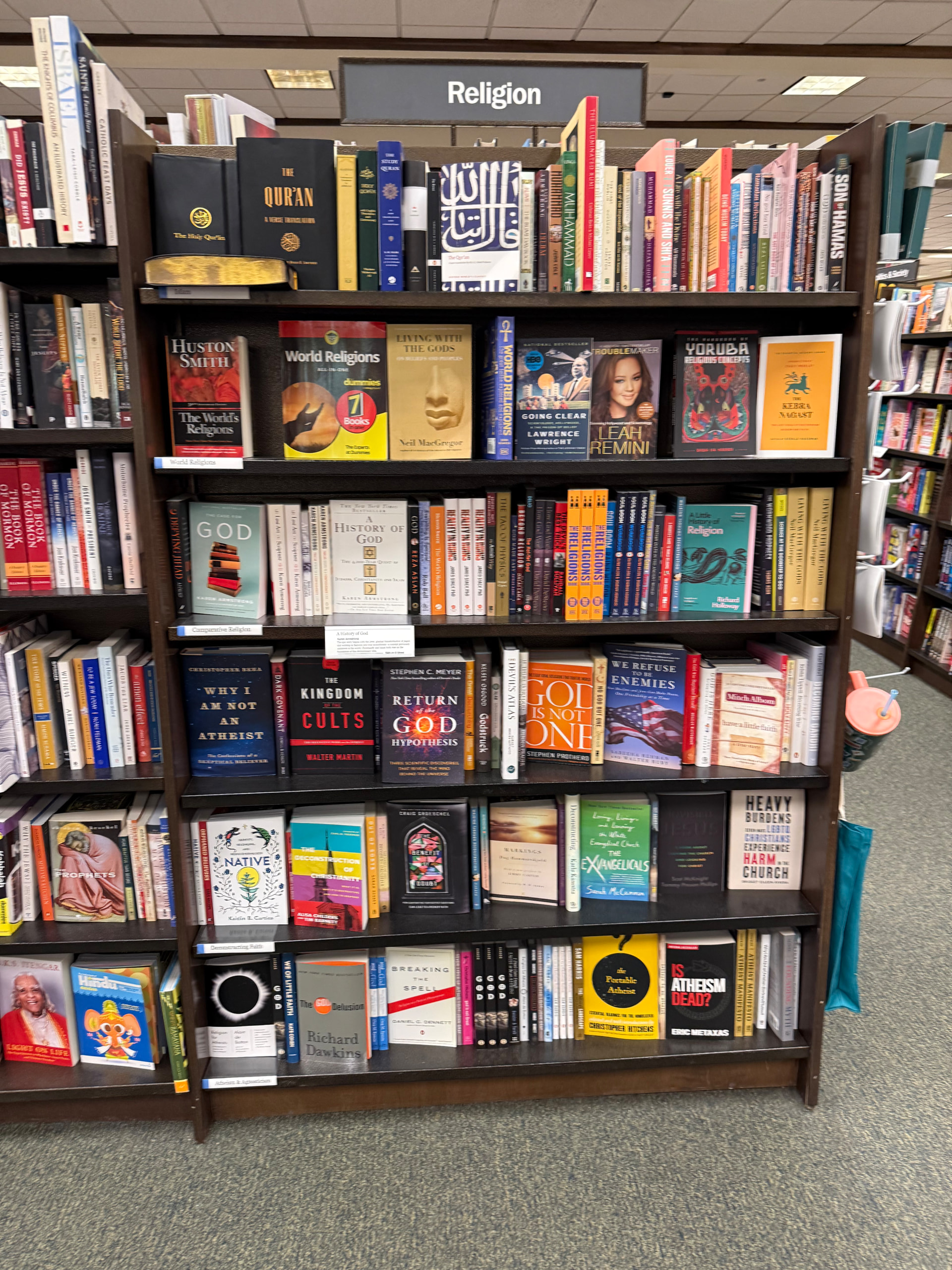
On this one shelf, I came across the Christian apologetics literature, the deconstructing faith literature, and the agnostic/atheist literature. It felt like I was coming face-to-face with my history of emotions. I didn’t know what to think seeing books like “The God Delusion” so close, an object that had previously given me much anxiety now within reach. Unfortunately, to my dismay, I couldn’t find any thought-provoking Christian books (I did find “Return of the God Hypothesis,” “God: The Science and The Evidence,” “Why I Am Not An Atheist,” and “The Case for God” by Karen Armstrong, which seemed like good reads but I held back my cash for now). This sparked a few questions in myself:
-
What are some good Evolutionary Creationist books? One of the earliest Biologos articles I read (https://biologos.org/personal-stories/what-happened-when-i-wanted-to-give-up-on-god) told the story of an amateur astronomer who bought as many books on Christian views of creation, including the Language of God. Unfortunately, a list wasn’t provided so I could only guess what they had bought.
-
How should I feel about coming face to face with these powerful atheist books? I wanted to be fearful but I also know that I was previously told that the real discussions lies with these books. Should I shun myself from these books or maybe one day give them a try? Would doing so be a mistake for a young Christian?
I don’t want to seem like I’m too afraid of atheists, or that I don’t even want to try and consider their views. However, I’m still shaky in my faith and have issues with understanding authority on subjects and who I can trust with saying what (especially in literature meant to education on a wide range of subjects). Even considering the contents of the books makes me a little queasy, especially since there didn’t seem to be any Evolutionary Creationist literature to give fair support for the Christian side of the debate. Maybe I’m holding atheists in too high regard, but I feel like this little encounter of mine started to psychology back myself into a corner regarding all the evidence that could get thrown around. If anyone also has any tips for such, meaning engaging with good books even if they disagree with you, please let me know.
