I’m doing research for a writing project and just discovered this forum today, along with an old conversation that mentions an age of 6,000 years for Mitochondrial Eve. There was also a passing reference to 5,000 years for the age of the father of all fathers. If we are going to use the name Eve from the Bible for the mother of all mothers, we should refer to the most recent father of all fathers as Noah, not Adam. The 17th-century calculations that place creation at about 6,000 years ago also place the flood at about 2348 BC, and Genesis states that Noah was 600 years old when the flood came, making him about 5,000 years old today. I’m interested if anyone can point me to genetic data and analysis that indicates this possible agreement between a literal reading of Genesis and modern genetic research. Thank you.
Welcome to the forum, Lauston! Good to have your voice here. You raise some good questions that have been addressed in the past, and you can probably use the search function to find those discussions.
Note that BioLogos, and most of the regular participants here are of the old earth persuasion, and are unlikely to think the research indicates a 6000 year old earth and a 5000 year old Noah, nor do I. As I understand it, both the mitochondrial Eve and the Y- Chromosomal Adam or Noah, are much further back in time, and did not live in the same time as well. I’ll do a little searching for you, but would encourage you to use the search function for forum discussions, and also on the main website for articles relating to these topics.
It would be helpful to hear a bit about your assignment, as well as your background and level of school to better answer your questions.
Blessings,
Phil
Here are a couple of articles on the main site that do a great job of giving background from an ancient earth evolutionary perspective, and the science behind it:
https://biologos.org/series/evolution-basics/articles/mitochondrial-eve-and-y-chromosome-adam
https://biologos.org/articles/mitochondrial-eve-y-chromosome-adam-and-reasons-to-believe
Current estimates based on genetic data:
Mitochondrial Eve = 155,000 years ago
Y chromosome Adam = 200,000 to 300,000
It is also worth mentioning that neither of these common ancestors would be the sole ancestors of humanity. They each would have been part a population of humans, and their title of Y-chromosome Adam or Mitochondrial Eve would not have been bestowed on them for 10’s or 100’s of thousands of years after their death.
Why is that? The easiest way to understand this is to look at your own ancestry. Mitochondria are only passed on from your mother, so your mitochondrial DNA is from an unbroken line of mothers inheriting their mother’s mitochondrial DNA. If you go back 3 generations in your own ancestors your mitochondrial DNA would have come from just 1 of your 4 great grandmothers. However, your full genome is a mixture of DNA from all your great grandparents.
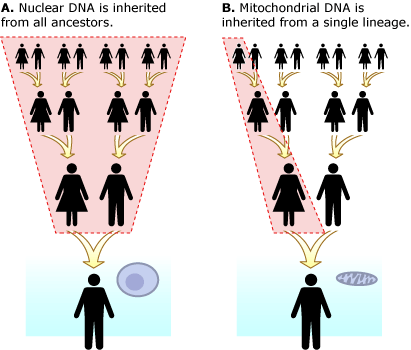
Thank you for your quick response. My project is not an assignment. I’m working on a book. As for education, I dropped out of college in my sophomore year after my dad died, but I earned a two-year certificate in liberal studies from a community college after I retired. (They give credit for classes in which you received at least a C in previous accredited schools, and tuition is half off for seniors.)
One challenge in writing is knowing your audience. I’m seeking to include both young earthers and old earthers, if possible.
Thank you. Yes, I’m familiar with that perspective.
I am unaware of any other published estimates in the scientific literature that comes close to the numbers you quote in the opening post. I am assuming you are getting those numbers from creationist websites?
If you want to give your readers a bad scientific explanation of the evidence, then I guess you could repeat what is on the creationist websites. However, if you want an honest scientific analysis in your book then the creationist sites aren’t the way to go.
A great deal of DNA, modern and ancient, has been sequenced and the results are wholly incompatible with a Mitochondrial Eve or Y-chromosome Adam anywhere near as recent as 6,000 years. DNA from ancient Egyptians and many other sites reveal an already great extent of variation, known as haplogroups, from that time period, and Denisovan and Neanderthal DNA diverged from homo sapiens sapiens long long prior. If by a literal reading of Genesis you mean the Usshur chronology, it is delusional to entertain any possible agreement.
The other challenge, of course, is knowing your material. If you are writing a book, hopefully you do not wish to spread falsehood. That requires honest research and not just confirmation seeking. Genetics is not a quick and easy field of study, so you are looking at a fair deal of homework.
“Perspective” is not appropriate as it implies an anything goes subjectivity. The results of genetic studies are based on real world measurable data which support time frames with a high degree of confidence.
Most of the time when I hear these arguments it’s more focused on a genealogical , not a genetic , focus. You may possibly get more out of “Peaceful Science” than Biologos. The majority here don’t read genesis literal.
There is little hope of salvaging a literal Genesis this way. If you want to be able to accept Adam and Eve, original sin and a flood that essentially killed all humans save Noah and company, the only real way is through genealogical means with a rational soul being introduced at some point.
Vinnie
I believe Kenneth Kemp’s proposal was correct in this instance.
That is the way I went. Feser has a number of articles on the issue and original sin as well.
Thank you, I’ll check that out. However, with today’s responses, I was able to find where the reference to 6000 years came from in the 2020 conversation:
“Calibrating the Mitochondrial Clock by Ann Gibbons, First International Workshop on Human Mitochondrial DNA, 25 to 28 October 1997, Washington, D.C.”
Mainline science, but 29 years old. I appreciated the article because there are real-world consequences if the premises are mistaken in estimating mutation frequency. No doubt there has been more work done since then.
A reprint of the article here:
Ann Gibbons - Calibrating the Mitochondrial Clock
Regardless of the cause, evolutionists are most concerned about the effect of a faster mutation rate. For example, researchers have calculated that “mitochondrial Eve”–the woman whose mtDNA was ancestral to that in all living people–lived 100,000 to 200,000 years ago in Africa. Using the new clock, she would be a mere 6000 years old
It is not surprising that would capture attention from YEC.
The first caveat is that Ann Gibbons is a general science communicator, and this is not a peer reviewed primary research paper. Even at the time of publication, her article could be subject to criticism, but it is probably more beneficial just to move on to more recent research on mtDNA.
This 2022 paper, Mitochondrial DNA variation across 56,434 individuals, found “10,850 unique mtDNA variants at more than half of all mtDNA bases….including 10,434 SNVs (96%) and 416 indels (4%)” And these numbers are not comprehensive; only 61% of 5184 haplogroups appeared in the study. Further, many ancient mtDNA lineages are extinct, and reverse mutation and lethal mutations do not show. No molecular clock rate accommodates that amount of variation over 6,000 years.
Surely the first caveat is that the sentence immediately after that quote begins "No one thinks that’s the case,"?
The second caveat would be that the modified rates actually give an age of between 6667 and 13333 years old, so “would be a mere 6000 years old” is false.
The age and source of the articles are third and fourth caveats at least.
More work has been done, and the concerns voiced in the article were later validated if memory serves.
Because few studies have been done, the discrepancy in rates could simply be a statistical artifact, in which case it should vanish as sample sizes grow larger, notes Eric Shoubridge, a molecular geneticist at the Montreal Neurological Institute. Another possibility is that the rate is higher in some sites of the DNA than others—so called “hot spots.” Indeed, almost all the mutations detected in Parsons and Howell’s studies occur at known hot spots, says University of Munich molecular geneticist Svante Pääbo.
https://www.dnai.org/teacherguide/pdf/reference_romanovs.pdf
1997 was early on in the DNA sequencing revolution. That’s about the time I started in research, and we were still reading Sanger sequencing results from paper readouts when we had our plasmids sequenced. One person would read while the other punched the bases into the keyboard. At one point we tried to get a sequencer that could do 384 parallel Sanger sequencing runs at once, and we thought that was hot stuff. Today, I can get a billion+ reads from a 24 hour sequencing run using next generation technology.
There are mutational hotspots in the mitochondrial genome, and if you use just those hotspots and an incorrect mutation rate then you get bad conclusions. This was discovered as more sequencing was done.
Dear Laughton, Your reading of Genesis is NOT literal, even though it’s what an English speaker would suppose from its usual translations. It also needs context, to be understood correctly. Let me be blunt: Genesis does not say Adam & Eve were the first humans, or that all humans descended from them. (Why not check out a good work in OT studies such as B. Childs’ Introduction to the OT as Scripture?) Also, it’s been known for over a century that the ages ascribed to prominent figures in Genesis follow the literary custom of the Sumerian king lists by being symbolic of their character or accomplishments rather than their chronological age. It was a base 60 system, so Noah is 600, Moses is 120, etc. I can send you an article on Gen. 1 - 7 if you wish. roy.a.clouser@gmail.com
Thank you. If the article isn’t too long, I will read it. But I’m not really interested in the age of the Earth or Eve. My book is about fulfilling the Great Commission. There are an estimated 31 million young-earth Christians and a less specific but large number of old-earth Christians. My interest is in writing in a way that both of them can read without pulling their hair out. I see agreement between Genesis and cultural anthropology and moral psychology. When the reference to mtEve and 6,000 years showed up in a Google search, I just had to check it out.
Sounds like a laudable plan. I think you will find most EC folk here do not think that the Bible is trying to address science, so are friendly to that idea
Given the Great Commission is to go out and “make disciples” how does writing a book aimed at Christians that should already be disciples help?