No salvation outside the (Christian) chur h wouldbe an historic dogma thst I personally do not conform to so I doubt there is much I can add to this specific doctrinal view.
However, from a purely logical view it maks no sense to include other faiths, otherwise there is no specific reason tofollw Christianity other than as one of many ways to God. It is self defeating.
(In human terms and logic, at least)
I have to be honest, though: I actually stole it from an old post by St. Roymond.
It is, in the context of what he was saying
Well, I have to tell you that your objection contains an element of historical truth, but it doesn’t adequately explain the difference between Catholic and Protestant institutional and doctrinal continuity.
Yes, the Catholic Church has excommunicated dissenters, and there have been periods in which religious dissent was punished through coercive measures, including executions carried out by civil authorities. I have no intention of denying or defending those historical abuses. The Church herself has acknowledged them and asked for forgiveness.
On March 12, 2000, Pope John Paul II publicly asked forgiveness for the sins committed by Christians throughout history, including violence perpetrated in the name of religious truth.
But none of this adequately explains why Catholicism has maintained a recognizable worldwide communion of approximately 1.42 billion baptized members, with a continuous teaching authority, while Protestant churches have repeatedly fractured into separate ecclesial bodies over disagreements concerning the interpretation of Scripture, doctrine, worship, and Christian morality.
And we aren’t talking merely about the original Protestant Reformation, either,
Consider the following eleven major, historically documented ecclesiastical divisions in which doctrinal disagreements played a substantial role:
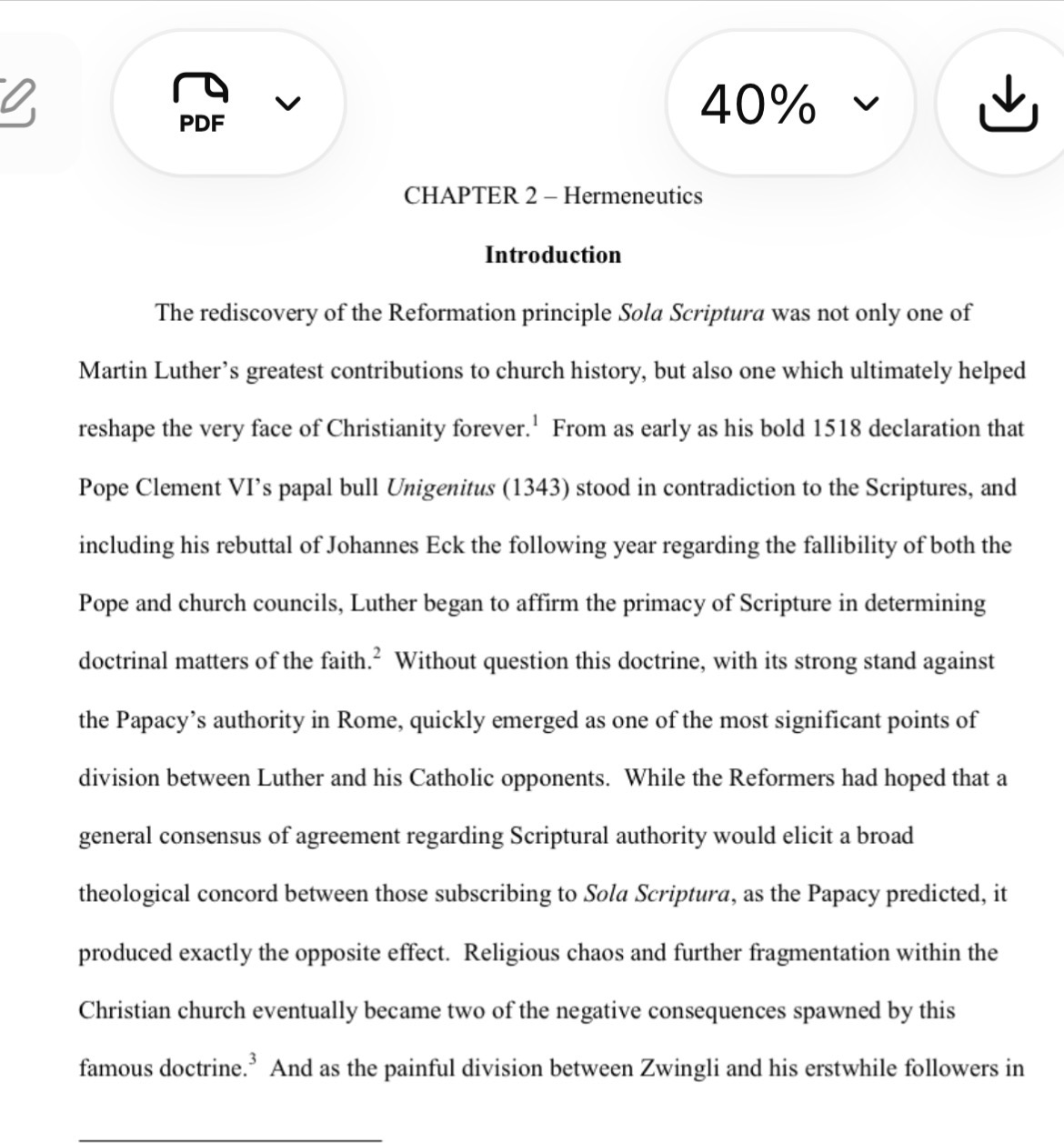
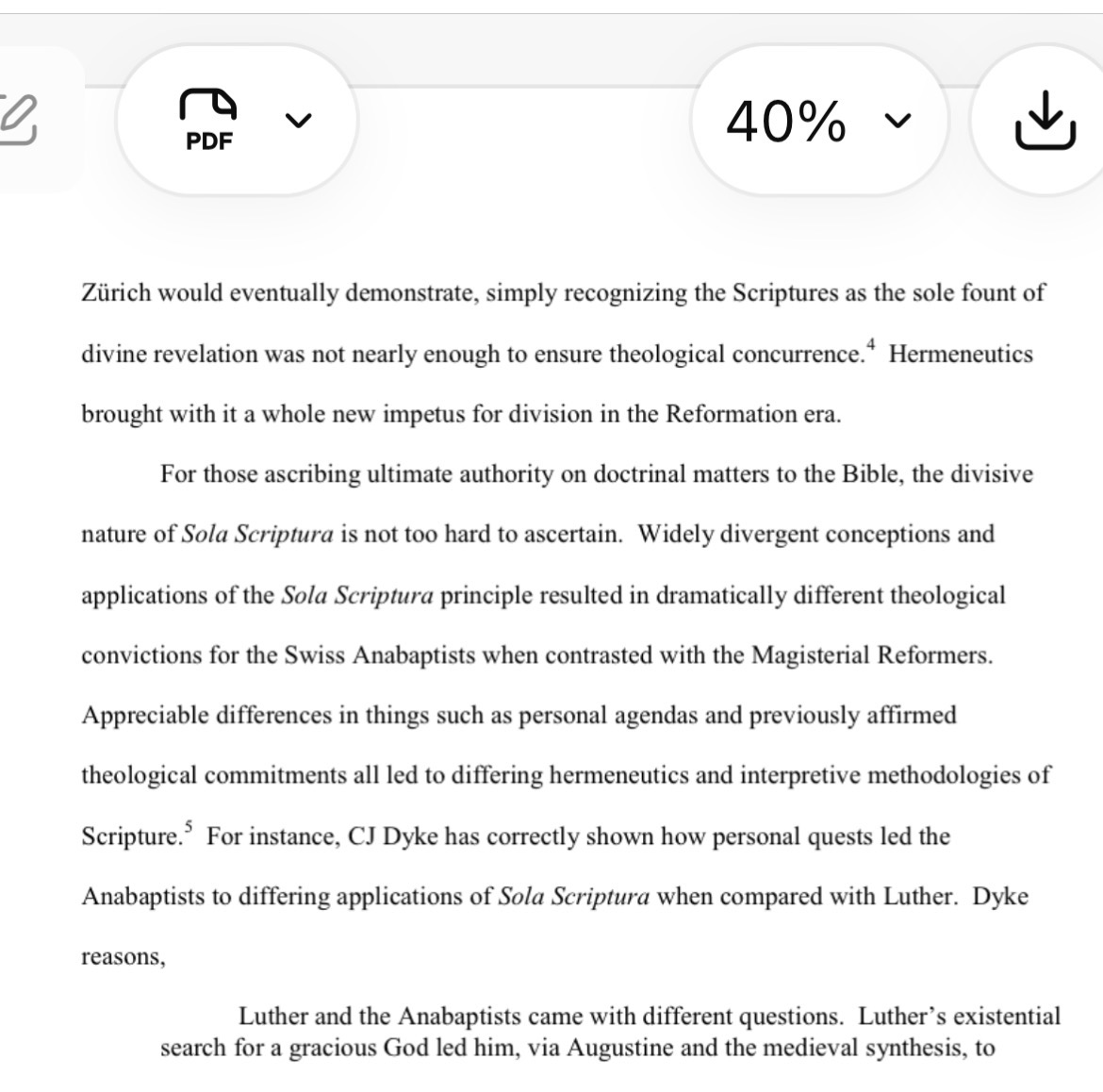
1525 — The Anabaptist break with the Swiss Reformation. Former associates of Huldrych Zwingli separated over their understanding of Scripture, particularly the question of infant baptism versus believers’ baptism. This gave rise to the Anabaptist tradition, from which the Mennonites and other Christian communities eventually developed.
1837 — The Old School–New School Presbyterian Schism. American Presbyterians divided into rival ecclesiastical bodies over serious theological disagreements concerning Calvinist orthodoxy, the Westminster Confession, revivalist theology, and the boundaries of acceptable doctrinal diversity.
1906 — The separation of the Churches of Christ from the Disciples of Christ. Disagreements concerning what Scripture authorized in Christian worship and ecclesiastical organization produced a lasting division, formally reflected in the 1906 federal religious census. Particularly contentious were the use of instrumental music in worship and the legitimacy of organized missionary societies.
1967–1969 — Another major division within the Disciples of Christ tradition. Disagreements involving baptismal practice, theological liberalism, and ecclesiastical organization culminated in the formal withdrawal of approximately 3,000 congregations.
This figure comes directly from the denomination’s own historical account.
1973 — The formation of the Presbyterian Church in America. Approximately 260 congregations, representing more than 41,000 communicant members, separated from the Presbyterian Church in the United States over disagreements involving biblical inerrancy, theological liberalism, Christology, and the ordination of women.
1976 — The Lutheran Church–Missouri Synod division. Following the Seminex controversy, approximately 250 congregations, representing 103,263 members, joined the newly established Association of Evangelical Lutheran Churches.
The controversy involved fundamental disagreements concerning biblical interpretation, inspiration, inerrancy, and the legitimacy of historical-critical approaches to Scripture.
2009 — The formation of the Anglican Church in North America. A major Anglican realignment followed disagreements concerning biblical authority, sexual morality, and ordination.
The resulting communion now includes more than 1,000 parishes.
2010 — The formation of the North American Lutheran Church. Disagreements within the Evangelical Lutheran Church in America concerning biblical authority and Christian teaching on sexuality contributed to another enduring Lutheran separation.
The controversy was closely connected to the ELCA’s 2009 decisions concerning the eligibility of clergy in committed same-sex relationships for ordained ministry.
2012 — The formation of ECO: A Covenant Order of Evangelical Presbyterians. The new denomination emerged amid substantial theological disagreements within the Presbyterian Church (USA), including disputes concerning biblical interpretation and ecclesiastical teaching.
According to the PC(USA)'s own reporting, 303 congregations, representing approximately 121,000 members, departed for ECO during the following five years.
2019–2023 — The United Methodist Church schism. More than 7,600 American congregations, approximately a quarter of the denomination’s US churches, disaffiliated amid profound disagreements concerning Christian sexual ethics, marriage, ordination, and the interpretation and enforcement of denominational teaching.
The Global Methodist Church emerged as a separate denomination in 2022.
2020–2024 — The Reformed Church in America division. The denomination experienced a major wave of departures amid disagreements concerning biblical interpretation, sexual morality, ordination, and church governance.
Its general secretary reported in 2024 that 248 congregations had decided to leave, most having already departed.
The RCA itself has explicitly identified disagreements over human sexuality and the interpretation of Scripture among the tensions affecting its ecclesiastical unity.
That is eleven major examples, and the list is by no means exhaustive.
And the divisions have hardly stopped.
In 2025–2026, GAFCON announced a restructuring of global Anglican leadership, explicitly rejecting the traditional Canterbury-centered instruments of communion on the grounds that they had failed to preserve biblical doctrine.
I have deliberately excluded this development from the count above because the precise institutional extent of the resulting separation is still developing.
There is also the foundational theological division between Lutheranism and the Reformed tradition, already evident in the disagreement between Luther and Zwingli over the Eucharist at Marburg in 1529.
I haven’t counted that episode as a formal schism within a previously united Protestant denomination, but the emergence of separate Lutheran and Reformed confessional traditions is obviously relevant to the broader question.
What I am pointing out is the difference between disagreements occurring within an ecclesial communion that retains a recognized and continuing authority for defining doctrine, and disagreements repeatedly producing new, institutionally independent communions holding mutually incompatible doctrinal positions.
The distinction becomes particularly striking when we consider the sheer magnitude of some of these divisions.
The United Methodist rupture alone involved more than 7,600 congregations. The Disciples of Christ separation in the late 1960s involved approximately 3,000 congregations.
Nor can this phenomenon simply be attributed to a lack of goodwill. The overwhelming majority of the Christians involved, we can infer, sincerely believed that they were defending biblical truth.
And that is the problem I have been raising.
I don’t believe for a second that this can be adequately explained away as a matter of individual moral failure on the part of Protestants: there is a more fundamental, structural difficulty arising from the principle of sola Scriptura itself.
Christians who acknowledge Scripture as their supreme doctrinal authority can nevertheless reach mutually incompatible conclusions about what Scripture teaches, while lacking any universally recognized Protestant authority capable of issuing a definitive and binding judgment to resolve those disagreements.
That difficulty is not merely an unfortunate historical accident. It follows from the absence, within sola Scriptura considered by itself, of a universally binding interpretative authority capable of settling disputes between competing ecclesial bodies.
Consider what happens when two Protestant denominations reach contradictory conclusions about a matter of faith or morals.
Both appeal to Scripture. Both claim fidelity to its teaching. Both may appeal to respected theologians, confessions, and centuries of Christian tradition.
Yet when their interpretations remain incompatible, what authority can definitively settle the disagreement in a way that both communions are bound to recognize?
An appeal to Scripture alone cannot, by itself, resolve the disagreement when the precise question under dispute is what Scripture actually teaches, and an appeal to a denominational confession doesn’t solve the problem at the level of Christianity as a whole, because another denomination may reject that confession precisely on the grounds that it interprets Scripture incorrectly.
This is an inherent structural difficulty for Protestant ecclesiology, not an accusation against Protestant Christians. It’s a problem that inherently arises from the underlying principle of Sola Scriptura.
Obviously, this doesn’t establish that every Protestant division is caused exclusively by sola Scriptura, as human sinfulness, cultural differences, politics, and institutional interests have also played important roles.
But neither can the repeated emergence of doctrinally incompatible Protestant communions simply be dismissed as irrelevant to the question of Christian unity.
The historical pattern is real, extensive, and continuing.
And since Scripture explicitly commands Christians to preserve unity in faith and condemns factions and divisions, I think the question of how Christ intended His Church to maintain doctrinal unity deserves a considerably more serious answer than the suggestion that Catholic continuity is merely the product of excommunication and coercion.
There is one final consideration that makes that explanation particularly inadequate.
The Catholic Church today doesn’t possess any general power to compel people, through civil coercion, to remain in communion with Rome.
Catholics can reject Catholic teaching, leave the Church, establish independent religious communities, or join other denominations without facing the civil penalties historically associated with religious dissent.
Yet the Catholic Church continues to exist as a single, recognizable worldwide ecclesiastical communion comprising approximately 1.42 billion baptized Catholics, under a common episcopal structure and a recognized teaching authority.
There is something important missing from your argument.
Research into alleged postmortem survival is not limited to children who seem to remember previous lives, there is also a substantial body of published research examining experiences in which deceased individuals allegedly continue to manifest as themselves, retaining their recognizable personal identities (which incidentally is compatible with the teaching on the intermediate state).
Interestingly, that last article appears in the very same issue of the International Review of Psychiatry as Jim Tucker’s 2025 review of reincarnation-type cases.
Now, I’m certainly not claiming that these studies conclusively demonstrate communication with the dead, but that is my point: alleged anomalous information about deceased individuals doesn’t, by itself, establish reincarnation.
Even if we granted that certain individuals possess information they could not have acquired through ordinary means, we would still need to establish how they acquired it and, more importantly, why that information should establish that the same soul previously inhabited another body.
The existence of research examining apparent communications from deceased individuals who retain their identities makes the problem of interpretation particularly relevant.
These phenomena are not necessarily logically incompatible with reincarnation, but they do raise an obvious methodological question: why should reports of previous-life memories be privileged as evidence of reincarnation when other reported phenomena could be regarded as evidence of continued personal existence (without becoming someone else) after death?
How is that not picking and choosing what to believe and what to discard?
I mentioned the Church fathers to show that the knew the phenomenon and they gave an explanation. Long before the Church solemnely condemned the doctrine.
You dismiss their explanation but you don’t explain the existence of other “evidence” of post-mortem survival that is not compatible with the idea that we will simply be reborn as someone else (brrr, what a horrible thought).
and there is also an enormous problem with your position, and this one goes considerably deeper than the interpretation of alleged past-life memories.
Reincarnation is incompatible with the Christian understanding of bodily resurrection, and the usual reincarnationist account of spiritual progress conflicts with the Christian doctrine of salvation through Jesus Christ.
Consider what the New Testament actually teaches.
1. Christianity teaches one earthly life, followed by death and judgment.
Hebrews 9:27 states: “Just as people are destined to die once, and after that to face judgment”
It’s straightforward: human beings die, and afterward comes judgment.
The passage doesn’t describe death as a transition into another earthly existence, followed by another death, another birth, and so on.
And this is hardly an isolated statement, the New Testament consistently presents our earthly existence as something that culminates in death, judgment, and ultimately resurrection.
2. Christianity doesn’t teach that the soul is destined to inhabit successive bodies. It teaches the resurrection of the body.
This distinction is absolutely fundamental.
Paul writes in 1 Corinthians 15:42:
“The body that is sown is perishable, it is raised imperishable”
Paul isn’t talking about a soul abandoning one body and subsequently inhabiting another human being, he is talking about the resurrection and glorification of the person who died.
The body is transformed, not replaced through a succession of unrelated earthly lives.
Philippians 3:21 makes the same point: Christ will transform our mortal bodies so that they become like His glorified body.
And Jesus Himself, in John 5:28–29, speaks of those who are in their graves hearing His voice and rising to judgment.
Human destiny according to Christianity has never been reincarnation. It is resurrection.
Moreover, the resurrection of Christ is the model for our own resurrection. The risen Jesus didn’t become another individual inhabiting a different body. He remained Jesus Christ, risen and glorified.
That continuity matters enormously.
3. The Christian doctrine of salvation is centered on Christ’s redemptive work, not on successive incarnations as a mechanism of spiritual purification.
Paul explicitly connects salvation from sin with the historical death and resurrection of Jesus.
In 1 Corinthians 15:17, he goes so far as to say that if Christ has not been raised, Christian faith is futile and believers remain in their sins. And in Ephesians 2:8–9, salvation is presented as a gift of divine grace, not something human beings ultimately secure through their own accomplishments.
Titus 3:5 is equally explicit about the fact that salvation rests on God’s mercy.
Now, of course, Christian theology also teaches that grace transforms us and that our cooperation with it matters, but this transformation does not require successive earthly incarnations, nor does Christian teaching envisage an indefinite cycle of rebirths through which the soul gradually works off the consequences of previous lives.
Even the doctrine of purgatory doesn’t involve reincarnation, it concerns the purification of a person who has died in God’s grace, not a return to earthly life in another body.
4. And perhaps the most interesting point, given our earlier discussion, is that Origen himself explicitly rejected transmigration.
In his Commentary on Matthew, Book XIII, §1, Origen addresses the suggestion that John the Baptist might have been Elijah reincarnated.
He rejects that interpretation, describing the doctrine of transmigration as foreign to the Church, absent from apostolic teaching, and unsupported by Scripture.
You can read his argument directly:
This matters because Origen’s speculative ideas about the preexistence of souls are sometimes confused with reincarnation.
But preexistence and reincarnation are not synonymous. The fact that Origen explored the former does not mean that he endorsed the latter.
And Origen was not alone. Irenaeus had already devoted an entire chapter of Against Heresies (Book II, Chapter 33) to refuting the transmigration of souls:
So this is hardly a doctrine that Christianity suddenly decided to reject under Justinian in the sixth century.
The rejection is demonstrably much earlier.
Now, could someone invent a theological system in which Christ saves human beings who undergo multiple incarnations?
Of course, one can construct all sorts of theological systems, but the relevant question is whether such a system corresponds to the faith taught by Christ and His apostles.
And here is the problem: the apostolic account of human destiny is not an indefinite succession of lives, deaths, and rebirths. It is earthly life, death, judgment, and the resurrection of the body through Christ.
That is the framework within which Christian salvation is understood.
So I think the burden of proof rests squarely on you.
Where do Christ or the apostles teach that human beings undergo successive earthly incarnations? How do you reconcile that doctrine with Hebrews 9:27, the resurrection of the body in 1 Corinthians 15, and Christ’s own teaching about the resurrection and judgment of the dead?
And why should alleged memories of previous lives (whose interpretation remains disputed even if we grant the accuracy of some reported details and may well be the work of demonic influence, since demons are deceivers by nature) be permitted to overturn such foundational elements of Christian doctrine?
That is the question I would really like you to answer
Understood although I have to push back on the word historic. This doctrine did not come out of thin air, in fact Scripture is the one requiring it. Paul writes in 1 Corinthians 12.v2-3 that no one speaking by the Spirit of God calls Jesus accursed, and no one can say Jesus is Lord except by the Holy Spirit. That is where the Church comes from so the Church is the body of those who affirm Jesus as Lord of all creation, not a prophet, not a teacher, not a philosopher, not a revolutionary, not a wise man. He is Lord.
Lord Jesus did not leave the ‘many ways to God’ possibility open either. ‘I am the way, the truth and the life, no one comes to the Father except through me’. That is why Christians preach repentance because coming to existential truth is not possible outside of Him.
From a logical standpoint, logic and reason do not exist without the rational Logos presupposed. In the beginning was the Word, the Word was with God and the Word was God. The Word became flesh and dwelt among us. This is not self defeating, the Christian God isn’t the unknowable deist god of philosophers, it’s really not another word for ‘Mother Nature’.
I did not invent the system, Origen published the Restoration of All Things, which fully describes the restoration of all the fallen souls through a long and slow process, not an infinite one. The goal is to fulfil the command of Jesus: become perfect as the Father is perfect. (Matt 5:48) In other words, become perfect as the Father had originally created us.
The research from Ian Stevenson and Jim Tucker which I referenced is not just children’s memories, but forensic evidence of memories and birthmarks that match the fatal wound on the autopsy of the person the child claimed to have been. There are thousands of such cases, meticulously documented.
The apostles did not know this and therefore did not teach it.
“I have yet many things to say unto you, but ye cannot bear them now. Howbeit when he, the Spirit of truth, is come, he will guide you into all truth: for he shall not speak of himself; but whatsoever he shall hear, that shall he speak: and he will shew you things to come.” (John 16:12–13)
Jesu knew they could not bear to learn that they had once denied Jesus and were cast out of Heaven with Lucifer. The job to teach this unbearable truth was left to the spirit of truth which Jesus promised to send. This spirit of truth has appeared multiple times to teach all of the unbearable truth. The first time was Origen of Alexandria, but as history has shown us, not many could bear the truth.
Yes, Gregory XII resigned on July 4, 1415, and Martin V was not elected until November 11, 1417, but I’m not sure how that establishes a discontinuity in the Catholic Church’s teaching authority or institutional identity.
A vacancy in an office is not the same thing as the disappearance of the office itself.
The papacy doesn’t cease to exist whenever a pope dies or resigns, just like the Church does not lose its apostolic succession during a sede vacante, nor does its doctrinal tradition disappear while awaiting the election of another pope.
In fact, there had already been an even longer papal vacancy between the death of Clement IV in 1268 and the election of Gregory X in 1271.
The official Vatican list of pontiffs records both intervals:
And there is another important historical detail: Gregory XII didn’t simply vanish from the scene, leaving the Church without any means of resolving the crisis: he authorized the Council of Constance through his representatives before resigning, helping to make possible the resolution of the Western Schism.
And the council subsequently elected Martin V in 1417.
The East–West Schism was one of the greatest tragedies in Christian history, but there is something very important that you are overlooking: the separation between Catholicism and Eastern Orthodoxy did not produce the same degree of doctrinal and sacramental divergence that we find between Catholicism and many of the ecclesial communities that emerged from the Protestant Reformation.
Consider what Catholics and Eastern Orthodox Christians still share:
Apostolic succession through the episcopate.
A sacramental priesthood.
The Eucharist, understood as the true Body and Blood of Christ.
The sacramental life of the Church.
The dogmatic heritage of the first seven ecumenical councils.
The veneration of Mary and the saints.
The understanding of the Church as a visible, apostolic and sacramental reality.
An understanding of Scripture inseparable from the apostolic Tradition of the Church.
These aren’t insignificant similarities, they concern the very foundations of Christian ecclesiology, sacramental theology, and worship.
And this is not merely my personal assessment.
The Catholic Church as I said officially recognizes the Eastern Orthodox Churches as true particular Churches, possessing apostolic succession and a valid Eucharist.
The Second Vatican Council says so explicitly in Unitatis redintegratio, §15:
By contrast, the theological divisions that developed within Protestant Christianity extend to fundamental disagreements about the sacraments, the Eucharist, the nature of ordained ministry, baptism, apostolic succession, ecclesiastical authority, predestination, and numerous questions of faith and morals.
And that diversity is precisely part of the phenomenon I am discussing.
Now, I certainly do not mean to suggest that the disagreements between Catholics and Orthodox Christians are trivial, butthe enormous common heritage preserved by Catholicism and Eastern Orthodoxy makes the nature of their separation rather different from the repeated emergence of Protestant denominations holding mutually incompatible positions on major doctrines.
And there is another relevant historical development.
Catholics and Orthodox Christians have been engaged in a sustained effort to restore full communion.
In 1965, Pope Paul VI and Ecumenical Patriarch Athenagoras took the historic step of removing the excommunications associated with the events of 1054.
The Catholic Church also recognizes the particular Orthodox Churches as sister Churches of particular Catholic Churches, an expression reflecting the real ecclesial bonds that remain between them despite the separation.
And this is not merely a historical aspiration that has since been abandoned.
As recently as June 2026, the Joint International Commission for Theological Dialogue between the Catholic and Orthodox Churches met in Hungary to continue its work on the question of infallibility.
A further meeting is envisaged for June 2027.
Official communiqué:
So no, I am not claiming that Catholicism has never experienced schisms. Nor am I claiming that the East–West Schism was somehow insignificant, i am pointing out that not all schisms have the same theological implications, and that the extent of doctrinal and sacramental continuity preserved after a separation matters enormously.
The Catholic–Orthodox separation illustrates how profoundly Christians can disagree about ecclesiastical authority while still preserving an extraordinary amount of their common apostolic inheritance.
The fragmentation of Protestant Christianity presents a different problem: repeated disagreements over the interpretation of Scripture have produced independent ecclesial communities that contradict one another on questions reaching into the very nature of the Church, its sacraments, and its teaching authority.
Pointing to the East–West Schism does not make those disagreements disappear, nor does it answer the question of how sola Scriptura is supposed to provide a definitive means of preserving doctrinal unity.
Also, the existence of schisms within Catholicism doesn’t change the fact that Catholics are immensely less likely to go into schism than Protestants are to separate from their own denominations. And the fact that Catholicism has experienced schism doesn’t change the fact that there is a principle of coherence that fosters unity. The principle of sola Scriptura by contrasts is inherently divisive as even Protestant authors have aknowledged .
Moreover, the fact that Catholicism has experienced schisms does not change the striking historical difference between Catholic and Protestant institutional continuity. Over the past five centuries, the Catholic Church has been far less prone to the repeated doctrinal fragmentation into rival denominations that has characterized Protestant Christianity.
Nor does the existence of Catholic schisms negate the fact that the Catholic Church possesses a recognized principle of doctrinal coherence that helps preserve unity and provides an authoritative means of settling theological controversies. The existence of that authority does not mean that individuals cannot reject it.
By contrast, I would argue that sola Scriptura is inherently conducive to division precisely because it provides no universally recognized, binding authority capable of definitively settling competing interpretations of Scripture, a problem that even some Protestant scholars have explicitly acknowledged.
Eccher, Stephen Brett. The Bernese Disputations of 1532 and 1538: A Historical and Theological Analysis. PhD dissertation, University of St Andrews, 2011, pp. 58–59.
Again, the existence of a deeply painful schism does not negate the fact that the Catholic Church remains fundamentally united and possesses the institutional and doctrinal means to preserve that unity. Nor does it change the striking historical fact that Catholics have been far less prone to establishing new, independent ecclesial bodies with conflicting teachings on matters of faith and morals.
The fundamental distinction is between possessing a recognized principle of coherence that fosters and safeguards unity, and embracing a principle that, by its very nature, is conducive to the fragmentation and doctrinal divisions that Scripture explicitly condemns as works of the flesh.
In the latter case, division is not merely an unfortunate accident or an occasional failure of individuals to agree. It is a predictable consequence of a system in which competing interpretations of Scripture cannot be definitively resolved by any universally recognized and binding ecclesiastical authority.
This is also my objection to sola Scriptura: its tendency to produce doctrinal fragmentation is not incidental but rooted in the principle itself, a tendency whose divisive consequences have been explicitly acknowledged even by some Protestant scholars.
Shawn, does your theory distinguish between a deceased person’s soul being reincarnated in a newborn, a deceased person’s soul entering an already living person, and a deceased person’s spirit temporarily possessing a living person? If so, how would you distinguish among these phenomena, and what evidence would establish which had occurred?
Scripture requires nothing. Scripture has no consciousness or intelligence.
It is how people read it that matters and what they decide is the correct meaning or usage.
For instance, the quote you gave does not explicitly talk about God or salvation but the identity of Jesus. So for that to be valid you must also know the quote about no one comes to the Father except by Him, which also require you to separate Jesus from God the Father, and decide that there is distinct and practical separation and difference. If Jesus is divine and therefore part of the Trinity, then There is no path involved, they are one.
From hen on you are arguing the Logic of Christianity, not faith in God
The reason I inserted human logic , is because it makes a difference.
Human organisations have needs and dynamics that are self fulfilling and required to survive. God does not. As far as God is concerned (in theory) any person fulfilling Hos basic requirements of living and identification will suffice, and the identity of Jesus only applies to Christianity. People can still fulfil everything else because Jesus and God are the same, and a name does not matter.
So you see, my statement is not se simple to refute as you think it is.
My, personal reasons for being a Christian are twofold
I was raised a Christian
I believe Christianity to be the best, even easiest of faiths
I do not like enforced ritual and controlled behaviour. Most religions rely on such things to “please” God. Christianity has a different starting point and a belief that it is God not our actions that matter. To me that is better, also, it is very logical that I should think so.
However, this also allows me to accept the possibility that for others a different approach or regime might seem better for them, or just the way they have been raised.
I a more interested in people with no faith or alegience to God, than someone who is devoted to God in their own tradition and manner. That too would seem logical, but
it ignores the needs and dynamics of the Christian faith
Great point. OTOH, when science obviously shows some claim about scripture – e.g. a global flood – to be erroneous, that should send us back asking “Did we read it wrong?”
To be accurate, he declared a certain view of such pre-existence to be anathema, namely a very Gnostic understanding that has (angelic) spirits falling and being transformed into souls.
People do not see things the same and the same words can produce different understandings, neither of which can be deemed false, but it would appear you cannot see that. If I am not thinking exactly as you expect I am wrong
Sorry, no.
And that covers 99.9% or your criticisms of me.
So I will try one more time in as simple language as I can muster.
You know your faith. You know the Biblical derivations of your faith. That does not mean you have “thought it through” in the manner I mean.
You have no clue of the ramifications or effects of your faith and assertions. You cannot see what effect they might have on the people you are preaching at. And you have no patience or acceptance of any other view than yours.
You talk of unity in the same breath as agreement or acceptance., and fail to see that by not accepting a different view you are causing the splintering not the other person. You saw the irony of my quote but failed to see how it applied to what you say and assert. If you cannot accept a different view to yours then it you who is causing the division not the person who has diverged.
Unity does not mean concordance or even allowing a difference, it means accepting that difference as both valid and equal to your own. It would appear that is beyond you. I do not want or need condescension or to be told
“Believe what you want”.
There are are still several fundamental problems with your interpretation, particularly your attribution of reincarnation to Origen and your identification of him with the Spirit of Truth promised by Christ.
First, you are conflating three distinct concepts: the preexistence of souls, universal restoration (apokatastasis), and reincarnation.
Origen certainly explored the first two, although the precise extent of his commitment to certain speculative doctrines remains a matter of scholarly debate. But neither the preexistence of souls nor their eventual restoration necessarily entails reincarnation.
In fact, Origen explicitly rejected the transmigration of souls, as I have already said and
In his Commentary on Matthew, Book XIII, Chapter 1, discussing whether John the Baptist was Elijah reincarnated, Origen describes transmigration as a doctrine: “which is foreign to the church of God, and not handed down by the Apostles, nor anywhere set forth in the Scriptures”
He proceeds to develop an extended argument against the idea that the same soul could successively inhabit different bodies.
And in Chapter 2, he specifically explains that John the Baptist came in the spirit and power of Elijah, not because John’s soul had previously belonged to Elijah.
So your claim that Origen taught a system of successive incarnations through which fallen souls gradually return to perfection is contradicted by Origen’s own explicit statements.
You cannot simply take his speculative discussions of preexistence and universal restoration, combine them with a modern reincarnation theory, and then present the resulting synthesis as something Origen himself taught.
For a detailed academic treatment of precisely this historical question, see Dan R. Schlesinger’s 2016 University of Glasgow thesis:
Second, your interpretation of John 16:12–13 is even more problematic, to put it very mildly.
You identify Origen with the Spirit of Truth whom Jesus promised to send, but Jesus Himself identifies that Spirit in John 14:26: the promised Advocate is the Holy Spirit, sent by the Father in Christ’s name.
And the Book of Acts explicitly records the coming of the Holy Spirit upon the apostles at Pentecost (Acts 2:1–4).
The promise was not that a human theologian would appear two centuries later to reveal doctrines supposedly unknown to the apostles.
Christ promised the Holy Spirit to His disciples, who would guide them into the truth and remind them of His teaching.
This doesn’t mean that theological understanding cannot develop over time. It means that subsequent theological developments cannot simply be declared new revelations that supersede or contradict the apostolic faith.
You are effectively treating your own interpretation of Origen as authoritative enough to overturn both Origen’s explicit statements and the plain identification of the Spirit of Truth in the Gospel of John.
That requires considerably more justification than your paper provides.
Third, Matthew 5:48 doesn’t establish the doctrine you are attributing to Jesus.
Christ’s command to be perfect as the heavenly Father is perfect occurs in a passage specifically concerned with loving one’s enemies and imitating the Father’s indiscriminate goodness.
Nothing in that passage states that human souls previously existed in heaven, rebelled alongside Lucifer, or must undergo successive earthly incarnations to recover their original condition.
Those propositions have been imported into the passage, they aren’t derived from its actual content.
Fourth, regarding Ian Stevenson and Jim Tucker, I am not denying the existence of their research.
The University of Virginia’s Division of Perceptual Studies reports having collected more than 2,500 cases involving children who apparently remember previous lives.
Stevenson’s research also included reported correspondences between children’s birthmarks and wounds sustained by deceased individuals.
But the distinction between documented observations and demonstrated explanations is fundamental.
In Stevenson’s study of 210 children with relevant birthmarks or birth defects, medical documentation was obtained in 49 cases. Of those, 43 were judged to show a satisfactory anatomical correspondence.
These are genuine reported findings, and they deserve to be evaluated carefully.
But the existence of an unusual correspondence does not establish the mechanism responsible for it.
Even if a particular case remains unexplained, it does not follow that the child possesses the same soul as the deceased individual.
Fifth, there is another substantial body of scientific research concerning experiences in which deceased individuals appear to retain the personal identity they had on earth, after death.
If we are going to treat unusual experiences as evidence concerning the nature of the human soul, why should we selectively privilege alleged memories of previous lives while overlooking this other body of research?
Consider the following studies.
1. Elsaesser and colleagues (2021) — 1,004 participants
Published in BJPsych Open, this study examined 1,004 reports of apparent after-death communications involving deceased individuals.
Participants described experiences involving sight, hearing, touch, dreams, and the perceived presence of deceased loved ones.
Interestingly, 24.4% reported receiving information they had not previously known, although the study did not independently verify all such claims.
Again, the individuals involved were not reporting memories of having become someone else. They were describing experiences involving people they recognized as their deceased spouses.
4. Bruce Greyson (2010) — 665 near-death experiences
In his research on near-death experiences, Greyson reported that, among 665 cases:
138 involved purported encounters with deceased individuals.
Only 25 involved purported encounters with living individuals.
Greyson also examined particularly unusual cases in which individuals reportedly encountered people whose deaths were unknown to them at the time.
These cases are relevant precisely because the deceased individuals were described as retaining their recognizable personal identities.
5. Controlled studies of alleged communication with deceased individuals
Research into mediumship has also attempted to establish whether information about deceased people can be obtained under conditions designed to prevent ordinary information exchange.
For example:
Beischel and Schwartz (2007) reported statistically significant results using a triple-blind protocol.
Beischel and colleagues (2015) reported further positive findings involving 86 readings.
Tressoldi and colleagues, in a study first published online in 2022, examined 100 readings under triple-blind conditions and reported that the intended readings were correctly identified 65% of the time.
Now, evenn positive results do not necessarily prove communication with surviving souls, since alternative explanations must be evaluated.
But that is exactly my point.
We have substantial bodies of research concerning both alleged memories of previous lives and experiences interpreted as encounters with deceased individuals who retain their recognizable identities.
Neither body of evidence establishes, merely through the existence of unusual observations, the metaphysical mechanism allegedly responsible.
What I am questioning is the arbitrary attribution of evidential authority to one category of experiences while dismissing, minimizing, or reinterpreting another category whenever it appears inconsistent with one’s preferred theological conclusions.
If apparent memories of previous lives are to be taken as evidence for reincarnation, then reported encounters with deceased individuals must also be examined seriously before drawing conclusions about personal identity and survival after death.
And the explanatory standards should be consistent in both directions.
You cannot simply assume reincarnation and then interpret every unusual observation through that assumption, treating the resulting interpretation as scientific confirmation of the very premise you started with.
That would be circular reasoning.
Returning to Origen, there remains a fundamental contradiction in your argument.
You appeal to his authority to defend a theory of successive incarnations, yet Origen explicitly rejected transmigration.
You identify him with the Spirit of Truth, yet the Gospel explicitly identifies that Spirit as the Holy Spirit, whose coming upon the apostles is recorded in Acts.
You appeal to Matthew 5:48 to establish a premortal rebellion of human souls, even though the passage says nothing of the kind.
And you appeal to modern empirical research as proof of a particular metaphysical explanation, without establishing why that explanation should be preferred over the alternatives.
The question is not whether Origen was a brilliant theologian. He unquestionably was. Nor is it whether Stevenson and Tucker investigated unusual cases. l
The question is whether Origen’s writings, the biblical passages you cite, or the empirical studies you reference actually establish the elaborate theological system you have constructed.
So far, I see no adequate justification for that conclusion.
And I think two specific questions require an answer:
1. How do you reconcile your attribution of reincarnation to Origen with his explicit rejection of transmigration in Commentary on Matthew, XIII, 1–2?
2. On what exegetical grounds do you identify Origen with the Spirit of Truth promised in John 16, when John 14:26 expressly identifies that promised Advocate as the Holy Spirit? Do yo really think and affirm Jesus was lying?
Finally, there is a fundamental inconsistency in your appeal to Origen’s authority.
In the preface to De principiis, § 2, Origen explicitly makes apostolic and ecclesiastical tradition the standard against which Christian doctrines must be evaluated.
Yet your interpretation treats Origen as the bearer of a previously unknown revelation that the apostles themselves supposedly did not possess.
You are therefore appealing to Origen’s authority while disregarding his own account of the proper relationship between theological speculation and the apostolic faith.
This has nothing to do with the beliefs and doctrines taught in the Gospel. What you are preaching is a Masonic conception of religious indifferentism that could hardly be further removed from the Gospel itself.
And since the Gospel is not yours to redefine, I have every right to challenge you when you present your own inventions and man-made doctrines as though they were authentic Christian teachings.
You are preaching a different Gospel.
It is Scripture itself that calls Christians to be united in mind and thought (1 Corinthians 1:10). It is the same Scripture that speaks of “one Lord, one faith, one baptism” (Ephesians 4:5) and explicitly condemns factions and divisions among Christians.
So, if words have any meaning at all, Scripture means what I am saying, not what you are saying.
Sorry, you don’t get to redefine what words mean. You don’t have this power.
The things that stick in memory from long-ago Latin class . . . .
We read that in a class in significant Greek readings from A.D. 1 to A.D. 500. Good clear thinking.
I know someone who maintains that reincarnation functions as purgatory, so those who don’t need purgatory escape the looping. She insists this is why the world keeps getting worse – the truly good are sifted off the top like cream from raw milk.
Just to be clear, you view Christianity mostly through the lens of utility rather than the lens of a truth that compels ?
Your own words point that way, your reasons for being a Christian are that you were raised in it and that you find it the best, even ‘easiest of faiths’ (that only could be true in western societies, not in societies where the Church faces violent persecutions). Alright now if we stay logical and faithful to the text, utility cannot carry that weight. Paul staked the whole faith on an event in 1 Cor 15 that if Christ has not been raised, our faith is futile and we are still in our sins, meaning we’re left to be our own saviors.
He left no middle ground where the faith could be false and still be the best dish on the table. Either the tomb is empty and the claim binds or it is not and the whole thing is pointless, like a beautiful story we have been raised with. I can’t hold it that way personally, it claims to be what happened.
Maybe that is also why the other approaches sit lower for you, none of them rests salvation on a historical event that changed the trajectory of history, and your own ranking points past the lens you say you hold.
On Scripture having ‘no mind or intelligence’ of its own, I have to honestly part ways there. In classical Christian theism, men spoke from God as they were carried along by the Holy Spirit. The mind in the text was written in by its author, no reader confers it.
“Moreover I will be careful to ensure that you always have a reminder of these things after my decease. For we did not follow cunningly devised fables when we made known to you the power and coming of our Lord Jesus Christ, but were eyewitnesses of His majesty. ”
2 Peter 1.v15-16
The paper is silent obviously but the voice behind it is not. Scriptures carries the will of the Holy Spirit thus is able to compel (or convict to be theologically correct) the one who reads it.
Your view relies on the belief that there is a right and wrong belief. Remove that and the meaning changes to mine. There is nothing in that Scripture that specifies what the beliefs must be, only that we should not splinter because of them.
Again, if words have any actual meaning, it does. If words don’t have any actual meaning then you can take words that for “normal” people are very clear and completely change their meaning. This leads to schizophrenia and is not a serious way of discussing at all, though.
Which is something that the Bible itself repeatedly affirms.
2 Timothy 4,3-4: “For the time will come when people will not put up with sound doctrine. Instead, to suit their own desires, they will gather around them a great number of teachers to say what their itching ears want to hear. They will turn their ears away from the truth and turn aside to myths.”
It’s unquestionable: sound doctrine exists, which means correct belief exists as well. Case closed.
Once again: words have meaning.
Demonstrably False. Scripture explicitly calls Christians to profess one faith and to be united in mind and judgment (Ephesians 4:5; 1 Corinthians 1:10).
This cannot reasonably be reduced to the mere coexistence of mutually incompatible doctrinal positions, because when Christian communities reach mutually contradictory conclusions concerning important matters of faith and morals (including the Eucharist, baptism, ordination, and Christian moral teaching, let alone when the majority of Christianity didn’t even agree on Christ’s divinity) those disagreements represent genuine divisions within Christianity and certainly not an example of “one faith”, much less being united in mind and thought.
That assumes that anyone was ever created perfect, or was supposed to have been created perfect. That’s really hard to argue from the text.
A Lutheran theologian from Australia compared that to the idea that a person under anaesthesia ceases to exist.
Solipsistic word games.
No – only to distinguish. You are applying human capacities to God.
Nicely put.
Makes me think of how the Masons reacted when as the head honcho of the local DeMolay chapter I referred to the Bible on their altar to make a point – they were rabid about their indifferentism.