I need to ponder this, but still I don’t think that it would make it possibile, for the possibility you speak of, to be a regular and ordinary occurrence, Terry. Both Scripture and Tradition are quite clear on this point, you make some really good points too, I’m just saying that turning this possibility into an ordinary occurrence seems very hard to square with the evidence from Scripture and Tradition.
Even some orthodox theologians have admitted that this could just be an acceptable difference between West and East.
In his article Papal Primacy, Emmanuel Clapsis, Greek Orthodox theologian and preist, writes: “Orthodox theologians must reflect whether this view can be accepted within the boundaries of legitimate diversity and uniqueness characteristic of the Western Church.”
Source : Emmanuel Clapsis, The Papal Primacy, The Greek Orthodox Theological Review, vol. 32, n. 2 (1987), pp. 115–130. https://www.goarch.org/-/papal-primacy
And there is also one rather important thing you are not considering (other than the first millenium evidence of Rome exercising far more than mere ceremonial primacy), something which I have already highlighted at least three times. Patriarch Bartolomew expects restoration, full restoration, of communion with Rome.
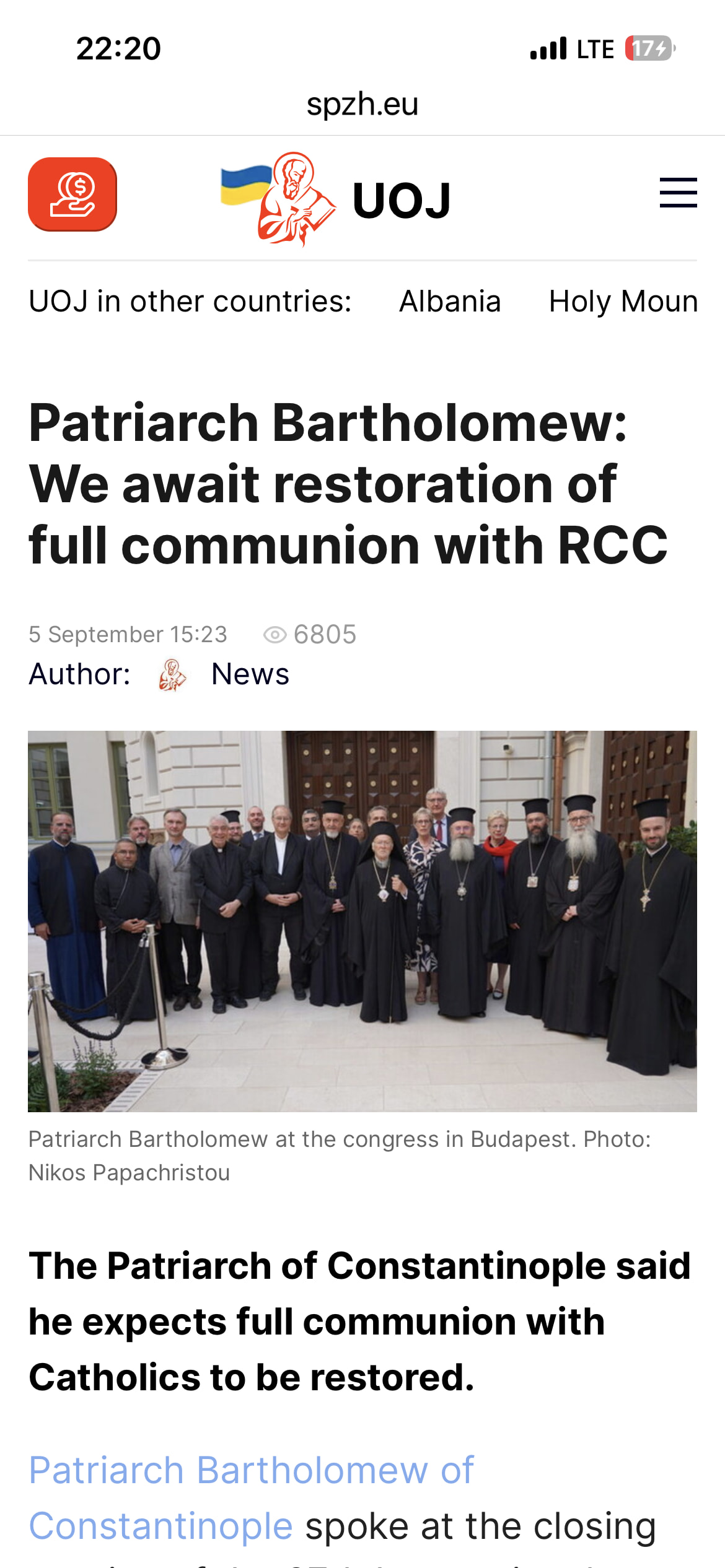
He obviously knows that Rome will never renounce an established dogma, yet he still believes that the restoration of full communion is possible. So does the Pope.
This suggests that even they do not regard our understanding of Roman primacy as inherently and irredeemably incompatible with the restoration of Christian unity. Otherwise, full communion would be impossible in principle, and expressing hope for its restoration would be rather pointless.
Protestant judgments concerning Rome’s orthodoxy are also rather amusing, considering that Protestantism introduced an ecclesiology, an understanding of the sacraments (particularly, though by no means exclusively, the Blessed Sacrament) and a principle that places individual interpretation above the authoritative teaching of the Church, all of which would have been profoundly alien to the Christianity of the first millennium.
The reduction of the Eucharist to a merely symbolic memorial is a particularly striking example. These theological innovations would have been regarded by the early Church Fathers as fundamentally incompatible with the apostolic faith.
And if that claim is mistaken, then by all means, let them produce patristic evidence in support of their teachings.
Let them demonstrate that the Church Fathers endorsed their understanding of the Eucharist, the supremacy of individual judgment over the authoritative teaching of the Church, and the doctrine of Scripture as the sole infallible rule of faith, coupled with the belief that the Church possesses no binding authority to interpret it and that individuals are perfectly entitled to reject her doctrinal judgments when these teachings disagree with their own interpretation of what the Bible means.
If these beliefs genuinely belong to apostolic Christianity, and would have been recognized as orthodox by Christians in the first millenium, there should be no difficulty demonstrating their presence in the writings of the early Church Fathers.
Until they can demonstrate that their teachings are even remotely compatible with the Christian faith in the undivided Church of the first millenium, their judgement of Rome’s orthodoxy can only be described with one term: one term I’m not going to write on here because it would incur moderation (and rightfully so: it wouldn’t be very nice, it would be the very opposite of niceness) so I prefer to moderate myself beforehand.
- Perhaps we can approach this from another direction.
- As I understand the traditional Catholic position, a living human being is a unity of body and soul. At biological death, the soul/or spirit separates from the body but remains conscious, retains personal identity, and awaits reunion with a glorified body at the resurrection.
- What interests me is the nature of that intermediate existence.
- Consider 1 Samuel 28:7–20. The medium at Endor apparently sees Samuel, whom Saul cannot see. She describes an elderly man wearing a robe, and Saul recognizes him from her description. Samuel then speaks to Saul.
- For purposes of this question, I’m asking you to accept the narrative’s identification of the apparition as Samuel, rather than explaining it as a hallucination, fabrication, or demonic impersonation.
- If Samuel was genuinely present, what exactly was present? His disembodied soul? If so, how did that soul acquire an appearance recognizable as Samuel to the Witch of Endor? Was the appearance a temporary manifestation of a spiritual being, distinct from bodily resurrection?
- And if Samuel could manifest himself in recognizable human form without possessing a resurrected body, how should we distinguish his appearance from those of Moses and Elijah at the Transfiguration?
- I’m not suggesting that these appearances prove immediate bodily resurrection. I’m asking what, in your understanding, distinguishes a conscious disembodied soul, its possible visible manifestation, and a permanently glorified human body.
And I want to add something here because I think there is an important distinction here that is often overlooked in discussions of Vatican I: possessing universal ordinary jurisdiction is not the same thing as habitually exercising it.
In Catholic theology, the term ordinary jurisdiction does NOT mean jurisdiction that must be exercised routinely or on a daily basis, It means jurisdiction that belongs to an office by virtue of that office, rather than being delegated by another authority.
Consequently, the doctrine of Vatican I can be understood as affirming that the Bishop of Rome permanently possesses supreme, full, immediate, and universal jurisdiction, without implying that he must ordinarily intervene in the internal governance of every local Church.
Such authority could remain largely unexercised in the ordinary administration of the Churches, with direct papal intervention reserved primarily for exceptional circumstances in which the preservation of faith, ecclesiastical discipline, or unity requires it.
This isn’t merely a hypothetical interpretation invented to facilitate ecumenical dialogue.
The Catholic theologian J. M. R. Tillard, in The Jurisdiction of the Bishop of Rome (Theological Studies, 40/1, 1979, pp. 3–22), examines precisely this distinction, explaining that ordinary jurisdiction refers to authority inherent in an office rather than necessarily exercised in ordinary circumstances.
Read Tillard’s original academic article
Similarly, Cardinal Walter Kasper, discussing the proper interpretation of Vatican I, observes: “Their statements on primacy were especially conceived for extreme and exceptional situations.”
Kasper argues that subsequent maximalist interpretations risked turning an authority intended particularly for exceptional circumstances into a model of routine centralized government. And they are just that: maximalist interpretations, not something inherently required by the dogma itself.
Read Kasper’s discussion of Vatican I
Interestingly, the Orthodox metropolitan Kallistos Ware acknowledged that the usual Western interpretation of Vatican I might not be the only possible one: “Perhaps the meaning attached to the definitions by most western theologians in the past ninety years is not in fact the only possible interpretation.”
Read Ware, The Orthodox Church
The distinction is therefore between the permanent possession of a real jurisdictional prerogative and the historically contingent manner and frequency of its exercise.
A pope could possess universal ordinary jurisdiction while normally respecting the autonomy of local bishops and synods, allowing them to govern their Churches without direct Roman intervention.
His jurisdiction would remain real, immediate, and available for exercise when necessary, but its possession would not entail its constant use.
Of course, this would not reduce papal jurisdiction to a merely honorary primacy (it can be demonstrated that even in the first millenium the Pope didn’t possessed a merely honorary primacy, the historical evidence is unmistikable) or make its exercise dependent upon permission from the local bishops. That would be a different doctrine.
The point is that Vatican I defines the jurisdiction the pope possesses, not a requirement that he exercise it continuously throughout the universal Church.
Such an interpretation preserves the substance of the Catholic dogma while allowing considerable room for different historical and ecclesiastical arrangements, including a much more synodal exercise of Roman primacy.
And it helps explain why the definitions of Vatican I need not necessarily constitute an insurmountable obstacle to the restoration of full communion between East and West.
And no, Arvis’s mere assertion that this dogma must be false is hardly sufficient to establish that it is.
Patriarch Bartholomew himself continues to express his hope for the full restoration of communion with Rome, knowing perfectly well that the Catholic Church will never renounce a solemnly defined dogma. This strongly suggests that the dogma need not be regarded as inherently and irreconcilably opposed to divinely revealed truth. Rather, the real obstacle may lie in certain maximalist ( and by no means necessary) interpretations of it.
But those interpretations are precisely that: interpretations, not the only possible ways of understanding the dogma, much less necessarily the most accurate ones.
And I certainly have no intention of accepting accusations of unorthodoxy from someone who professes a merely symbolic understanding of the Eucharist, elevates individual judgment above the authoritative teaching of the Church, and regards Scripture as the sole infallible rule of faith while denying the Church any binding authority to interpret it.
These are positions profoundly alien to the ecclesiology, sacramental theology, and understanding of doctrinal authority that characterized Christianity throughout the first millennium.
Before questioning the orthodoxy of Rome, perhaps he ought to demonstrate that his own theological principles can be reconciled with the faith of the early Church, because I affirm that they would have been rejected wholesale as unorthodox and heretical even in the first millenium. This is what I affirm and I affirm it loud and clear.
I want to quote the Protestant historian and theologian Adolf Von Harnack.
https://ccel.org/ccel/harnack/dogma3/dogma3.ii.iii.i.iii.iii.html
-
Sola Scriptura. “The authority of Holy Scripture frequently appears in the Fathers as something wholly abstract and despotic. It contained, in fact, a latent tendency to assert its independence of the conditions out of which it had arisen. But the revolution which was characterised by the isolation of the Bible, its deliverance from the authority of ecclesiastical tradition, and the annihilation of the latter, only took place in the sixteenth century, and even then it was, we know, not completely successful. In ecclesiastical antiquity, on the contrary, the bond was by no means severed which connected Scripture with the maternal organism of the Church. The Church, its doctrine, institutions, and constitution, were held, in and by themselves, to constitute the source of knowledge and the authoritative guarantee of truth. “ In other words, he is affirming that Sola Scriptura delivered from the authoritative teaching of the Church is an invention and a distortion of the Christian faith of the first millenium. He obviously believed the revolution (he himself defines it with this term) to be veritative (otherwise he would have converted to Catholicism, which he didn’t as far as I know), but as an historian he recognizes that the Protestant principle of sola Scriptura and the sovereignty of personal interpretation over the intepretation of the Church would have been seen as an invention and a revolution in the early Church, in other words as an unorthodox principle. The fact that he, as a Protestant, may regard this unorthodox principle as true and consistent with God’s will does nothing to change the fact that it would have been thoroughly rejected by the early Church and he himself describes, as an historian, the nature of the faith of the universal Church of the first millenium, which was incompatible with the revolutionary and individualistic and radically contrary to unity principle introduced in the sixteenth century.
-
The nature of the Blessed Sacrament. In his History of Dogma, vol. IV, p. 294, discussing the Eucharistic theology of St. Gregory of Nyssa (fourth century), Harnack writes: “through the act of consecration the bread and wine are changed into the flesh and blood of the Lord” This is Harnack’s own description of Gregory’s teaching, Harnack explains that Gregory understood the consecrated Eucharist as a real participation in Christ’s immortal body, through which believers receive the promise of immortality. He also emphasizes the close connection Gregory established between the Eucharist and the Incarnation.
Harnack, History of Dogma, vol. IV, pp. 294–296. Source: Adolf von Harnack, History of Dogma, vol. IV, Chapter IV, The Mysteries and Kindred Subjects, pp. 294–303.
Adolf Harnack: History of Dogma - Volume IV - Christian Classics Ethereal Library . In his History of Dogma, vol. IV, p. 289, footnote 534, he also writes: “A purely symbolic conception of the Supper never existed”
Harnack then explains that the ancient Christian understanding of a symbol was fundamentally different from the modern conception of a merely representative sign. For the early Church, the Eucharistic symbol was not simply an outward reminder of an absent reality; it was inseparably connected with a genuine sacramental mystery.
-
Roman primacy, not merely honorific but factual and doctrinal. In his History of Dogma, vol. II, Chapter III, Harnack makes several remarkable observations.
3.1. Rome was already the leading Church in the second century.
On p. 155, Harnack describes the Roman community as: “the first and most influential Church”
He reaches this conclusion after examining Rome’s role in the development of early Christian institutions. He then discusses the First Epistle of Clement, written to the Corinthians toward the end of the first century, as evidence that Rome already felt responsible for the welfare and discipline of other Christian communities.
In Harnack’s account, Rome did not merely enjoy honorary precedence: it actively intervened in the affairs of other Churches.
3.2. Rome possessed exceptional doctrinal authority.
Discussing St. Irenaeus and his appeal to the apostolic tradition preserved in Rome, Harnack describes the Roman Church’s decision as: “the most authoritative and impressive in Christendom” (History of Dogma, vol. II, pp. 157–158.)
This is particularly significant because Irenaeus invokes the Roman Church in his argument against heresy. Harnack recognizes that Rome’s exceptional standing made its testimony to apostolic doctrine especially influential throughout the Christian world.
The Roman Church was therefore not simply accorded ceremonial respect. She served as an important reference point in determining and defending the apostolic faith.
3.3. Harnack explicitly recognizes a real Roman primacy.
On p. 160, he describes the early Christian communities as united: “under the primacy of the Roman Church”
He identifies this as a de facto primacy: one that existed and operated historically, even though he does not believe it had yet been established as a legally defined universal jurisdiction belonging personally to the Roman bishop..
He then proceeds to discuss concrete examples of Roman intervention, including the Montanist controversy and Pope Victor’s attempt to impose a common rule concerning the celebration of Easter. He considers these events evidence that Rome exercised an exceptional influence over the conditions of ecclesiastical communion.
3.4. By the middle of the third century, Roman primacy was already acknowledged. On p. 162, discussing Roman interventions in the affairs of the Church of Carthage around AD 250, Harnack explicitly recognizes: “an acknowledged primacy”
He explains that this primacy manifested itself through Rome’s active involvement in the affairs of other Christian communities and her concern for their ecclesiastical welfare.
The historical conclusion is therefore significant: Harnack was not attempting to defend the Catholic doctrine of papal supremacy, nevertheless, his historical analysis explicitly recognizes that the Roman Church already possessed an exceptional position of leadership, exercised influence beyond her own territory, intervened in controversies involving other Churches, and enjoyed particular authority in matters of apostolic doctrine.
Harnack’s account is incompatible with the claim that Rome’s early primacy was merely ceremonial, entirely passive, or devoid of concrete ecclesiastical significance.
Original source: Adolf von Harnack, History of Dogma, vol. II, Chapter III, pp. 155–162.
Adolf Harnack: History of Dogma - Volume II - Christian Classics Ethereal Library
-
The exceptional role and holiness of the Blessed Virgin. the Virgin Mary already occupied an exceptional position in Christian thought during the earliest centuries of the Church.
In his History of Dogma, vol. IV, p. 315, Harnack writes: “Mary takes the first place among the saints. She came into notice even in the first three centuries.”
Original source:
Adolf Harnack: History of Dogma - Volume IV - Christian Classics Ethereal Library
Harnack thus acknowledges that Mary’s exceptional position did not simply emerge in the Middle Ages or originate with the Council of Ephesus in AD 431. Its theological foundations were already present in the earliest centuries of Christianity.
Even more remarkably, when discussing St. Irenaeus of Lyons and Tertullian, writing in the second and early third centuries, Harnack recognizes that both employed: “very extravagant expressions with regard to Mary (History of Dogma, vol. II, p. 277.)
Original source:
Adolf Harnack: History of Dogma - Volume II - Christian Classics Ethereal Library
Harnack is referring particularly to the ancient parallel between Eve and Mary.
For Irenaeus, Mary’s obedience reverses Eve’s disobedience. He even describes Mary as having become a cause of salvation for herself and the whole human race, precisely through her obedient cooperation with God’s saving plan.
This is an extraordinarily significant theological role to attribute to Mary as early as the second century.
And remember, Harnack was not a Catholic apologist attempting to defend Marian devotion. Nevertheless, his historical testimony remains important: even a Protestant critic of Marian devotion acknowledged that Mary’s exceptional theological status had roots in the first three centuries and that some of the earliest Church Fathers attributed to her a remarkable role in the history of salvation.
-
The divine protection from error enjoyed by ecumenical councils. In his History of Dogma, vol. III, p. 216, Harnack writes that, during the fourth century, the conviction gradually emerged that: “the Nicene Synod possessed an infallible authority”
He further explains that the Church came to regard the council’s doctrinal decisions as possessing “an authority above discussion”
Harnack connects this development with the belief that the bishops assembled at Nicaea had been guided by the Holy Spirit. Consequently, the Nicene definition of the Trinity increasingly came to be regarded not merely as the collective opinion of individual theologians, but as a definitive expression of the Christian faith.
in History of Dogma, vol. I, p. 4, Harnack identifies among the traditional presuppositions transformed by Luther: “the infallible teaching function of the Church”
The difference is not merely about which doctrines one happens to believe. It concerns where final doctrinal authority resides: in the Church’s authoritative confession of the apostolic faith, or in the individual’s right to reject that confession whenever his personal interpretation of Scripture leads him elsewhere. In the early history of the Christianity, Luther’s view of individual judgment would have been seen as fundamentally alien and incompatible with the apostolic faith.
Primary sources:
Adolf von Harnack, History of Dogma, vol. III, pp. 210, 216–217:
Adolf Harnack: History of Dogma - Volume III - Christian Classics Ethereal Library
Adolf von Harnack, History of Dogma, vol. I, p. 4:
Adolf Harnack: History of Dogma - Volume I - Christian Classics Ethereal Library
Having established all of this, I am going to ask once again:
Can anyone demonstrate that sola Scriptura, understood as Scripture divorced from Sacred Tradition and the authoritative interpretation of the Church, would have been recognized as an orthodox principle during the first millennium of Christianity?
Can anyone demonstrate that the claim that Roman primacy was a later invention, and that the early Church was governed exclusively through synodal structures, with no special authority accorded to Rome in doctrinal matters (not merely ceremonial precedence) would have been considered an orthodox understanding of the Church during the first millennium?
Can anyone demonstrate that a purely symbolic or memorialist understanding of the Eucharist would have been regarded as orthodox and compatible with the apostolic faith during that same period?
Can anyone demonstrate that one’s own judgement can contradict the judgement of the Church and, when this happening, the early Christian was entitled to reject the interpretation of the Church on the grounds the her interpretation of the meaning of Scripture conflicts with his own?
And if the answer to all these questions is no (which it clearly IS and if it is not, then by all means, produce the historical and patristic evidence demonstrating that these beliefs were genuinely compatible with early Christianity, rather than fundamentally alien to its faith) How exactly am I supposed to respond to accusations of heresy against the very Church founded by Christ (accusation raised against the dogma of Vatican I), coming from people who themselves profess these alien principles, without bursting into a fit of genuine, thunderous laughter at the remarkably successful (albeit entirely unintentional) jokes of a comedian who, even more amusingly, seems utterly unaware that he is playing the part?
What standing does someone whose own theological convictions are fundamentally at odds with the faith of the early Church have to accuse Rome of having abandoned that very faith?
Before presuming to sit in judgment over Rome’s orthodoxy (as the person(s) these posts have been written for clearly did) , perhaps they should first demonstrate that their own beliefs would have been recognized as orthodox by the Christians of the first millennium, rather than condemned as the poisonous, unorthodox, and heretical errors they actually are. Because that is precisely what they are: poisonous, false, unorthodox, and fundamentally unapostolic errors and distortions of the Christian faith, every bit as pernicious (or perhaps considerably more so, given how widespread they are) as Arianism, Nestorianism, Marcionism, Catharism, and the countless other heresies refuted and condemned by the Church of Christ. The only substantial difference lies in the degree of historical success these “modern” heresies have unfortunately enjoyed. Those who profess such heresies by all means should continue to profess them, if they really believe them to be correct, despite all the contrary evidence, but they have absolutely no standing to accuse the very Church founded by Christ of heresy or doctrinal corruption, much less to expect their accusations to be taken seriously rather than treated like they deserve.
We represent different traditions and therefore, it is not fruitful to argue about differing interpretations. Yet, in some details I want to lift up alternative viewpoints to show that the interpretation you represent is not the only possible one.
You and possibly the whole RCC try to monopolize the words ‘one, holy, catholic and apostolic church’ - please note that ‘catholic’ and ‘Catholic’ are not synonymous in the modern use of the words.
‘One’ does not mean that all should belong to the same institution/organization or to be lead by one person. The only head of the body of Christ is Jesus Christ, and those who believe in him and follow him have been joined to the one body. The members of the body are disciples that are learning from the Master. Depending on what stage of the learning they are, they may misunderstand some parts of the Apostolic teaching but they are members of the one body despite the misunderstandings. Who of us can claim to have perfect knowledge?
‘Holy’ refers to being in Christ. Those who have been transferred from darkness into Christ are holy. Not because of what they do or in what church they belong, the holiness is the given holiness of the Lord.
‘catholic and Apostolic’ means belonging to the group of churches that accept the teachings of all the (original) Apostles.
Many gnostic-type groups relied on the claimed teaching of an apostle. The definition ‘catholic and Apostolic’ separates these churches from the groups that rely on ‘special’ or ‘secret’ teaching that is claimed to come through one person.
In the context of the Nicene creed, there also seems to be an assumption that the Apostolic teaching agreed with the creed.
If one church separates itself from the other ‘catholic and Apostolic’ churches and tries to monopolize the definition to itself, we may ask if that church wants to cut themselves out from the group of ‘catholic and Apostolic’ churches. Each group needs to answer for themselves but any claims that ‘only we have the saving faith and the correct doctrines’ is an alarming sign.
The claim that Protestants rely just on one’s own judgement, or that individual personal opinion is the highest authority, is a strawman, a caricature that is spreading false information from others. There may be such individuals but they are rare exceptions.
Also your claims about ‘sola scriptura’ is a caricature. The expression was used in the context of debates on whether we should obey the current teaching or stick to the early Apostolic teaching of the church. The early Apostolic teaching can be seen in the biblical scriptures. ‘sola scriptura’ was used to´express that in such a choice, we should obey the early Apostolic teaching of the church more than the current claims - obey what is written in the biblical scriptures more than what the Pope or some bishops claim.
I’ve never said it is the only possible one. I have asked you if your positions would have been considered orthodox in the first millenium. It doesn’t look like you have addressed this point at all. I will now address your other points.
I have never made this claim. The claim i have made is that the universal Church cannot err when establishing divinely revelead truths in ecumenical councils. I also claim that the Church of Rome has always occupied a very special place (not only ceremonially but even in terms of doctrinal authority) in the undivided Church of the first millenium.
These are my claims and they are both historically consistent.
And yet Rome had a real primacy from the beginning as I have shown quoting an actual historian. A Protestant historian and theologian. You contradict him, but can you offer evidences that your position would have been received positively in the early Church? Your opinion is not enough, you are free to keep it of course but establishing that it would have been accepted in the early Church and not seen as heterodox is something different.
Strawmen. Nobody is talking about secret teachings. The oral teachings of the apostles aren’t gnostic teachings, they belong to sacred Tradition.
Exactly. Which is what the Arians rejected. The Arians had some father (if I remember correctly, I will check) who was subordinationist and they could use them to back up their positions. Which church fathers support your positions on the ecclesiology of the Church, the nature of the Blessed Sacrament, the primacy of your own intepretation over the authoritative teaching of the Church, the fallibility of ecumenical Councils?
FEEL FREE TO SHOW THEM. YOU AREN’T JUST ENCOURAGED TO SHOW THEM; I’M ACTUALLY IMPLORING YOU TO DO SO. I’M BEGGING YOU TO SHOW ME EVEN A SINGLE CHURCH FATHER WHO SUPPORTS, OR WHO IS EVEN REMOTELY COMPATIBLE WITH, THE TENETS OF PROTESTANTISM.
This claim needs to be supported. Nobody monopolized anything, Rome was recognized an actual primacy throughout the entirety of the first millenium. Which doesn’t mean that Rome was absolutely above correction or that she represented, by herself, the entirety of the universal Church.
This proposition is foreign to early Christianity.
It is not. It is consequential, if the Church is the pillar and foundation of the truth as the Scripture itself testifies. You cannot be the pillar and foundation of the truth if you cannot discern truth to begin with and establish which doctrines are incompatible with the apostolic faith.
Is it, really?
So, when the Protestant historian and theologian Adolf Von Harnack wrote the following words Adolf Harnack: History of Dogma - Volume III - Christian Classics Ethereal Library
“The authority of Holy Scripture frequently appears in the Fathers as something wholly abstract and despotic. It contained, in fact, a latent tendency to assert its independence of the conditions out of which it had arisen. But the revolution which was characterised by the isolation of the Bible, its deliverance from the authority of ecclesiastical tradition, and the annihilation of the latter, only took place in the sixteenth century, and even then it was, we know, not completely successful.In ecclesiastical antiquity, on the contrary, the bond was by no means severed which connected Scripture with the maternal organism of the Church. The Church, its doctrine, institutions, and constitution, were held, in and by themselves, to constitute the source of knowledge and the authoritative guarantee of truth. “
WAS HE MAKING A STRAWMAN AND A CARICATURE OF HIS OWN BELIEFS?
If my claim that, within Protestantism, individual personal opinion is the highest authority is false and a caricature, by all means tell me who, on this earth, can authoritatively correct a Protestant when he or she reaches a certain doctrinal and/or moral conclusion after reading the Scripture and establishing the meaning of the Scripture (which, as demonstrated, is far, really really far, from being obvious and unambiguous, and the thousands of denominations that contradict each other, each claiming that their own understanding is the correct one, is the proof of how much differently and contradictorily Scripture can be interpreted).
You have accused me of spreading false informations. You have also accused me of having offered a strawman of Protestantism. By all means, show me where my error is, please. Don’t merely make an assertion: show me where I’m wrong.
Are you suggesting that an ecumenical council can teach doctrinal error and command the faithfuls to give divine and Catholic assent of faith to an erroneous proposition? In this case, can you show me even one Church Father who supports your position?
Why does a “new” view have to be false?
Is the Scriptural view of madness and disease the same as modern medicine?
Would you assert that view over modern medicine any more than YECs do the age and Nature of the Earth and Cosmos?
Perhaps we have to be talking Theology for the principles to apply.
So the Biblical view of God wandering around the Earth and treating humans as pets remains. (Nature of God is Theology) The view of the afterlife being static and sleeping until the final days is constant and orthodox. The view of God being only accessed by specific Priests or Prophets is orthodox. The view that God is immutable and cannot be changed, or swayed (by prayer) is orthodox. The view that God controls all things and all peoples to war and peace is not Scriptural or Orthodox
You have a singular view of Theology .
Richard
What are these early apostolic teachings you are talking about? You subscribe to the symbolic view of the Eucharist. Which fathers of the early Church support your view?
I’m not against you professing these beliefs, but this thing that you “have recovered the ancient roots of Christianity” needs to stop because it is false. You have not recovered anything, you have created a fundamentally different Christianity with fundamentally different principles.
Ancient Christianity was hierarchical, sacramental, ancient Christianity unmistakably believed in Christ’s real presence in the Eucharist and Rome enjoyed a true, real, concrete primacy throughout the first millenium, and the individual had to accept and recognize the authoritative interpretation of the Church instead of assuming that his own interpretation, arising from his own autonomous reading of the Scripture, was the correct one. Even a Protestant historian and theologian like Von Harnack, someone who certainly had no vested interests in defending Catholicism and undermining his own denomination, has recognized these historical truths, as shown here Logic, reason and Christianity - #558 by 1Cor15.54
This is an entirely different matter. One can conceivably believe that God, for reasons known to Him alone, deserted the Church almost from the very beginning and allowed her to mislead the faithful for fifteen centuries, until a group of revolutionaries finally rediscovered the true Gospel, which had supposedly been buried beneath the wicked and Pharisaical traditions of the very Church Christ had founded and subsequently and almost immediately deserted, offering her no kind of protection whatsoever despite His claims that the gates of Hell would not prevail.
One is, of course, free to entertain such a hypothesis. It is not logically impossible, although I find it extraordinarily difficult to take seriously (which is also why Protestants claim that they are the original Christianity: they know this claim is very hard to take seriously, so they claim historical and patristic roots which unfortunately for them do not exist, or better yet they do and they soundly refute their claims, because the early Church was ierarchical, sacramental, sola Scriptura did not exist and the teaching of the Church was extremely important, immensely more important than one’s own private judgment reached after reading the Scripture autonomously, and Christ’s real presence in the Eucharist was basically recognized by every Christian, except some heretics who, even back then, put their own opinions above the teachings of the Church).
But claiming that God allowed His Church to fall into error for fifteen centuries before the Reformers finally recovered the truth is an entirely different proposition (like I said it’s not inherently impossible, just like it’s not inherently impossible that in my city there is a pink flying unicorn that can’t be touched and can’t be seen, a unicorn that is nevertheless a very good friend of mine, even saying that this unicorn exists is not inherently and logically impossible) from claiming that Protestantism simply restored the original apostolic faith as it had actually been taught and professed by the early Church.
The former is a theological hypothesis about divine providence and the alleged corruption of Christianity. The latter is a historical claim about what the earliest Christians actually believed and taught—and, as such, it must be substantiated by historical evidence.
Principles such as sola Scriptura divorced from Sacred Tradition and the authoritative interpretation of the Church; a merely symbolic understanding of the Blessed Sacrament; the supremacy of individual judgment over the authoritative teaching of the Church; the claim that one may legitimately reject the Church’s doctrinal judgments and resist ecclesiastical correction whenever one’s personal interpretation of Scripture leads to a different conclusion; the fallibility of ecumenical councils; all of these principles would have been rejected as fundamentally incompatible with the apostolic faith during the first millennium of Christianity.
Anyone openly professing such beliefs would have been subject to correction and, if they obstinately persisted in rejecting that correction, could ultimately have been excluded from ecclesiastical communion.
This claim goes against the teaching of Jesus and warnings of Jesus regarging church leaders.
“And call no man your father upon the earth: for one is your Father, which is in heaven. Neither be ye called masters: for one is your Master, even Christ. But he that is greatest among you shall be your servant. And whosoever shall exalt himself shall be abased; and he that shall humble himself shall be exalted. But woe unto you, scribes and Pharisees, hypocrites! for ye shut up the kingdom of heaven against men: for ye neither go in yourselves, neither suffer ye them that are entering to go in.” (Matthew 23:9-13)
How can you follow an organisation that cannot follow the teachings of Jesus and claim to be Christian? Not only do they call themselves Father, but they have also led millions away from the teachings of Jesus.
The same Scripture you abuse on a daily basis (and you will have to answer for it, what you are doing is not something harmless) also describes very clearly the Church as the pillar and foundation of the Truth. And the very Jesus whose words you distort on a daily basis gave Peter the keys of the kingdom and the power to bind and loose.
I read the lives of the saints. Great men and women who followed the Church and, through their loyalty to Christ, His Gospel and His Church, led millions of faithfuls to embrace Christ. The claims you are making are very grave and you will have to answer for every single one of them, in the presence of God Himself. By all means, continue. I really hope you continue, I’m not joking.
Romans 12:20: “If your enemy is hungry, feed him; if he is thirsty, give him something to drink.
In doing this, you will heap burning coals on his head”
Go ahead Shawn. Seriously. Continue. Don’t stop.
This is the crux
Yu have declared such a thing impssibe with n Scriptura backing at a In fact, the witness f the d Testameny is that pepe beieve what they will despite God.
God does not force Himself, or His knowledge onto anyone.
Your faith in the integrity of humanity (The Church) would seem to deny your belief in the Fall and the witness of the Old Testament
Richard
I have not. Anyone who wishes to hold such an opinion is perfectly free to do so. Whether it is ridiculous, or whether it makes even the slightest bit of sense, is a matter of subjective judgment. *
But it is not an inherently impossible proposition, that is for sure.
For that matter, even my claim that I possess a magnificent pink flying unicorn, invisible and intangible to everyone but myself, cannot simply be declared logically impossible. You should see her (her name is Katy, for the record), she is such a sweetheart. It’s too bad only I can see and touch her. * How can you prove that I don’t possess Katy? Afterall you already believe in invisible entities, like angels and God Himself. What makes the claim that I possess such a creature inherently and logically impossible? Nothing; to my knowledge. Just because something is not inherently impossible does not mean it is credible.
*The claim that Protestantism is consistent with early Christianity, and that its distinctive tenets would not have been categorically rejected and condemned as false and heretical by the early Church, is an entirely different proposition, like I said, one that can actually be subjected to historical scrutiny.
Of course, one might concede that the early Church would indeed have condemned those teachings, while maintaining that the Church had already become corrupt and been abandoned by God. Whether such a hypothesis can be reconciled with Christ’s promises to His Church (and whether it effectively turns Jesus into a liar or a schizophrenic) is another matter entirely.
But as I have already explained, the assertion that Protestantism merely recovered the original teachings of the early Church is a historical claim, and I have yet to see any convincing historical evidence whatsoever to substantiate it. While I have seen, and provided, a lot of evidence that shows the exact opposite, including evidence coming from a Protestant historian and theologian.
The witness of the New Testament is also that the Church is “the pillar and foundation of the truth” (1 Timothy 3:15).
Now, whether one wishes to believe that this very Church was effectively buried for fifteen centuries, only to be rediscovered by a group of supposedly enlightened revolutionaries who proceeded to rebuild it (producing a movement that has continually fragmented into competing denominations, many of which profess mutually contradictory doctrines on fundamental matters of faith ) is another question entirely.
Is such a proposition something one can believe? Certainly. It is not inherently impossible. Whether it makes any more sense than my claim about Katy, my adorable pink flying unicorn, who is both invisible and intangible to everyone but me, is entirely a matter of subjective judgment. Historical claims, though, are far less subjective. And history shows that the Protestant doctrines are not compatible in the slightest, not even remotely, with the faith of the early church.
Am I wrong? Then one should show the evidence that demonstrates that my claim is wrong, because I have provided substantial evidence, for my part, to support my claim.
*P.s: Katy says hi to everyone, I managed to capture her visually for a brief moment.

She is a thing of beauty, isn’t she?