This is a good discussion about autism. I have several grandchildren who are autistic, as well as a nephew who is high functioning but is now realizing at age 50 that he is on the spectrum. In retrospect, I think my mother was also on the spectrum as she had relational difficulty. Hard to know as farm folk are often stoic in nature. Shoot, I may be a bit myself, but worry that perhaps that is just a bit of psychobabble, sort of like how everyone was diagnosed as bipolar a while back. ( In defense of the mental health professionals, sometimes you have to give a label to get coverage and help for people). In any case, the article summarizes what we know and how we should respond to autism as Christians. After all, according to the article, we are a good number of that group.
https://biologos.org/articles/understanding-autism-spectrum-disorder-epidemiologically-and-theologically?mc_cid=041f72c255&mc_eid=695fcd92a6
The diagnosis of autism is not black-and-white. Many have some features that are common among autists but not so many that it would classify them as autistic. There are lots of individual-level variation among humans - we are not identical clones. In fact, being 100% ‘typical’ or ‘average’ may be more rare than autism - I have no data showing this but it is my impression.
My experience of the university world is that the percentage of people suspected to be on the autism spectrum seems to be especially high among students and researchers within natural sciences. The switch from individual-based research work to working in social networks of researchers has been stressful for the autistic persons. Apparently, the autistic features may be even beneficial in certain conditions but become a burden in other kind of environments.
I think that’s something that makes diagnoses so murky, because there is a focus on to what degree the person’s life (or lives of others) is disrupted by the condition, but that depends a lot on their environment.
I think about how most of our ancestors at some point along the way lived in agrarian communities. They needed people who could spend their entire day with animals, in relatively quiet places, keeping track of how many there were at all times. That seems like an ideal job for many autistic people (makes me think of Temple Grandin and her relationship to animals), but as humans transitioned to cities and got louder, jobs like that were less in demand. The technological revolution of the past couple hundred years has led to so many cultural shifts in what kinds of skills are valued and where and to what degree. I can’t help but think that’s a factor in how we view autism too.
He gave at talk at the last ASA meeting on the same general topic.
I’m looking forward to this; thank you.
I just watched this podcast by Triggernometry, with Simon Baron Cohen (cousin to Sasha, but one of the world’s leaders on autism, too), which I found really interesting. He points out that autism is a mirror opposite to sociopathy. On the one hand, one doesn’t perceive social norms, but cares when one understands (as with Temple Grandin, and even with others; one is often very gullible and innocent), and on the other, one understands, but doesn’t care.
https://youtu.be/VJg2_EVheY4?si=Qbw3p6RK5W6duxvq
He also wrote a book, “The Pattern Seekers.”
I always like this cartoon.
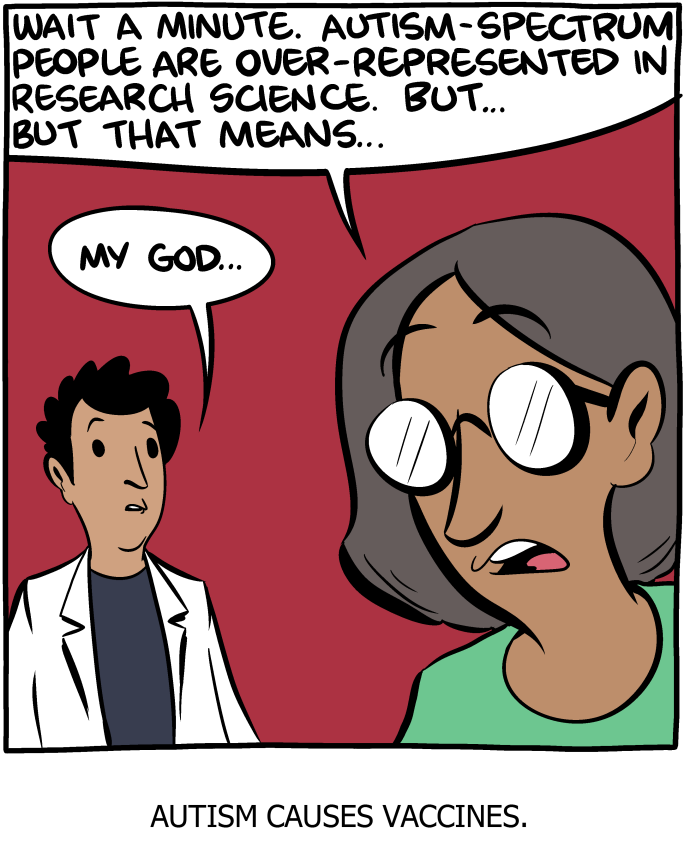
Research seems to show that autism is actually 4 or more different conditions that have overlapping symptoms. Makes sense as it varies widely. While a lot has been lumped in the autism spectrum, I suspect that in the future better diagnosis will split types apart. Some of that may be slowed by support for other neuroatypical conditions may not be there like it is for autism.
The article I found discussing subtypes:
Multifactorial, yes, with developmental, genetic and environmental inputs. This is highlights how dependent our reasoning, outlook and feelings are on the neurological substrates we possess.
The problem/objection I have to this is the word “disorder.” I have little doubt many things including schizophrenia, attention deficiency, and psycho/sociopathy as well as autism are at the end of various spectrums of human thinking, personality, and behavior. But I think the trend of many to see themselves (or worse others) as part of some disadvantaged group is not so very helpful. Of course, this does not mean that the extremes on these spectrums do not have serious challenges to deal with (or do not present difficult challenges to others). But the idea that there is some narrow range of personality defines normality is something else. I frankly think the norm is simply that everybody is different, and these differences are a good thing.
I partly agree. The ‘norm’ is diversity and the capabilities of individuals may be a benefit or a burden, depending on the social environment.
Then comes the ‘but…’ part: modern societies are such that deviating individuals may have great challenges to adapt and these persons may suffer or cause suffering to others because of their deviating qualities. If the deviating qualities (condition) of the person makes the person poorly suited for life that is considered ‘normal’ or ‘expected’ in that society, the condition can be seen as the consequence of deviating development and the condition may cause suffering, I think it is justified to have a diagnosis for that condition - a generally accepted set of criteria for that kind of condition. In the best case, the diagnosis may help the society to give the person suitable help - if there is enough of good will to help those that need help.
Another question is that which deviations are classified as such that deserve a medical diagnosis and special treatment, are ‘disorders’? The history has really dark shadows in this area.
The symptoms aren’t the “disorder”. The cause (neurosis) is the disorder.
What are you claiming to be caused by neurosis???
Genetic diversity is not a disorder. That is not a bug but a feature.
Causality in regards to everything I mentioned has proven to be very complicated with many genetic and environmental factors. In other words, life, frankly. Life is not a disorder. Like I said above, extremes on these spectrums are certainly problematic and not the easiest things to live with. My objection is the treatment of larger portions of any of these spectrums as a disorder. Far more helpful than such participations in the delusions of normalcy is the simple acceptance of diversity with a greater flexibility in dealing with people.
I know for a fact that it is caused by a neurosis.
What are you claiming to be caused by neurosis???
autism?
seriously? LOL
I think that is in the same category as believing it to be caused by vaccines. It suggests a serious lack of understanding of both neurosis and autism, including the measurable chemical differences between them.
It would help to know what is meant by neurosis in his statement. But I also disagree.
But if we don’t call it a disorder it is at least an atypical neurological ordering which confers challenges as well as sometimes advantages.
My objection isn’t about forbidding the word “disorder” for anyone. My reaction was more about using this word for a whole spectrum which might include people who don’t require much support.
Though I suppose, I may have been treating the word “spectrum” too linearly, when in the case of autism in particular the spectrum is multi-dimensional – IOW there is a collection of many different symptoms which we include under the broad label of “autism.”
Yeah we need to be careful not to sell each other short based on differences in our demographics. Variety isn’t pathology.
It is obviously not a settled field in which all is understood.
The symptoms remain even after the neurosis is fixed.
A friend of my sister who is a neuropsychologist would disagree, primarily by saying that the word “neurosis” is just shorthand for “a collection of symptoms”.
That friend did her doctoral work in modeling disorders in mutli-dimensional space; IIRC she commented once that at least five dimensions are needed.
But do these two multi-dimensional spectrums even overlap? What em3ry is suggesting is that one is (at least causally) a subset of the other. Is “neurosis” that poorly defined? Even my brief look at the subject suggests this is not the case and the only overlap is that some people might have both conditions.