I think the garden of Eden was shaped like a primitive cell. The two trees in the center were grapevines representing either the two strands of DNA of 1 chromosome or two sister chromosomes. Image below only shows 1 chromosome in the exact center. The story alludes to how the evolution of sexual reproduction led to death (the flood). Before sexual reproduction all living things lived forever.
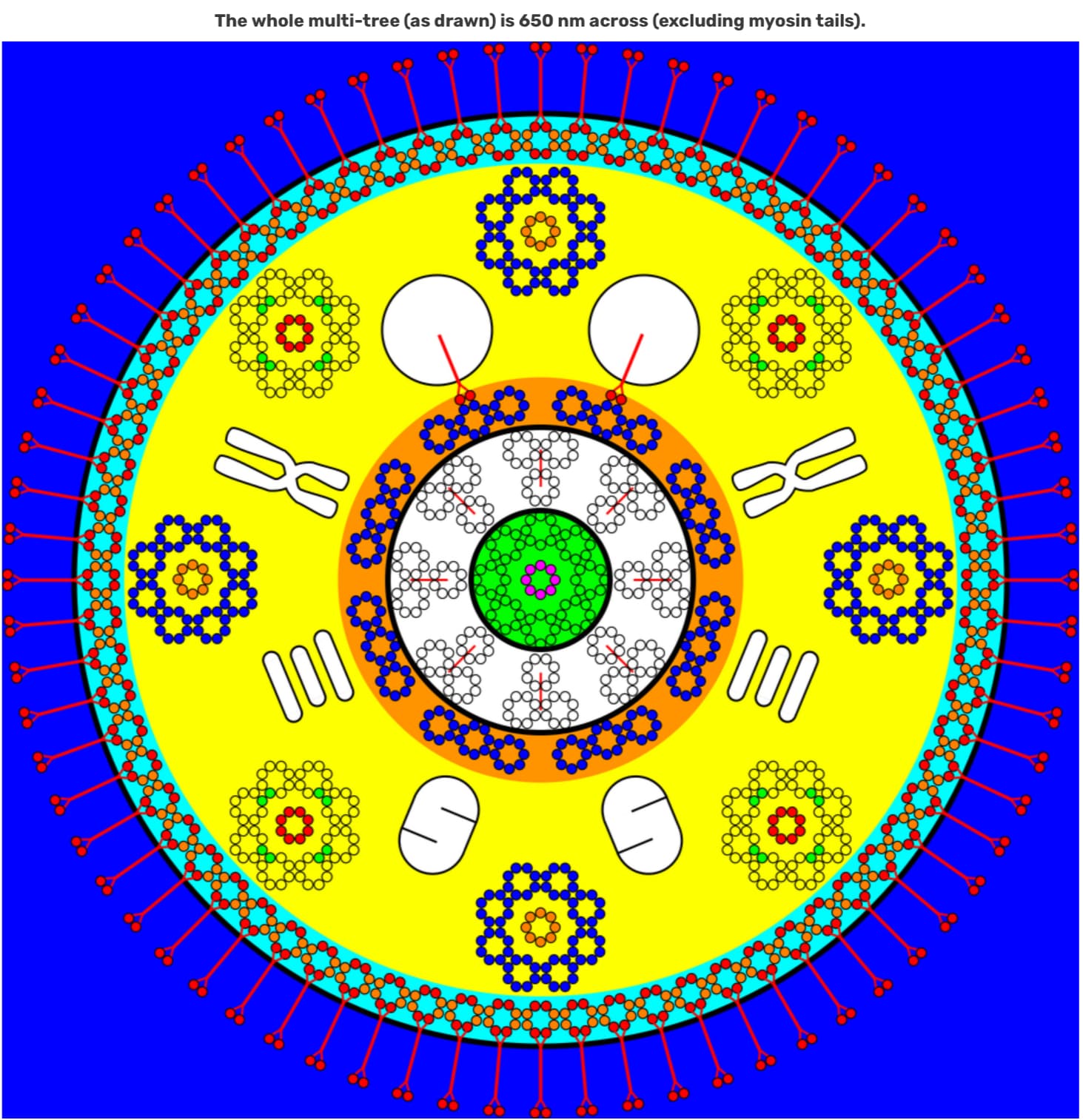
From the inside out:
-
Green region (Nuclear region. cf #Proto-NPC below):
-
1 perfectly straight vertical 33-nm fibre chromosome (purple) in the exact center. (This is the original self-reproducing tree from which all the others are derived. The “head” tree. This stage in its lifecycle actively swam and collected PM’s when they first hit the surface of the water.)
- Later the chromosome would evolve to a spring-like spiral shape.
-
8 spliceosomes surrounding the chromosome.
-
Encircling black line is a lipid membrane
- In the RNA-world introns may have been ribozymes.
-
Most of what remains of the RNA world resides today in the nucleus
-
-
White region (Endoplasm):
-
8 ribosomes creating unfolded proteins (straight red lines) which are reminiscent of radial centrosomal structures.
-
8 T-complex protein Ring Complexes formed by two rings (containing 8 similar but non-identical subunits) stacked forming a barrel-like structure that encloses the unfolded protein and folds it so that its hydrophobic parts face outward.
-
Encircling black line is a lipid membrane
-
At the top of the multi-tree the white and green regions are empty and function as a stomach (see acrosome).
- This is where the mRNA exits the polyribosome when it is no longer needed.
-
-
Orange region (Archaeal cell wall region, see S-layer):
-
8 proto-microtubule triplets (blue)
- These microtubule triplets will evolve into the centriole
-
The orange region is 365 nm in diameter. Centrioles are 250 nm in diameter.
-
-
Yellow region (Ectoplasm):
-
Trees lying on their sides (This stage crawled on their bellies like serpents and collected PM’s (“dust”) already lying on the seafloor):
-
2 vesicles each carried by a myosin dimer “biped” (which is red),
-
2 micronucleus chromosome pairs (gonads).
-
1 chromosome divides forming a pair but only 1 of the 2 chromosomes is actually released. The remaining 1 then divides again
-
Without an outer cell wall the multi-tree would be vulnerable to brood parasitism. But with an outer cell wall animal (i.e. plastids) husbandry becomes possible.
-
-
2 proto-Golgi bodies (kidneys)
-
2 proto-mitochondria,
-
-
Vertical trees:
-
4 nerves (blue microtubules surrounding orange neurofilaments),
-
-
Cyan region (Eukaryotic cell wall region):
-
Cell wall of intermediate filaments (orange)
-
Myosin molecule “quadrupeds” (red)
-
Paddling (like a rotifer) on the outside against the surrounding water (which is blue)
-
Paddling on the inside to create cytoplasmic streaming. (not depicted)
-
-
Encircling black line is a lipid membrane
-
The strength of the cell wall is due to turgor pressure not rigidity.
-