Okay - this one’s math, but for those who like to geek out about even minor nerdy things …
So I’ve been teaching geometry to high schoolers for a lot of years now (cough - ‘decades’ - cough), and only just this morning I learned this cool new term! (Thanks to the Gemini AI for the answer…)
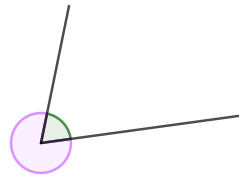
So most high school students should be able to tell you that any two angles adding to 90 degrees are complementary angles. And any angles adding to 180 degrees are supplementary angles. But is there a word for two angles that add to 360 degrees? Turns out … yes there is: explementary angles! (Or ‘conjugate’ angles - if you find the first word a mouthful.) So the green and lavender angles below are explementary!
Or maybe they could more specifically be called a ‘conjugate pair’ (Sorta like two adjacent supplementary angles are called a linear pair.) I mean - I knew what a ‘reflex’ angle is - any angle larger than 180 degrees. But in the process of grading tests and challenging students to identify sets of adjacent angles, it occurred to me that an astute student could argue that their three letter angle identification was really meant to refer to the reflex angle rather than the standard (less than 180 degree) one! (None have done so.) But it did set me to wondering how would one identify the conjugate (reflex) angle - since it involves the same three letters and the same vertex? Turns out you have to add the word ‘reflex’ in front of your angle symbol - otherwise it is assumed you are referring to the less-than-180-degree angle.
If you read this far, your high school geek street cred is more-than-intact!
Given that yesterday, I worked out (for fun) how to fully separate the real and imaginary output terms given complex inputs into the Binet formula (a continuous version of the Fibonacci sequence), in order to graph it when I don’t have a graphing calculator that handles complex numbers, I don’t think that it was ever in doubt. There’s also the fact that doing so was inspired by something covered in the Ordinary Differential Equations class that I’m taking as an elective.
where \varphi = \frac { 1 + \sqrt 5 } 2 is the Golden Ratio and \psi = \frac { 1 - \sqrt 5 } 2 is its conjugate.
Thanks for reminding us about it. I knew that
\lim_{n\to\infty}\frac{F_{n+1}}{F_n}=\varphi
but I’d forgotten about the closed form though I’m sure I must have heard about it before. Calculating members of the Fibonacci sequence is a popular topic in software developer interviews, though you’re usually not expected to know the closed form.
“Around 600m years ago, large parts of Scotland used to lie south of the equator in the continent of Laurentia but over millions of years drifted north.” Squeeze that into 10,000 years. And none of the Picts noticed?
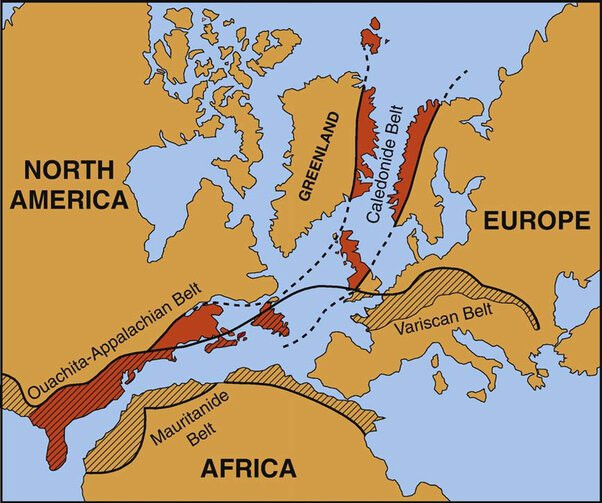
As I recall, the Highlands of Scotland is part of the same mountain range as the Appalachian Mountains, which has a certain irony as many Scot Irish wound up settling in those areas, including my relatives who started out on the Isle of Bute in Scotland.
Recent weird science news: a paper showing that in one species of ant, the queens produce offspring of two different species, with the workers being hybrids of the two.
That’s a striking story. In DID there are reports of state-dependent physiological changes (autonomic, even some immune), but a true disease like type-1 diabetes can’t switch off by personality. What can change is behavior and stress hormones—both affect glucose. If you’ve got a citation for the diabetic/non-diabetic claim, I’d love to read it; otherwise I’d file it under “great anecdote, likely an indirect effect or a retelling.”
I learned “conjugate” in high school, and the way it was identified with a symbol like the standard angle symbol but with a partial circle drawn around the outside (like the purple partial circle in your diagram).
The Caledonides (Scotland to Scandinavia) mountains are a continuation of the Appalachians. The Great Glen fault (including Loch Ness) is the contact zone between the old continent pieces. Parts of Great Britain are underlain by peri-Gondwanan terranes - broken off of South America or Africa, so there’s at least three continents in the mix, not counting smaller continental blocks.