Recently, I came across a pop philosophy video that discussed what is actually you when it comes to your mind. This is said video (warning: it does contain some cursing and other jokes)
The author makes the claim that, since the brain makes a build-up of signal before making a decision, there seems to be some evidence that free will doesn’t exist. However, the same guy that conducted said experiment also found that people could cancel these build-ups. With such overarching consequences, and my little knowledge of neurological philosophy, I was wondering if I could get some help in understanding this subject and whether my decisions are truly mine.
So because your brain goes through processes before you decide, you aren’t really deciding? Sound like really faulty logic to me. Cognitive psychology is a fascinating topic that has a lot of relevance for things like Bible interpretation and doctrines of inspiration (i.e. the construct of inerrancy), but I’ve never heard it linked to free will like this. You probably aren’t going to get a good intro from YouTube influencers. Again, I would encourage you to read books or articles from actual experts if you want to explore ideas or fields of inquiry.
There have been some interesting discussions about the topics of evoutionary psychology and free will (not necessarily connected) in the past here, I’ll try to dig up some threads for you. If you ever want to continue a discussion on a closed thread, message @ moderators and we’ll open it for you. Or you can start a new thread quoting the part you want to discuss and it will automatically link for you.
Questions about free will are linked to questions about consciousness. If you can get hold of the February 2026 issue of Scientific American, the cover story is “Why consciousness is the hardest problem in science” (sorry – it’s probably behind a paywall for most people). There’s also a second article with amazing graphics that compare and contrast all the leading theories about consciousness: “Your guide to 29 wildly different theories of consciousness.” At present, researchers are a long way from any consensus.
On sites such as Scientific American and Popular Mechanics, I’ve seen posts that say we don’t have free will and other posts that say we do have free will. So the science is a bit murky at the moment, perhaps we don’t yet have any real idea how consciousness emerges in our biological brains.
My personal belief is that we’re definitely born with free will. But I can think of a number of neurological, psychiatric, and societal issues that make it harder for human beings to fully exercise their free will. I’m thinking, for instance, of traumatic brain injury, dementias, or heavy use of hallucinogenic drugs. So the question of free will, and how we use it, is probably a multi-layered issue – one that’s highly relevant to religious debates because of its links to morality, good versus evil, and redemption.
I have indirectly treated this isssue in another topic, where I was discussing the logical consequences that would follow an hypothetical discovery of the full material origins of our consciousness.
Yes, they are definitely linked to questions about consciousness and the nature of it, and the materialist view of consciousness is not really compatible with libertarian free will.
I basically agree with your point of free will being a multi-layered issue, and I would say that the fact that traumatic brain injury, dementia, psychosis, intoxication, or severe psychiatric disturbance can drastically impair judgment, agency, and self-control doesn’t by itself prove that consciousness is produced by the brain in an exhaustive sense. What it proves if that our conscious life on this plane of existence is profoundly conditioned by embodiment: in other words, even if one were to hold that consciousness has an irreducible or non-material dimension, it would still make perfect sense to say that the brain is the organ through which consciousness is ordinarily expressed in human life. Damage the organ, and the expression is distorted. That point, by itself, doesn’t settle the deeper metaphysical question, it only shows that conscious agency, as we live it here, is inseparable from the bodily conditions through which it is manifested.
The radio analogy is helpful: If you damage a radio, the music may become distorted or disappear altogether, but it certainly doesn’t follow from that fact alone that the music originates inside the radio’s circuitry.
The damage may tell you a great deal about the instrument through which the signal is received and expressed, without telling you everything about the ultimate source of the signal. Likewise, the fact that brain damage impairs memory, judgment, personality, or deliberation does not logically entail that consciousness is nothing but neural machinery: It may show that the brain is the indispensable vehicle, filter, or interface through which consciousness is embodied, without proving that consciousness is identical with brain activity.
And this is not merely a philosopher’s game, as a number of major brain scientists have said things that point in exactly this direction.
Wilder Penfield, one of the great pioneers of neurosurgery, wrote in The Mystery of the Mind that “the mind seems to act independently of the brain,” and on the same page he added that expecting brain mechanisms alone to perform all the functions of mind is “quite absurd” (The Mystery of the Mind, p. 79). John Eccles, Nobel Prize–winning neurophysiologist, argued in Evolution of the Brain: Creation of the Self that the self-conscious mind is “not just engaged passively in a reading-out operation from neural events,” but has “an actively searching operation” (Evolution of the Brain, p. 213). Those are not ambiguous formulations: both Penfield and Eccles are explicitly resisting the idea that mind can be treated as a mere by-product of neural mechanics.
Mario Beauregard Mario Beauregard - Wikipedia has taken a similarly anti-reductionist line, though in a more explicitly post-materialist framework. In the “Manifesto for a Post-Materialist Science” (see here https://opensciences.org/files/pdfs/Manifesto-for-a-Post-Materialist-Science.pdf )which he helped advance, the thesis is stated in unmistakable terms: “Mind is fundamental in the universe” and “cannot be derived from matter and reduced to anything more basic.” That goes beyond merely saying that consciousness is hard to explain; it’s a direct rejection of the claim that matter is sufficient to account for mind.
If consciousness has an immaterial or irreducible dimension, then it’s perfectly coherent to say that the brain functions as the embodied medium through which consciousness is expressed in this life. In that case, neurological and psychiatric damage can severely compromise the exercise of free will without proving that free will or consciousness are reducible to matter. Actually, I would say that this is exactly what one would expect if the brain were not the ultimate source of consciousness but its ordinary bodily instrument.
I think such impairments makes it harder to exercise rationality.
I do not know why it is important to have free will as the ability to choose to do what you choose not to do; that seems a self contradiction to me. The freedom to do what I want is freedom enough - if the decision makes sense all the better.
It’s important in the sense that the choice has to be truly yours and not the mere end product of a causal chain of material events and causes, otherwise free will is only an illusion. Which is precisely and uncoincidentially what many materialist scientists argue (but at least they are coherent with their paradigm).
Only if “what you want” really comes from your own volition; if it’s wholly predetermined by your genetics, the environment, your upbringing etc it doesn’t really make sense to talk about “free” will in any meaningful sense. You would maintain the illusion of free will and you wouldn’t be coerced, but that’s different, very different, from true freedom, which is impossibile if the materialist paradigm is true.
Sam Harris (neuroscience PhD), Free Will (New York: Free Press, 2012), p. 9: “Free will is an illusion. Our wills are simply not of our own making. Thoughts and intentions emerge from background causes of which we are unaware and over which we exert no conscious control.”
Robert M. Sapolsky (professor of biology, neurology, and neurosurgery at Stanford), Determined: A Science of Life Without Free Will (New York: Penguin Press, 2023), p. 4: “We are nothing more or less than the cumulative biological and environmental luck, over which we had no control, that has brought us to any moment.”
Daniel M. Wegner (Harvard psychologist/cognitive scientist), The Illusion of Conscious Will (Cambridge, MA: MIT Press, 2002), p. 146: “Our sense of being a conscious agent who does things comes at a cost of being technically wrong all the time. The feeling of doing is how it seems, not what it is …”
Same book, p. 342: “All is well because the illusion makes us human.”
I think that they couldn’t be more wrong even if they tried, but they are very coherent with their own paradigm, the materialist one.
I have much more respect for coherence, even when it leads someone wholly into error, than for a muddled inconsistency that happens to preserve a few fragments of truth while also generating serious confusion. At least the former follows its own principles to their logical conclusion, while the latter, by contrast, survives only by refusing to think through what it actually implies.
A materialist, for example, who affirms the wholly material nature of consciousness and then still wants to speak of genuinely free will is trying to retain two positions that sit in deep tension with one another. And likewise, a Christian who thinks that the doctrines of sin, free will, and man’s free response to God could remain intact within a thoroughly materialist framework of the consciousness is just preserving Christian language while hollowing out all of its metaphysical substance.
For my part, I think one of the most overlooked points in this whole discussion is just how radically against nature Christian morality becomes once it is detached from its proper metaphysical foundation.
Within a materialist framework, the human being is ultimately nothing more than a highly complex biological organism, the contingent product of blind forces, driven by survival, self-interest, competition, desire, and the struggle to persist, but Christian morality asks for something profoundly at odds with that picture: the love of enemies, the blessing of those who curse you, the moral primacy of the weak, the dignity of the useless, the sanctity of suffering borne in love, the equal worth of every human being regardless of their “mundane” greatness etc etc etc, I could go on and on for 30 minutes.
That moral vision makes full sense only within a non-materialist metaphysical order, one in which the human person is not reducible to matter, but is made in the image of God and therefore possesses an intrinsic and immeasurable dignity. Only on that basis does it become intelligible why the weak should matter as much as the strong, why the vulnerable should not be discarded, why self-sacrifice should be higher than self-assertion, and why love should stand above domination, instinct, and advantage; remove that framework, and Christian morality begins to look less like truth and more like an astonishingly unnatural demand imposed upon creatures whose underlying reality no longer supports it.
Tha’s why I find it deeply incoherent when someone embraces thoroughgoing materialism and yet still wants to retain a broadly Christian ethic: what is being preserved, in that case, is not a morality that flows naturally from materialist premises, but a moral inheritance that becomes increasingly unintelligible once its metaphysical roots have been cut away.
In other words, Christian morality is not merely somewhat difficult to justify within materialism; in many of its central affirmations, it becomes radically counter-natural within a materialist view of man.
For that reason, I respect the nihilist materialist more than the “mainstream” one (who adopts materialism while at the same time retains a basic Christian morality on many things).
The former is more gravely mistaken, but also immensely more consistent. And I strongly suspect that if more people grasped what materialism really implies (and I have made my case also hereUnderstanding atheist perspective - #407 by 1Cor15.54 ) many fewer would adopt it with the superficial ease with which it is so often embraced today. Because when one looks at one’s own children, spouse, parents, or friends, after having REALLY grasped what materialism actually implies ( without any foolish irenicism standing in the way, an irenicism often embraced by modern Christians who, feeling defeated by the spirit of the age, seem to imagine that continually retreating and conceding ground to the materialist worldview will somehow help them blend in or even evangelize) materialism reveals itself in all its horrific meaninglessness, and its farcical, dehumanizing nature becomes painfully self-evident.
And the rather happy-go-lucky way in which many “modern” Christians seem to approach materialism * (while failing to acknowledge, or even flatly denying, its implications for free will, as well as its moral and metaphysical implications) does not help matters either.
*Not materialists as individuals; I am speaking properly of materialism itself. For while it’s certainly right to love materialists as persons and not condemn them, materialism as a worldview must be opposed, refuted, and rejected as thoroughly as possible. It certainly should not be granted the prominence, plausibility, and cultural authority it enjoys today.
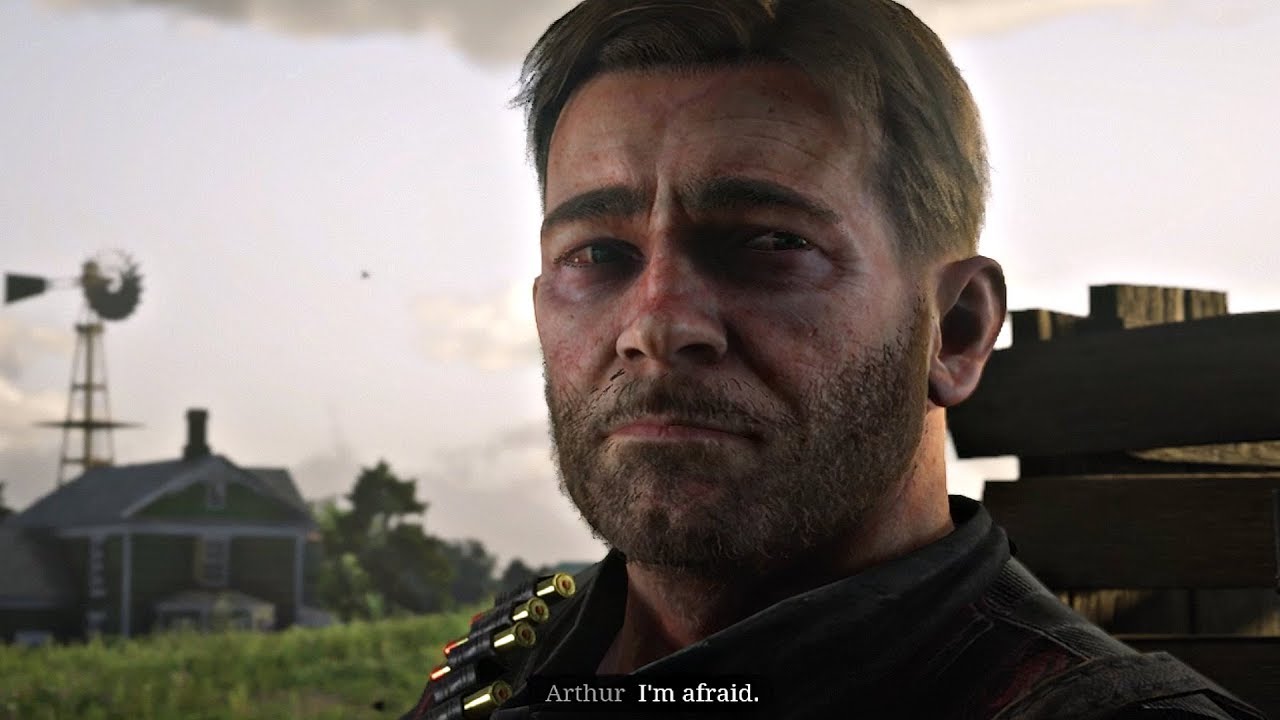
As Sister Calderon said to Arthur Morgan: “take the gamble that love exists, and do a loving act”.
But love is nothing more than a biochemical reaction, a complex neurobiological, psychological, and social phenomenon shaped by evolution and devoid of any intrinsic value, in the materialist framework.
I agree with everything in your post but I feel a need to say something about the freedom involved. I think it isn’t just the damaged who experience less of it. I think we all do at various times for a variety of reasons. Free will is just about not have one’s choice of action constrained, but a busy schedule may rule out a desired outing as can the desire to spend more time with family or a friend. You can say we constrain ourselves in those circumstances and I’d agree. But I think it highlights that we don’t and sometimes can’t just steer our will any old way we want. We are imbedded in many relationships with individuals, groups, the world and the sheer number can be an impediment to doing all we might like.
Let me start by thanking you for the substance you always bring to the conversation. This forum is elevated by that.
Yes, inescapably. But volition does not exist in some separate reality from your make-up, upbringing, and the environment. It is all of a cloth. We are conscious, creative, and deliberate, and all that is integrated into our behavior. That does not necessitate that anything ghostly is involved.
Anti Free Will’ers such as Harris also embrace some idea that free will means going against one’s own thoughts. “Thoughts and intentions emerge from background causes of which we are unaware and over which we exert no conscious control.” Harris here exactly describes where a button is pushed and an output occurs, with the machine no more aware than a rock. That is not us. We are conscious, and unavoidably process the whole shebang.
Same with Sapolsky. “We are nothing more or less than the cumulative biological and environmental luck, over which we had no control, that has brought us to any moment.” What does he think we have been doing our whole lives? Every decision you make today has been preceded by a lifetime of choices, consequences, and development of values. That is not enslavement to sheer luck over which a person had zero input.
So I subscribe to neither the classical definition of free will, nor some idea of helpless determinism. I suppose that makes me a compatibilist, to throw a label at it. Our choices may not escape what made us who we are, but we certainly participate in it all. Free will is not a fundamental question anyways, it is entirely contingent on one’s position on the nature of consciousness.
Thank you so much. I really really appreciate this.
The problem is that if free will is to be preserved in any meaningful way, it requires more than the mere experience of choosing: it requires that the act of will not be wholly fixed in advance by prior causes. If my volition is entirely determined by my make-up, upbringing, environment, and prior brain states, then what I call a “choice” is really just the final link in a causal chain whose decisive conditions were already in place before I became aware of deciding. In that case, I may still feel that I’m choosing, but I’m not, in any meaningful and proper sense, the true originator of my act. And that’s precisely why some form of non-determinative agency is necessary if free will is to be preserved.
The point is whether one is the true originator of one’s thoughts, intentions, and acts of will in a sufficiently deep sense. Harris may well overstate his case at times, but the basic problem he’s pointing to doesn’t disappear simply by saying that we are conscious and that we process everything as a unified whole. Conscious awareness, by itself, doesn’t yet establish freedom.
A machine-like example is insufficient, because human beings are conscious, reflective, imaginative, and capable of deliberation, but that still leaves the decisive question untouched: does deliberation amount to genuine self-determination, or is it itself just part of the unfolding of prior causes? To say that we consciously process “the whole shebang” * is not yet to show that the outcome is not already fixed by our constitution, history, desires, habits, and prior brain states, it only shows that the process is richer than a button being pushed. Richer, yes. But not therefore free in the robust sense.
But Sapolsky’s claim is that even the choices through which we have formed ourselves were themselves made by a person whose character, dispositions, capacities, and circumstances were already shaped by factors he did not ultimately choose. In other words, the problem is not whether our present character reflects past choices; the problem is whether we were ever the ultimate source of the chooser in the first place.
That’s why the appeal to a lifetime of choices doesn’t, by itself, rescue strong free will. Yes, I’m in part the product of my earlier decisions, but those earlier decisions were made by someone with a given temperament, given drives, given formative influences, and a given range of options and limitations. So the question simply reappears one step back: where did that earlier self get the character and motivational structure from which it chose? And if one answers by pointing to still earlier choices, the same issue arises again, unless one eventually reaches some point at which the agent is not merely acting out the net effect of antecedent causes, the regress never really secures ultimate self-determination.
The inescapable problem is that compatibilism only preserves the language of freedom, for it tells us that an act is “free” if it flows from our own desires and character rather than from external coercion, but if those desires and that character are themselves wholly determined by prior causes we didn’t choose, then the act may be voluntary, yet not truly self-determining. In that case, compatibilism saves the semantics of freedom, while surrendering its metaphysical reality.
And that’s a real problem.
Well it depends, if one is a Christian it’s certainly a fundamental question.
*Never heard that word before. The first thing that came to my mind was Ricky Martin’s song.
Well, let’s say I’m at an ice cream shop, because where are you faced with more choices than 50 flavors? I may hem and haw, but eventually settle on chocolate. If I did not choose based on constitution, history, desires, habits, and prior brain states, then what was the basis? Maybe I wanted to demonstrate to myself that I had free will by deliberately picking a flavor I did not really want, but all that has happened is one existential desire to prove a point overrode another desire. Or the desire to try something new. Or the desire to be social and go along with someone else’s suggestion. In the moment, you will do what you most want, and how would what you want be free of all those antecedents?
Put another way, what would exercising strong Free Will even look like in the parlour? How is it done? Picture that I want to make a Free Will selection, freer than anybody has ever seen before. Like a Himalayan monk, I strip away all earthly desire for chocolate. I man up and ignore my partner’s suggestions. I am impervious to the sights and smells before me. Unencumbered by external influences and prior states, I am now ready to exercise pure Free Will. Now what??
True, the objective is not to rescue strong free will, only to establish that we are not haplessly passive bystanders in our own lives. I do not understand how creativity happens, but people construct a whole world of human creations which would not exist otherwise, and part of those creations are personal learning, ability, and character themselves. This is emergent, and there is much in nature that is emergent without being divorced from antecedent.
I mean in respect to the more basic question of consciousness itself. Whether one holds that consciousness emerges from electrochemical process in the brain, or the brain is a transducer for an immaterial mind, and such conceptions of mind, will constrain the operation of Free Will.
I think my sort of fear is that, in my mind, taking any sort of stance in this based on my faith makes me following my beliefs and not the evidence. I don’t know what the exact story is behind the current debate but, with my strange brain, K usually assume the worst, with that being complete lack of free will. Obviously this is a very scary thought to ponder, so I hope to find evidence against it. However, then this loop makes me think that in looking for the evidence I want and not the evidence actually there. I have no idea why my reasoning works like this but if you got any advice I’m all ears (because listening to myself usually doesn’t turn out well, as you can see in why this thread was started in the first place).
The experiments certainly show that it is more complicated than we might have thought but they do not settle the issue of free will. Actually I think the biggest problem with free will is not scientific but philosophical – i.e. what is does free will mean and how to reconcile the conflict between will and it being free. To be will, we must be the cause, but if it is caused, then how is it free?
I think the critical scientific issue is that the laws of nature are a causally open system because of quantum physics and chaotic dynamics – in other words events are not determined by any measurable pre-existing conditions. I think one of the biggest classical theological errors is in thinking the problem can be solved by making the cause of actions some nonphysical source.
As for me, I am an incompatibilist libertarian and open theist. Why incompatiblist libertarian? Frankly it is Kierkegaard’s criticism of philosophy which is divorced from basic human experience and the basic problems of human existence, where the fact of human choices is inescapable. Why open theist (a fixed future does not exist)? Because that is what I see in the basic realities of quantum physics where things exist in superpositions – i.e. the multiple futures are right there in measurable physical realities.
So how to deal with the philosophical problem? I think it requires rejecting the limitation to time-ordered causality. In other words, the cause of our actions are found in what we become because of our choices rather than just in what we were before choices are made. It can be observed that science pretty much restricts itself to time-ordered causality and the existence of free will only means that there will be gaps in the determination of events by previous condition, which is exactly what we see.
Yes. How we define free will is crucial in these discussions.
We do not have completely free will. That is selfevident: we cannot jump to the Moon or to the other side of the Earth whenever we want. Some may think this is not relevant but it is in the sense that our physical limitations are just an example of the limitations to our decisions. We can only select from those options that are currently possible and available for us.
If I want to buy cereals in a shop, my choice is limited to the alternatives that I can find from the shop.
If I want to order a particular food in a restaurant and they say that they do not currently have the ingredients for it, I have to select something else.
If I want to marry a woman and she is not willing to marry me, in my society that would prevent me from getting her. In another type of society, I could perhaps get her by asking her father to sell her to me, so the alternatives depend on the type of culture and society where I live (with this example, I do not say that it would be morally correct to force a woman against her will).
The number of alternatives we have at a moment are always limited. The alternatives we have are dependent on our previous choices. Free will could be compared to following a path. We meet forks on our way and we can select from the alternatives at that spot, not something that is not there.
That is also a way how God could affect our choices without taking away free will. If God acts so that one alternative is not anymore available for us, we need to select from those alternatives that are left.
Yes, of course. My main concern was stay as far away as possible from the idea that free will is a force that can be separated from all other aspects of being human. How often do we hear that if so-and-so tried harder and used their free will better, they wouldn’t be in such a pickle?
Human beings are constrained not only by circumstances beyond their control, as you point out, but by the limits of their own biology. The human brain can’t produce a harvest of infinite of free will fruit if the very roots of their brain’s functioning are damaged by scientific factors such as head injury, etc. What’s the point in blaming a dementia patient for failing to understand the consequences of their poor choices? Or refusing to help a person with an addiction disorder because their biological brain is caught (hopefully temporarily) in a destructive cycle? Shouldn’t we be using our knowledge of healing and hope to help lift up those who not only can’t change their external circumstances but have also lost the ability to change their internal circumstances?
Sometimes the only set of circumstances to which we can apply our free will is our own inner kingdom – our thoughts and feelings, our emotional choices towards others, and our emotional choices towards God and ourselves. But even this application of free will can be lost to us if our biological brain becomes too seriously imbalanced. Unfortunately, the differential diagnosis (the list of medical possibilities that could account for symptoms of imbalance) is very long, very complex, and very much in need of ongoing research and improved treatment plans to help people recover a sense of agency in their own lives.
For some individuals, the medical science is never going to be able to promise them a restored sense of agency. In these cases, it falls to others in society (those who can apply their free will to compassion, empathy, service, and personal responsibility) to fill in the gaps for those who can’t contribute fully to their own well being.
I guess it’s fair to say I think of human free will as a sort of communal well, where we can all contribute a small measure of independent choice that somehow adds up to a much larger pool of compassion. Of course, it could go the other way – where large groups of people combine their hatred and contempt to create a toxic cesspool of mob obedience. But I prefer to think on the positive side.