That’s a point I can’t deny. I have seen it with my own eyes. I might as well ask … which historians and which philosophers?
Hm…Klax? Darkness.
1 Like
And then in your next ten or twenty years (if you get yourself outside the social media bubble of fundamentalists) you’ll come to see the enculturated blindness of that approach. Many people around here emerged from that and aren’t looking back.
2 Likes
Great point. Example: I think I understand the YEC perspective, but I still find it willfully ignorant and borderline blasphemous.
So their ignorance is still willful, they just switched polarity.
I’m not convinced the second part is true, though; I think they just haven’t ever really understood what a worldview is and what one they hold and how others could be different. A good example is the idea that gods would dwell on high mountains: to the ANE that was obvious, and asking why they thought that would have gotten blank stares, yet today the idea seems ridiculous given that people have climbed so many and they’ve all been photographed and we know that taller ones are more desolate, so someone with a MSWV asks why anyone at all would want to dwell in such a dead and desolate place.
3 Likes
That’s like saying that because you found the brush used for a painting then there was no painter.
This is because the only evidence they are willing to accept or things they are willing to accept as evidence is those provided by scientific materialism. If you go to the beach with a metal detector, you should not be surprised that it doesn’t find bones buried in the sand. It would be an egregious error to conclude no bones exist in the sand though because you are using a tool not suited to find them. This is being duped by modernity or scientism. Stockholm syndrome induced by philosophical naturalism. The cosmological argument (hierarchical) tells us every material object and process in the universe is dependent upon God at every instant. Nothing exists outside God’s sustaining will. Thus, the regularity we see in nature, your existence, the keyboard I’m typing this on, every scientific discovery, every material object with an actualized potential, the stars in the sky and even the toilet paper in my bathroom all attest to God’s existence at every instant. The evidence for God’s existence is so overwhelming and obvious, we miss it or take it for granted.
Another angle of the problem is one of theistic personalism (modern) vs classical theism. The theistic personalist plays the atheists game and treats God like a coin in the sand. An object out there, one amongst many, to be discovered. Once you play this game you have assumed atheism is true and lost the debate. The classical theists understands God is being itself and the reason the sand, coin and metal detector works and why any of it exists in the first place. Both the naturalist and the theistic personalist are casting a net with large hole spacings and wondering why there is no evidence for fish smaller than the ones they catch. Cakes don’t bake themselves.
Vinnie
I’d assert it’s true among militant atheists who want to argue online. My evidence is merely anecdotal, but it reaches back to bulletin boards before the creation of social media. Don’t remember ever seeing a study on the subject, though.
I’m not a fan of the “worldview” perspective. So what if an atheist hasn’t been exposed to Christian apologetics? Everyone has a lens through which they view the world, whether they realize it or not. The militant atheist’s opposition to Christianity can be driven by many motivations, but it’s rarely the fact they don’t understand how others could think differently. Feels to me like you’re forcing a complicated reality into a ready-made framework.
In my real-world experience, all my best friends are atheists, and they could care less what Christians believe in everyday life. The only time it’s a subject of conversation is when MAGA evangelicals try to turn their personal beliefs into national policy, a la Christian Nationalism.
1 Like
That’s the mantra of people who love and push the term “worldview”. Christian school curricula love to major in the concept - the (usually explicitly) stated goal being to make sure that the students are being taught a (or almost always: “the”) biblical worldview.
And they are correct - that everyone has a “worldview”. Anthropologists and sociologists have equivalent terms for the same sorts of things I believe. But yeah - if you come visit a Christian school teacher conference, don’t forget to bring your ‘worldviews’ bingo card!
1 Like
It wouldn’t all be so nearly obnoxious if this particular (U.S. centered) group of Christians weren’t so married to the notion that they are God’s stewards of the only true world view and that everyone else that isn’t similarly committed to it and all the indispensable cultural baggage that is deemed essential to it, must either be on board or else be seen as a mission project… if it weren’t for all that, the concept actually has much to commend it!
2 Likes
J. Richard Middleton told me he’s rewriting his first book from 1984, The Transforming Vision: Shaping a Christian Worldview, to “rehabilitate” the concept of worldview in our current context. No idea how much progress he might have made so far.
1 Like
The paintbrush doesn’t require a painter. A paintbrush hanging by a thread from a branch just touching the canvas can produce the Mona Lisa given the right wind conditions. 
The saying ‘everyone has a lens through which they view the world’ is rewording the ‘worldview’ concept. Sometimes rewording is needed. The concept ‘worldview’ does not have a generally accepted accurate definition, so people use it in different meanings. Some are twisting the word in ways that make it a shield against claims they do not want to face.
Worldview can be a useful concept if you define and use it properly. Many avoid the word because the word may have unwanted mental baggage attached. Yet, those who want to abandon the word (worldview), try to invent and use other words that have overlapping meanings. For example in sociology, the term ‘social imaginary’ is a concept that partly overlaps with ‘worldview’ but sounds more neutral.
If someone really wants to understand what the concept means, I recommend the book ‘Naming the elephant. Worldview as a concept.’ by James W. Sire. It is <200 pages and easy to understand, which makes it reader-friendlier than the thick academic books about the topic.
1 Like
But that is not the right analogy.
Before we get the Mona Lisa, first you need simple cave painting. Then, over millions of years the methodology of painting evolves until the Mona Lisa is possible.

Richard
Evolution isn’t teleological. You seem to be saying that the Mona Lisa is our end goal. Over millions of years evolution could take is in any direction whatsoever. My analogy doesn’t make this erroneous assumption.

Teleology is a philosophical question, not a scientific one.
The majority of “Christian apologetics” I’ve encountered in the last couple of decades just feeds the fundamentalist viewpoint held by YEC and many atheists.
So they’re deliberately lying and they think that’s fine?
MAGA evangelicals have the same worldview as most atheists, a MSWV – they have no clue that there could be anything different.
Except it is rare to find “Christian school” curricula that has a biblical world view. I haven’t encountered more than four versions, and every one of them rested on a MSWV. As with YECers we’ve had here, they use the word but haven’t actually examined what it means.
How does he define “truth”? Does he make it clear that the biblical worldview does not define it as that which is historically and scientifically correct?
The “Mona Lisa” only has meaning as “The Mona Lisa”
because an external, immaterial mind imposes it on this artifact. Without that you would have random lines, shapes and colors devoid of meaning.
Vinnie
Sometimes polemicists lie or exaggerate, yes. Other times they’re speaking about a subject (biblical interpretation) that they know next to nothing about so they just frame it in the worst possible way. We’re talking about perpetually online argumentative atheists, not your run-of-the-mill atheist who doesn’t care that much about religion.
I haven’t read the book, and keep in mind that it was written in 1984. But here’s the TOC and original foreword, if it helps:
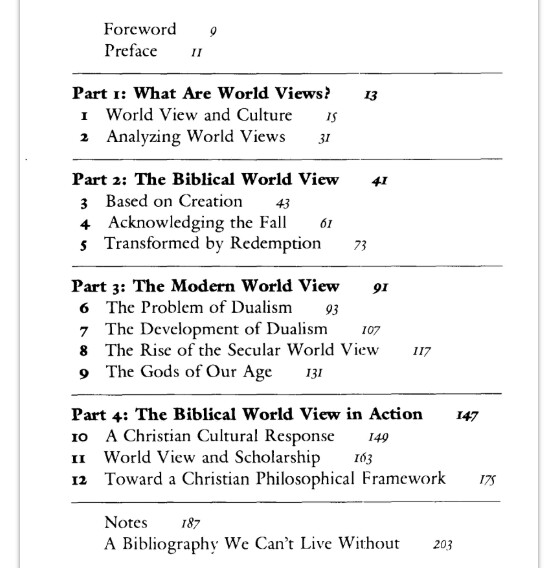
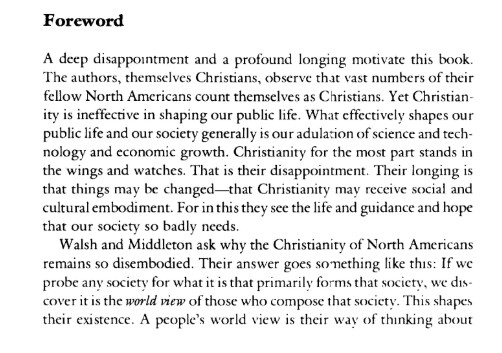
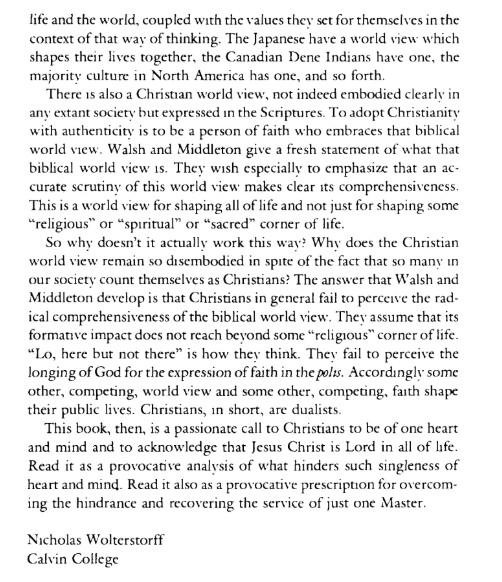
2 Likes