Which is how the majority will always think: beyond mere religion, in politics.
I see that in your post, you have put together a “diagnostic tool” to assess whether or not a person (me in this case) holds to a modern view of truth, which you hold is not a legitimate view when dealing with the initial chapters of Genesis.
So to answer your first question, the biblical wrote using their own personalities, language and grammar, and in doing so, conveyed precisely what God wanted to communicate. Yes, God can do that without dictating to the authors the precise words to write.
The Biblical text says,
“Then the men were seized by a great fear and said to him, “What have you done?” The men knew he was fleeing from the Lord’s presence because he had told them. 11 So they said to him, “What should we do to you so that the sea will calm down for us?” For the sea was getting worse and worse.
12 He (Jonah) answered them, “Pick me up and throw me into the sea so that it will calm down for you, for I know that I’m to blame for this great storm that is against you.”
So yes, according to the text, Jonah expected that being thrown overboard would calm the storm.
The answer to the second and third questions is also “yes,” because that is what the text plainly says.
So now you have your answer. Your diagnostic tool then tells you that with the answers I have given, it shows that I have a modern view of truth that is contrary to the way the readers to which this text was written would understand it. Interesting. Hmm. Your diagnosis is designed to give the answer it was designed to give.
Now, let me ask you. Are Genesis chapters 1-3 literal history? You will answer “no.” That is not how the original readers would have understood it.
You would consider that to see Genesis 1-3 as literal history would be a modern way of reading them. Well, consider this:
“Several Hebrew scholars and academic experts have affirmed that the author(s) of Genesis 1–3 intended the narrative to be understood as historical, not merely figurative or allegorical. James Barr, a respected Hebrew scholar and former professor of Old Testament at Oxford, stated in a 1984 letter that, as a Hebrew scholar, he believes there is no professor of Hebrew or Old Testament at any world-class university who does not believe the writer(s) of Genesis intended the account to be taken as historical. Similarly, Professor Emanuel Tov, a leading expert in Hebrew Bible textual studies, affirmed that for the biblical people, the creation narrative was understood as history, even if it is difficult for modern readers to accept this view. Peter Williams, the current warden of Tyndale House, a renowned theological research library near Cambridge, has stated that the position—that the author of Genesis 1–2 meant to convey a literal six-day creation—is nearly universally held among scholars who do not have a religious requirement to interpret the text otherwise. These scholars emphasize that the narrative structure, including the use of historical markers like “the generations of,” and the presence of direct speech from divine and human figures (e.g., God in Genesis 1:27, Adam in Genesis 2:23), supports its classification as ancient historical narrative rather than purely poetic or mythical?”
So what do Hebrew scholars have to say about Jonah as an historical account:
“The question of whether Hebrew scholars believe the original readers of the Book of Jonah considered its events as real history involves a range of scholarly perspectives, with significant divergence between traditional and modern academic views.
“Traditional Jewish interpretation, as reflected in the Hebrew Bible and early rabbinic literature, treats Jonah as a historical figure. The prophet Jonah is mentioned in 2 Kings 14:25 as a real individual who prophesied during the reign of Jeroboam II, and his hometown, Gath-hepher, is specified. This reference supports the idea that the original readers of the biblical text may have viewed Jonah as a historical person. Furthermore, the Book of Jonah is read annually in Jewish tradition during the afternoon of Yom Kippur, a practice that underscores its significance as a serious religious text rather than a mere allegory.
“However, mainstream modern biblical scholarship generally regards the Book of Jonah as a literary work composed long after the events it describes, likely during the post-exilic period or even the Hellenistic era (332–167 BC), due to its use of Aramaic vocabulary and motifs. Many scholars consider the book to be fictional, possibly satirical or parabolic in nature, rather than a historical account. For example, some argue that the story’s narrative structure, use of irony, and theological themes suggest it was intended as a literary or didactic work rather than a factual report. The fact that the book contains no specific historical markers such as names of kings or precise dates beyond the reference to Jeroboam II has led some to question its historical reliability.
“Despite this, the book’s internal consistency with ancient Near Eastern literary forms and its detailed depiction of Assyrian culture—particularly the city of Nineveh—have led some scholars, such as Donald J. Wiseman, to argue that the story reflects an accurate historical understanding of Assyria and thus may be based on real events. Wiseman contends that the details in the book are consistent with eighth-century BCE history, suggesting that the author had access to reliable historical knowledge.
“Jesus’ references to Jonah in the Gospels—particularly in Matthew 12:38–41 and Luke 11:29–32—have also been interpreted as affirming the historicity of the events, as he refers to Jonah’s time in the fish and the repentance of Nineveh as real historical occurrences. This has been used by some scholars and theologians to argue that the original readers of the biblical text likely viewed the story as factual.
“In summary, while traditional Jewish and early Christian views, supported by references in 2 Kings and the teachings of Jesus, suggest that the original readers may have considered the events of Jonah as real history , modern academic scholarship often interprets the book as a later literary composition with possible satirical or allegorical intent, reflecting theological rather than historical concerns. Thus, the belief among Hebrew scholars varies: traditional interpretations affirm historicity, while many contemporary scholars view the book as a fictional or symbolic narrative.”
So the issue is up for debate, generally between more conservative and more liberal scholars.
So what is the Hebrew view of truth versus the modern view of truth?
The ancient Hebrew view of truth differs significantly from the modern Western view of truth, particularly in its foundational understanding. In ancient Hebrew thought, truth is primarily understood as a property of being or character, especially of God, rather than as a correspondence between statements and facts. The Hebrew word emet (אֱמֶת), often translated as “truth,” conveys qualities such as faithfulness, reliability, firmness, and steadfastness, emphasizing moral and relational integrity. This view positions truth not as an abstract idea but as a lived reality rooted in the character of God, who is described as “faithful” and “without deceit” (Deuteronomy 32:4). Thus, truth is first about who is true—God—and then about how humans, by imitating God’s character, live truthfully in their actions and relationships.
In contrast, the modern Western view of truth, heavily influenced by ancient Greek philosophy—particularly Plato and Aristotle—tends to prioritize the correspondence theory, where truth is defined as a statement aligning with objective reality or fact. This intellectual tradition values abstraction, logical consistency, and impersonal rationality, often separating truth from personal or divine context. As Alfred North Whitehead noted, Western philosophy is largely a series of footnotes to Plato, reflecting this enduring Greek legacy.
Moreover, the Hebrew worldview emphasizes dynamic, concrete, and relational experiences of truth, shaped by divine encounter, covenant, and moral commitment, rather than detached intellectual contemplation. The Hebrew Bible portrays truth as something to be lived, not merely contemplated. This contrasts with modern secular perspectives that often treat truth as a cognitive or propositional matter, focused on verification and evidence rather than character or divine revelation.
While modern thought may incorporate elements of both traditions, the ancient Hebrew view retains a distinctive emphasis on truth as relational, ethical, and rooted in the person of God, which continues to influence religious and philosophical discourse today.
In conclusion, I learned quite a bit in researching this with help from my friends, which includes that my view about truth is a bit eclectic. I firmly believe that truth is grounded in the very character of God, which is also completely comparable with the idea that truth is that which corresponds to reality.
So we do not agree on the historicity of Genesis 1-3 and the book of Jonah. But it is not as simple as saying that to believe in their historicity means a person is using a modern and illegitimate definition of truth when looking at ancient documents.
I am sorry to see you using a straw man argument. Who would say that? No one.
I basically agree with what you have stated. But the statements in Job are in agreement with our current scientific understandings and have sometime led to important scientific discoveries. For example:
“Matthew Fontaine Maury was inspired by the phrase “the paths of the seas” in Psalm 8:8, which states: " whatsoever passeth through the paths of the seas."  According to multiple accounts, Maury—a devout Christian—was struck by this verse while reading the Bible, reportedly during a period of illness. He interpreted it as a divine indication that ocean currents existed as fixed “paths,” much like rivers. This insight motivated him to study thousands of ship logs and chart the world’s ocean currents and wind patterns, leading to revolutionary advancements in navigation. His work confirmed the existence of systematic oceanic and atmospheric circulation, such as the Gulf Stream, and earned him the title “Pathfinder of the Seas.” A monument in Virginia even cites Psalm 8:8 and Ecclesiastes 1:6 as his inspiration.”
If you want a poetic account of creation, read Psalm 104. Then read Genesis 1 and find another account written as historical narrative. The difference is clear.
As to your last paragraph, the evolutionist often interprets evidence through their evolutionary lens without examining contrary positions–a common affliction to all.
Randy, was it you that was asking for the source of a William Lane Craig quote–
” . . . William Lane Craig said something like this: . . .”
Here is the source: “The statement by William Lane Craig expressing concern that young-earth creationism might be true was made during an interview with Sean McDowell, published on September 26, 2021, titled “Is Adam Historical?” This interview was part of the promotion for Craig’s book In Quest of the Historical Adam. In it, Craig described his “great fear” that young-earth creationists are correct in their literal interpretation of Genesis, as this would create a perceived conflict with modern science, history, and linguistics.”
I searched for this answer, so I asked my AI “friend” Leo who quickly answered my question.
1 Like
Thank you, Mr Ewoldt. I have to laugh that AI is better than Google. I am curious what you think about that comment. I did like the Four Views on the Historical Adam–we have some discussions about it. I have a tough time with interpretation, sometimes.
I guess I have to keep falling back on believing that God knows our hearts, and that it’s hard to know the answer; that He is just, and more –that He’s a Father.
Thanks.
1 Like
Randy,
Whoa, such a quick response. You must have already been on the forum or reading email.
Yes, we should be careful in our use of AI, but it is clearly a good way to search for specific information such as this.
I guess the part of his comment that strikes me most is the one above, about creating a perceived conflict. First, I find it interesting that he called it a “perceived” conflict rather than an actual conflict. I don’t know what to make of that, because if he doesn’t see YEC in actual conflict with modern science, history, and linguistics, why wouldn’t he just accept that the conflict is only perceived, and accept Genesis 1-11 as an historical account? Then he could have written a book on how there is no actual conflict between the Genesis historical creation account, and dispensed with researching all four views. Well, I guess there would still be four views, and I found his interviews on his book to be interesting and informative.
As YEC, I would agree that there is a perceived conflict, but would further assert that there is no actual conflict.
I appreciate your comment. It is good to hold our positions with humility, believing that God is more concerned about our heart than our correct interpretation or theology. I am certain I am wrong or ill informed about many issues, but I look forward to a cordial conversation with Jesus about all of that. Maybe we will both laugh enthusiastically as under the tutelage of Jesus the light dawns in my mind: “Wow, why didn’t I see that; it seems so clear now that you explain it.” Maybe we can go and ask some questions together. I am sure that his calendar will be clear, and we can drop in without an appointment.
Thanks for a link on the BioLogos forum on WLC’s book.
1 Like
Which makes it of dubious value as we were only just discovering the kinds of literature that fit much of Genesis. Any commentary on Genesis that does not take the new discoveries into account is useless.
When you know that (1)ancient writers had no such thing as “historical narrative” and (2) Genesis 1 matches two different ancient literary types, you’ll know it isn’t historical narrative.
1 Like
Some AI is. Some can use Google, Bing, and other engines simultaneously while searching multiple encyclopedias online at the same time. Some are even self-correcting: ChatGPT5.2 yesterday caught itself using wrong o=information and corrected itself in the middle of a statement (which blew me away!). [I should ask it about that.]
1 Like
Thanks. I enjoy this passage. I think that Jesus’ calendar will be clear! And I agree–the fact that some things are not clear to us, may also indicate that they are not the things God is most concerned about.
I found another interesting discussion here
1 Like
First of all. As a previously non believer in God, due to absence of evidence, I was almost suckered to believe the Quran had “Scientific” descriptions written up 14000 years ago.
Once I investigated all the claims made by these Muslim scholars against the Bible about science, and their glorification of the Quran, I found that Genesis was the source of the Nebular theory as postulated by Emmanuel Kant in 1755.
When I investigated the Quran on the other hand, I found it failed miserably in any scientific descriptions. It says the Earth was created before the Universe, the Sun orbits the Earth in conjunction with the Moon. The Sun sets in a murky spring on Earth, the Sun ducked and dived the sleepers of Ephesus to prevent shining on them, shade has nothing to do with the Sun in relation to an object, but prostrates to Allah, and He could even make shadows stationary. Allah thinks Sail ships are living animals, and thinks the gender of a baby is determined just before birth.
Anyhow, Once I found that the Nebular Theory originated from Genesis, I looked for other scientific descriptions in the Bible, and found plenty. As a matter of fact, I am of opinion that the reason why the Western World advanced Modern science and the Scientific method, was due to the mass printing and Translations of the Bible that ended up in the hands the normal people, away from the Church that dominated the possession of the Bible.
Nowadays I indulge in publications of Creationists, such as James Tour who destroys Evolution with detailed scientific facts, and I am of opinion, due to my research, that the Creationists are far more superior in their holistic knowledge of science than the Atheist who believes in Evolution and has no answer to the Origins of the Universe and Life.
That for a laer discussion.
I had my own concerns about the reason why “a loving and All Powerful” God would create humans to age, get sick, and die.
I shared my opinion with Richard Dawkins that such a god must be discarded by all means as a Narcissist bloodthirsty Killer.
That was until I understood Genesis about who this YHWH is.
First of all, YHWH did not create Adam and Eve to die, but they were created immortal beings. The reason is that He said, if they were to eat from the Tree of Knowledge, they will then die.
This was what happened.
We think of Adam and Eve as Humans that looked like us. Well, this is so far from the Biblical description, that I laughed at myself for having the same thought.
- God Created Adam and Eve as Immortal Beings.
- Being the Immage of God, they also were clothed in Light as He is described by Moses when God appeared to Moses at Mount Horeb. Wherever YHWH appeared to Humans, He was clothed in Light.
- They never went hungry. Everything was provided to Adam and Eve to live without need. They walked with God, a Life givin Spirit. The Earth was totally different than what we see today.
- There was no corruption or death before the fall of Adam. Not only were they immortal beings like God, but all animals and Plants were immortal too. They were in another form of matter, just as Adam and Eve had bodies composed of light, the Earth, Plants and Animals, even the Universe was different than what we see today. They did not have to eat, cloth, work, etc.
- Once Adam and Eve disobeyed God, due to Satans’ deception, everything changed to the extend that God had to call out to Adam to prevent destroying him. No Corruption can be in the Face of God, it will simply be destroyed in His presence.
- God made clothes from animal skin and covered the corrupted bodies of Adam and Eve. This is the only way that Man can appear in front of God, covered by sacrificial blood. This was how Hod could live with Israel. The Priests had to practice perpetual sacrifices to cover the Corrupted human bodies with blood.
- This is the reason why God’s Word, or as we know it, Mind, became flesh and lived with us on Earth. So He could be sacrificed and His Blood could atone, or Cover our corrupt nature.
- Satan managed to change the creation of God, and by corrupting the Human nature, he managed to remove humans from God’s presence.
- Final thought. WE are all living dead! Zombie so to say. From the Day we were born, to the day we die, we age, and have billions of dead cells in our bodies. Living rotten carcasses.
This is not how God created us. This was how Satan managed to destroy Gods’ creation that was made to exist in His presence.
What I learned was that Satan hates Humans so much, that he will do everything to ket them destroyed.
Just my observation of Genesis.
For What it is worth anyhow.
Then you’ve avoided being suckered by one set of religious claims only to be suckered by another set.
Kant’s nebular theory is not sourced in Genesis. Kant doesn’t even mention Genesis in his original publication.
So does Genesis. Earth day 1, sun moon and stars day 4
James Tour doesn’t talk about evolution, but about abiogenesis.
Oh joy.
Now why on Earth would you make such a claim. You dont even know what I found in Genesis that made me change my mind about the existence of God.
And note your error, I am not suckered into any religion, I simply discovered that the Bible describes the Nebular theory in full detail.
I dont believe in any Church or whatever, I simply saw the Bible is the source of the Western Civilizations’ advancement to the Scientific Method.
I am in posession of all Kants; works, I advise that you read the History of the Heavens and see how Kant praises the God of the Bible on the description of the Origins of the Universe.
It is soo easy to coppy and paste a link, but it takes time to critisize with referencing the contents of a writing.
Wrong.
It says the Heavens and the Earth was created in the Beginning.
Look at the nice scientific description about these few words.
- There are plural Heavens, “Galaxies/ /Universes”, but one Earth.
It was created in the Beginning.
- There was no light yet, therefore the Sun was taking shape as it collected matter from the Nebular Cloud where the Solar System would form from.
- The Earth was also collecting matter as it changed into a proto planet.
- The Earth eventually collected enough matter, and bu conservation of energy, It also turned around it’s axis as it grew larger.
- The God of Genesis then says that the Earth was a collection of Gas, Liquid and solids, and there was no light on the Earth at that time.
- The Description,… the Spirit of God hovered above the waters of the deep and the Earth was dark without form describes the state of the Earth that collected Ice and Space dust that collected into a sphere.
- Then Genesis says that God said…Let there be light, and it was evening and morning, the first day!
Now, lets take time and look at this statement. First of all, the Bible is correct in its sequence to say it was Evening, followed by Morning because there was no light before God said, let there be Light.
-
Therefore, before the Sun started to shine, the Solar System was dark!
-
and most importantly, there was no Time before the First Day, in the Biblical description. If scientists say the Universe is billions of years old, and the Bible says the Universe was created before Solar System Time existed, I dont find any contradiction at all.
- Then the Author of Genesis says, there there be a firmament to divide waters from above and below the firmament, and God called this firmament, heaven.
Now lets look at this scientific description. This one had me for a while until I understood the 3rd day where land and sea formed as they separated from each other.
I realized that if Land and Sea separated on the 3rd day, it must have been a mixed collection of solids and liquids at the morning of the 3rd day! So to say, Mud Ball Earth!
- The word Firmament in the Hebrew sense is describing this firm surface that appeared on the Earth for the first time.
- Remember that before the 1st day the Earth had no shape, and was a dark liquid entity. Now it was turning on its axis with light shining on it, resulting in the first day.
- This means that on the second Day, the Earth formed its surface, and still had a lot of Water below this icey mud surface, and water above this firmament surface.
- What also impressed me was that the surface was called “Heaven”. Just think about this fact. The Heaven starts on the surface of the Earth and extends into space .The solid Earth starts on the surface of the Earth towards the deep. This is a very scientific description I never thought about.
- Day 2 describes the percolation of gasses that escaped the interior of this Mud Ball Earth that still had its gasses contained within its interior.
- Not only does day 1 to 3 describe the gravitational field of the Earth growing stronger as the Earth became denser, it is also correct to have known that Gasses will escape first, then water and land will separate!!!
- How the heck did the Author of Genesis knew this?
- Nice, now we arrive at day 3
- Land and sea appeared on day 3. Again, I realized that of land and sea separated, it was a collection of mud to have turned into land and sea!!
- This lends to the thought that day 2 was a collection of Gas, Loqid, and Solids, and the Earth released it gasses first, changed into a Mud Ball Earth with a surface and an atmosphere, that developed into Land and Sea.
- Lets now turn to day 4. The “Sun, Moon and Stars shined on the Earth.
-
The Author of Genesis makes the following statements. He said let the Lights shine on the firmament of Heaven. Remember now that the Firmament of Heaven is that surface of Earth of day 2. So, for the first time now the Sun and Moon shined on the Earth, and for the first time, “Time” was measurable in “Times, Days, Seasons, and Years.”.
-
Now what confused me was that the translation I used also said that God created the Sun, moon and Stars to give light on the Earth. However, the word “made” is not in the Hebrew. Therefore, the verse reads that the Sun, Moon and Stars shined on the Earth for the very first time.
Wow, lets see what happened here!
- The Stars that is mentioned in Genesis is the Planets of the Solar System.
- The Moon and the “Stars” started to shine on the Earth for the very first time in Creation, and “Time” came into existance!
Lets recollect what this means!
- If Genesis describes the development of the Earth as a collection of spoace dust and Ice including Gasses, the same would be true for the Sun and other planets.
- This Light of Day 1 was the kickstart of Nuclear fusion, and the Sun shined very faint at the Beginning of Day 1,
- At the 4th day, the Sun bursted into full nuclear reaction, and cleared the inner Solar System from all its residuce space dust, and reflected light for the first time from the Moon and Planets. Furthermore, the other stars in the Universe was now visible when the solar system cleared the night skies.
This was the description from Kant, and the choice is yours.
If Kant did not observe this description from Genesis…Do you then agree that I am the first to have observed the Nebular Theory from Genesis
I call this the predicament of the Atheist!
They think by using the Nebular Theory, they destroy the Bible…Not knowing they are actually reading Genesis itself!
And yes, I do find it hilarious that I as a prior Non Believer of the Bible, did exactly the same as you.
I told you: "Kant’s nebular theory is not sourced in Genesis. Kant doesn’t even mention Genesis in his original publication."
Deleting part of a post and responding as if it wasn’t there is quote-mining. That you later included that part in another post doesn’t help you.
I know what you didn’t find in Kant’s paper on Nebular Theory: any mention of Genesis.
Please cite the verses in the Bible that describe:
- the plane of the solar system
- gravitational forces in the solar system
- the different densities of the planets
- the eccentricity of planetary orbits
- Saturn’s rings and other non-Terran orbiting bodies
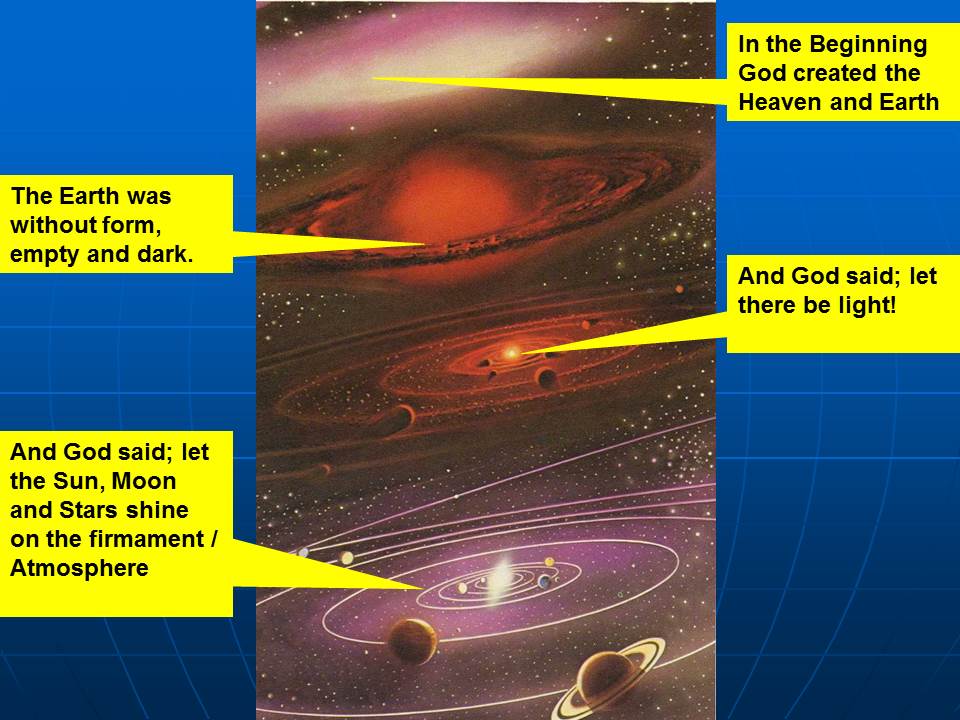
I took the Artistic description from Nigel Henbest’s book, and added the Genesis 1 call outs.
I can paste this picture in any Bible, and it does not contradict the Bible at all!!!
‘Heavens’ and ‘universe’ are not the same thing.
How did this affect the fruit trees?
You’re the first that I have seen.
This isn’t the predicament you think it is.

Is there an error in what I observed from Genesis?
It contradicts the creation of fruit trees on day 3, since they could not survive without sunlight.