Links, context for the list of key words? I.e. where do you get this from?
1 Like
Khnumhotep II seems to have been a ruler of a nome in ancient Egypt circa 1900BCE and his tomb has a wall painting of some people generally considered Asiatic.
The idea is that you should provide some evidence, hopefully from archaeology journals. After all, Noah’s ark has been found several times.
2 Likes
I’m reminded of the relic cult. Martin Luther wondered why 18 of the 12 apostles were buried in Spain alone. (btw, the Holy Grail is up for auction on ebay)
1 Like
Pax Christi, White!
You are absolutely right: the straight-forward portrayal of The Exodus in the titular book is not realistic (though there is evidence and The Documentary Hypothesis suggesting that the event did happen in a lesser form in the Ramesseside Period ; check out Dr. Richard Elliott Friedman), and the “Habiru” you speak of are not the Israelites. “Habiru”, or “Apiru”, meaning dusty or dirty, was a broad category of people consisting of slaves, mercenaries, outlaws, and laborers, not pertaining to one particular ethnic group. While the name sounds like “Hebrew”, there is no linguistic connection, and the depiction of said “Habiru” look nothing like Israelites in Egyptian art.
As for The Conquest, it seems very likely that it never happened, though the Egyptologist Dr. David Falk has made some interesting points (look up his channel if you’re curious) in favor of a less dramatic event. However, I would not spend too much time trying to defend and justify it; I take an Origen and St. Gregory of Nyssa approach to this particular Biblical problem.
Interesting. What was their approach? 
1 Like
Pax Christi, Liam!
Here is what Saint Gregory wrote about the death of the first born:
“How would a concept worthy of God be preserved in the description of what happened if one looked only to the history? The Egyptian acts unjustly, and in his place is punished his newborn child, who in his infancy cannot discern what is good and what is not. His life has no experience of evil, for infancy is not capable of passion. He does not know to distinguish between his right hand and his left. The infant lifts his eyes only to his mother’s nipple, and tears are the sole perceptible sign of his sadness. And if he obtains anything which his nature desires, he signifies his pleasure by smiling. If such a one now pays the penalty for his father’s wickedness, where is justice? Where is piety? Where is holiness? Where is Ezekiel, who cries: The man who has sinned is the man who must die and a son is not to suffer for the sins of his father? How can history so contradict reason?”
Saint Gregory recognized that The Scriptures do sometimes not only say conflicting things about God, but they also ascribe immoral things to God. He also believed that Scripture has several levels of Truth to it, which seems in-line with Biologos. In his view, the reason why such ugly and false passages are still allowed in The Bible is because they can be applied in a spiritual way for the betterment of others and ourselves; Saint Gregory takes the first born’s slaying as an allegory for destroying sin before it has the chance to mature. This creative reading of the text, while troubling at first, I realized is in-line with the greater Judeo-Christian tradition as a whole.
Here’s an interesting website I found that explains it all better than me:
2 Likes
Are we still doing that Grail thing? I thought it fell into a chasm in the Al Khazneh in 1938?!
1 Like
Funny you mention slavery. There are videos on YouTube trying desperately to defend Levitical Law by resorting to “yeah, but at least it wasn’t harsh slavery!”
I’d drink a beer with Saint Gregory!
Many early Christians took an allegorical view of many parts of the OT. There was a bit of Marcion in a lot of people back then. It’s very sad that the church changed into “everything is literal history.”
And yes, some do like to claim slavery in the Bible is more like indentured servitude. But they are just playing “make believe.”
Vinnie
2 Likes
The One trouble with Marcion is that he didn’t allow for an allegorical reading. That’s why he was repulsed by the Old Testament and saw it as unfit for God. Many of those others were contradicting him, saying that of course it looks bad if you take it so woodenly, but that’s not what we should do with writings that are from God. If they are inspired, they must mean more than what is on the surface. They must be for us today, not just facts about the past.
Their creative exegesis was due to their difference from Marcion, not their commonalities.
I think the church could have a much better discussion about Joshua if our Old Testament was arranged like the Jewish Scriptures. Instead of placing Joshua in a section called “History,” it was within the “Former Prophets.” If you approach Joshua as a prophetic text written to speak to the audience’s present, then those early church readings on Joshua look a lot less crazy.
3 Likes
Yes, a lot depends on how you come at Scripture. If you come at it one way you get one result, taken another way, you get a quite different result. Christians would be wise to learn from the historical approach of the Jews. If for no other reason than they have had a little more time to get things right and both groups agree that the OT was originally only for them. This said, we must also consider that the Bible was written by people who are imperfect. If the Bible is imperfect then some things may not be correct in it but god can still use it. We see this all the time in real life. We believe that god uses imperfect people to accomplish his perfect will. We don’t say we can’t trust anything about a person because he/she is imperfect. We have to use our critical thinking skills etc. to determine the details. These things may not be tidy but who says life is tidy.
2 Likes
The trouble with Marcion is that he was anti-Semitic and wanted to discard the OT, just like the Nazis did. But for the New Testament writers and Jesus, the OT was their Bible.
2 Likes
No! It’s in the Dublin museum after King Arthur sent it to Iona, after Joseph of Arimathea took it to England! (I have seen a book claiming that). Or does this belong in Humor in Science and Theology?
1 Like
I like your points. I’m aware of what you say (although not of some of the specifics such as Dr. Falk). Obviously the story didn’t appear out of the thin air. There has got to be something that these stories are based on either within the Hebrew history or stories borrowed by the Hebrews from others at some point. That the stories grew in their significance and scope is not unusual. This happened all the time in the past within a group and has been well documented.
If someone want to demonstrate that these stories are historical they must present a sizable amount of written and archeological evidence that confirm details within the story. Piecing together bits and pieces of hearsay, physical evidence etc. suggesting something could have, might have or perhaps happened is not really evidence. There is currently no evidence that over a million people were in the desert for 40 years, then entered ancient Israel and conquered the land by killing large numbers of people.
2 Likes
If the conquest of Canaan had really happened as reported, this is what we’d see:
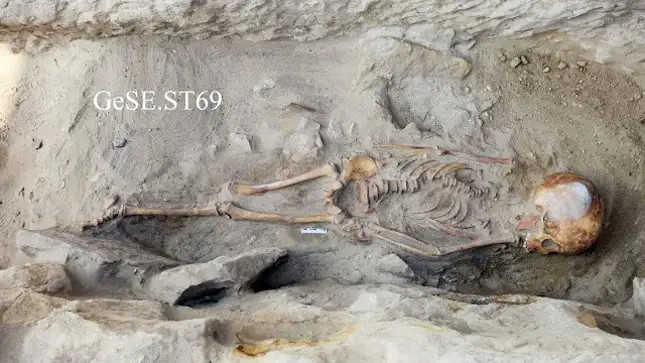
From a dig site in ancient Egypt, this is the skeleton from a child who died between age 5 and 9, left unceremoniously in a quarry pit and covered in debris (Image: The Gebel el-Silsila Project 2017)
Only we’d expect to find the remains of whole families slaughtered, with evidence of a violent death (hacking, stabbing, etc.) in their skeletons. .
1 Like
Yes, I think the parallels to the beginning of Genesis are pretty strong. Once other ANE stories were unearthed with strong parallels to Genesis, it changed the way most scholars read it. Rather than using Genesis to vet our science, they saw how the book was using a known style of writing to say something new. It both assumed an existing cultural understanding and stretched it in new directions.
The early Christians who allegorized Joshua had little reason to doubt the historical accuracy of the conquest accounts. They didn’t deny the historical meaning even as they focused on another layer of meaning that spoke directly to them.
But we do have reasons. Beyond differing details in different biblical accounts, we have archaeological research that shows Israel emerged gradually and was largely made up of Canaanites; the Hebrew language seems to have begun as a Canaanite dialect. We also have evidence that leads most scholars to see Joshua as written, at least in close to its current form, about 500 years after the events it describes. Those writers and readers were facing exile. The book spoke to them. It was treasured because it was relevant, not because it preserved historical trivia.
If we see the source material of Joshua being many conflicting oral traditions as well as remains poking out of the desert, it again shifts what we take away from the text. Joshua unifies traditions from different communities to unite the nation. “You have a tradition that Joshua took Debir while you claim that Caleb and his brother did? Fine, we’ll include them both” (Joshua 10:38–39; 15:13–17). Joshua explains the landscape around them. “You see those ruins over there? Let me tell you the story of Ruins” (in Hebrew that’s Ai, found in Joshua 7). The stones of ruined walls, like the bones of dinosaurs, could anchor stories that would endure.
But their creativity had a point: explain who they were today and what God called them to do. In Joshua’s first detailed conquest stories, the Canaanite Rahab’s house is folded into Israel while the Israelite Achan’s house is destroyed. It mixes the categories to show that a true Israelite is defined by their faithfulness, not their lineage. If we allow more recent knowledge into our reading, we can see how most Israelites at the time of the exile shared Rahab’s backstory. They were of Canaanite stock. Would they match her allegiance, even in a foreign land?
As history, Joshua fails. Even internally it fails, providing multiple versions of some of the same events, multiple takes on the scale and speed of destruction. But as a call for exiles to put to death their syncretistic past and live loyally to God, it succeeded.
When read by the powerful and the comfortable, it’s a dangerous, troubling book. But for generations of exiles under the thumb of a dominant power – all the way to African slaves on cotton plantations – it has continued to inspire.
3 Likes
That is well put; and it was certainly written by those who had gone through the Babylon Captivity, with intent to remind them of many events relevant to their experience. However, I don’t know how to say what parts are relevant to us. Also, isn’t it meant to relate true events as well? I am sympathetic to Marcion in that respect. You have written a lot on that, and I am interested in what your thoughts are. Thanks.
1 Like
Joshua was a powerful way to explain Israelite origins: We have undergone a transformation, we are no longer pagan Canaanites, and we now worship the one true God.
1 Like
I don’t think writers 500 years removed from the events could record what really happened. Sure, God could have inspired someone to write down the historical story, but that doesn’t seem to be how inspiration works elsewhere. Luke did his research, for instance. He wasn’t given a supernatural shortcut. When God does reveal a vision of something a writer didn’t witness directly, it tends to look pretty wild, not like normal historical prose.
So just as I don’t insist that Genesis 1–2 include a blow-by-blow account of what security camera footage would show, I also don’t expect that for Joshua. If God wanted us to have a historical account of the conquest, God could have inspired an eyewitness to record something. The evidence suggests God didn’t do that. Maybe we don’t need it.
Most early Christians aside from Marcion’s crowd focused on spiritual lessons in Joshua, such as putting to death your inner Canaanite. When the book is recognized as emerging during the exile, this allegory can actually be seen as part of the original intended meaning: it was written to encourage exiles to be faithful to Yahweh. And when Israelites are recognized as beginning largely as a Canaanite group, this allegory becomes historical in a sense. They did have an inner Canaanite, and that’s perhaps why Canaanite beliefs and practices were uniquely tempting.
So, I find these extra layers helpful in not seeing Joshua as just a genocidal text. As I’ve said before, I’m allowed to tell Mennonite jokes because my family is Mennonite. The Israelites are allowed to caricature Canaanites because (1) it’s their own past, and (2) by the time these texts are written, Canaanites are long gone, absorbed into various other identities.
Joshua is relevant because it’s a big part of how we learn that God’s people are defined by obedience and not lineage – a theme that the New Testament runs with, but doesn’t create. Joshua redefines Israel as a “mixed multitude,” enabling us to now reread passages in Deuteronomy 7 and elsewhere that seem to draw the line based on nationality. After all, Joshua “fulfills” all that Moses commanded, even as it encourages us to now read what Moses commanded differently.
There’s of course much more than that one theme, but that alone makes me grateful for Joshua’s place in our canon. At the same time, I’m thankful that the New Testament encourages us to rethink Joshua just as Joshua does to Deuteronomy. From the New Testament’s references, you’d think Rahab was the hero and Joshua was just one more person who failed to give the people true rest.
4 Likes