Maybe they thought men could live for centuries but women couldn’t? Or at least couldn’t stay fertile for centuries?
1 Like
Thanks for sharing that as I have never seen the ages broken down like that. It makes a lot of sense. As for Joseph, his association with Egypt was a two edged sword, as his actions ultimately put his family in slavery when he was no longer around to advocate for them.
2 Likes
In the case of Abraham and Sarah having Isaac, both partners were thought to have aged out. Abraham, Sarah and two New Testament authors all conclude that both of them were too old.
Abraham:
Abraham fell facedown. Then he laughed and said to himself, “Can a child be born to a hundred-year-old man? Can Sarah, a ninety-year-old woman, give birth?” (Genesis 17:17)
Sarah:
So she laughed to herself: “After I am worn out and my lord is old, will I have delight?” (Genesis 18:12)
The Hebrew beneath “delight” there is the rare word eden. At their age, they were no Adam and Eve in the garden of Eden. Sarah is saying that Abraham was past the point of giving her marital pleasure. He couldn’t make it happen.
In the New Testament, Paul calls Sarah’s womb and Abraham’s body both “dead” (Romans 4:19). Hebrews says the couple was given strength to conceive despite being “past the age” and “as good as dead” (11:11–12).
The main counter to this is that Genesis 25:1–6 shows Abraham having another six sons with Keturah, seemingly his wife after Sarah died. But that passage is better understood as an appendix to Abraham’s story that ties up loose threads related to inheritance. It’s not uncommon for Genesis to conclude a section by briefly mentioning some details the main narrative left out. Keturah was Abraham’s mistress wife while Sarah was still alive, even though the rest of the narrative of Genesis never mentions her. (She is called a concubine in 1 Chronicles 1:32, which wouldn’t be the case if she was simply a second wife after Sarah died.) The sons with Keturah were probably born much earlier than Isaac, similar to Ishmael with their slave Hagar.
So, the general conclusion of the narrative of Genesis is that Isaac’s birth was a miracle, not only because his mother was 90, but because his father was 100. Since there are no similar comments about how miraculous it was for 500-year-old Noah to produce sons or 100-year-old Seth, that suggests the genealogy ages were not taken at face value.
(Edit: The reason Noah is so anomalous with having sons at 500 is because otherwise his fathers would have their lives cut short by the flood. By moving the next generation half a millennium later, it allows his grandfather Methuselah to live to a quite respectable 969. Only his father Lamech has a “shorter” life, but since it’s the special number 777, it doesn’t look like a judgement. So Noah’s line doesn’t look like they were judged by the flood because Noah had kids at 500. I think this is a pretty clear example of the numbers being used creatively to serve the story, not to factually document history.)
4 Likes
So … they were paying enough attention to the face-values of these numbers to make sure that this added up right then! Couldn’t the authors have just as easily ‘resolved’ that problem by letting Noah have his sons at the ‘normal’ age of around a hundred or so, and then just declaring that Noah, and all his descendants went onto the ark with him? Of course this is me imposing our modern questions on the text and its ancient editors. Probably it seemed cumbersome to them to think that the ark could have such a potentially large crowd of humans aboard - they would just know that to be unworkable in ways that they recognized then, whereas they wouldn’t have had reasons to be concerned about animal populations that we know more about now.
Thanks for those additional details of Abraham’s reproductive life! The soap opera continues! I’m not sure all that had ever registered with me despite having read through those texts so many times myself by now!
This was unnecessary. We all understand things can “can evoke something other than its plain meaning” but the specific issue under discussion is on what grounds should we deny the plain sense of ancient people thinking their distant ancestors lived to very old ages?
@St.Roymond articulated something similar:
How about because one of the authors of material at the same time period has Abraham and Sarah laughing at the idea of having a kid at a century of age. This indicates that they darned well knew people didn’t live for centuries.
John Bergma says what we all know: (A Catholic Introduction to the Bible: The Old Testament).
“Almost all the ancient Near Eastern cultures remembered an ancient flood that divided human history into a “pre-modern” period beforehand and the “modern” period afterward. Kings and heroes had enormous life-spans before the Flood, but death came more quickly for those who lived afterward."
Noah and Abraham may have overlapped half a century or so but Abraham lived hundreds of years AFTER the flood and hundreds of years after Genesis 6:3 where many, including the Jewish Study Bible interpret this as God limiting the ages of men going forward.
3 Then the Lordsaid, “My spirit shall not abide[a] in mortals forever, for they are flesh; their days shall be one hundred twenty years.”
Jewish study Bible: it records yet another breach of the all-important boundary between the divine and the human (vv. 1–2) and explains why human beings no longer attain to the great ages of their primordial forebears (v. 3).
There is a lot going on here. Two separate lines with different ages it seems. Bergma writes:
“In contrast to the line of Cain, Adam’s genealogical line, traced through Seth, is marked by extremely long life-spans, righteous figures such as Enoch, who “walked” (Hebrew halak) with God (Gen 5:21-22), and Noah, who is prophetically described as a kind of deliverer figure who will bring “relief” (Hebrew nuach) to the world (Gen 5:29).”
Genesis has multiple authors with complimentary and conflicting stories and details from different times edited into one. ThePentateuch is littered with doublets that contradict itself, sometimes side by side. Here are the 31 doublets proposed by Friedmann in The Bible with Sources Revealed :
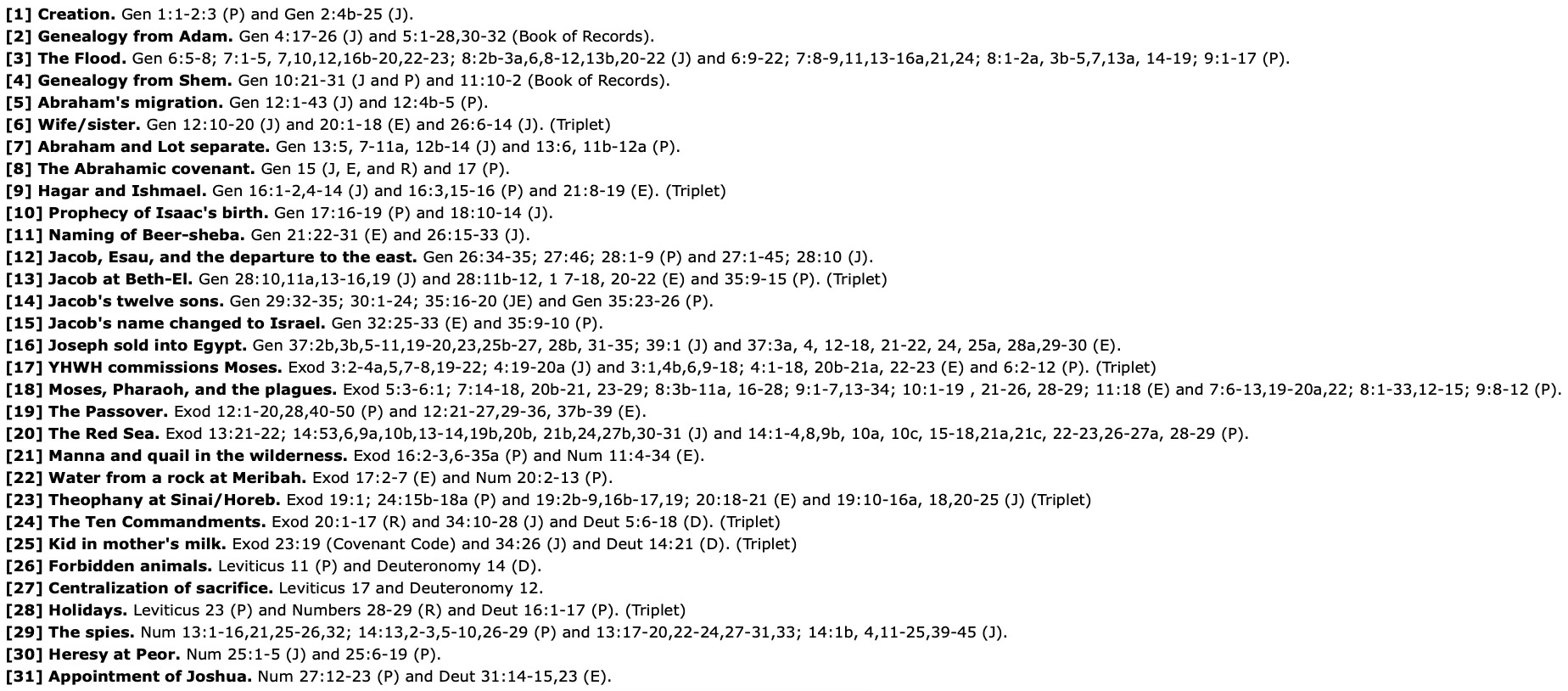
There are other examples of doublets outside the Pentateuch not listed by Friedmann who was interested in the composition of the first five books. Examples include: Saul chosen as king (1 Sam 9:15-16, 10:1 with 1 Sam 8:1-22; 10:17-19), Saul’s death (1 Sam 31 with 1 Chron 10), David and the ark (2 Sam 6:1-11 with 1 Chron 13:5-14), Solomon (1 Kings 3:4 with 2 Chron 1:3, 1 Kings 11:41-42 with 2 Chron 9:29-30, 1 Kings 3:4-15 with 2 Chron 1:3-13), David’s sons (2 Sam 3:2-5, 13-16 with 1 Chron 3:1-9) and King Asa (1 Kings 15:17-24 with 2 Chron 15:16-17:1). There are certainly conflicting details in some of these and those listed above. For example, the minimum age of service for Levites is 25 in Numbers 8:24 but 30 per Numbers 4:3, 23 and 30 and Moses’s father-in-law is Reuel in Exodus 2:18 but Jethro in 4:18. The Jewish Study Bible is correct when it wrote: “In these instances, most modern biblical scholars see different antecedent documents that editors (known as redactors or compilers) have combined to give us the text now in our hands.” Different source documents have been woven together in scripture which leaves us with a number of incongruities. Friedman subscribes to the documentary hypothesis, the belief that several authors composed the Pentateuch as opposed to tradition which asserts Moses wrote it. He identifies four sources in the Pentateuch: J is the Yawhist source, E is the Elohist source, D is the Deuteronomist source and P is the Priestly source. These are the letters you see above. One does not have to agree with all details of the documentary hypothesis to understand the force of the argument presented by the list above. We have many doublets, sometimes right next to one another, or even intertwined, that have mutually exclusive details.
So my question to Walton and to you, and as a lover of Scripture, I am rooting for you both, outside of the (1) prior belief in inerrancy and (2) modern belief that these ages are impossible being coupled together, what evidence is there for thinking ancient people didn’t actually think these long ages were a part of reality? I haven’t seen anything substantial provided to the contrary. We should not impose our modern skepticism on ancient authors and even if the numbers are churning out some theological truths, there is no reason to assume they are not doing double duty. None. Even if the ages are structured to fit numerical patterns, this does not rule out belief that primordial figures lived this long and starting with the flood, their ages waned to normal times. Ancient story telling and compositional techniques could easily lend themselves to using important nunmbers that are inexact but still ancient. Or maybe even these are considered literal. Why couldn’t ancient authors see God’s providence at work in these carefully crafted patterns?
I suspect living to 100 in Abraham’s day (Bronze Age) is almost as fanciful as living to 930 in Noah’s time.
Vinnie
2 Likes
What about providence? This does not tell us what ancient authors/hearers/readers might have thought. Only what modern skeptically inclined readers think about the text.
God could have delayed the flood to spare Methuselah (a righteous ancestor?) from judgment. God could have prevented Noah from having children until he was 500 so his sons could help build the ark without massive, wicked families of their own that would be destroyed by it. Lamech’s 777 is highly symbolic but what is there to suggest God did not grant such a specific lifespan as a sign of grace before the impending judgment?
You as a modern person might “think this is a pretty clear example of the numbers being used creatively to serve the story, not to factually document history” but what about ancient audiences who subscribed to God’s providence and who were far less scientifically minded? Not to mention factually documenting history is more of a modern hangup. Ancient authors had a lot of freedoms we would cringe at since the 19th century in documenting what they think happened.
Vinnie
Makes you wonder if after some apocalypse, future archeologists might unearth a trove of AIG artifacts and conclude people in our time believed in a 6000 year old earth. How funny! Opps, I guess some do. But seriously, just as serious scholars believe things that the common populace does not may well be a characteristic of ancient people, as well as of modern.
4 Likes
The ancient use of symbolic numbers has been well documented for over a century. It’s in the Jewish Encyclopedia for 1903.
1 Like
Who denies the symbolic use of numbers. It is the false dichotomy that is being denied.
I mostly agree but what “serious scholars” in antiquity , in pre-scientific times, have any reason not to believe in the long life spans they we see attested in so many cultures? The educated elite have no reason to question the long life spans in some primordial time before everything went downhill. Even if they had reason to think the numbers could have been adjusted, they would still have no reason to deny the basic claim behind them. This is a modern imposition.
Vinnie
1 Like
From our culture we might understand that words can evoke something other than their plain meaning, but we might not understand that about numbers. That’s why I used the example of Herod the fox. You’re right, it’s really obvious Herod wasn’t an actual fox, but it’s also really obvious that 500-year-olds don’t have children and no human lives to 969. Note how nobody even tried to suggest that providence might have intervened to make Herod a literal fox. Yet we do get those suggestions for a 500-year-old father. I think that’s due to our empiricist culture where we have more trouble with nonliteral numbers than nonliteral words.
The words “enormous life-spans” conceal how practically every example of it, from variant Sumerian king lists to versions of the Genesis genealogy in the Samaritan Pentateuch or Septuagint, contain different numbers, often orders of magnitude different. This makes sense if they’re all different ways of communicating the majesty of these past figures in prehistory compared to piddly people today, but if they’re all preserving actual lifespans, why such shocking variety?
You cut out the juicy bits:
6:1–8: The prelude to the flood. 1–4: This brief narrative reads like a condensation of a much longer, well-known myth. It records yet another breach of the all-important boundary between the divine and the human (vv. 1–2) and explains why human beings no longer attain to the great ages of their primordial forebears (v. 3). It also explains the origin of the Nephilim (v. 4), the preternatural giants that Israelite tradition thought once dwelt in the land (Num. 13:31–33). (Jewish Study Bible, p. 21)
So no, they don’t interpret it as God limiting ages going forward. They interpret it as a condensation of a well-known myth that also has angels breeding with humans and producing giants.
I think Abraham qualifies as an ancient person. What was his reaction when he heard he would have a son at 100? He laughed and didn’t believe it because 100-year-olds don’t have children. In other words, he reacted much like people today.
As for me personally, I can buy a one-off miracle with Isaac’s birth, since the text describes that as miraculous. But I don’t buy a bunch of unmentioned miracles to make everyone in the genealogies live as long as is stated (or Abraham to live to 175). If Abraham didn’t believe it (even though taken literally several of these long-lived men were still living in his day) then I don’t feel the need to.
Indeed. But when an ancient person like Abraham shares our modern skepticism, perhaps it’s not really that modern.
2 Likes
Yes, and the details are fascinating (for those who like this sort of stuff). From this article:
The three major surviving textual traditions of Genesis — the Masoretic Text (MT), Samaritan Pentateuch (SP), and Septuagint (LXX) — do not agree completely on the chronologies of the patriarchs. Three patriarchs differ between the MT and SP: Jared, Methuselah, and Lamech. All the pre-Noah patriarchs differ in the LXX from the MT (except Jared) and SP. When we look at SP in particular, it becomes fairly obvious what the reason for these variations is. Jared Methuselah, and Lamech — the three that differ from the MT — all die in 1307 A.M., the year of the Flood. The Flood is the key.
As I have remarked in previous articles, it is fairly well-understood that the story of the Flood was a later insertion into a patriarchal foundation story that didn’t have it. […]
According to research by Old Testament scholar Ronald Hendel among others (Hendel 2012), the insertion of the flood story in Noah’s day created a problem that later scribes couldn’t overlook: if you did the math, the long-lived patriarchs Jared, Methuselah, and Lamech all survived for many years past the Flood, even though the Flood story made it clear that all outside the Ark had perished.
The editors of the LXX, SP, and MT had basically two ways to solve the problem: either delay the year of the Flood by delaying the age at which the patriarchs begat sons, or have the patriarchs in question die sooner. Here’s what each of them did:
The LXX’s editor methodically added 100 years to the age at which each patriarch begat his son. Adam begat Seth at age 230 instead of 130, and so on. This had the result of postponing the date of the Flood by 900 years without affecting the patriarchs’ lifespans, which he possibly felt were too important to alter. Remarkably, however, the editor failed to account for Methuselah’s exceptional longevity, so old Methuselah still ends up dying 14 years after the Flood in the LXX. (Whoops!)
The editor of the SP adopted a simpler method. He just altered the lifespans of the three patriarchs that posed a problem. Adjusting their ages as little as possible, he had them die in the same year as the Flood.
The editor of the MT chose to keep the lifespans untouched (like the LXX), and he altered the age of begetting only for the three patriarchs affected, pushing back the Flood date as a result. He first added 100 years to Jared’s begetting, and then 120 years to Methuselah’s. This reduced the overlap to 94 years. By adding 94 to Lamech’s begetting, he completed the fix, placing Methuselah’s year of death in the year of the Flood.
@Vinnie , this is more evidence that at least educated ancient people didn’t see these ages as real. If these scribes thought these ages preserved actual historical records, why would they feel free to change them? It seems they were more intent on making sure the message wasn’t undermined (by having people live through the flood). To that end, it apparently wasn’t a problem to change a few numbers.
2 Likes
I have read that previous beliefs of human ages during the early history (including Bronze Age) have been based on misunderstandings. One source described that ages of skeletons could be estimated fairly well up to the age of 40 years. If the skeleton belonged to a person that was clearly older, many studies recorded the age of the individual as 40+ years. When historians summarized the available data, they misunderstood the records of the 40+ years old skeletons. That lead to a false belief that the oldest persons tended to live to the age of 40-50 years.
Mortality of children was high and that lowered the mean age. If the person survived the childhood and early adulthood, mortality dropped much. For young women, a major cause of death appeared to be childbirth. After the woman stopped getting children, the risk of mortality dropped. Epidemics spread in large villages or harbours where the density of people was relatively high but the risk of a fatal disease was lower in sparsely populated or isolated sites. If the person was not killed by violence (local wars) and there was enough of food, a healthy life style promoted living to an old age.
The oldest persons were dependent on social help. If there was enough of food or the person had a high social status, others were likely to support the weakening person. Although the proportion of old people was much lower than in the societies with modern healthcare, living to a fairly old age appeared to be normal. Hundred years was probably rare but not a miracle. For example, I have heard that some of my fathers relatives lived close to 100 years or even above before the start of a modern-type healthcare.
3 Likes
It is not self-evident to anyone that someone living 5,000 years ago could not have lived to 500. You bring certain assumptions in with you. It only seems obvious to you with your current knowledge of human physiology, the fossil record and history going back thousands of years. But you are imposing your modern world view onto an entire culture with an entropic understanding of human origins. They believed humans started in some sort of pristine (sinless?) primordial state with abnormally long lives that waned to their present reality. Adam/Noah (930/950) → Abraham (175) → David (70). There is a progression here and this is a widespread belief in the ANE as I already quoted Bergma on and will not repeat here. As I said, Genesis 6:3 even offers an explanation fort this (God decided to lower human life spans). Your argument is because the exact numbers change a bit that the educated didn’t take this seriously. I find that unpersuasive in that it reads the text like a modern evangelical would (black vs white) as opposed to assessing all the evidence and trying to understand ancient compositional practices that might be different from our own.
As a case in point, a highly educated Jew named Josephus in the first century argued these dates were literal (Antiquities Chapter 1, Book 3)
But let no one, upon comparing the lives of the ancients with our lives, and with the few years which we now live, think that what we have said of them is false; or make the shortness of our lives at present an argument, that neither did they attain to so long a duration of life, for those ancients were beloved of God, and [lately] made by God himself; and because their food was then fitter for the prolongation of life, might well live so great a number of years: and besides, God afforded them a longer time of life on account of their virtue, and the good use they made of it in astronomical and geometrical discoveries, which would not have afforded the time of foretelling [the periods of the stars] unless they had lived six hundred years; for the great year is completed in that interval.
Notice that at this time (just shy of 100 CE) Joseph’s does have have to defend this position because some do think it fanciful but he also justifies his response by appealing to a number of other authors who said the same thing in composing their own histories. He goes on to finish:
Now I have for witnesses to what I have said, all those that have written Antiquities, both among the Greeks and barbarians; for even Manetho, who wrote the Egyptian History, and Berosus, who collected the Chaldean Monuments, and Mochus, and Hestieus, and, besides these, Hieronymus the Egyptian, and those who composed the Phoenician History, agree to what I here say: Hesiod also, and Hecatseus, Hellanicus, and Acusilaus; and, besides these, Ephorus and Nicolaus relate that the ancients lived a thousand years. But as to these matters, let every one look upon them as he thinks fit.
I don’t fully know or really need to know. Changing numbers doesn’t change the view that ancient people thought pre-flood individuals lived abnormally long lives. Josephus seems to be saying, “don’t just take my word for it, everyone knows this.” I am sure there are some reasons for the date changes. AI gives me this:
By the time the Septuagint was translated (3rd–2nd centuries BCE), the Jewish diaspora was highly educated and interacting with Egyptian and Babylonian records, which claimed human history stretched back tens of thousands of years.
Adding 100 years is an attempt to harmonize the timeline with new information. To me this shows they take the long life spans and material inside seriously. I am not saying we have to accept the Biblical numbers as exact. Ancient scribes may have had a fluid but factual mindset. I don’t pretend to understand all or many ancient compositional practices. I am reading Mike Licona’s “Why are there differences in the Gospels?” and sometimes the way Plutarch retells the same scene across different lives boggles my mind. I don’t think you or Walton have provided enough to show that ancient authors and audiences did not see these long life spans as a reality even if we can quibble about the numbers.
I didn’t cut out the juicy bits. I am aware the specific author of the section on Genesis in the Jewish Study Bible text doesn’t take the account seriously. I was using them as an authority justifying the interpretation of Gen 6:3 as God limiting human life spans. Some people take it in a different direction and use it as the interim before the flood (120 years).
This is an anachronism on your part because Abraham is post flood and should have a shorter life span where kids at 100 could be a joke.
The text doesn’t need to include a bunch of miracles. It was normal in pre-flood times for people to live to be very old. It was as normal to them as people living to 70 is to you and me. The normal at the time was long life spans that waned after the flood. Genesis has no need to mention miracles because you are imposing your views on the text. It is simply narrating the normal understanding of how the world worked. It does include the miracle you seek. It’s Genesis 6:3. The normal long life spends pre-flood are miraculously limited by God. You are approaching the account backwards.
@Vinnie , this is more evidence that at least educated ancient people didn’t see these ages as real. If these scribes thought these ages preserved actual historical records, why would they feel free to change them? It seems they were more intent on making sure the message wasn’t undermined (by having people live through the flood). To that end, it apparently wasn’t a problem to change a few numbers.
All of these authors (MT, LXX, SP) all retain long life spans–though conservatives would say the MT is the original. If they all thought these long life spans were fiction, they were certainly free to make Methuselah 85 at death. They all retain them. What I see is a correction or harmonization which indicates to me these authors took these long life spans seriously and needed to fix what they may have seen as errors in the tradition.
What we have from Joseph’s is a host of positive evidence and authors that take these long life spans serious. You offer only a questionable inference on the basis of changing numbers that they didn’t take them seriously. But I think we can also just as reasonably infer by these changes that they actually took them seriously but didn’t have great record keeping at the time. I just don’t think the reasoning here by Walton (or your attempted defense of it) is sound.
It is pure harmonization based on 1) a belief in inerrancy coupled with 2) a belief people never lived this long. That doesn’t make it wrong. I like the Bible too. But let us call it what it is.
Vinnie
This article says in the Abstract:
Age-at-death estimates for adult skeletons are a particular problem, especially for adults over 50 years that undoubtedly are mistakenly underrepresented in published studies of archaeological skeletons.
I’m sure some people lived much older than 40. But I suspect 100 in the Bronze Age would bet pretty rare and Abraham actually lived to 175 in the text if we are taking his skepticism of childbirth at 100 seriously.
Vinnie
Is your view that ancient people assumed that people lived much longer before the flood, but they weren’t hung up on the details? So the genealogy would support their pre-existing belief in long-lived antediluvians rather than being the source of it, allowing them to freely change the numbers in that genealogy as needed?
If this is what you’re arguing, this is not much different than many other cases where ancient people had different ideas about how the world worked, and they often read those beliefs into Genesis. For instance, Augustine thought flies and weeds could arise directly from the ground without needing physical parents or seeds (spontaneous generation); he saw this confirmed by the creation week where God commands the earth to bring forth life. Many ancients believed there was a solid dome at the top of the sky with waters above it, and so of course day two of creation confirmed that pre-existing view. And likewise, many ancients thought angels and humans could breed and create hybrids, and saw that confirmed in the beginning of Genesis 6. To those you add Josephus, who points out that when Genesis genealogies speak of long-lived antediluvians, it’s saying the same thing many people already believed.
That far, I don’t think that reveals anything controversial, but where do we go from there? Certainly we don’t just end with saying if ancients once believed something, it must be true. Nor even that if Scripture could prop up an ancient belief, that belief must be true and so much the worse for modern science. Is your point just that we need to accept that Scripture often reflects ancient understandings, whether with long-lived early people or a solid sky with waters above it? I don’t think you’re suggesting we should make those beliefs our own, but what are you suggesting?
What I find interesting is that even if the belief in long-lived early people was just as common as belief in a solid sky, ancient communities of faith weren’t fussed about pinning down the details. They accepted divergent views of the Genesis genealogy with different numbers as equally Scripture. For them, the details didn’t really matter. That’s quite different from modern literalism that insists the genealogies contain actual ages so we can calculate the age of the earth. Ancient people of faith, even if they accepted the premise that people once lived much longer, would probably shake their heads at those who thought Genesis reveals those exact ages to us.
I’m certainly not trying to harmonize, and neither do I think inerrancy is a useful way to describe Scripture. I simply think that inspiration did not prevent ancient writers from using creativity in their stories. They could invent speeches and ages and structure scattered remnants of cultural memory into a cohesive narrative, and none of that was controversial at the time or grounds for treating their work as not inspired by God. I believe God inspired, but did not dictate, both their creative vision and their historical vision.
I like how you put it earlier: “Ancient authors had a lot of freedoms we would cringe at since the 19th century in documenting what they think happened.”
2 Likes
Not that we should make those views our own, the former. For the most part. I personally don’t accept the long ages. I recognize it’s possible Adam and the first few generations of humans God ensouled (since I accept a literal Adam) could have been extended long lives through preternatural gifts that God took away after the flood. That is possible but I am presently inclined to see these long ages like I see belief in a solid firmament in the sky. But I won’t fault someone for believing this. I think we overestimate our interpretive abilities and what we think we know at times. But Walton operates under the assumption of inerrancy. He wrote the following:
My point is that ancient people most likely accepted the long ages. The only reason to assume the numbers are purely rhetorical and educated people didn’t actually accept them is an attempt to preserve the truth of the Bible–or rather a specific model of inspiration and inerrancy. I don’t share that view. I don’t think the Bible’s trustworthiness is dependent on or not dependent on people having lived for hundreds of years. That is like saying the Bible’s trustworthiness is dependent upon there being a solid dome in the sky. Ancient authors were simply mistaken on some points. Why do we have to find some special rhetorical meaning in every detail to salvage the Bible’s trustworthiness? I don’t think our scripture is that weak or fragile but I also don’t share Walton’s views on inerrancy nor work for an institution that makes me sign an agreement to such and such a belief. That is what I have been critiquing from the beginning. As Walton said and rejected in the beginning of the article, one of the options is the accounts are fanciful:
The account is fanciful and not to be believed. This is not a ready option for those of us who hold the Bible in high esteem.
His rhetorical argument is an example of harmonization. Ancient people most likely took these long life spans very seriously even if special numbers were used or the details were a bit fluid.
We agree here fully on this. I don’t think accommodation applies only to scientific statements (ancient authors did not have this distinction). God spoke from within and accommodated every aspect of their worldviews, including their philosophical understanding of the world and knowledge of history.
Vinnie
4 Likes
Psalm 90:10, attributed to Moses states:
Our days may come to seventy years,
or eighty, if our strength endures;
yet the best of them are but trouble and sorrow,
for they quickly pass, and we fly away.
So not a lot has changed. I’m sure a few lived to over 100, but very few. Once you hit that 80 mark, the wheels start coming off, and minor issues turn to major ones and death soon follows. The first bout of pneumonia was probably the last one.
One of the practical obstacles to exceedingly long lives, is the normal wearing of teeth. I have heard some say that pre- flood that teeth were super hard, but of course that would be miraculous as nothing escapes wear and tear, and teeth do not regenerate in humans, so Methuselah would have had to gum his food for the last 800 years of life.
7 Likes
Unless Tubal-Cain artificed a smoothie-maker.
1 Like
This made me think of a book called Lying With Numbers that was on a statistics & probability course I took. In the intro it noted that we seem to think that all sorts of things can stand in for other things, except numbers . . . but then went on to note that we’re not consistent because we say things like “a thousand years” to mean “a long time” and “a million years” to mean “never”.
2 Likes
What scientific mechanism do you propose that results in this change?