-
I googled this question:
- "What manner of Christian would say there’s no difference between “Jesus is God” and “God is Jesus” must be a: ____ ?
-
And Google’s AI told me this:
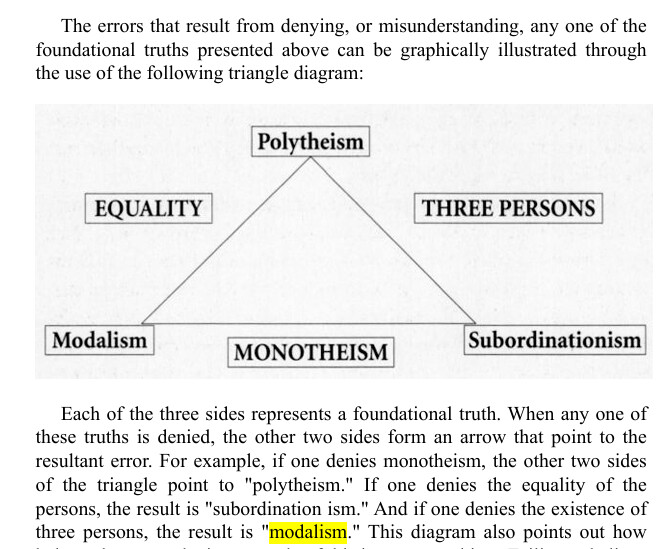
- A Christian who says there is no difference between “Jesus is God” and “God is Jesus” must be "a Modalist (or an adherent of Oneness Pentecostalism / Sabellianism / “Jesus Only” theology). That kind of Christian may still think they are Christian, but they certainly are not a trinitarian Christian.
- The claim is logically and theologically accurate because equating “Jesus is God” with “God is Jesus” directly contradicts historic Trinitarian definitions while correctly identifying Modalist or Oneness theology.
-
The Reformed Baptist, James R. White, has written a solid little book called “The Forgotten Trinity”. If I remember correctly he quoted another Trinitarian Christion who described the distinction between any one of the three “persons” of the Trinity, i.e.. Father, Son, Holy Spirit, and God like this: Identifying a person in the Trinity answers the question: “Who?”. “God” answers the question: “What?”.
-
A divine “Person” is a part of the whole. “God” is the whole. Anybody who says a part is the whole is uninformed and incorrect.
And since when was Google a valid theological source.
Saying Jesus is God is not Modalist. That is a false conclusion. Jesus is as much God as any of the Trinity and there is no need to cite the whole lot to prove anything.
All the so called heresies about the Trinity are just being pedantic. Look at the illustration. Each one says Is God. and Is not the other two. Anyone who knows the Trinity does not have to be pedantic or precise in their usage of it. They know what they mean and so do you.
Richard
1 Like
Shame you don’t take any notice of it.
Richard
Edit
You would try the patience of Job
- Apparently English is not your native language, otherwise you’d have realized that saying “Jesus is God” is Tinitarian, but saying “God is Jesus” is Modalist.
- You are very, very confused, and if you continue, I’m going to summon a moderator to explain your error to you.
3 Likes
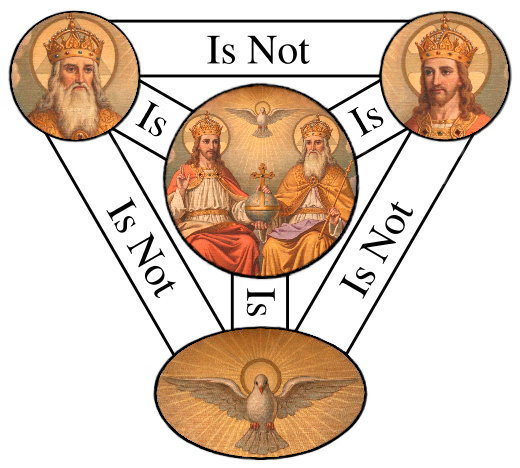
There are no arrows on this diagram. Saying that God is Jesus is not modalism.
modalism is when God changes into each form to the exclusion of the others. As in Ice, water, Steam. When in one form the others do not exist.
Saying God is Jesus does not mean that God is only Jesus. It is a juxtaposition of Jesus is God that is still valid unless you are being pedantic.
Stop telling me my faith! You may not like it, and you may consider it bad English, but that does not make it wrong or modalism. I know what Modalism is, and have told you so,
RIchard
- Your latest reply illustrates several serious misunderstandings of the doctrine of the Trinity.
- Your definition of Modalism is inadequate. Modalism is not simply the belief that God changes from Father to Son to Holy Spirit, like water changing into ice or steam. Its defining error is the denial that Father, Son, and Holy Spirit are three eternally distinct divine persons. Sequential transformation is not a necessary feature of Modalism.
- You haven’t adequately distinguished between divine person and divine essence. Classical Trinitarian theology distinguishes “who” God is (Father, Son, and Holy Spirit) from “what” God is (the one divine essence). Jesus is fully God, but Jesus is not the Father or the Holy Spirit. That is why the statements “Jesus is God” and “God is Jesus” can’t simply be treated as logically interchangeable without explaining what each term means.
- Your own diagram contradicts your dismissal of these distinctions as pedantic. “The Shield of the Trinity” explicitly affirms that each divine person is God while each person is not either of the other two persons. Whether its lines have arrows is irrelevant. The labels “Is” and “Is Not” are what matter.
- Your explanation of what you mean by “God is Jesus” does not establish that the expression is equivalent to “Jesus is God.” You now explain that you do not mean God is only Jesus. Fine. That clarification helps establish that you are not necessarily advocating Modalism. But it also demonstrates why theological precision matters. Without the clarification, the statement is ambiguous.
- Finally, you previously declared that “all the so called heresies about the Trinity are just being pedantic.” Yet the distinction between Trinitarianism and Modalism is precisely the distinction your own diagram was constructed to express.
- You cannot reasonably dismiss the distinctions as pedantic while simultaneously relying on a diagram whose purpose is to preserve them. This is not about telling you what you believe. It is about examining whether the explanations you have offered accurately represent the doctrine. And they don’t.
3 Likes
I never said anything about sequencing.
I am not going to read anymore, and you are going to drop this like a hot potato.
You want the moderators to intervene? Then keep going.
Richard
I’m afraid not. They didn’t capitalise the initial ‘m’. Otherwise, yes.
I don’t know how accurate this description is though, not least because different sources give different descriptions. AFAICT it’s wrong because in modalism there is no actual change in form, just a change in presentation, but I’m not going to commit.
1 Like
I would think AI would go for the Standford Dictionary of Philosophy.
Hey Roman, thanks for bringing such a heavy question to the table! The biggest mistake we can make is thinking we have to warp, stretch, or compromise the words of Genesis to fit modern science. The reality is exactly the opposite: the text isn’t a collection of random poetic markers. It is an incredibly precise, mathematically aligned concordance of the universe’s actual deep-time history.
By using 2000 years ago (the time of Christ) as our anchor point, we can calculate backwards through time. The cornerstone key comes from 2 Peter 3:8, which tells us that “with the Lord one day is as a thousand years”. When we trace that key through the text, a beautiful conversion factor unrolls:
- 1 day with the Lord = 1,000 literal years
- 1 year with the Lord = 1,000 literal years × 365 days = 365,000 literal years
- 1,000 years with the Lord (one full Creation Day) = 365 million years
Now, if you take a flat conversion factor of 365 million years per Creation Day and simply multiply it over 6 days, you only get about 2.2 billion years. This is exactly where most people get stuck and abandon the idea. But they completely overlook the fact that a calendar day is not a cosmic constant!
As we go back millions and billions of years into Earth’s deep history, tidal friction from the moon has been slowly putting the brakes on our planet’s rotation. The further back you go, the faster the Earth spun, meaning there were fewer hours in a day, but significantly more calendar days packed into a single solar year.
Because a “Creation Day” is anchored to a literal year’s worth of Earth days relative to that specific point in time, the duration of each Genesis day expands the further back we look. Here are the exact data sheets showing how the shifting earth days dynamically adjust to reveal the true scriptural timeline:
Shifting Earth Days & Solar Years
| Historical Shifting Point | Hours in a Year | Hours in a Day | Days in a Year (Formula Multiplier) |
|---|---|---|---|
| Today / Anchor Point | 8,766 | 24 | 365 (Defines Day 7) |
| 400 Million Years Ago | 8,766 | 21.33 | 411 (Defines Day 6) |
| 0.8 - 1.5 Billion Years Ago | 8,766 | 19 | 461 (Defines Days 4 & 5) |
| 2.0 Billion Years Ago | 8,766 | 18 | 487 (Defines Day 3) |
| 2.5 Billion Years Ago | 8,766 | 17 | 516 (Defines Day 2) |
| 4.5 Billion Years Ago | 8,766 | 4 | 2,192 (Defines Day 1) |
| 13.8 Billion Years Ago | 8,766 | 1 | 8,766 (Defines The Beginning) |
The Adjusted Creation Day Boundaries & Biological Order
When you map this shifting planetary deceleration scale directly onto the text, the chronological boundaries hit mainstream scientific milestones and track our common descent with life day-by-day with incredible accuracy:
- In the Beginning: Starts at 13,294,000,000 years ago (~13.29 billion years ago). Maps perfectly to the scientific estimate for the birth of the first stars.
- Day 1 (4,528,000,000 to 2,336,000,000 years ago): 2,192,000,000 years long. Encompasses Earth’s actual geological origin (~4.54 bya) and the emergence of early light detection and photosynthesis in Bacteria (~3 bya) and Archaea (~2.5 bya).
- Day 2 (2,336,000,000 to 1,820,000,000 years ago): 516,000,000 years long. Maps to atmosphere and crust shift alongside the rise of single-celled Protists (~2 bya).
- Day 3 (1,820,000,000 to 1,333,000,000 years ago): 487,000,000 years long. Continental stabilization occurs while terrestrial Plants like early algae and mosses form (~1.6 bya).
- Day 4 (1,333,000,000 to 872,000,000 years ago): 461,000,000 years long. Advanced environmental light processing tracks with light-sensitive photoreception networks evolving in Fungi (~1 bya).
- Day 5 (872,000,000 to 411,000,000 years ago): 461,000,000 years long. Captures the massive Cambrian Explosion and early sea life like corals and fish. While translations say “birds,” the Hebrew word used is עוֹף (of), which literally means “flying creature.” Paired with the text’s description of a sky “swarming” (שָׁרַץ - sharats), it points beautifully to the origin of flying insects! Paleontology shows the first things to master flight were insects (~400+ mya), fitting Day 5 perfectly before standard avian birds showed up later.
- Day 6 (411,000,000 years ago to the Time of Christ): 411,000,000 years long. Transition to land explodes with four-limbed Tetrapods (~355 mya), reptiles, advanced land mammals, and finally Humans (~350 kya) made in the Image of God (Time of Christ).
So no, Roman, we aren’t reshaping the text to fit a modern scientific picture. The data has been sitting there in the word meanings and structural metrics for thousands of years, waiting for modern physics and paleontology to finally catch up!
The “substantive claim” would be that the things named actually exist – other than that it’s literary.
Long ago it wasn’t so binary; one Father (Origen?) listed seven ‘levels’ of inspiration, from the living Word to several levels in the canon to councils to sermons.
Not at all – the heresies all present a different gospel because they have a different Christ.
1 Like
This confuses me. The 1 day = 1000 years I get, though I have never seen any reason to believe that Genesis assumes that kind of thing or that 2 Peter actually means anything about math, calendars, history, or real time and dates. What I don’t get is going further than that. If you’re applying “a day is a thousand years” to seven days, then you get 7000 years. I don’t see how “a year with the Lord” or “1000 years with the Lord” fit into that. It kind of seems like you just did the multiplication, then decided to do it all over again but I don’t see a reason for that.
And this is even more confusing for me. Why wouldn’t that at least be based on a day’s length from the point of view of the writer? The thing I don’t get about these complicated mathematical codes people claim to see in Scripture is how anyone was ever supposed to figure it out. What did the human writers think of any of this? What in the Bible tells people to read it like a numerical code?
I might not use such strong terminology, but it seems to me like that’s what this whole number scheme is doing.
That said, I am glad to see something on topic as opposed to fighting about unrelated doctrines.
3 Likes
Ethan, thank you. @ShiningCloud has already raised most of the questions that occurred to me about the mathematical construction itself, so I will not repeat them.
What interests me more is the prior question: what gives us reason to use 2 Peter 3:8 specifically as a numerical key to the chronology of the days in Genesis?
I am quite open to the possibility that the images and sequence of Genesis have real referents in the history of the created world. In fact, that is precisely the possibility I am exploring in this thread. But for me, that does not yet imply that the duration of those “days” can be derived by means of a particular mathematical conversion.
There is one other point that seems important to me. Genesis is, first of all, a text of the Hebrew Scriptures. In traditional Jewish calendrical reckoning, Rosh Hashanah corresponds to the sixth day of Creation — the day of the creation of Adam and Eve — rather than to the first day.
At the same time, the Hebrew word yom has a broader semantic range than “a twenty-four-hour day” alone. So, as I understand it, the use of the word yom by itself does not give us the precise duration of each of the first days.
So what I would like to understand is the underlying basis of your approach: why should the comparison in 2 Peter 3:8 be applied to the days of Genesis as an exact numerical conversion rule, and why should the time of Christ serve as the anchor point for that chronology?
2 Likes
?? For most of the 13.8 billions years, none of sun, earth, or moon existed.
3 Likes
Actually a year was 360 days. The opposite of manscience beliefs
The earth was also here before the sun stars or moon.
1 Like
Is it still? Do I have to cut a few days out of my calendar? I hate arts and crafts.
1 Like