Appreciate any feedback, pushback, criticism, examples of glaring errors, weaknesses etc…
Can God Author a Text with Errors?
“Sometimes fun is poked at the people who confess that they believe whatever the Bible says. “Do you really believe that the whale swallowed Jonah?” was the question put to one friend of mine, and she answered, ‘I’d believe what the Bible says, even if it said that Jonah swallowed the whale!’ One hopes that the answer was given tongue in check.” [Marshall, Inspiration p. 9]
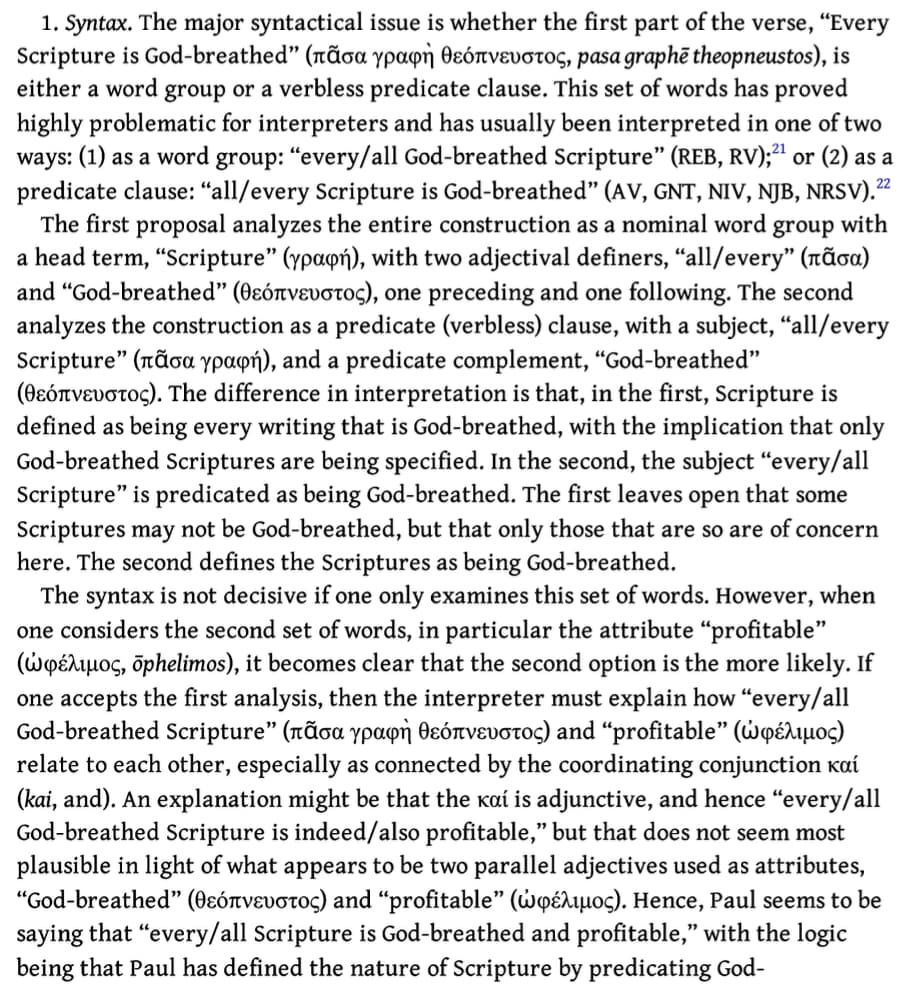
Can a text written or inspired by God contain errors? In order to answer this, we need to clarify what it means for something to be written by God and define what an error actually is. For the latter, I tend to think of an error as only applying to what the Bible intends to teach. Genre is extremely important in this framework. For example, if the Bible intends to teach a person named Jonah literally spent 3 days in the belly of a giant fish, and this event did not happen, the Bible would be in error. But even if the details of the story were fictional, no error is found if the purpose of the book of Jonah was not to narrate history, but instead us give us a dramatic story teaching is it fool’s errand to run from God as his purposes are unavoidable and will be fulfilled whether we comply or resist. I am not choosing a side, only pointing out the importance of genre for identifying potential errors. The friend mentioned in the quote above by Marshall certainly thinks the genre of Jonah is some form of factual, narrative history. I will discuss genre considerations more fully in another article on this website. I want to dig into the issue of how a text written by God or one that is inspired by God can be understood to have errors.
If we believe God sat down and wrote the Bible from His divine, heavenly perspective and its genre is historical narration, if discrepancies were to arise, then of course we should give priority to its truth claims over all others, including those of science and archaeology. Any stories that appear outlandish to us or inconsistent with external data would have to be accepted if they had such a heavenly stamp on them because the reliability of God is beyond reproach. The first commandment tells us to love and put God before everything else, and that includes our children and spouses, let alone archaeology and science. In this framework, Jonah could have swallowed the whale. “God said it, that settles it.”
We know the Bible is "unashamedly geocentric” and seemingly teaches that the sun (not the earth) stood still (Joshua 10:12) and there are several passages declaring the latter immutable (Psalm 93:1). Calvin famously defended his geocentric ideology against new Copernican ideas:
"We will see some who are so deranged, not only in religion but who in all things reveal their monstrous nature, that they will say that the sun does not move, and that it is the earth which shifts and turns. When we see such minds we must indeed confess that the devil possess them, and that God sets them before us as mirrors, in order to keep us in his fear. So it is with all who argue out of pure malice, and who happily make a show of their imprudence. " – Calvin [Biologos Article]
Calvin can be intellectually forgiven here. It is customary for pre-scientific people to embrace pre-scientific ideas, and it takes time for major paradigm shifts to occur in human thinking. Conventional knowledge at the time supported the notion that the sun moved and the earth stood still. Cavin thought both science and scripture was on his side. Calvin was certainly a man of great intelligence though if he made this statement today we could not be so charitable in our appraisal. While the minor historical conflicts between faith and science that happened in the past are often exaggerated, this should serve as a cautionary tale as there seems to be a bit of incorrect scientific background knowledge scattered throughout the Hebrew and Christian Scriptures. Parts of the Bible refer to the four corners of the earth (Is. 11:12), think thoughts come from our kidneys (Psalm 16:7), believe there is a solid firmament or metal dome in the sky (Gen 1:6, Job 37:18), identify the moon as a light like the sun (Gen 1:16), proclaim the earth is immutable and does not move (1 Chron 16:30, Ps 93:1, 96:10, 104:5; Is 45:8), consider the earth flat (Mt 4:8, Dan 4:10-11), thinks stars are small and close enough to the earth they can fall from the sky and land on it (Rev 6:13-16, 8:10; Mt 2:10, 24:29; Dan 8:10), rain and snow are kept in heavenly storehouses (Job 38:22, Ps 135:7), heaven and hell/Sheol are up and down (Isaiah 66:1, Psalm 33:14, Mt 12:40, Eph 4:9). These examples could be multiplied.
This is part of why we do not envision God as writing the Bible from his heavenly perspective. Some places in scripture do claim to be the product of divine dictation (Rev 2:1,8,12; Isa. 38:4-6, etc.) and there are many places that begin with “Thus says the Lord.” But this is not what all of Scripture looks like. Hebrews 1:1 says that God spoke to the prophets “in many and various ways” (e.g. dreams, visions, etc.). If we look at the prologue to Luke (1:1-3) it claims to be the product of human research and careful investigation, not divine dictation. Let us take a look at 1 Corinthians 1:14-16 as an illustrative example:
14 I thank God that I baptized none of you except Crispus and Gaius, 15 so that no one can say that you were baptized in my name. 16 (I did baptize also the household of Stephanas; beyond that, I do not know whether I baptized anyone else.) 17 NRSV
Divisions had arisen in Corinth and Paul (or a secretary) writes he is thankful he had only baptized Crispus and Gaius but quickly remembers he baptized the household of Stephanas and adds in that caveat overriding what he just wrote. The NIV and NRSV put verse 16 in parenthesis. Paul momentarily forgot that he baptized a household, corrected himself and then admitted further ignorance on who else he baptized. This doesn’t look like God writing from a heavenly perspective as He certainly would not forget who Paul baptized. It could be claimed that God allowed the authors to write from their own experiences and perspectives but moved over them to ensure certain things were included and prevented them from making errors. However, it seems odd to me to imagine God as having Paul erroneously list who he baptized only to immediately correct himself.
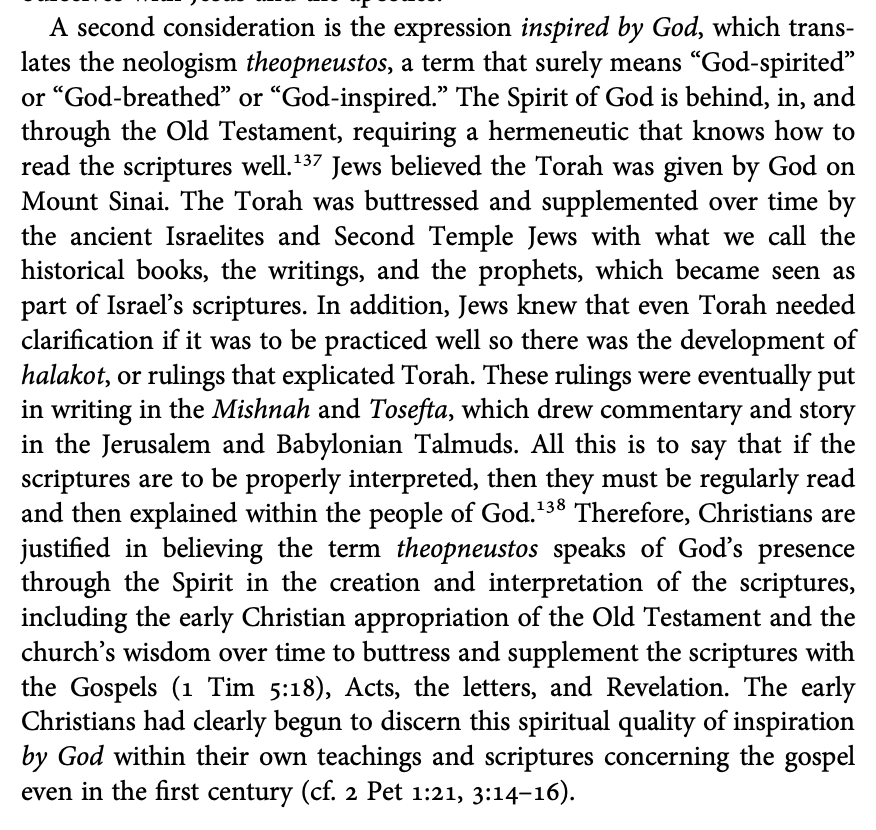
The Biblical authors had significant autonomy in the words they chose to write. This is even a standard evangelical position. The Bible did not fall from heaven as a completed work. It consists of 73 distinct literary works (67 for Protestants) written by several dozen different authors chronologically spread over roughly a thousand-year time period and separated geographically in some cases by a thousand miles or more. Each book of the Bible is a discrete literary production written and disseminated by human hands in its own life setting. Flesh and blood people composed the Bible and Christians from all backgrounds generally agree with this as these two statements from diverse groups delineate:
The Chicago Statement on Biblical Inerrancy:
“We affirm that God in His work of inspiration utilized the distinctive personalities and literary styles of the writers whom He had chosen and prepared. We deny that God, in causing these writers to use the very words that He chose, overrode their personalities.”
The Catholic Church’s Dei Verbum (“Wod of God”):
“In composing the sacred books, God chose men and while employed by Him they made use of their powers and abilities, so that with Him acting in them and through them, they, as true authors, consigned to writing everything and only those things which He wanted. . . . “God speaks in Sacred Scripture through men in human fashion.”
Most Christians in general don’t imagine God sat down in heaven and told story of Jesus or wrote the Bible from his divine, “eyewitness” perspective. This partially explains why the text can be less than perfect. Ken Sparks writes:
“Why is the written discourse of a perfect God less than perfect? The most common answer given in our survey is that God has chosen to speak to finite human beings through the context of our finite cultural and social horizons. As a result, he accommodates his speech to those cultural settings, imbibing as he does of our perceptual plusses and minuses. On the plus side are those points where human beings are already getting things right, and on the minus side are those perceptual deficits that God, in his wisdom, chooses to leave alone. But the net result of this divine strategy is revelation— God-given insights that take humanity a step farther in our understanding of things human, and of things divine.” – God’s Word in Human Words
Sparks also goes on to point out the authors of scripture were fallen human beings and wonders if scripture could reflect this:
“The only question that remains, then, is whether God somehow protected or insulated their biblical words from their human fallenness. If he did so, it should be easy to recognize. Scripture would reflect a single, coherent, and consistent God-given view of morals and ethics from Genesis to Revelation. Its words would be free of the sinful vagaries of human authors and would give us the one and only universal ethic of Christ’s teaching. --– God’s Word in Human Words
As I have articulated on this website, I do not think God protected the human authors from all errors. My own view is that God was suggestive rather than coercive when inspiring scripture and viewing the text as a one-and-done event where it was inspired only at some specific time in the past and we just need to interpret it correctly is troublesome. This doesn’t give due diligence to the idea that the Bible is used by God in the here and now to bring people to faith and that without the illuminating light of the Holy Spirit, we would have a far poorer understanding of what it intends to teach. The understanding of scripture that I subscribe to tends to view the inspiration of the Biblical works as something that occurred in the past but is still ongoing. Since God was suggestive rather than coercive, I do not have any issue with errors creeping into the text. I certainly don’t imagine the errors being mistakes on God’s part. They are either human mistakes or limitations due to our “finite cultural and social horizons” that God chooses to speak through. God communicates with us intelligibly and progressively on our level.
The Bible can teach spiritual truth through material falsehood: that is teach theology through ancient frameworks or understandings of the world we now know to be incorrect. Even though the moon (a rock in space) generates no light of its own and only reflects sunlight, can we still not understand Genesis 1:16 as firmly and faithfully teaching that it and all things are the result of God’s creative activity? Instead of narrating a scientific account of how the universe and earth formed, can Genesis not simply be telling us these heavenly bodies that were once worshipped as deities are mere lamps God put in the sky to mark the seasons and He is sovereign over them? In a polytheistic culture where gods were seen as rivals and in competition with one another, this interpretation makes much more sense because it highly doubtful the author of Genesis was trying to tell us there was nuclear fusion occurring in the core of the moon causing it to emit photons that we perceive as light on earth. That makes about as much sense as the Biblical authors being concerned about cars or airplanes, things that simply did not exist at the time. Even if there are no heavenly reservoirs of rain and snow above a solid dome, can we not understand these verses as instilling in us awe and humility as they intend to teach us that God governs the natural processes we lack control of? God meets us sinners where we are, and accommodates his message through familiar images, stories, parables and even in appearance – being born into our world as one of us.
Identifying Errors in the Bible is NOT disagreeing with God.
It is important to stress this final point in closing. If someone wants to argue that God cannot stand behind or speak through a text with errors or material falsehood inside, this is simply one understanding of inspiration. If I subscribe to a theory at odds with this portrait, I am not disagreeing with God, I am disagreeing with how other people understand the Bible. My disagreement is with them, not with God. We should always be humble in this regard and extremely hesitant to confuse our interpretation of scripture with exactly what God says on an issue. Hopefully we are correct, but this distinction is of special importance especially when some believers pit the Bible vs. science and tell us we have to pick one or the other. As Ken Sparks wrote in God’s Word in Human Words:
“Consider this example from a fundamentalist book on biological evolution: ‘If the days of creation [in Genesis 1] are really ‘geologic ages’ of millions of years, then the gospel message is undermined at its foundation because it puts death, disease, thorns and suffering before the Fall. This idea also shows an erroneous approach to scripture—that the Word of God can be interpreted on the basis of fallible theories of sinful people.’ To be sure, the author of this statement has his finger on a potentially significant theological difficulty raised by evolution, namely, that death seems to have entered creation before the fall of humanity. Nevertheless, his understanding of the ideological conflict itself is quite erroneous. Although the author describes the situation as a quarrel between God’s infallible Word and fallible human science, this is an illusion created by the assumption that his interpretation of Scripture is a perfect reflection of “what God says.” In reality, however the conflict is not between the Word of God and human science but between fallible human interpretation of Scripture and fallible human interpretation of nature. By sleight of hand, the author implicitly assumed that his own interpretation of Scripture was infallible, thereby shielding his “infallible” views from the criticisms of modern science.
I would caution my brothers and sister in Christ, based on history, our fallen natures and humility against pitting the gospel or the Bible in an either or vs science. Imagine if Calvin had said, “Either the earth doesn’t move or the Gospel is false.”
Vinnie