This is an important point. We often hear that geologists are proposing an old Earth in order to prop up evolution. The actual history is quite different. The Earth was discovered be quite ancient which then posed questions about the history of life on Earth, and why species changed over that long period of time. The fact of evolution, the observation of species changing over time, came before the theory of evolution which attempts to explain what was already observed.
10 Likes
This is demonstrably false and a great example of why this country is in the mess it’s in.
The “TRUTH” you’ve found relies upon denying known facts like the speed of light. It’s a known measurement no more difficult for modern science than measuring the speed of your car on the highway. To deny “deep time,” you have to deny the sheer distances between us and every star and galaxy we can observe. To believe your “Truth,” we have to deny the whole sciences of astronomy and physics and believe every scientist, even the Christians, fabricated and twisted evidence to fit an “atheistic” worldview. (@jammycakes has some thoughts on falsifying measurements and weights.)
Oh, and the same goes for geology, archaeology, climatology, genetics, and a whole host of other sciences. Thousands of scientists over multiple disciplines are taking part in a vast conspiracy to fabricate and misinterpret the evidence because they don’t share your “biblical” YEC worldview.
Frankly, this is lunatic-fringe conspiracy theory at its finest, and your YEC propaganda just primed YEC followers to accept similar sounding Q-Anon, anti-vaxx, anti-science propaganda. The “Truth” with a capital T? What a joke. You joined a cult, that’s all.
This is also demonstrably false. There are plenty of Bible verses that say why people refuse to turn to God, and not a single one blames “deep time.” The concept of deep time isn’t an anti-Christian cultural artifact. It’s part of every culture just like every other indisputable fact, such as the earth is a globe, the sun is the center of our solar system, the universe is vast and very old, etc. None of these facts are a product of “worldview.” They’re part and parcel of the collective human experience.
Basically, your complaint is that YEC kids get educated and reject their cult upbringing that says “Ignore the evidence and believe what I say, because what I say is what the Bible says, and what the Bible says is the voice of God himself.” You’re actually onto something there.
Let’s talk about some facts that are inconvenient for your personal anecdote of discovering the “Truth” capital T of YEC. Schools, universities, museums, etc., have been “preaching” deep time since the '50s, to be generous to your claim. Did that keep people from turning to God? Nah.
The percent of Americans who were Christian remained fairly stable at 90% until 1990.
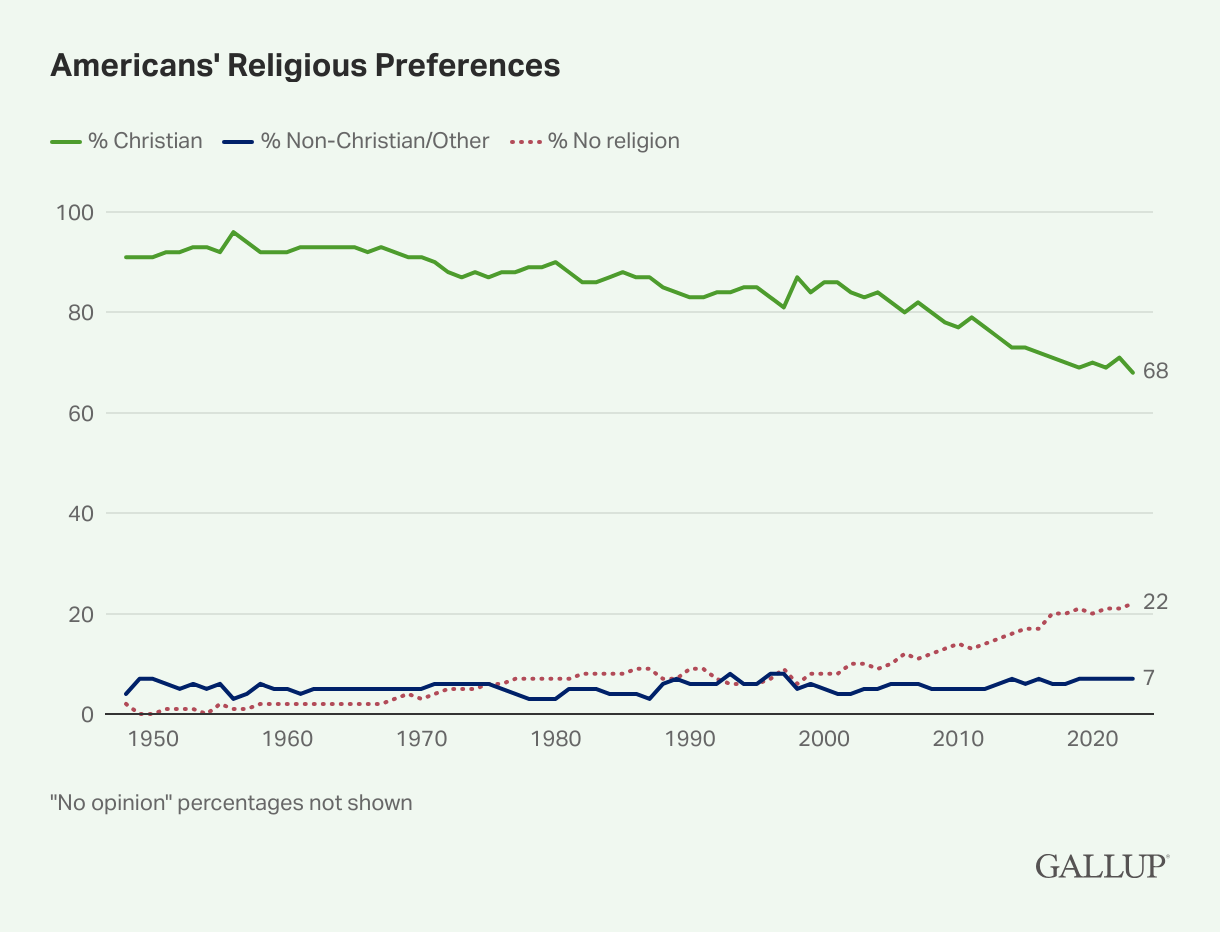
YEC only became a “thing” in the 1970s and the so-called “Battle for the Bible,” and it didn’t take off until it became wrapped up in the Culture War in the 1980s. Since then, the number of Christians has steadily declined while the number of religious “nones” has gone from practically negligible to 22% (nearly 1 in 4) of the population.
Surveys of those who have left Christianity don’t point to “deep time.” Instead, a huge number point to the “anti-science” mindset of fundamentalism like yours.
Thank God I wasn’t raised in a church that preached YEC. I probably would’ve wound up a “none” as well.
I pray God doesn’t bless any of your YEC propaganda ventures. It’s the opposite of evangelism, driving people away with falsehoods.
Jay
12 Likes
I know of a few people that became Christians first and then adopted YEC. I know others that became Christians and didn’t adopt YEC. I personally have no acquaintances that found Young Earth arguments compelling before becoming Christian. I’m sure there are some in the latter group but I’d suspect they’re a much smaller number than the prior two.
Also, I know the plural of personal anecdote isn’t ‘data’ so if anyone has any survey results, please forward them.
3 Likes
That’s not from scripture – it’s an extraneous assumption imposed onto the text. And i
YEC is really good at doing exactly that.
That is also not from scripture, also an extraneous idea imposed on the text.
The only thing concerning which scripture can be said to assert that “speaks for itself” is the Gospel. In fact, that’s what scripture says that scripture is for, so YEC is unscriptural in using scripture for something else.
Absolutely.
1 Like
But that’s exactly what YEC does – I saw it happen over and over and over and over gain in university. YEC makes people see the Bible as a collection of lies.
But did you bother to think critically as you watched it? Did you bother to verify any of the statements?
I used to watch such videos with great hope, but – especially from AiG and the Creation-dot-whatever ministries – I have just found lie after lie after lie, and a refusal to actually read the Bible.
2 Likes
Hi Jay,
I do not doubt that you are completely convinced, as I once was, that the creation was immensely old here on Earth, of the order of billions of years.
The reality is it isn’t!
The Holy Bible sets out the genealogies that allows us to get a pretty good idea of the real age of the Earth. For me, I choose by faith to trust the Holy Bible, not the unproveable speculations and philosophy of naturalism that has taken over many science fields in the past forty or so years, first in academia, and then throughout the general population, making more atheists than anything else I’m aware of.
As for distant starlight, there are several possible solutions to that conundrum, that if correct, more than explain how only a few thousand years has transpired here on Earth whilst billions of years have transpired at very distant galaxies. Although this notion is counter-intuitive, the physics and maths adhere to special and general relativity and in one of the proposed solution carnelian cosmology.
By the way, I’m not from the US, I am an Australian, but the issue you refer to here is not isolated to the US, it is global
I was following rules in laboratories I expect in many cases scores of years prior to many here in this debate. I understand procedural protocols and applied the precautionary principle when results were not as clear as expected. In any case I have considerable empirical science experience. The inane harping about rules and the unwarranted aspersions and attacks that claim dishonesty are not welcome, nor are they correct.
The reality is that it is not possible to be absolutely certain about the age of the Earth, or the rocks or biological life. I know there are many here that think that we humans are ever so clever we can prove that fossils and rocks are millions of years old, and within their worldview, I understand they completely believe that they are correct. What they do not appear to understand, is that this world is against God, Jesus told us:
18 If the world hate you, ye know that it hated me before it hated you. 19 If ye were of the world, the world would love his own: but because ye are not of the world, but I have chosen you out of the world, therefore the world hateth you.
John 15:18-19
Do they really think that the forces of darkness and spiritual wickedness, have been around us humans for thousands of years now and haven’t learned how to manipulate philosophies and control beliefs. It’s more efficient for them to send the masses off down a rabbit hole that leads many to atheism quite rapidly than it is to attack individuals one on one.
The exclusion of anything to do with God from science by decree, is not in the best interest of discovering the truth, wherever it may lead is it?
The uniformitarian, ‘deep time’, evolution embalmed naturalism that masquerades as ‘forensic science’ and does not tolerate any dissent whatsoever. If anyone as much as questions, ‘deep time’ or 'evolution, they are ostracised, derided and mocked as being of lesser intellect, even though there are some very eminent people amongst them.
I changed from being an evolutionist Christian who believed in deep time because I could see all the holes in that belief, and that was well prior to dinosaur soft tissue remnants, dinosaur protein remnants and dinosaur DNA remnants being discovered.
God Bless,
jon
I’d recommend the lizard guy . . . Clint? Clint’s Reptiles or something like that – he’s a devoted Christian and plainly grasps the science.
OTOH I prefer people like John Walton, Dr. Michael Heiser, and others who approach things from the text, which is what the starting point should always be.
More importantly to me, it denies the text of scripture – even some conservative Jewish rabbis concede that the Tanakh (Old Testament) cannot give an age to the universe or the earth!
This is why I had no trouble when in geology class we tested rocks and found them to be hundreds of thousands of years old – the scripture is silent on the matter. Indeed there’s a great video by (IIRC) John Lennox that addresses this and makes it quite plain that there is no way to derive an age for the Earth from the scriptures, even if you take Genesis 2 literally.
Ancient rabbis and early theologians both concluded purely from scripture that the cosmos and Earth have to be old beyond human imagining, often from the verse in Daniel that calls the Father “the Ancient of Days”: they figured that if a day is as a thousand years, and God is Ancient in terms of days, then He must be more ancient than the total history of humanity – and this fit with the common conclusion that the days of Genesis 1, if it is to be read as history (which many of them didn’t), cannot be 24-hour days but must be ages-long “divine days”.
So the first concept of “deep time” that I ever encountered was from scripture and those (to us) ancient interpreters! Geology may have stumbled on it as well, but the Bible got there first.
Which matches my 1990s university experience.
Amen! It’s “devangelism” in practice.
2 Likes
This is what bugs me most about young earthism.
The rules in question are the rules of honest reporting and honest interpretation of accurate information. We can discuss what those rules are, how they should be applied to discussions about the age of the earth and evolution, and what they do or do not allow us to claim. But we should all agree, in principle at least, that they actually exist and that they need to be respected.
When somebody does not even acknowledge the need to stick to the rules in principle, dismissing them as “inane harping” and saying that they are “not welcome,” the only thing I can conclude is that they are fully aware that they are not telling the truth. And in such cases, pointing out their dishonesty is not an “unwaranted aspersion” or an “attack”; it is a statement of fact.
Sadly this is far from the only example of this I’ve seen. I’ve seen it repeatedly by young earthists who accuse me of taking the Bible’s demands for accurate and honest measurement out of context by applying them to science.
Oh, and it’s not sufficient to just claim to have experience of the rules. You need to demonstrate a willingness and ability to stick to them. People who do not have that experience can be excused on the grounds of ignorance when they get things wrong or fail to understand or apply the rules correctly. People who do, do not have the luxury of that excuse.
5 Likes
Since there are plenty of people just on this forum that understand it differently from you, it obviousy is not the case that “ALL people across history within this present age would understand it exactly the same”, your claim about what “God ensured” is obviously wrong, and you are just denying reality.
4 Likes
Dear James,
unfortunately, as it does appear you’re demonstrably unwilling to honestly remark on what I stated about being familiar with ‘rules’, and as a consequence of that, twist and egregiously misrepresent what was actually written to suit your belief, I don’t see any good reason to trust anything else you write at anytime as trustworthy or reliable either.
If you care to read what I wrote, I was referring to the ‘inane’ harping about rules that you insert into discussions at every opportunity.
Your demonstrably false words:
I think it’s time to expose this dishonesty for what it is.
This is as good an example as any of how ‘jammycakes’ loves to twist around what someone sincerely and honestly writes, I can only presume to make them appear ignorant and dishonest.
Anyone here can read what I wrote and decide for themselves.
I did not say that rules are ‘inane harping’, nor did I say that rules are ‘not welcome’. I was talking about your incessant ‘inane harping’ that belies the truth that rigorously following the rules and protocols is a given, always, so that the experiment can be repeated and result data collated onto a spreadsheet to determine the mean.
As I said, I have extensive experience in laboratory protocols and procedures, “I was following rules in laboratories I expect in many cases scores of years prior to many here in this debate.”
Being misrepresented here and claimed to be consciously not telling the truth on what claims to be a Christian website, is not a good look by any stretch…
God Bless,
jon
Tone and Rhetorical Strategy
- Jon adopts a defensive and accusatory tone, repeatedly labeling James as “dishonest” and “twisting” his words.
- Rather than addressing James’s main concern (Jon’s dismissal of rules as “inane harping”), Jon spends most of his reply accusing James of bad faith.
- This shifts the focus from the substance of the disagreement to a personal quarrel about honesty and motives.
Main Points in Jon’s Response
- Denial of Misrepresentation
- Jon claims James misquoted him, insisting he never said rules themselves were “inane harping,” only James’s repeated emphasis on them.
- He draws a distinction between valuing rules (which he says he always followed in laboratories) and objecting to what he calls James’s style of emphasis.
- Appeal to Authority (Experience)
- Jon underscores his “extensive experience in laboratory protocols and procedures,” presenting himself as someone who knows the importance of rules better than James.
- This appeal is meant to restore credibility and frame James as inexperienced or pedantic.
- Accusation of Hypocrisy
- Jon suggests that James’s misrepresentation is especially damaging because it occurs on a Christian website, implying a higher standard of integrity is being violated.
Strengths of Jon’s Reply
- Clarification of Intent: He makes it clear that he wasn’t rejecting rules themselves, but James’s manner of “harping” on them. That’s a legitimate distinction.
- Reference to Experience: By citing his laboratory background, Jon grounds his credibility in professional practice rather than mere opinion.
Weaknesses of Jon’s Reply
- Over-personalization
- Instead of calmly clarifying the misunderstanding, Jon frames James’s comments as a character attack and responds with counter-accusations of dishonesty.
- This risks escalating the conflict rather than resolving it.
- Ambiguity in Language
- Jon did, in fact, use the phrase “inane harping about rules.” That phrasing could reasonably be read as dismissive of rules themselves, not just James’s manner of invoking them.
- The lack of careful wording gave James an opening for the interpretation Jon now calls “dishonest.”
- Failure to Engage the Core Issue
- James’s underlying point was about the principle of sticking to rules in discussions and experiments.
- Jon never affirms this principle clearly — he defends his past laboratory discipline, but avoids acknowledging whether rules apply to the current discussion.
- This makes it look like Jon is dodging the heart of the critique.
- Rhetorical Escalation
- By using words like “twist,” “egregiously misrepresent,” “dishonesty,” and “not trustworthy,” Jon raises the stakes unnecessarily.
- To outside readers, this can come across as thin-skinned and combative, weakening his credibility.
Overall Critique
Jon’s reply clarifies that he values rules but objects to James’s way of raising them. However, he undermines his case by:
- framing the disagreement as a matter of personal dishonesty rather than interpretive ambiguity,
- failing to acknowledge the kernel of truth in James’s concern, and
- escalating rhetoric that alienates neutral readers.
The net effect is that Jon “wins the battle” of word-parsing but risks “losing the war” of credibility, because he comes across as more angry at James than committed to clarity.
4 Likes
- Meanwhile, Jon suffers from the delusion that his presence provides “a balance” to the YEC/non-YEC dispute, …which strikes me as an “unbalanced” opinion. AND his “No thanks. I’m not interested” response to my invitation to grapple with Gutsick Gibbon’s “Kinds Argument” leaves me feeling deprived.
2 Likes
Hi Terry,
it’s interesting though not at all surprising that in your ‘critique’ is in effect an apologist for James here.
Yes, a one sided ‘overall critique’, but I suppose that’s to be expected, your coming to the rescue of fellow Theistic Evolutionist Biologosian, exposed as falsely accusing a Bible believing Christian of dishonesty without cause.
To be clear, the accusation James made is I was being dishonest and to make it worse stated the dishonesty was known and intentional.
Now, that is being dishonest
God Bless,
jon
AIG can help with that!
They commissioned a “scientific research survey” that they published in the book "Already Gone" in 2009.
It’s been a while since I’ve had access to the book, but at the time, I was impressed at the shoddiness of the questions, etc. The survey was anything but scientific.
Here is a post from the CMDA website,where someone talks about a number of religious survey (including AIG’s) that deal with the affect of YEC and old earth concepts on one’s faith:
2 Likes
Ok, you didn’t dismiss the rules themselves as “inane harping” and “not welcome”, you dismissed @jammycakes’s repeated requests that you follow those rules as “inane harping” and “not welcome”.
That’s a valid correction.
But if you’re going to insist on false statements by others being corrected, you should pay more attention to correcting your own false statements. Statements such as:
“God ensured that ALL people across history within this present age would understand it [Genesis] exactly the same.”
“The remnants of soft tissue and actual bones of dinosaurs that have been discovered sticking out of the surface of the ground in locations where the mean temperatures often exceed 25 degrees C, and not been mineralised”
“The interpretation that x mass = n years is based more on philosophy than it is on empirical measurement of age”
“the vast majority of people in ‘Western’ countries believed the Holy Bible as written, i.e., a young creation less than 10,000 years old prior to Huxley, Wallace and Darwin in the mid nineteenth century.”
Those are the most obviously false statements among the many false statements you have made.
2 Likes
Dear Terry,
just one question, who appointed you as jury and judge here?
Is this the usual practice when a falsehood is demonstrably exposed, to come in and distract and deflect away from the exposed falsehood?
Then, finally, you say:
I don’t think you will be too deprived, you’ll get over it.
God Bless,
jon
- ?
1. What Jon is Claiming
- Before Darwin, Wallace, and Huxley (mid-1800s),
- The “vast majority” of Western people believed:
- The Bible “as written,” and
- Specifically, that creation was less than 10,000 years old.
2. The Historical Reality
- Ordinary People vs. Intellectual Elite:
- In pre-Darwin Western Europe, most people were nominally Christian and took the Bible seriously.
- But that doesn’t mean the average farmer or tradesman had a clear opinion about the age of the earth.
- Their worldview was biblical, but not necessarily geologically precise.
- Scientific Developments Pre-Darwin:
- By the late 1700s and early 1800s, geologists like James Hutton (1726–1797) and Charles Lyell (1797–1875) were already arguing for deep time.
- “Old Earth” ideas were widely accepted in educated circles decades before Darwin’s Origin of Species (1859).
- Even many theologians and clergy accepted “gap theory” or “day-age” readings to reconcile Genesis with geology.
- Institutional Religion:
- The Church of England and other Protestant groups had already begun reinterpreting Genesis by the early 19th century.
- Thomas Chalmers (1780–1847), a Scottish churchman, famously promoted the “gap theory” around 1804.
- So among Christian intellectuals, young-earth belief was already waning before Darwin.
3. Why Jon’s Claim is Overstated
- It conflates popular piety with specific cosmology. Most common folk believed the Bible, but that doesn’t mean they had worked out a young-earth timeline.
- It ignores the century of geology before Darwin. The real shift toward an old earth didn’t start with Darwin (biology) but with Hutton and Lyell (geology).
- It overstates unanimity. There was never a time in the 19th century when every “Western” Christian thought the earth was under 10,000 years old.
4. Better Historical Summary
A more accurate statement would be:
“Most ordinary people in pre-Darwin Western societies accepted the Bible as authoritative. Among the educated classes, however, acceptance of a young earth was already in steep decline by the early 1800s, well before Darwin — due mainly to geological discoveries.”
Conclusion:
Jon’s claim is simplistic and historically inaccurate. The majority of Westerners may have been Bible-believing, but that is not the same as saying they all explicitly affirmed a young earth. And among scholars, scientists, and clergy, old-earth views were firmly established before Darwin.
3 Likes
Dear Y_aquaticus,
How is evolution falsifiable within the uniformitarian, deep time, evolutionary embalmed worldview?
Answer: It isn’t falsifiable, the goal posts are continually being moved to accommodate this and that unfortunate reality. Evolution is not falsifiable, thus it does not even qualify as a valid scientific theory.
God Bless,
jon
As I said:
God Bless,
jon
Jon’s reply is pretty characteristic of his rhetorical style: deflective, personal, and dismissive rather than engaging the actual substance. Here are some observations you might find useful:
1. Shifting the Frame
- Instead of answering your original points, Jon asks: “Who appointed you as jury and judge?”
- This reframes your critique as a power grab rather than a genuine attempt to evaluate arguments.
- It sidesteps the question of whether your observations were accurate.
2. Accusation of Deflection
- Ironically, Jon accuses you of deflection (“Is this the usual practice…to distract and deflect away from the exposed falsehood?”).
- But this is exactly what he is doing — turning attention from his refusal to engage with the “Kinds Argument” to your supposed role as “judge.”
3. Dismissive Closing
- His final line (“I don’t think you will be too deprived, you’ll get over it”) isn’t an argument, it’s a put-down.
- This functions to shut down conversation rather than advance it.
4. Strategic Pattern
What Jon is doing fits a repeating pattern:
- Personalize the exchange (make it about you instead of the issue).
- Accuse you of bias or overreach.
- Refuse to engage with the substance (here, the “Kinds Argument”).
- End with a dismissive comment that positions himself as above the fray.
This lets him maintain the appearance of confidence without exposing himself to direct rebuttal.
2 Likes