Iain McGilchrist is a massive influence for me at the moment. I read The Master and his Emissary and am now working my through The Matter with Things.
1 Like
For me TMAHE was inspiring but TMWT was transformational in that it helped me see past the intuitive appeal of reductive physicalism.
1 Like
Interesting video. What I find most interesting in it is the natural inclination toward the panpsychist approach, once we try to give consciousness its due inside a framework that has to account for consciousness and its qualia. That is what bothered Thomas Nagel who arrived at a very similar place decades ago and then went further, conceding that the cosmos may carry a teleological structure with immanent principles built into nature rather than imposed on it. It might be of interest,
Emergence, a widely accepted idea, suggests that complex systems like the nervous system throw up novel properties, such as consciousness, that do not belong to the sum of their parts. But Nagel’s point is that if something keeps cropping up, it is unlikely to be either accidental or magical, and more likely due to a general property or tendency. In short, the evolution of mind needs a more powerful explanation.
2 Likes
Going to have to read that one. I like Nagel’s writing and his thinking but I haven’t read that one. What he says in this quote dovetails nicely with what McGilchrist says about the brain evolving not to produce consciousness but to shape it as ours at least for the time we exist. After that it is back to the sea for water or to God for us. My own intuition is that God is us and everything else that exists.
Even better my library had a copy available as. ebooks for Kindle. Next to see if I can make that happen ..
1 Like
From the introduction of Nagel’s Mind and Cosmos:

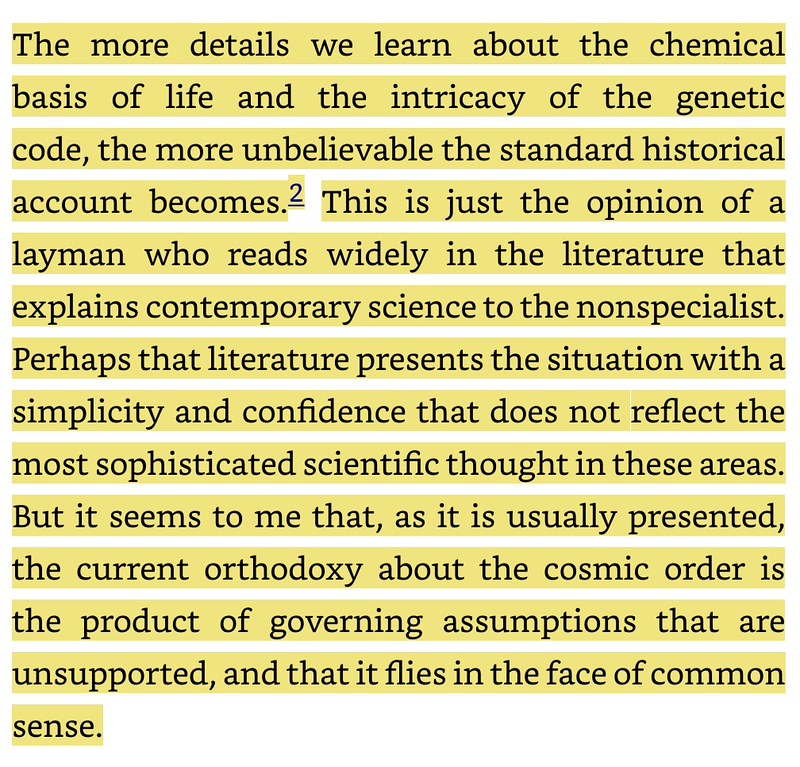
2 Likes
I’m curious about where you are in the book and if you’re taking it in order or sampling particular parts. The only thing I skimped on was the further evidence for the brain lateralization and its implications as I was already convinced enough and I didn’t catch any retractions coming in the introductions to those chapters. Maybe you don’t like talking about it in progress?
I’m reading it front to back, which is a bit of a slog, but just working through it slowly. I also skimmed the “further evidence for brain lateralization and implications.” Already read the first book. I get it.
I’m fine to talk about it in progress; I’m just not on here much. One of my current “projects” is developing overarching strategy for my church context, and I’m influenced by what he says about motion and flow, etc. Also “fuzzy boundaries.” I think much of our “business wisdom” is LH-dominated in ways that cannot adapt and respond to changes in context.
Case in point: beginning of 2020, I’m sure a lot of pastors preached “vision for the year” messages—“year of plenty in 2020,” and stuff like that. Not sure how many preached about a global pandemic and were able to pivot easily. Are we okay to use that word again? “Pivot”?
Sure and really it took me a very long time to read it at about an hour a night before sleep for the better part of two years. It is good to go slow as there is so much to digest. I find him as clear as the subject matter allows. No one can explain him better and certainly not me. I guess my interest is just to revisit the excitement of that reading.
I find it exciting that these ideas are going into church communities too. I’m not in one of those myself. I’ve also tried to interest online atheists in his books but they are by far more resistant. I don’t count myself as an atheist now but did for about 50 years. Believe me it is breath of fresh air not to be saddled with that perspective anymore.
1 Like
Are you aware of the podcast, where he is interviewed about each chapter in turn? I’ve listened to all episodes except the final one.