An impossible challenge

False

It is an engine that combines the characteristics of the two types of engine. it only has one fuel type and one controlling electric.

Yes there is. You need two types of fuel and electrics!

Why can you not understand? Diesel deos not spark ignite, it works on compression and a heated coil. There is no spark. The electrics do not marry or relate. They are literally alien to each other.
I have not full looked at this new Mec engine but suffice it to say it will be one integrated system not two disparate ones.

This is so basic practicalities I am amazed that you cannot see any of it. Your theoretical knowledge fails to manifest practically.

Richard

Edit,
even if there are vehicls with two engines, they were designed as such. The baodywork is built to accomodate the two engines. There is room for them Neither is redundant or replacement. You have missed the whole point with all your ā€œCleverā€ answers! They are not cllever at all. They demonstrate a lack of understanding.

So it is irreducible if removing a part causes the system to stop functioning, correct?

I think you are being too literal and simplistic.

You need to realise that the whole point of IC from the start was to dispute the ability to create anything (everything) incrementally. The fact that it has all got too technical and speiific does not change that. Evolution is not about taking parts away or devolution, it is about evolving and changing beneficially.
The point about ICs is that they are a selfcontained unit with many integral and interconnecting parts that need to be assembled before it works. It is the assemblly that matters, not the disassembly (No 5 not going to be disassembled!) If you are going to ignore the assembly factor of evolution you are taking the roots from under it.

Richard

Then what do the letters I and C represent if the argument is meant for everything? I think it would also be pretty easy to come up with many examples in the fossil record of features evolving incrementally.

So now we are talking about embryonic development? Or in the case of prokaryotes, the self assembly of multi-component systems like the bacterial flagella? The flagellum assembles all on its own over time, so does that violate your claims about IC?

1 Like

Forget it1 You are just on one of your fantasy trips

Richard

It seems rather odd that you claim certain structures can’t evolve, but when asked about them you can’t describe them in any coherent manner. All of the sudden irreducible isn’t irreducible any more, or is it? Instead of evolutionary pathways you now want to talk about how they are assembled, and even then you can’t say anything about how they are assembled as it relates to IC or evolution. You even say that IC is an argument that nothing can evolve incrementally. The whole thing sounds like you are randomly choosing stuff and deciding, for no apparent reason, that it can’t evolve.

4 Likes

Well, that didn’t really answer my question, so let’s try another way more concretely.

I did a quick implementation of what you described. Start with the word ā€˜ant’, apply the various mutation operators with some probability (capping the size at 5 words), then either toss if the result includes any strings not in English or add to a library of ā€˜genomes.’ Then repeat, drawing genomes randomly from the library. Understandably, OED and Merriam-Webster don’t make convenient electronic word lists available, so I used the words-alpha list from here.

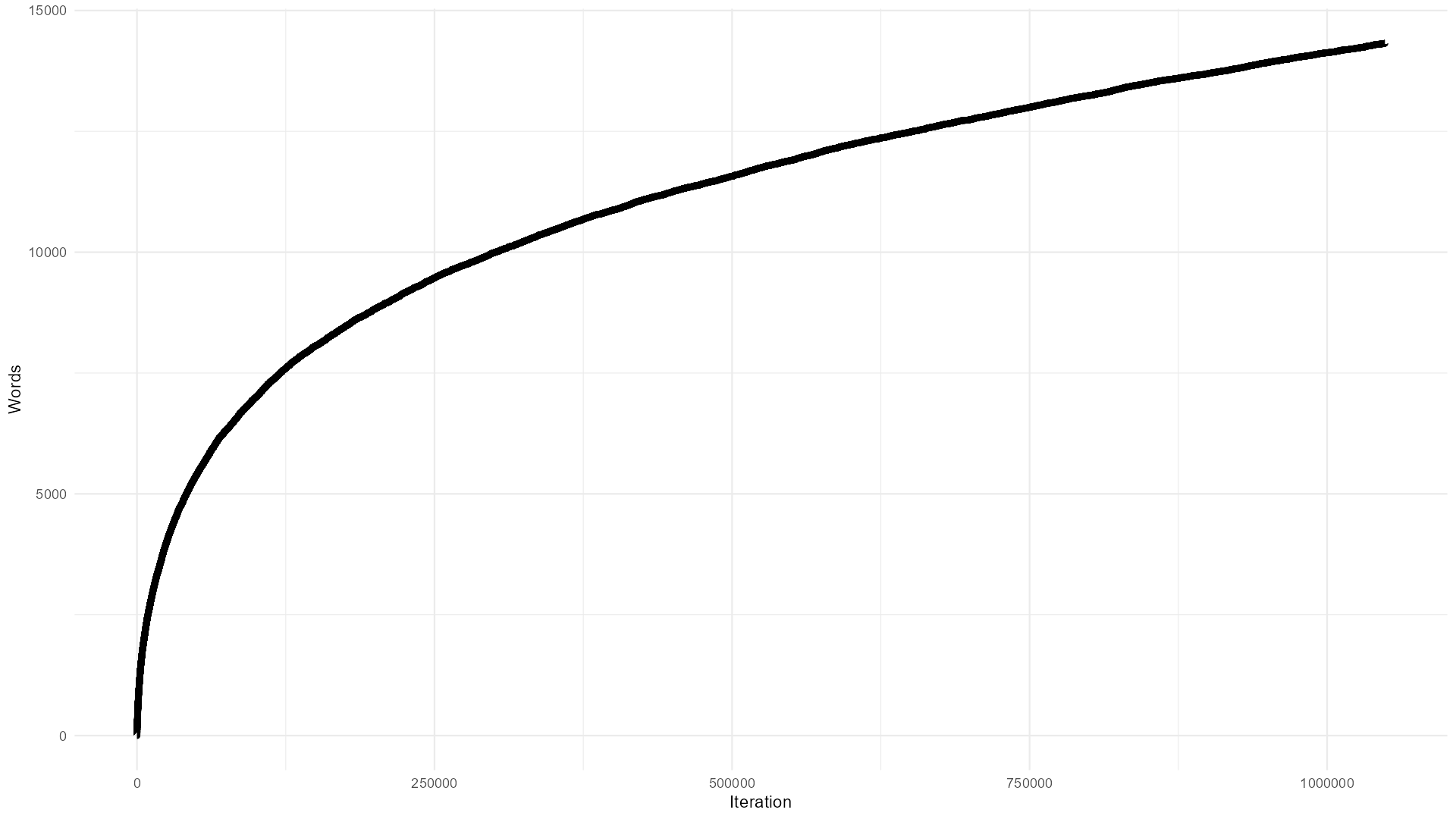
After 2^{20} iterations, I had discovered 14,322 unique words out of 370,105 (4%). Here is how they accumulated over time.

Stills seems to be in a linear phase when I quit, so I’d expect it will keep discovering new words for at least a while more. Presumably there are words which cannot be reached via this process; after all, the operations don’t really reflect how English words are constructed. But we know that there is a route to antidisestablishmentarianism, so even though it was not one of the words discovered so far, in principle it is reachable.

Is the question then how long it will take? I could keep going to try to find the answer, but I’m not sure what that would tell us. And besides the length, is there anything particularly interesting about antidisestablishmentarianism relative to the 14,322 words already found?

And if the interest is in incremental routes to irreducibility, this model excludes a known route which I explored in the other simulation I mentioned and which is biologically relevant: take a functional system, add a component that does not alter the function, then remove any elements from the original system that are redundant to the added component.

4 Likes

The answer in general is O[n\log{n}], or ā€œBig Ohā€ nlog(n), or ā€œOn the order ofā€ nlog(n), in case I screwed up the latex.

Your graph shows this relationship very nicely.

AND it appears the impossible challenge, isn’t.

4 Likes

What was the longest word found? That might be interesting. Even if it wasn;t the rather obscure one I suggested I would reckon 9 letters would be the top limit; only because there is a reason why quizzes like Countdown use 9 letter anagrams.

Anyway, I am a little confused by your opening gambit:

This was my answer

Why is that not clear?

Richard
Edit
@EastwoodDC
I am intruiged as to how on earth you produce an equation to prove otherwise?

Is this a quirk of statistics perhaps?

Sure, but the interest seems to be in the worst case result, not the typical behavior.

So far, 8 letters. I expect that is partly because valid English words are less dense in the space of all possible character strings as length increases. But also partly because, as I noted, long English words aren’t really constructed in a way that is compatible with the algorithm. They tend to be made of roots and prefixes and suffixes, many of which are not themselves valid words.

And then there is the fact that so many of the ā€˜genomes’ in the library contain one or more copies of the staring word ā€˜ant’. That means the search is still concentrated near that word. I thought about only adding unique genomes to the library, but my first attempt was too computationally expensive. That seems like it should spread out the search faster.

Another way to get more longer words faster would be to add selection for longer words. Tweaking the probabilities of the various mutation operations might also lead to more longer words.

Those sentences are clear, but they are not an answer to my questions about what success or failure in the simulation would show.

While ā€˜antidisestablishmentarianism’ has not yet been discovered, words have been discovered which are irreducible in the sense that if you remove a letter they stop being valid words. So does finding them mean that IC is within the capacity of a system driven by chance, or does it mean that they are not IC by your criteria because they were within the capacity of a system driven by chance? Would the answers change if ā€˜antidisestablishmentarianism’ were found?

4 Likes

Ouch

I am sorry but no analogy is perfect, and neither was this one

As has been poointed out, if this was a comparison with DNA then the ā€œValidā€ sequences do not tally with vocabulary, in terms of leng th or syntax.

However it was never meant as a comparison to DNA itself. it is about incemental growth and the reulting ā€œstructureā€ not code or word.

If, instead of looking at it microspocically you equate a word to be a valid structiure or system then perhaps the validity or meaning of the analogy becomes at least different if not clearer.

The increments are not DNA changes, they are things like a change in colour, or an additional organ, or change in size, or an additional ability. It does not allow really for redundancy when one system or feature takes over from another. neother does it allow for outside influences or competition that might affect the validity or effectiveness of the change. What it does address is the fact that to have a joint you need muscles and ligaments, lubrication, nerves and ancilliary connections to the brain, (Complexity) If you have a joint without these things it is useless. How do you add all these thing incfementally?
Regardless of whther the structure is irreducible in terms of removing parts, it seems that no one cares how to put it together in the first place. There is no simple joint flapping around without control that could be termed useful or advantageous. Even this so called jaw hinge from a gill. Where do these other bits come from? All you can see is a shape.

RIchard

Context restored:

Yet later, after having Behe’s original definition thrust under his nose:

What a tangled web.

1 Like

Tell me.

Why does all this matter so much to you?

Why must you be right and me be deceptive, ignorant and a pain in the provebial?

Why can you not just discuss, without judgement, knitpicking and showing off?

virtually every post aimed at me from you is derogatory to some extent.

Richard

That’s probably why you missed that it does in fact have two controlling electrics, so that it can use either compression or sparking depending on the performance requirements:

Controlled auto-ignition (CAI)
This is suited to the most frequently used driving modes, ie low to medium speeds and small throttle openings. The engine operates in a diesel mode, and the fuel is injected just before top dead centre on the compression stroke. To achieve ignition, the compression ratio must be raised to a value higher than that used during the Otto cycle (normal petrol combustion) to make the mixture hot enough, because the spark plugs are deactivated. Details of the mechanism employed have not been released, beyond saying that it uses a variable crank mechanism with which the compression can be adjusted within a single stroke.

At higher loads, the engine automatically switches to the Otto cycle, running at a lower compression ratio and relying on the spark plugs to initiate combustion.

So?

I remember a scrapheap challenge episode where one team mounted a mini on the back of a flatbed and used the mini’s engine to power a winch while the flatbed’s engine was manoeuvring it. So while you say it’s not possible for a single vehicle to have two completely separate engines because they also need separate fuel and electrical systems, I’ve actually seen it done.

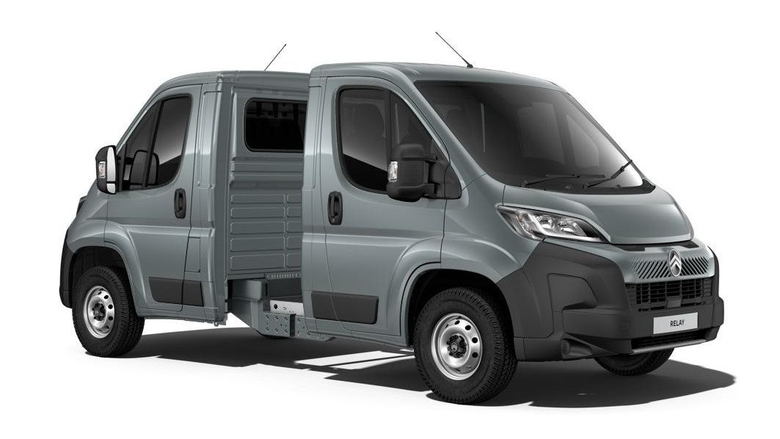
It’s also possible to one engine at each end, as has been done in various PMPY vehicles, including this commercially available one which is basically two back-to-back connected truck cabs and has two separate engines, two fuel tanks and two non-connected electric systems.

You are basically insisting it’s not possible for this to be done with one diesel truck cab and one petrol-powered truck cab - but since the latest model can be fitted with either a diesel engine or a petrol engine you could actually order that supposedly impossible vehicle today!

Ah the usual insistence that anyone who disagrees with you doesn’t understand - and as usual, its actually that I do understand, and (unlike you) know how to get circumvent the problems.

If you had bothered to look at the links I provided - which you clearly didn’t - you’d know that many of those twin-engined vehicles are modified single-engined vehicles, where the extra engine is installed in the boot or where the back seat was, without substantial changes to the bodywork. They were not designed as twin-engined vehicles, but space was found for a second engine anyway.

Once again, what you claim to be ā€˜impossible’ has actually been done, and the issue is actually your inability to think outside the box - or in this case, to think inside the boot.

Reality is not limited by your lack of imagination.
Using the Webster’s 2nd edition word list:

A → AH → RAH → RACH → RANCH → BRANCH → BRANCHI → BRANCHIA → BRANCHIAE → BRANCHIATE → ABRANCHIATE[1].

That’s an 11-letter word reachable by just adding letters, without substitutions or concatenations.


  1. From memory - the route may be slightly different, though the destination is achievable. ā†©ļøŽ

1 Like

It doesn’t have to be that way.

You could stop being deceptive, ignorant and a pain in the proverbial.

1 Like

:joy: :rofl: :+1: :confounded_face:

The proof that you do not is in your answers.

You have no idea whatIi mean, or why I mean it.(Other than claimed ignorance)

You think you can just expand or rebuild the shell and still keep the thing functional! You can’t tell the difference betwen a designed dual engine and one that has so say appeared by chance *evolution)/ You cannot even relate what you are claiming to the evolutionary subject that underpins this whole thead.

The evidence is for all to see (except you, of course)

Richard

Eduit

I watched Scrapheap. If you think any of those vehicles functioned properly even before the start let alone during the build…

There is no valid insult.

Vertebrates that don’t have bones have many of those things. The lancelet has no bones, but it does have muscles, ligaments, nerves, and ancilliary connections to the brain.

Why would incrementally adding cartilage or bone be a problem?

3 Likes