Is that true?
We observe mutations in every generation. Humans are born with ~70 substitutions on average and a smattering of indels and recombination events. This is just from a few months ago:
2 Likes
If it is it wouldn’t work.
No matter how long you have there would not be enough time to “manufacture” all the diversity of life 1 cell at a time, regardless of the “gaps” bridged.
Richard
What data are you basing this on?
The science says something completely different.
The number of neutral mutations that reach fixation in each generation is the same as the per individual mutation rate. For humans, that rate is 70 substitution mutations per generation per person, so we should see 70 substitution mutations reach fixation per generation.
Let’s compare the human and chimp genomes. There are 35 million substitution mutations that separate them. If half of those fixed in each lineage, this would require 17.5 million mutations to reach fixation in the human lineage. Over 6 million years we would expect to see 16.8 million mutations fix just through neutral drift. Add in standing variation of about 4 million mutations, and we are well within the range of what we would expect to see with evolution.
So how is there not enough time? What data are you working from that says there is not enough time?
3 Likes
You are quoting 2 life forms. How many different life forms exist now? And how many more have died out? So how mamy cells is that?
The existance of life on this planet is finite, not infinite. A consevative estimate would be 3.'5 billion years. The figures do not compute.
And even so, there is no way you could “buid” a complex creature like a fish. let alone onvert it to a land creature 1 cell at a time!
I know I have asked for the scope of change but this is pathetic.
All it proves is that you have no means to achieve the changes you claim happened. You can join as many dots as you like in ancestry but if you can’t “build” the creatures it is meaniinglless.
I am guessing that you actually have a better answer.!
Richard
Would you agree that there has been more than enough time for human evolution from an ancestor shared with chimps?
Why would it have to be 1 cell at a time?
What do you mean? I just showed you human evolution is easily achievable with the observed mutation rate.
Added in edit:
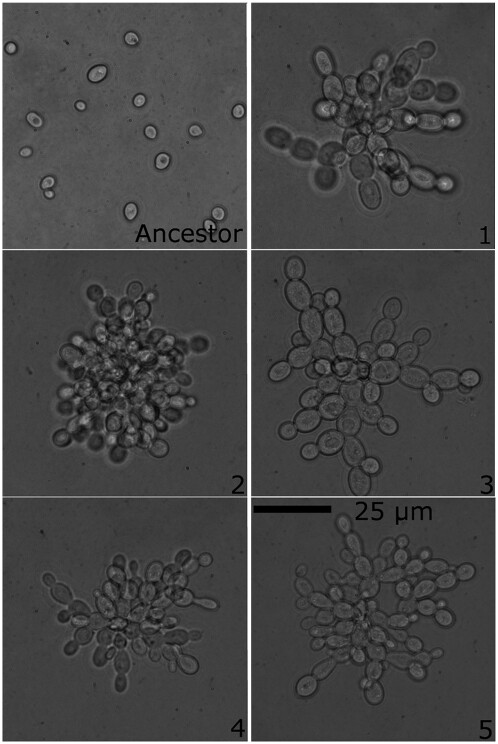
Baker’s yeast quickly evolves multicellularity into groups of ~100 cells.
2 Likes
You don’t even read the previous posts then
I equate that to one cell at a time. How about you?
No. Because you haven’t enough time to reach the chimp. let alone a human.
Besides the difference between humans and chimps is much bigger than you are leting on, and the “change” is before the chimp is finished. You are about 3.4 billion years ahead of yourself.
It is no use you concentrting on chimps and humans, you have to get past the Amoeba first! 1 cell at a time will just about make a Hydra (Although that is supposed to be coalessing of a group of cells.)
Like i have said, you just gloss over the minor details of how the things actually change!
Richard
I did read them.
" And even so, there is no way you could “buid” a complex creature like a fish. let alone onvert it to a land creature 1 cell at a time !"
Again, WHY 1 CELL AT A TIME???
With baker’s yeast, they go from 1 cell to hundreds. In snowflake yeast they go from 100 cells to half a million cells in just 3,000 generations.
Organisms don’t change 1 cell at a time. Mutations change whole suites of cells at one time.
Large morphological changes are linked to mutations at single loci in fish:
It doesn’t take millions of mutations because there are millions of cells in a given structure.
And you seem to be avoiding my question of human evolution. Do you agree or disagree that there has been more than enough time to produce the differences between humans and chimps?
3 Likes
If you read them you ignored them. I told you, it was not my idea it was Roymond’s!
Show that you actually know what you are talking about and undestand the conversation, and i will continue. At present… forgrt it!
If it isn’t 1 cell at a time, how is it?
Richard
Shouldn’t there be a supporting calculation?
Claims made without maths can be dismissed without maths.
Added: Also, biological information ‘bits’ are nucleotides, not cells.
3 Likes
No it wasn’t. This is what @St.Roymond said:
“Biological information is rearranged one ‘bit’ at a time, equivalent to one sand grain.”
No mention of cells, nor 1 cell at a time. He is talking about biological information which in this case would be the DNA sequence of the genome. It is changed a bit at a time, although I wouldn’t agree with precisely 1 bit since multiple mutations occur in each generation. However, I see nothing indicating he was saying 1 cell is changed at a time.
It is a tiny percentage of bases in the genome at a time. Sometimes it can be the whole genome, as in rare events where there is whole genome duplication which has happened in the vertebrate lineage at least once.
Single base changes or changes to a string of a few bases can result in relatively large changes in an entire body part. It’s not as if there has to be billions of mutations because a fin or arm is made up of billions of cells (billion is way low, but vertebrate genomes are only billions of bases long in most cases).
1 Like
You do the math.if you want.
3.5 billion devided by the total number of cells in creations
Good luck
Richard
As shown earlier, there are 70 substitution mutations per human per generation. In a population of 7 billion humans that is 490 billion substitution mutations. The diploid human genome is only 6 billion bases long with only 3 possible substitutions at each base. This means there are enough humans alive today for there to be a mutation at every possible base in the human genome many times over, some of which would be lethal mutations so won’t be seen in living humans.
2 Likes
A likelihood concluded by science, that has nothing to do with theology.
I didn’t say He did. But He inspired it, i.e. ‘breathed’ it, which is true of no other literature.
You have an incredibly short memory – which explains some of the meandering disrespectful snark you post.
You demand that T_Aquaticus remember posts of yours from years ago, but you can’t even remember posts from less than a week ago that you responded to.
No, it wasn’t – but you just showed your ignorance on the matter because Peter did write about it.
1 Like
And how many new species of human has that made?
You are talking out of your behind.
Richard
Several.
- Homo sapiens
- †Homo antecessor
- †Homo cepranensis
- †Homo erectus
- †Homo ergaster
- †Homo floresiensis
- †Homo habilis
- †Homo heidelbergensis
- †Homo juluensis
- †Homo longi
- †Homo luzonensis
- †Homo naledi
- †Homo neanderthalensis
- †Homo rhodesiensis
- †Homo rudolfensis
Care to be more specific?
1 Like
How any Christian can read that and not see the glory of God is astounding! A mechanism that can facilitate such continual change while still resulting in viable organisms is amazing.
T isn’t that obtuse. Why would you think that a cell is a basic unit of biological information?
Please go learn the basic science!
No, it wasn’t – it was your failure to know the basic science involved.
That’s material from fifth-grade science class.
2 Likes
If you can’t do the math, then you don’t have an argument.
Besides which, you’re specifying the problem incorrectly, in a way that shows you lack even a fifth-grade level of knowledge on the subject.
This not being my field, I can only guess, but haven’t these basics been known for over a half century? So anyone who studied any biology since 1975 should know them.
2 Likes
If you do not know then you have no business criticising me.
The basics of evolutionary change have not changed in the past 59 years or so. There have been a few tweeks with Genetic drift and some other supplementary mechanisms but the basic change, as in “andom Deviations” has never been adjusted. It didn’t compute then, it doesn’t compute now.
Whehter you want to call it bridging “gaps” or just being able to accomodate the changes needed. The ere is no mechanism proposed that could do it. Not then, and apprently not now, because no one has jumped down my throat about it. (and you lot have doen that enough elsewhere)
Richard
You haven’t shown any computations, and you have refused to address any of the computations I have put forth.
Here it is again:
What data are you basing this on?
The science says something completely different.
The number of neutral mutations that reach fixation in each generation is the same as the per individual mutation rate. For humans, that rate is 70 substitution mutations per generation per person, so we should see 70 substitution mutations reach fixation per generation.
Let’s compare the human and chimp genomes. There are 35 million substitution mutations that separate them. If half of those fixed in each lineage, this would require 17.5 million mutations to reach fixation in the human lineage. Over 6 million years we would expect to see 16.8 million mutations fix just through neutral drift. Add in standing variation of about 4 million mutations, and we are well within the range of what we would expect to see with evolution.
So how is there not enough time? What data are you working from that says there is not enough time?
2 Likes